
Art and Restorative Justice: Transformative Healing Through Expression
January 14, 2020
By Madhulika Murali
As of 2019, 5% of the world’s population resides in the territory of the United States.[1] However, the US prison population makes up 25% of the world’s prison population, with the country assuming the leader position in global incarceration rates.[2] Since the 1970s, incarceration in America has increased by 700%.[3] It is now well known that mass incarceration does not affect all US communities equally. According to The American Civil Liberties Union (ACLU), the National Association for the Advancement of Colored People (NAACP), and other nonprofit organizations that documented research into incarcerations in the US, one out of every three Black boys born today will go to prison in his lifetime, as will one of every six Latino boys, as compared to one of every 17 white boys.[4]
Thus, one of the harms of mass incarceration, as analyzed by lawyers and academics such as Michelle Alexander[5] and Bryan Stevenson,[6] is that it serves as a contemporary tool of oppression for Black and Brown communities that have historically been persecuted in America. The documentary “13TH” by Ava Duvernay skillfully explores this reality.[7] This is charted from slavery, through Jim Crow and the War on Drugs, to the current state of disenfranchisement through incarceration. In addition to this troubling role, the actual impact of mass incarceration on crime rates is highly questionable. The Brennan Center for Justice, in its 2015 review of the research, found that incarceration’s effect on crime since 2000 has been non-existent.[8] Instead, the decline in crime seen in the last two decades was owed to “various social, economic, and environmental factors”[9] — for example, growth in income and an aging population. The report concluded that programs targeted towards boosting economic opportunities and expanding treatment programs would be better public safety investments than the current astronomical investments ($182 billion a year according to World Prison Brief) into incarceration.[10]
Restorative Justice
Increasing realization of racialized mass incarceration has meant that restorative justice has made its way into mainstream discussions and initiatives to serve as an alternative to incarceration.
Rooted in Native American and indigenous practices,[11] restorative justice is a set of principles and practices that aims to help communities heal from conflict and harm by developing a common understanding of the root causes and effects.[12] Restorative justice can occur in a variety of different contexts: in the workplace, at schools and within, or instead of, the criminal justice system. It rests on the belief that everyone involved in conflict and harm — often categorized as those who perpetrate it and those who are the victims — deserve healing, community care, and the opportunity to grow. There are three main “pillars” associated with restorative justice — harms and needs, obligation (to put right) and engagement (of stakeholders).[13] There is no one particular way of taking part in restorative justice. Often, it can take the shape of moderated group meetings with the immediate actors as well as wider community members to talk through particular conflicts, paying close attention to everyone’s needs.
In the US, restorative justice is most often used in schools, which research shows to have several advantages over traditional disciplinary methods, including a better relationship between students and teachers and lower rates of disciplinary referrals.[14] It has also been used with success in courts in Colorado, Chicago, and New York, where young people charged with non-violent felonies or misdemeanors, instead of being incarcerated, can take part in a mediated dialogue with various actors and engage with ideas of restitution targeted at the local community.[15]
Through the growing prominence of restorative justice, a new development has emerged: the introduction of art to restorative justice.
Art and Restorative Justice
There is a growing consensus that art can be a powerful tool in restorative justice processes. This is, in part, due to the therapeutic nature of art — art, as an introspective and expressive endeavor, can encourage emotional processing and the kind of active and productive healing that restorative justice aims towards.[16]
To that end, there are several organizations that have created programs that integrate art and restorative justice in and around the criminal justice system: Young New Yorkers, the Prison Arts Collective in California, a program in Nashville, the Mural Arts Program in Philadelphia, the Justice Arts Coalition, a nation-wide project, Transform/Restore Brownsville, and Project Reset in Brooklyn, among others.
How do these organizations bring art and restorative justice together? There are two main approaches: a diversionary approach, in which programs conducted by the organization serve as alternatives to incarceration, and an integrated approach, in which certain restorative justice aims are achieved through art, but within an incarceration setting.
Interacting with the Criminal Justice System
Young New Yorkers and Project Reset are two New York-based organizations that have developed successful diversionary programs that combine art and restorative justice. Project Reset was started in 2015 by the Manhattan District Attorney’s office to give teenagers who have committed nonviolent crimes such as trespassing and turnstile-jumping the opportunity to avoid criminal justice involvement. The process “begins at the point of arrest and before arraignment,”[17] when police officers inform potential participants of their eligibility for this program. The program itself consists of two counseling sessions of three-hours each, where participants may be paired with an artist. The artists then lead group activities for participants, focusing on positive self-expression. On completion of the program, the case is “declined by the local district attorney’s office, the arrest record is sealed, and the individual never sets foot in a court room.”[18] The program has a 98% completion rate, with 96% of participants recommending it to others.[19] To date, more than 1,750 people have participated in the program.[20]
Young New Yorkers, a nonprofit founded in 2012 by Rachel Barnard, is somewhat similar. Through conversations with the Honorable Judge Gubbay, and with the support of Brooklyn Defender Services, Brooklyn Legal Aid, and the Brooklyn District Attorney, Young New Yorkers, a restorative justice and arts program, has now become a court-mandated alternative to incarceration for 16 and 17 year olds convicted of misdemeanors. Graduates of the program thereby avoid being “saddled” with the burden of a lifelong criminal record, while engaging in a workshop that allows them self-reflection and “healing from the harms of the system,” as described by Ms. Barnard.[21]

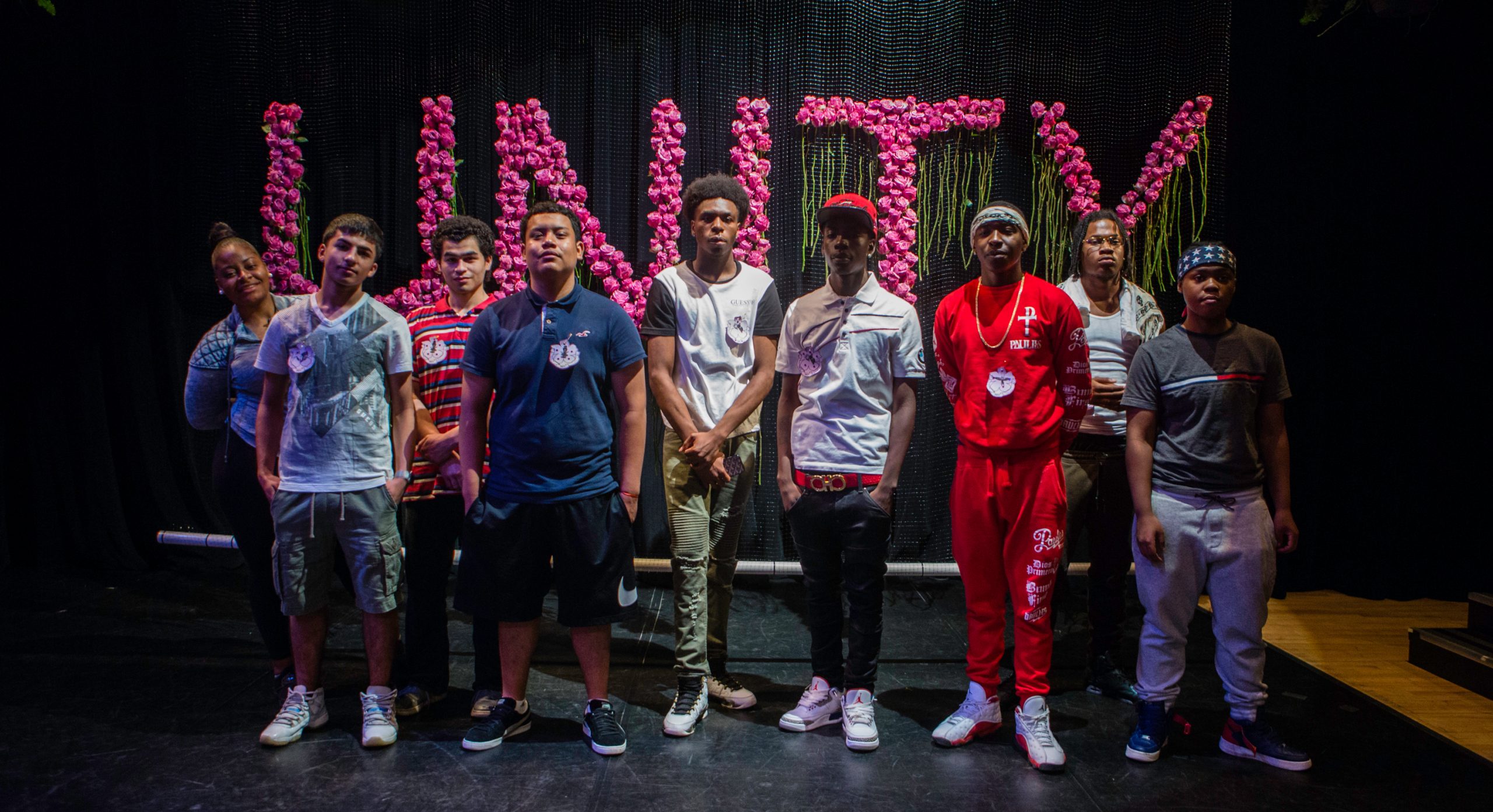
Young New Yorker graduates with Executive Director Rachel Barnard, program artist Ash Rucker, and program teacher and artist Izzy Webb. Credit: Mansura Khanam, courtesy of Young New Yorkers.
Daniel Aguilar, a 25-year-old Young New Yorkers graduate and ambassador for the organization, spoke to the Center for Art Law about his experience with the program when he was 16 years old. Engaging with art, for him, was powerful as a self-reflective tool; it allowed him to “dig down deep inside” and ask himself questions such as: “Who am I? What do I think I can become?” The program allowed him a “safe space” to “decompress, breathe and analyze.” One of the projects he completed during the program was a collage of different animals, all of which symbolized certain concepts or feelings — lions for strength, eagles for bravery. Another project involved taking simple videos of a regular day, encouraging mindfulness and attention to the small aspects of everyday life. “It grounded me in a bigger purpose,” Daniel reflects. Daniel is currently in the process of developing a restorative justice curriculum at a school in New York, which is one of the many ways in which he enjoys “giving back” to his community.
Meanwhile, projects such as the Prison Arts Collective are grounded in “principles of restorative justice”[22] but adopt an integrative approach rather than a diversionary approach. As such, they offer art programs in corrections facilities that “serve the needs of each specific population.”[23] They understand art as promoting the “development of self-expression, reflection, communication and empathy.”[24]
Other projects such as Mural Arts Philadelphia adopt a post-incarceration approach to restorative arts and justice. The Guild, one of their programs, gives formerly incarcerated people the opportunity to work on creative projects such as “mural making, carpentry and mosaics,” while concurrently developing “job skills” and reconnecting with their community.[25] The Guild seeks to prevent re-incarceration and has success with this — participants of the Guild are recidivistic at a “marginal” rate of 12%, versus a 35% average across the state of Pennsylvania.[26]
The Way Forward
What can these projects and organizations suggest about the way forward for justice, particularly in the age of mass incarceration?
“The collateral consequences of a 16- or 17-year-old being sentenced as an adult and in turn incurring a criminal record can be devastating on a young life, narrowing one’s chances of completing high school, attending college, finding a career, or accessing many welfare and housing benefits,” writes Ms. Barnard.[27] This is in addition to the trauma of facing arrest as a teenager. Ms. Barnard details how, during a photography field trip intended for the kids to “make sense of the experience of the arrests,” one 16-year-old described how scary it was to be handcuffed, turning around as though “shoved against the police van.”[28] A criminal justice system that disproportionately affects Black and Brown people[29] and ultimately inefficient at tackling community harms[30] appears to be particularly ill-suited to young people, creating high recidivism rates and affecting those who already have “high levels of instability” in their lives.[31]
Restorative justice through art instead offers a more nuanced exploration of the factors that lead to community harms and encourages positive thinking about the ways in which individuals and communities can be restored from them. Not only, as detailed earlier, do these projects have more success in eliminating future harms, but they also reflect greater respect for the human dignity of those taking part in these projects. The core beliefs of restorative justice — of everyone’s potential for growth and collective empathy — humanizes young people instead of “other”-ing them for choices made under conditions unknowable to others. Incarceration, by contrast, a cruel, violent, and unnecessary practice, reinforces negative and damaging messages to young people, pulling them further into cycles of harm.
A deeper consequence of restorative justice through art is to encourage us as a society to confront and interrogate our understanding of “crime.” Against the backdrop of research showing that the decline in crime is attributable to social and economic factors, as well as the research indicating that the majority of children affected by incarceration have high levels of instability in their lives, it would be short-sighted to understand crime as the singular domain of “bad people.” A more honest approach would understand “crime” as a broader community harm that flows in cycles from the conditions of society that already inflict harm and, in the cases of poverty and racism, intergenerational trauma on young people. Restorative justice brings us closer to this truth, through exploration of the causes and consequences of such harms on both the individual and the community.
More broadly, restorative justice and art initiatives cultivate a culture of empathy and mutual understanding that young people deserve the opportunity to “rewrite their own story,” as Ms. Barnard told the Center for Art Law during an in-person conversation. Art can and should be used as a powerful tool with which to access this higher level of common humanity. The resulting connection between all members of society would allow for a more positive and ambitious vision for everyone’s future.
Acknowledgments: The author thanks Rachel Barnard and Daniel Aguilar for speaking with her about the work and mission of Young New Yorkers. More information about the program can be found here.
Sources:
- American Civil Liberties Union, Mass Incarceration, American Civil Liberties Union, https://www.aclu.org/issues/smart-justice/mass-incarceration. ↑
- World Prison Brief, Highest to Lowest – Prison Population Total, https://www.prisonstudies.org/highest-to-lowest/prison-population-total?field_region_taxonomy_tid=All. ↑
- Id. ↑
- supra note 1. ↑
- Michelle Alexander, The New Jim Crow (2010). ↑
- Bryan Stevenson, Slavery gave America a fear of black people and a taste for violent punishment. Both still define our criminal-justice system, New York Times (August 14, 2019), https://www.nytimes.com/interactive/2019/08/14/magazine/prison-industrial-complex-slavery-racism.html. ↑
- Ava Duvernay, 13TH (2016), http://www.avaduvernay.com/13th. ↑
- Lauren Brooke-Eisen, What Caused the Crime Decline?, Brennan Center for Justice, https://www.brennancenter.org/our-work/research-reports/what-caused-crime-decline. ↑
- id. ↑
- id. ↑
- Yana Kunichoff, Should Communities Have a Say in How Residents Are Punished for Crime?, The Atlantic (May 2, 2017), https://www.theatlantic.com/politics/archive/2017/05/chicago-restorative-justice-court/524238/. ↑
- Restorative Justice Initiative, What is Restorative Justice, https://restorativejustice.nyc/what-is-restorative-justice/. ↑
- Howard Zehr and Ali Gohar, The Little Book of Restorative Justice (2003), 21, https://www.unicef.org/tdad/littlebookrjpakaf.pdf. ↑
- Daisy Yuhas, Restorative justice is about more than just reducing suspensions, The Hechinger Report (July 25, 2018), https://hechingerreport.org/restorative-justice-is-about-more-than-just-reducing-suspensions/. ↑
- Yana Kunichoff, supra note 11. ↑
- Jenna Walters, Integrating Restorative Justice Approaches in an Art Therapy Group (2014). LMU/LLS Theses and Dissertations. 60. https://digitalcommons.lmu.edu/cgi/viewcontent.cgi?article=1124&context=etd ↑
- Shay Urbani, Arts-centered New York Diversion Program for Youth Displays High Success Rate, Juvenile Justice Information Exchange (Dec. 13 2019, 9:34pm) https://jjie.org/2018/05/25/arts-centered-new-york-diversion-program-for-youth-displays-high-success-rate/ ↑
- Laura Staugaitis, Project Reset Diverts Low-Level Offenders from Court with Art Workshops in New York City, This is Colossal (Dec. 13 2019, 9:37pm) https://www.thisiscolossal.com/2019/11/project-reset-criminal-justice/ ↑
- id. ↑
- id. ↑
- Rachel Barnard, Young New Yorkers: Restorative Justice Through Public Art, Urban Omnibus, https://urbanomnibus.net/2013/07/young-new-yorkers-restorative-justice-through-public-art/ ↑
- Prison Arts Collective, About Us, Prison Arts Collective, https://www.prisonartscollective.com/about ↑
- id. ↑
- Prison Arts Collective, Mission & Vision, Prison Arts Collective, https://www.prisonartscollective.com/cba ↑
- Mural Arts Philadelphia, The Guild, Mural Arts Philadelphia, https://www.muralarts.org/program/restorative-justice/the-guild/ ↑
- id. ↑
- Rachel Barnard, supra note 21. ↑
- id. ↑
- supra note 1. ↑
- supra note 8. ↑
- Mark Lynch, Julianne Buckman & Leigh Krenske, Youth Justice: Criminal Trajectories, Canberra: Australian Institute of Criminology, Trends & issues in crime and criminal justice no. 265 (Sept. 2003), https://aic.gov.au/publications/tandi/tandi265. ↑
Suggested readings:
- Howard Zehr and Ali Gohar, The Little Book of Restorative Justice (2003), https://www.unicef.org/tdad/littlebookrjpakaf.pdf.
- Annie Buckley, Art Inside: Does Art Contribute To Restorative Justice?, BLOG // LOS ANGELES REVIEW OF BOOKS (Sept. 3, 2018), https://blog.lareviewofbooks.org/arts-culture/art/art-inside-art-contribute-restorative-justice/.
- Angela Davis, Are Prisons Obsolete? (Seven Stories Press, 2003), https://www.amazon.fr/Are-Prisons-Obsolete-Angela-Davis/dp/1583225811.
About the Author:
Madhulika Murali was a Fall 2019 intern at the Center for Art Law. She is undertaking a Master of Laws (LL.M.) at New York University School of Law, focusing on how law relates to social justice. She completed her undergraduate law degree at the University of Oxford (U.K.) and specialized in human rights law. Madhulika can be reached at mm10773@nyu.edu.
Disclaimer: This article is for educational purposes only and is not meant to provide legal advice. Readers should not construe or rely on any comment or statement in this article as legal advice. For legal advice, readers should seek a consultation with an attorney.


You must be logged in to post a comment.