
Spotlight: “Warfare of Art and Law” Podcast Hosted by Stephanie Drawdy, Esq.
June 26, 2023
By Sophia Williams
Launched in 2020, Warfare of Art & Law, a podcast hosted by attorney and artist Stephanie Drawdy, is a trove of conversations exploring how “justice does or doesn’t play out when art and law overlap.” Podcast topics include restitution, technology, cultural heritage protection, mass incarceration, propaganda, and countless other compelling stories that meld art and law, set in a broad scope of time and place, from conflicts in World War II to the current Russian invasion of Ukraine to contemporary mass incarceration. Drawdy’s guests include artists, attorneys, curators, police captains, poets, provenance researchers, novelists, scientists, filmmakers, professors, economists, and many others offering distinct lenses onto culture, creativity, and social issues.
If warfare itself is understood as the activities involved in conflict, the podcast explores the multitude of ways activities of art and law appear in the setting of conflict – arts engagement as healing, preserving histories, risking danger, constructing social value, persuading, empowering, or even weaponizing. As Drawdy notes, the intent of the podcast is to spark conversation about how art and its connection with the law can shape our social fabric for the better.[1] The introduction to each episode offers listeners the thought “injustice anywhere is a threat to justice everywhere.”[2] Episodes speak to a common thread of how speakers see justice or injustice in the work that they’re doing, and Drawdy often ends by asking for their personal definition of justice.[3] Drawdy herself defines justice as the “creation of empathic dialogue,” and discusses the role of dialogue as an antidote to discord. According to Drawdy, a step towards justice is giving other people the chance to speak truth, in turn creating dialogue and understanding, especially those whose voices are historically undervalued.[4] The Warfare of Art & Law podcast may be an extension of this conception of justice, a platform for voices and ideas to surface and circulate.
The first episode of the podcast was released in June 2020. Since then Drawdy has interviewed over 65 guests (including our very own founder, Irina Tarsis) and created more than 100 episodes presented in varying formats, ranging from hour-long interviews, open town-hall-style conversations, and brief supplemental spotlights on particular topics in arts and culture. At the time, Drawdy had been reading about and writing on art law issues, prompting further questions she wanted to have conversations about, which gave rise to the idea of a podcast as a forum. Drawdy happened to be writing about a specific case for restitution of art looted during World War II, and was able to be in contact with an author who wrote a novel fictionalizing the story. A conversation with the author followed and constituted the podcast’s first conversation.[5] This talk resulted in further recommendations and contacts for continued guests on the podcast, enabling an organic, developing schedule of speakers and subjects for The Warfare of Art & Law, with passion for the project serving as a driving force and natural momentum following.
One emergent theme across the episodes is how arts spaces elicit social cohesion, healing, and reconciliation. For example, guest Alistair Hudson, the then director of the University of Manchester’s Whitworth Art Gallery and Manchester Art Gallery, spoke about the role of museums not just as containers for art objects but as sites for conversations, seminars, and developmental art projects.[6] He connects the mission he envisions with the context of the museums’ formation in the 19th century, during Manchester’s modernization. At the time, intellectuals recognized that amongst the mills, chimneys and merchants, the city needed to look after its residents and its workforce. As Hudson shares, despite the rapid change, it was also a time of great social thinking. The museums were formed in this context, with a focus on social value. Rather than a tourist attraction, they aimed to improve social conditions, supplement the health and quality of life of residents, and provide instrumental education for a more skilled, smart workforce, especially in textiles. There was an idea that the museums could facilitate a “healthy mind, body and spirit” in its community members, a counter to the amount of time spent in industry and its working conditions. During the conversation, Hudson discusses his thoughts how he adapts this mission to the contemporary context, reassesses the social value of the two museums, and operates a museum that considers art for the purpose of improving social conditions.
A recent episode invited Milena Chorna, the Deputy Director of Development and Communications of Ukraine’s war museum in Kyiv, known in its entirety as The National Museum of the History of Ukraine in the Second World War. On February 24, 2022, Russia invaded Ukraine, and as Chorna recounts, the only people out were firefighters, soldiers – and museum workers. On this day she and her colleagues went into the museum to pack and dismantle the exhibitions and place the most valuable objects from the collection into safekeeping. They were especially aware of protecting objects that Russian soldiers would have specifically targeted, including, for example, historical artifacts of the Ukrainian Insurgent Army, Ukraine’s resistance movement against the Soviet Union in the 1940s and 50s.
Chorna shares the story of Ukraine. Crucifixion. Tribunal, an exhibition organized by the museum first presented in Kyiv in May 2022 and opened in New York City adjacent to the United Nations in March 2023.[7] The exhibition displays artifacts of the ongoing Russian invasion of Ukraine, from insignia on Russian soldiers’ uniforms, maps used to plan attacks, military equipment and ammunition, burnt school desks destroyed in a bombing – and many more items left behind in the wake of the war. The exhibition thus operates less as the museum’s presentation of objects, but instead as documentation of a living conflict, and a repository of war crime evidence itself, in light of the international condemnation of Russia’s actions.
Chorna discusses the reaction to the exhibition she’s seen from visitors in Kyiv, including soldiers. Initially, she worried whether the exhibition would retraumatize visitors, but visitors instead have found it to be psychologically healing. A family with young children that survived under occupation noted that they visited the museum “to relive [the experience of occupation] and get rid of these memories.” Once they saw artifacts of warfare in a museum, it allowed them to distance themselves from what they’d endured, and connect personal memories with national stories, so that they could feel their pain not as strictly personal but instead as collective. She understands the mission of the museum to collect and share the record of those affected by war, preserve memories, and operate as a place of regular discussions and commemorative gatherings for residents, soldiers, and their families – the formation of a close, healing community.
Several compelling episodes also explore the theme of art and healing through the lens of mass incarceration. Miki Garcia, Director of the Arizona State University Art Museum discusses centering art and artists in the service of community well-being, and Undoing Time: Art and Histories of Incarceration, an exhibition that presents how cultural images form presumptions around the carceral system and those impacted, and how existing narratives may be rethought.[8] Dr. Randall Horton, a poet and professor who started the Radical Reversal Project, places creative studio space in correctional facilities, for those inside to create and restore a sense of voice and humanity.[9]
Some podcast episodes are 2-3 minute snippets that supplement topics brought up in longer-form episodes, interludes on artworks, or suggestions for films, books, music, or other podcasts. In one, Drawdy discusses the Rothko Chapel, a space in Houston with abstract painter Mark Rothko’s art adorning the interior, to spotlight a project mentioned in a conversation with Professor Ziva Amishai-Maisels, who researches the influence of the Holocaust on modern art.[10] Rothko sought to address the events of the Holocaust through his work, and after World War II received a request to create a commemorative chapel, which was never actualized. However, later in his career, he produced several color field paintings for John and Dominique de Menil, for the interior of a chapel intended for spiritual growth and dialogue, and open to individuals of all religious beliefs. The chapel, like other themes explored in Warfare of Art & Law, is a testament to the belief that art spaces not only host works but serve an additional ethical dimension, as platforms for social healing.
Drawdy’s own range of professional capacities, as a lawyer, artist, and podcaster, informs the approach to Warfare of Art & Law. In addition to exploring prominent issues in art law, the podcast often explores how having a legal background can inform an art practice, and feature speakers whose own work exemplify the intersections between art and the law. Several conversations invite those with such backgrounds, sharing approaches from law-inclined artists and art-inclined attorneys, whether as former lawyers who left a law practice for an art practice, artists who examine social issues, and even an attorney who conceptualized law school as an art project.
Portraits as Still Lives is an upcoming group exhibition featuring work from such artists Drawdy is organizing.[11] On the podcast, artists in the exhibition shared their experiences as artists working in or studying law, including Stefania Salles Bruins, a Brazil-born Brooklyn-based oil painter with a master’s degree in Philosophy of Law from the Netherlands who moved to the U.S. on a Fulbright Scholarship to study law. [12] Bruins initially attended live figure drawing sessions as an escape, but after an increasing interest in oil painting, eventually decided to obtain an MFA at the New York Academy of Art. Another artist featured is Geoffrey Stein, who describes himself as “a recovering lawyer” who first practiced law before transitioning to a career as an artist.[13]
Bayeté Ross Smith, the inaugural Artist-in-Residence at Columbia Law School, a program that began in 2021 that invites an artist to create work for the law school and engage with its Law School community, is interviewed in another episode. Among many topics, Smith discusses working with historians on a project he created called Red Summers VR, a collection of short films that narrate overlooked violent incidents of racially motivated domestic terrorism in the early 20th century.[14]
Drawdy herself has designed paths for the various veins of interest she has, creating simultaneous practices of law, art, illustrating work, oil painting, and the podcast. She values opening the door for all of these creative practices to be alive and supported.[15] In a piece written for the Center for Art Law in 2018, Confessions of an Artist and a Lawyer: Practicing Art Law, One Trial and Painting at a Time, Drawdy describes her approaches to holding complementary practices of legal work and painting.[16] Drawdy also donated her own work to the Center for Art Law’s charitable auctions in 2019 and 2021.
In future episodes, Drawdy would like to continue creating holistic projects that may extend the podcast’s work to other dimensions, such as the group art exhibition. As a note on episodes and when visiting the podcast’s website, Drawdy shares her email and invites listeners to share their thoughts on the topics discussed by emailing her, almost as a way to extend a conversation beyond the release of an episode.[17] Drawdy asks listeners to share ideas, build on the conversations, or even become involved. Whether you are an artist whose practice overlaps in some way with the law, a lawyer who creates art and is interested in participating in the upcoming group show, or in possession of a suggestion for a future guest, Drawdy encourages your engagement.
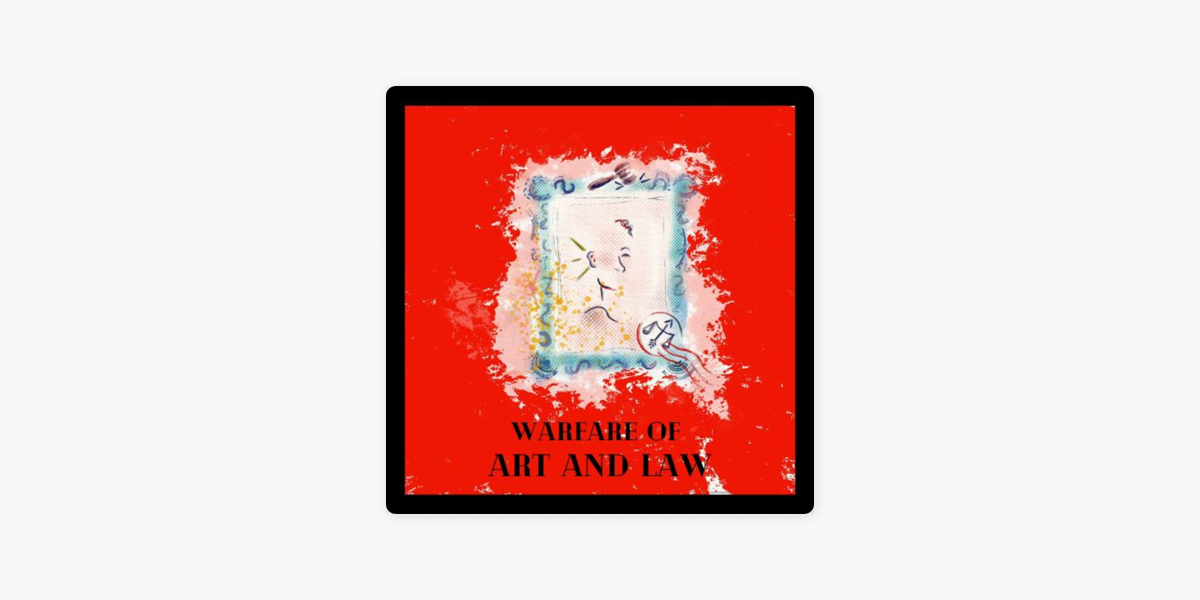
The cover artwork for the podcast is a digital artwork Drawdy created, of a painting frame composed of various curves and color splotches, surrounded by a vivid red background. An elusive person is central, without their features entirely demarcated. In the lower right corner, a symbol of the scales of justice hovers, not entirely within the frame but seemingly in flux. For Drawdy, the artwork represents the stories hosted on the Warfare of Art & Law Podcast—the people in the middle of every story, the presence of art around it, and the framework of the law that everyone works within. The frame may be very rigid, and yet, people and forces of the arts exist inside and beyond this frame, interacting with it, clashing with it, and probing it.
About the Author
Sophia Williams, Center for Art Law Spring 2022 intern, is interested in legal issues surrounding the commercial art world, artist rights, and illicit markets. Sophia graduated from Princeton University with a B.A. in Architecture and Urban Studies and has since worked in NYC at an auction house, art gallery, and the International Foundation for Art Research (IFAR). In the summer of 2022, she was a post-graduate certificate student in art crime and cultural heritage protection at the Association for Research into Crimes Against Art (ARCA) in Amelia, Italy.
Select Sources
- Stephanie Drawdy, Warfare of Art & Law, https://warfareofartandlaw.com/. ↑
- Stephanie Drawdy, host, Warfare of Art & Law (podcast), https://warfareofartandlaw.com/. ↑
- Stephanie Drawdy, host, Warfare of Art & Law (podcast), https://warfareofartandlaw.com/. ↑
- Interview with Stephanie Drawdy, April 20, 2023. ↑
- Stephanie Drawdy, host, “3. Nazi-Looted Art in the Netherlands: A Conversation with Author Janet Berg about her debut novel, Rembrandt’s Shadow, Nazi-Looted Art and Dutch Restitution,” Warfare of Art & Law (podcast), June 28, 2020. ↑
- Stephanie Drawdy, host, “51. The Whitworth and Manchester Art Galleries: Alistair Hudson on Social Justice, Economics and the Role of Museums,” Warfare of Art & Law (podcast), January 9, 2022. ↑
- Denys Glushko, “Ukraine. Crucifixion. Tribunal: an Exhibition to Open in the USA,” gwara media, March 30, 2023, https://gwaramedia.com/en/ukraine-crucifixion-the-tribunal-an-exhibition-to-open-in-the-usa/. ↑
- Stephanie Drawdy, host, “83. ASU Art Museum Director Miki Garcia On Art’s Power to Address Inherited Notions About Mass Incarceration, the Undoing Time Exhibition, and Justice As Public Love,” Warfare of Art & Law (podcast), September 11, 2023. ↑
- Stephanie Drawdy, host, “104. Dr. Randall Horton on the Collaborative Radical Reversal Project, Mass Incarceration, Reformation and Justice,” Warfare of Art & Law (podcast), April 2, 2023. ↑
- Stephanie Drawdy, host, “31. Glance at Culture – The Rothko Chapel,” Warfare of Art & Law (podcast), May 7, 2021. Stephanie Drawdy, host, “34. Glance at Culture – The Holocaust in Modern Art: Professor Ziva Amishai Maisels on Artists Picasso, Chagall, Rothko, Bacon and more.” ↑
- Stephanie Drawdy, host, “103. Artists’ Talk about Upcoming NYC Group Show of Artists Who Work In or Study the Law,” Warfare of Art & Law (podcast), March 19, 2023. ↑
- Stefania Salles Bruins, Artist Website. ↑
- Geoffrey Stein, Artist Website. ↑
- Stephanie Drawdy, host, “48. Columbia Law School’s Inaugural Artist-In-Residence: A Conversation with Bayeté Ross Smith on Social Justice, Racial Injustice and Virtual Reality (VR),” Warfare of Art & Law (podcast), December 12, 2021. ↑
- Interview with Stephanie Drawdy, April 20, 2023. ↑
- Stephanie Drawdy, “Confessions of an Artist and a Lawyer: Practicing Art Law, One Trial and Painting at a Time, Center for Art Law,” June 19, 2018, https://itsartlaw.org/2018/06/19/confessions-of-an-artist-and-a-lawyer-practicing-art-law-one-trial-and-painting-at-a-time/. ↑
- Please email Stephanie Drawdy at Stephanie@warfareofartandlaw.com with any ideas, comments, or other. ↑
Disclaimer: This article is for educational purposes only and is not meant to provide legal advice. Readers should not construe or rely on any comment or statement in this article as legal advice. For legal advice, readers should seek a consultation with an attorney.


