
The Commodity of Colored Bricks: The Limitations of Art in the Real Estate Market
December 8, 2023
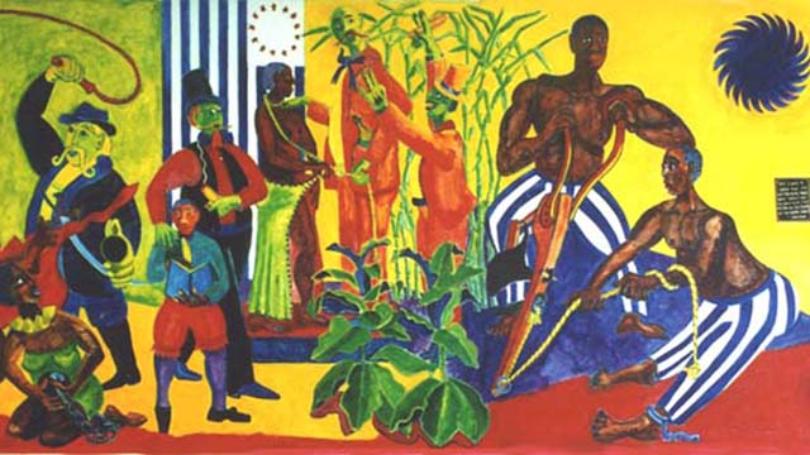
(Image Credit: The Vermont Law School mural made by artist Sam Kerson © WCAX)
By Stephanie Nicole Argueta
Murals have long been celebrated as a powerful medium of artistic expression, capable of transforming public spaces, conveying cultural narratives, and creating a sense of identity within communities. However, in recent years, the legality of murals in the United States is not without its challenges, especially with regards to murals made by and for minority groups. This article explores the relationship between street art and the real estate market. Part I of the article will look at the different federal and local laws that govern the placement and protection of street art. Part II will take a step back and look at the application of the law in a variety of cases across the country. Part III will then look at the sociological impact that both the creation and the removal of murals in immigrant and minority communities have on the population. This section will also look at the effects of gentrification in these spaces. Finally, Part IV will examine possible legal and social resolutions to deter the efforts of removal of murals and gentrification.
Part I: Federal & Local Laws
The vibrant tapestry of street art and murals has become an integral part of urban landscapes, fostering self-expression, cultural enrichment, and community engagement. However, the creation, maintenance, and removal of street murals are subject to a complex interplay of federal and state laws, designed to strike a delicate balance between artistic freedom and public order. In this section, we delve into the intricate legal framework governing street murals, explore the relationship between federal and state regulations, and various considerations that artists, municipalities, and advocates must navigate to create, protect, and sometimes dismantle these iconic works of public art.
The most prominent law regarding the protection and removal of murals is the Visual Artist Rights Act (VARA).VARA was enacted in 1990 as an amendment to the U.S. Copyright Act.[1] VARA recognizes certain rights of authors of visual art including It their rights to attribution and integrity. This means they can claim authorship of their work and prevent any intentional modification, distortion, or destruction of their art that may be harmful to their reputation.[2]
Murals often exist in public spaces, and the distinction between “fine art” and “applied art” is not always clear-cut. This exact issue makes it challenging to determine whether a mural is eligible for VARA protections. This also connects to an issue that arises out of the legality of murals, which is VARA’s relationship to property laws. VARA protections can sometimes conflict with property rights and the rights of property owners. Property owners may desire to modify or remove murals for various reasons, such as redevelopment, renovations, or to comply with local regulations. VARA’s restrictions can create a legal dilemma when these property rights clash with the rights of mural artists. This further complicates itself when looking at individual states and city regulations when it comes to zoning ordinances.
Zoning laws and real estate regulations play a crucial role in the context of mural removal since they dictate the permissible uses and aesthetics of properties within designated zones. In many jurisdictions, zoning laws address the visual aspects of a neighborhood, including the presence of public art such as murals. Property owners and developers must adhere to these regulations, which often outline specific guidelines for the installation and maintenance of murals. However, situations may arise where a mural needs to be removed due to changes in property use, renovations, or other legal requirements. The process for mural removal is typically subject to local real estate laws, which may include permitting procedures, consultation with relevant authorities, and adherence to specific removal protocols. Property owners must navigate these legal frameworks carefully to ensure compliance while also respecting the cultural and artistic significance of the mural in question. Balancing the interests of property development with community and cultural preservation is a complex aspect of real estate law in relation to mural removal.
Part II: Case Law
One notable legal case involving the removal of murals and the Visual Artists Rights Act (VARA) is the case of 5Pointz in New York City.[3] In 2013, the owner of the 5Pointz building, a renowned graffiti art mecca in Queens, whitewashed and ultimately demolished the site to make way for luxury condominiums.[4] Graffiti artists who had created vibrant murals that showcased the culture of Queens through the years on the building sued under VARA, claiming that their rights to the integrity of their works were violated.[5] In 2018, the court ruled in favor of the artists, stating that the owner’s actions amounted to willful destruction of art protected by VARA and they were awarded $6.7 million in damages.[6] This case set a precedent for the protection of street art under VARA, emphasizing the rights of artists to safeguard the integrity of their creations, even in unconventional settings.
Another significant legal battle involving murals and VARA unfolded in the case of Kerson v. Vt. Law Sch., Inc. in 2021. This case revolved around a public mural painted on the side of a building in a law school in Vermont during the 1990s.[7] The plaintiff in this case, Sam Kerson, intended for the mural to be a tool for people to understand the tragedies of slavery and acknowledge the role of Vermont in the underground railroad.[8] However, after the murder of George Floyd, many students sent a letter to the school stating that it was insensitive despite the artist’s intentions.[9] The school covered up the mural and Kerson immediately sued claiming that, under VARA, the school was destroying his art.[10] However, the lower court disagreed, denying Kerson summary judgment and saying that covering up the mural does not mean they are destroying the mural itself.[11] When the case came before the court of appeals, they affirmed the lower court’s decision, stating that the act of covering up the mural did not violate VARA.[12] This mainly has to do with the specific language that VARA uses with regards to its protections of works of art. VARA specifically states that artists have the right to “to prevent any intentional distortion, mutilation, or other modification of that work which would be prejudicial to his or her honor or reputation, and any intentional distortion, mutilation, or modification of that work is a violation of that right.”[13] The court zeroed into the word destroy, defining it as the act of tearing something down or breaking it.[14] They used this definition to justify that the act of erecting panels on the mural was not destroying the mural itself and therefor did not violate VARA.[15]
Part III: Socio-Poltical Implications
The act of covering up or destroying murals in certain communities has become a contentious socio-political issue, emblematic of broader struggles tied to gentrification[16] and the real estate market. Murals often serve as powerful expressions of a community’s identity, history, and cultural diversity. When these artworks are systematically covered or removed, it can be seen as erasing the unique culture of a neighborhood and stripping away layers of heritage that have defined the community for generations.[17] This act not only diminishes the aesthetic vibrancy of the area but also undermines the social fabric that binds residents together, fostering a sense of displacement and loss.[18] Gentrification, driven by rising property values and the influx of wealthier residents, is often implicated in these mural removals, as incoming developers may prioritize a sanitized and marketable aesthetic over the authentic cultural narrative embedded in the artwork.[19] This issue tends to affect many neighborhoods that house a large number of immigrant communities due to the historic lack of political power that they have had for years.[20]
The impact of mural cover-ups on gentrification and the real estate market is profound. As neighborhoods undergo transformation to attract more affluent residents, the erasure of murals can contribute to the commodification of space.[21] This removal transforms what was once a haven for local artists and residents into a sterile environment catering to the tastes of a wealthier demographic.[22] The process can lead to the displacement of long-time residents who can no longer afford to live in the area, exacerbating social inequality.[23] Furthermore, the removal of murals can contribute to a loss of neighborhood identity, making it easier for developers to rebrand and reshape the narrative of an area without acknowledging its historical and cultural roots.[24] For example, neighborhoods like Williamsburg for years had streets covered with memorials for fallen residents or tags[25] of different groups that had been a staple of the neighborhood.[26] However, as gentrification has become a bigger issue and real estate developers wish to sell trendier neighborhoods, these markers of the community have been buried under eggshell paint.[27] In turn cities grapple with the ethical dimensions of urban development, and thus the fate of these murals have now become a poignant symbol of the tensions between preserving community character and succumbing to the forces of gentrification.
Part IV: Resolutions
With many of these communities facing fears of displacment of the only home they have known and especially with regards to the preservation of their cultural hubs such as murals, many groups have chosen a variety of avenues to protect their communities. To address these issues, several approaches should be taken across the board:
1. Clarify the Application of VARA: Since the 5Pointz case there has calls from legal scholars and activists to have VARA clarified and expanded. Essentially courts and legislators should work to clarify the application of VARA to specifically murals. They should be determining when murals qualify for VARA protections and when property rights should take precedence can help provide legal clarity.
2. Community Engagement: Local governments, property owners, artists, and community members should engage in open dialogues about the fate of murals in gentrifying neighborhoods. Collaborative decision-making can help protect the interests of both artists and communities.Many well known institutions like The American Institute for Conservation and StreetSmARTS have made initiatives to help many communities to preserve, rescue, and maintain their community murals
3. Create Public Art Conservation Programs: Establishing public art conservation programs can help maintain and restore murals as neighborhoods undergo gentrification. These programs could receive public funding or contributions from developers to ensure the preservation of community identity. The Municipal Art Society of New York is a prime example of this working. They have a program called Adopt-A-Mural in which individuals can donate money to help efforts of preserving and maintain murals in different neighborhoods across the five boroughs.
Conclusion
The legality of murals, as regulated by the Visual Artist Rights Act, intersects with the broader issue of gentrification in low-income and minority communities. The removal of street murals in the face of gentrification highlights the tensions between property rights, artistic rights, and community preservation. Balancing these concerns requires a nuanced approach that respects both the legal rights of artists and the cultural significance of murals in vulnerable communities. By engaging in constructive dialogues and exploring creative solutions, it is possible to protect the cultural fabric of these communities while complying with the legal framework of VARA.
Suggested Readings
Margaret Back, Managing Community Murals in an Urban Preservation Framework (2019)
Tokunbo Fashanu and Julianne Schmidt, Pre & Post VARA: A Study of the Protection of Public Art, June 29, 2022
ARTICLE: THE SAGA OF 5POINTZ: VARA’S DEFICIENCY IN PROTECTING NOTABLE COLLECTIONS OF STREET ART, 35 Loy. L.A. Ent. L. Rev. 281
NOTE: REFORMING THE VISUAL ARTISTS RIGHTS ACT TO PROTECT #STREETART IN THE DIGITAL AGE, 63 Wm. & Mary L. Rev. 645
About the Author
Stephanie Nicole Argueta is a second year law student at Brooklyn Law School. She received her B.A. in Political Science from CUNY Brooklyn College. Growing up as a first generation Latina in New York City she grew a deep passion for issues like cultural preservation in immigrant communities and artistic expression for many minority communities, thus influencing her decision to attend law school.
Sources:
- 17 U.S.C. § 106A(a)(3)(B). ↑
- 17 U.S.C. § 106A(a)(2)(3) ↑
- Valentina Di Liscia, Before and After Photographs of 5Pointz Mural Site Show a Bleak Transformation, Mar. 30, 2021, https://hyperallergic.com/632795/before-and-after-photographs-of-5pointz-mural-site-show-a-bleak-transformation/ ↑
- Id. ↑
- id. ↑
- id. ↑
- Kerson v. Vt. Law Sch., No. 5:20-cv-202, 2021 U.S. Dist. LEXIS 176903, at *2 (D. Vt. Mar. 10, 2021) ↑
- Id. ↑
- Id. at *3-5 ↑
- Kerson v. Vt. Law Sch., Inc., 79 F.4th 257, 262 (2d Cir. 2023) ↑
- id. ↑
- Kerson v. Vt. Law Sch., Inc., 79 F.4th 257 (2d Cir. 2023) ↑
- 17 U.S.C § 106A(a)(3)(A) ↑
- Kerson v. Vt. Law Sch., Inc., 79 F.4th 257, 266 (2d Cir. 2023) ↑
- id. ↑
- Gentrification is defined as “a process in which a poor area (as of a city) experiences an influx of middle-class or wealthy people who renovate and rebuild homes and businesses and which often results in an increase in property values and the displacement of earlier, usually poorer residents” (Gentrification, Merriam-Webster) ↑
- Andrew Gumbel, ‘Whitewashed’: how gentrification continues to erase LA’s bold murals, Jan. 26, 2020, https://www.theguardian.com/us-news/2020/jan/26/whitewashed-how-gentrification-continues-to-erase-las-bold-murals ↑
- Id. ↑
- Thomas Musca, How Developers Turned Graffiti Into a Trojan Horse For Gentrification,May 19, 2017, https://www.archdaily.com/871531/5-pointz-how-developers-turned-graffiti-into-a-trojan-horse-for-gentrification ↑
- Kipp Pietrantonio, Jasmin D. Llamas, Keith McIntosh, A mural cannot replace us: Immigrants, gentrification, and displacement, Contemporary immigration: Psychological perspectives to address challenges and inform solutions. American Psychological Association. (2022 ↑
- Otávio Ribeiro Raposo. (2023). Street Art Commodification and (An)aesthetic Policies on the Outskirts of Lisbon. Journal of Contemporary Ethnography, 52(2), 163-191. https://doi.org/10.1177/08912416221079863 ↑
- April Short, Artists Spark a Challenge to Gentrification in Oakland, May 13, 2020, https://citizentruth.org/artists-spark-a-challenge-to-gentrification-in-oakland/ ↑
- Id. ↑
- Id. ↑
- Tags are seen as signatures of many graffiti street artists and local groups from certain communities ↑
- Meghan Kelly, The Gentrification of Street ART, http://uwec-geography368nyc.weebly.com/gentrification-of-street-art-williamsburg-brooklyn.html ↑
- Id. ↑
Disclaimer: This article is for educational purposes only and is not meant to provide legal advice. Readers should not construe or rely on any comment or statement in this article as legal advice. For legal advice, readers should seek a consultation with an attorney.


