
Legal Protection of the Tangible Cultural Heritage in Slovenia
June 14, 2024
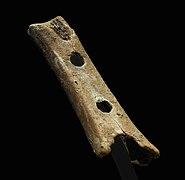
Paleolithic flute found in Divje Babe cave. Photo: Petar Milošević / CC BY-SA, Wikimedia Commons.
By Žan Berro
Slovenia is a small country of around 2 million people at the crossroads of the Balkans and Central Europe.[1] It borders Italy to the west, Austria to the north, Croatia to the south, Adriatic Sea to the south-west and Hungary to the north-east.[2] In 1991, Slovenia gained independence from Yugoslavia and joined European Union in 2004.[3] It is situated at the junction of the Alps, the Dinaric Mountains, the Pannonian Basin and the Adriatic Sea.[4] This central transit location has attracted the interest of many empires in the past, as many superpowers have ruled the area of present-day Slovenia. Slovenia has three cultural monuments inscribed on the UNESCO World Heritage List. The Ig prehistoric pile dwellings have been inscribed on the World Heritage List along with some other pile dwellings around the Alpine region in 2011. Idrija mercury mine was inscribed together with the Spanish site Almaden in 2012, and the architecture of architect Jože Plečnik in Ljubljana was inscribed in 2021.[5]

Historical Development of Legal Cultural Heritage Protection in Slovenia
Most of the territory of present-day Slovenia was under the control of the Austrian Monarchy from the Middle Ages until the end of the First World War.[6] For this reason, the earlier development of the legal protection of cultural heritage in Slovenia must be seen in the context of the Austrian Monarchy. The movable cultural heritage was protected, at least in part, by certain administrative procedures from an early date. In 1776, under Joseph II, a decree was issued requiring all antique coins to be deposited in the Imperial Numismatic Cabinet. In 1812, the regulation was extended to some other categories, such as statuettes and weapons. In 1846, a decree was issued stipulating the division of archaeological finds between the excavator and the landowner. It also stipulated that public collections should have priority in the purchase of important finds. Thus, ownership rights of cultural heritage were well regulated. The situation of immovable cultural heritage was much more complicated, as no legislation was enacted before the start of the First World War to protect it in the Austrian Monarchy.[7] In 1850, the Central Commission was established, but it was primarily tasked with managing cultural monuments.[8] In 1913, the system underwent further changes with the establishment of several provincial offices responsible for heritage management in designated areas. One such office was established in Ljubljana while monuments in certain parts of Slovenia fell under the administration of the offices in Graz (present-day Austria) and Pula (present-day Croatia). In the absence of legislation protecting cultural heritage, provincial conservators collaborated with church authorities to safeguard cultural heritage.[9]
Shortly after the end of the First World War, Slovenia became part of the kingdom (or state) of Serbs, Croats and Slovenes (“SHS”), which lasted until the Second World War. During this turbulent time, the authorities failed to pass any legislation to protect cultural heritage. Specialists were still using the previous Austrian management model of 1913 and were working without an express legal basis, relying only on alternative and preventative management methods. An important turning point came in 1923, when the Slovenian provincial government introduced export certificates for the export of works of art.[10] In 1929 and 1930, the Forestry Act and Building Act were passed, providing partial protection for cultural monuments.[11] After the Second World War, the Kingdom of the SHS was transformed into the socialist state of Yugoslavia. The first national legislation on the protection of cultural heritage was adopted in 1945.[12]While progress in this field was gradual, the introduction of new legislation in 1981 sped up the development of cultural heritage protection. Some of the terminology of the UNESCO World Heritage Convention (1972) was used in the drafting of the new Code, introducing the concepts of cultural and natural heritage. In addition, the legislation created a legal basis for the organization of heritage protection at regional level with a central government body. The weakness of the 1981 law was the lack of coordination between regional and central bodies and the inability to create a central inventory of cultural heritage.[13] Eight years after Slovenia became an independent country in 1991, did the first legislation protecting cultural heritage was introduced in 1999.[14] It was soon declared inadequate because the 1999 legislature failed to implement provisions of the already ratified 1992 European Convention on the Protection of the Archaeological Heritage. Negotiations on a new law of cultural heritage began in 2005, and a new Cultural Heritage Protection Act finally came into force in 2008.[15]
Current System of Legal Protection of Cultural Heritage
The Constitution is the basis for the legal protection of cultural heritage in the Republic of Slovenia.[16] Article 5 of the Constitution determines the State as the protector of human rights and fundamental freedom. In addition, the State is responsible for the protection of cultural and natural heritage and the harmonious development of culture in Slovenia.[17] This Article is linked to Article 73 of the Constitution, which states that everyone has a duty to protect cultural monuments. This Article of the Constitution identifies the State and local communities as the central caretakers of cultural heritage.[18] Article 218 of the Criminal Code determines a penalty for the illegal trafficking of “goods of cultural significance” out of or into the country and for the selling of “goods of cultural significance” that were illegally imported or exported. If either of these offenses are committed with goods of special cultural importance to the State, the penalty is imprisonment for up to 3 years.[19] If the goods are of great or exceptional cultural importance, the penalty is up to 5 years imprisonment.[20] Article 219 of the Criminal Code punishes the removal or destruction of goods of special cultural importance with up to 5 years imprisonment. In the same Article, destruction or removal of goods of great or exceptional cultural importance is punishable by up to 8 years imprisonment.[21] Despite the fact that the offenses in these articles can easily be interpreted in the context of cultural heritage, the application of the Criminal Code in these cases is very complicated. This is because the Criminal Code does not use the terms ‘heritage’ or ‘monument’ in the articles related to cultural heritage[22] (Articles 205, 218, 219 and 222), as prescribed in the Cultural Heritage Protection Act (2008).[23] Therefore, the courts must determine the value in each case on a case-by-case basis and then decide on the penalty. To do this the assistance of experts is required, but different experts may have differing opinions in related cases.[24]
Currently, Slovenian cultural heritage is protected by the Cultural Heritage Protection Act, which was adopted in 2008 (the Slovenian name of the Act is Zakon o varstvu kulturne dediščine, often cited as ZVKD-1).[25] It provides a modern basis for the legal protection of cultural heritage, as Slovenia has ratified the most important international conventions in this field and successfully implemented them in current legislation.[26] Cultural Heritage Protection Act defines heritage as “the goods inherited from the past that Slovenians[…] define as a reflection and expression of their values, identities, ethnic identity, religious and other beliefs, and knowledge and traditions. Heritage includes the aspects of the environment arising from the interaction between people and their environment over time.”[27] In accordance with the relevant international conventions, the law divides heritage into two categories: tangible and intangible. Tangible is further divided into movable and immovable heritage.[28] There are some special categories of immovable heritage defined in the Act, such as archaeological sites, cultural landscapes and settlement areas.[29]
Legal Protection of Immovable Cultural Heritage
The tasks of legal protection of immovable cultural heritage are divided between the Ministry of Culture, responsible for cultural heritage, the Institute for the Protection of Cultural Heritage and the municipalities. The Ministry carries out administrative tasks and is responsible for the management of the heritage inventory system and providing guidelines for the integration of cultural heritage in spatial planning. It also funds archaeological research, which is then carried out by the Institute. The Institute for the Protection of Cultural Heritage is divided into regional units. It is responsible for evaluating the heritage and providing data (e.g. for the heritage inventory system). It also analyzes the archaeological potential of different areas through the research. In addition, the Institute issues permits for interventions and prepares proposals for designations of national and local importance.[30] The problem of assigning status to immovable heritage (of local or national importance) arises from the lack of professional standards. The Act clearly stipulates that the responsible Institute must clearly define the values for which it wishes to grant this special status to a heritage site. This is what Institutes do, but the problem arises when the Cultural Heritage Protection Act stipulates that the valuation standards on the basis of which the Institutes carry out their valuations must be adopted by the Minister of Culture.[31] Such standards have never been issued. As a result, any valuation of immovable cultural heritage is currently left to the subjective judgment of the units of the Institute for the Protection of Cultural Heritage. The municipalities act at local level, they carry out spatial planning at municipal level and adopt acts on the declaration of monuments of local importance.[32]
The immovable heritage is further divided into three classes: monuments of national importance, monuments of local importance and cultural heritage (without monument status).[33] It is important to note that these classes are not the same as those in articles 218 and 219 of the Criminal Code. The Cultural Heritage Protection Act (2008) introduced a number of measures to protect immovable cultural heritage. The first is the inclusion of immovable heritage and its special categories in spatial planning. This means that before any intervention in the area where the immovable heritage is located, the strategic impact on the cultural heritage must be assessed.[34] In the context of the special categories of immovable heritage, there has been a development of preventive archaeology.[35] The second measure was to establish the legal basis for the creation of the Heritage Register, which serves as a central information system for the immovable heritage. The purpose of the Heritage Register is to collect and present core data. The Register is open to the public and serves as a source of information for research, public awareness of heritage and education.[36] A large part of the immovable heritage in Slovenia is privately owned. The Cultural Heritage Protection Act serves as the legal basis for the rights and obligations of heritage owners. Owners have the right to receive expert advice on the management of cultural heritage and are entitled to limited funding for interventions that comply with professional standards or in the case of compulsory archaeological excavations. They may also receive compensation if the duty to protect cultural heritage restricts their economic activities. However, it is the responsibility of owners to regularly maintain cultural heritage, preserve its heritage value, and provide authorized bodies with access to the heritage or remains. Prior permission must also be obtained from the relevant authorities before any intervention is made on the heritage site.[37]
Legal Protection of Movable Cultural Heritage
The Cultural Heritage Act defines movable heritage as “movable property items or a collection of such items with heritage values.”[38] Archaeological material makes up a significant part of movable heritage. However, archaeological finds or remains do not immediately gain heritage status. They are given this status after they have been studied by experts and their heritage value has been recognised.[39] The law defines archaeological finds as “movable archaeological remains that have been below the surface of the earth or under water for at least 100 years. Archaeological finds also include weapons, ammunition, other military material, and military vehicles and vessels or parts thereof that have been below the surface of the earth or under water for at least 50 years.”[40]
The law also establishes State ownership of all archaeological finds or remains below and on the surface of earth or under water. State ownership of artifacts in public collections is also established. Despite these measures it can be concluded that the enforcement of these articles is inadequate, as illegal searches with metal detectors are still regularly carried out throughout the country.[41] In line with contemporary international legal instruments, Slovenia has adopted measures to combat illicit trafficking in cultural goods. The law established basic rules for antiquities dealers, like requirements to keep a list of dealers, keep record of transactions and conduct due diligence.[42] Any export of movable cultural property and objects with the status of national treasure requires the authorisation of the Minister of Culture.[43] The Cultural Heritage Protection Act defines the concept of national treasures on the basis of Regulation 3911/92/EEC. It considers as national treasures the objects listed in the Annex to the aforementioned Regulation, but also includes in this category archaeological finds, parts of immovable monuments, inventoried parts of public collections, etc.[44] The return of cultural objects illegally imported into Slovenia from countries outside the European Union is made possible by the implementation of international conventions into the Cultural Heritage Protection Act.[45] A special law, the Act on the Return of Illegally Removed Cultural Objects (2003), has been adopted for the return of cultural objects illegally imported from EU countries. The same law regulates the return of cultural objects from EU countries that have been illegally exported from Slovenia.[46]
Concluding Remarks
 In the spring of 2024, remains of a Roman harbor were found off the coast of Slovenia in Portorož. The find yielded thousands of ceramic fragments as well as ship masts and sails parts. More findings are waiting to be unearthed so what are the future challenges for the legal protection of tangible cultural heritage in this country?
Slovenia has a relatively young system of legal protection of cultural heritage which began to develop rapidly after 1981. Despite its age, it is a modern system owing to the successful implementation of various international laws in the Cultural Heritage Protection Act (2008). However, it is also clear that the development of the legal protection of cultural heritage slowed down considerably since 2008, given the issues arising with the terminology used in the Criminal Code and the problem of valuation of immovable cultural heritage. There is also a lack of enforcement of the law in the area of protection of movable cultural heritage, particularly with regard to illegal searches with metal detectors.[47] In conclusion, the establishment of a link between the Criminal Code and the Cultural Heritage Protection Act, will be crucial for the further development of the field. It is also essential to establish professional standards for the enforcement of the law and to develop a clear plan for dealing with the issue of illegal metal detector searches.
Suggested readings:
- Jelka Pirkovič, Evolution of National Legislation on Monuments Protection in Slovenia, Historical perspective of heritage legislation: balance between laws and values: conference proceedings (2017), available at https://www.academia.edu/41522062/Evolution_of_national_legislation_on_monuments_protection_in_Slovenia (last accessed Mar. 16, 2024).
- Jelka Pirkovič, Concept of Cultural Heritage Protection and Management in Slovenia , Shared Global Experiences for Protection of Built Heritage (2017), available at https://openarchive.icomos.org/id/eprint/2205/1/Pirkovic%202015.pdf(last accessed Mar. 16, 2024).
- Gašper Rutar and Matija Črešnar, Reserved optimism: preventive archaeology and management of cultural heritage in Slovenia, Remote sensing for Archaeological Heritage Management (2010), available at https://www.academia.edu/9571924/Reserved_optimism_preventive_archaeology_and_management_of_cultural_heritage_in_Slovenia?email_work_card=view-paper (last accessed Mar. 17, 2024).
- Jelka Pirkovič, The collecting of archaeological finds and the »amnesty« in the new Cultural Heritage Protection Act, Varstvo spomenikov (Journal for the Protection of Monuments) 45 (2010), available at https://www.academia.edu/41559928/Zbirateljstvo_arheolo%C5%A1kih_najdb_in_tako_imenovana_abolicija_v_novem_Zakonu_o_varstvu_kulturne_dedi%C5%A1%C4%8Dine_The_collecting_of_archaeological_finds_and_the_amnesty_in_the_new_Cultural_Heritage_Protection_Act (last accessed Mar. 16, 2024).
- Andrej Gaspari, Purchase, compensation or reward? Abolition scheme for the illegally excavated artifacts between law and practice (experience from the Republic of Slovenia), Cultural Heritage and Legal Aspects in Europe (2010), available at https://www.academia.edu/24683905/_2010_Purchase_compensation_or_reward_Abolition_scheme_for_the_illegally_excavated_artifacts_between_law_and_practice_experience_from_the_Republic_of_Slovenia_ (last accessed Mar. 17, 2024).
About the Author:
Žan Berro is a Slovenian-Lebanese archaeology student currently completing his Masters in Archaeology at the University of Ljubljana in Slovenia. He specialises in international cultural heritage law and the fight against illicit trafficking of cultural property. Žan is also writing his master’s thesis on these two topics. His other interests include Near Eastern archaeology, provenance research and the Arabic language.
Sources:
- Britannica, “Slovenia”, https://www.britannica.com/place/Slovenia/Trade (last accessed Apr. 18, 2024). ↑
- Jelka Pirkovič, Evolution of National Legislation on Monuments Protection in Slovenia, Historical perspective of heritage legislation : balance between laws and values : conference proceedings (2017), available at https://www.academia.edu/41522062/Evolution_of_national_legislation_on_monuments_protection_in_Slovenia (last accessed Mar. 16, 2024). ↑
- Eurydice, “Slovenia”, https://eurydice.eacea.ec.europa.eu/national-education-systems/slovenia/historical-development (last accessed Apr. 18, 2024). ↑
- Jelka Pirkovič, Concept of Cultural Heritage Protection and Management in Slovenia , Shared Global Experiences for Protection of Built Heritage (2017), available at https://openarchive.icomos.org/id/eprint/2205/1/Pirkovic%202015.pdf (last accessed Mar. 16, 2024). ↑
- UNESCO, “Slovenia,” https://whc.unesco.org/en/statesparties/si (last accessed Mar. 12, 2024). ↑
- Supra note 4. ↑
- Supra note 2. ↑
- Zvezda Delak Koželj, Etnologija in varstvo naravne in kulturne dediščine, Vestnik XXI (2009). ↑
- Supra note 2. ↑
- Id. ↑
- Tjaša Ivanc, Varstvo nepremične kulturne dediščine: pravna ureditev, De Vesta (2012). ↑
- Id. ↑
- Supra note 2. ↑
- Supra note 11. ↑
- Supra note 4. ↑
- Supra note 11. ↑
- SLOVENE CONST. Art. 5, English translation of the Constitution is available at https://www.us-rs.si/media/constitution.pdf (last accessed Mar. 16, 2024). ↑
- SLOVENE CONST. Art. 73. ↑
- The Official Gazette of the Republic of Slovenia, no. 50/12 – official consolidated version, 6/16, 54/15, 38/16, 27/17, 23/20, 91/20, 95/21, 186/21, 105/22 – ZZNŠPP and 16/23, Art. 218., English translation of Slovenian Criminal Code available at https://www.policija.si/images/stories/Legislation/pdf/CriminalCode2009.pdf (last accessed Mar. 16, 2024). ↑
- Id. ↑
- The Official Gazette of the Republic of Slovenia, no. 50/12 – official consolidated version, 6/16, 54/15, 38/16, 27/17, 23/20, 91/20, 95/21, 186/21, 105/22 – ZZNŠPP and 16/23, Art. 219. ↑
- Slovenia has also failed to ratify the Council of Europe Convention on Offences relating to Cultural Property (2017). The main objective of this Convention is to strengthen the criminal justice response to all criminal offenses related to cultural property. Convention is available at https://www.coe.int/en/web/culture-and-heritage/convention-on-offences-relating-to-cultural-property (last accessed Jun. 10, 2024). ↑
- The Official Gazette of the Republic of Slovenia, no. 50/12 – official consolidated version, 6/16, 54/15, 38/16, 27/17, 23/20, 91/20, 95/21, 186/21, 105/22 – ZZNŠPP and 16/23. ↑
- Republic of Slovenia: Higher Court of Celje. (2012). Decision number VSC0003918. Verdict of Sep. 4, 2012. Available at: https://sodnapraksa.si/?q=id:2012032113078718&database[SOVS]=SOVS&database[IESP]=IESP&database[VDSS]=VDSS&database[UPRS]=UPRS&_submit=i%C5%A1%C4%8Di&page=0&id=2012032113078718 (last accessed Jun. 9, 2024). ↑
- Jelka Pirkovič and Borut Šantej, Pravno varstvo nepremične kulturne dediščine v Sloveniji (Tutela giuridica del patrimonio culturale immobile in Slovenia), Vestnik XXV (2012). ↑
- Supra note 2. ↑
- Cultural Heritage Protection Act, 2008, Article 1, paragraph 2. English translation available at: http://www.arhiv.mk.gov.si/fileadmin/mk.gov.si/pageuploads/min_eng/legislation/CHPA.pdf (last accessed Mar. 13, 2024). ↑
- Cultural Heritage Protection Act, 2008, Article 1, paragraph 3. ↑
- Supra note 4. ↑
- Supra note 25. ↑
- Cultural Heritage Protection Act, 2008, Article 24. ↑
- Supra note 25. ↑
- Supra note 25. ↑
- Supra note 4. ↑
- Gašper Rutar and Matija Črešnar, Reserved optimism: preventive archaeology and management of cultural heritage in Slovenia, Remote sensing for Archaeological Heritage Management (2010), availible at https://www.academia.edu/9571924/Reserved_optimism_preventive_archaeology_and_management_of_cultural_heritage_in_Slovenia?email_work_card=view-paper (last accessed Mar. 17., 2024). ↑
- Supra note 2. ↑
- Supra note 25. ↑
- Cultural Heritage Protection Act, 2008, Article 3, paragraph 29. ↑
- Jelka Pirkovič, The collecting of archaeological finds and the »amnesty« in the new Cultural Heritage Protection Act, Varstvo spomenikov (Journal for the Protection of Monuments) 45 (2010), available at https://www.academia.edu/41559928/Zbirateljstvo_arheolo%C5%A1kih_najdb_in_tako_imenovana_abolicija_v_novem_Zakonu_o_varstvu_kulturne_dedi%C5%A1%C4%8Dine_The_collecting_of_archaeological_finds_and_the_amnesty_in_the_new_Cultural_Heritage_Protection_Act (last accessed Mar. 16, 2024). ↑
- Cultural Heritage Protection Act, 2008, Article 3, paragraph 2. ↑
- Andrej Gaspari, Purchase, compensation or reward? Abolition scheme for the illegally excavated
artifacts between law and practice (experience from the Republic of Slovenia), Cultural Heritage and Legal Aspects in Europe (2010), available at https://www.academia.edu/24683905/_2010_Purchase_compensation_or_reward_Abolition_scheme_for_the_illegally_excavated_artifacts_between_law_and_practice_experience_from_the_Republic_of_Slovenia_ (last accessed Mar. 17, 2024). ↑
- Supra note 25. ↑
- Cultural Heritage Protection Act, 2008, Article 46. ↑
- Supra note 25. ↑
- Supra note 39. ↑
- Return of Unlawfully Removed Objects of Cultural Heritage Act, 2003, art. 3 and art. 6, English translation available at http://www.pisrs.si/Pis.web/cm?idStrani=prevodi (last accessed Mar. 22, 2024) in the section of the Ministry of Culture. Slovenian name of the Act is Zakon o vračanju protipravno odstranjenih predmetov kulturne dediščine (ZVPOPKD). ↑
- Supra note 41. ↑
Disclaimer: This article is for educational purposes only and is not meant to provide legal advice. Readers should not construe or rely on any comment or statement in this article as legal advice. For legal advice, readers should seek a consultation with an attorney.


You must be logged in to post a comment.