• About
    • Mission
    • Team
    • Boards
    • Mentions & Testimonials
    • Institutional Recognition
    • Annual Reports
    • Current & Past Sponsors
    • Contact Us
  • Resources
    • Article Collection
    • Podcast: Art in Brief
    • AML and the Art Market
    • AI and Art Authentication
    • Newsletter
      • Subscribe
      • Archives
      • In Brief
    • Art Law Library
    • Movies
    • Nazi-looted Art Restitution Database
    • Global Network
      • Courses and Programs
      • Artists’ Assistance
      • Bar Associations
      • Legal Sources
      • Law Firms
      • Student Societies
      • Research Institutions
    • Additional resources
      • The “Interview” Project
  • Events
    • Worldwide Calendar
    • Our Events
      • All Events
      • Annual Conferences
        • 2025 Art Law Conference
        • 2024 Art Law Conference
        • 2023 Art Law Conference
        • 2022 Art Law Conference
        • 2015 Art Law Conference
  • Programs
    • Visual Artists’ Legal Clinics
      • Art & Copyright Law Clinic
      • Artist-Dealer Relationships Clinic
      • Artist Legacy and Estate Planning Clinic
      • Visual Artists’ Immigration Clinic
    • Summer School
      • 2026
      • 2025
    • Internship and Fellowship
    • Judith Bresler Fellowship
  • Case Law Database
  • Log in
  • Become a Member
  • Donate
  • Log in
  • Become a Member
  • Donate
Center for Art Law
  • About
    About
    • Mission
    • Team
    • Boards
    • Mentions & Testimonials
    • Institutional Recognition
    • Annual Reports
    • Current & Past Sponsors
    • Contact Us
  • Resources
    Resources
    • Article Collection
    • Podcast: Art in Brief
    • AML and the Art Market
    • AI and Art Authentication
    • Newsletter
      Newsletter
      • Subscribe
      • Archives
      • In Brief
    • Art Law Library
    • Movies
    • Nazi-looted Art Restitution Database
    • Global Network
      Global Network
      • Courses and Programs
      • Artists’ Assistance
      • Bar Associations
      • Legal Sources
      • Law Firms
      • Student Societies
      • Research Institutions
    • Additional resources
      Additional resources
      • The “Interview” Project
  • Events
    Events
    • Worldwide Calendar
    • Our Events
      Our Events
      • All Events
      • Annual Conferences
        Annual Conferences
        • 2025 Art Law Conference
        • 2024 Art Law Conference
        • 2023 Art Law Conference
        • 2022 Art Law Conference
        • 2015 Art Law Conference
  • Programs
    Programs
    • Visual Artists’ Legal Clinics
      Visual Artists’ Legal Clinics
      • Art & Copyright Law Clinic
      • Artist-Dealer Relationships Clinic
      • Artist Legacy and Estate Planning Clinic
      • Visual Artists’ Immigration Clinic
    • Summer School
      Summer School
      • 2026
      • 2025
    • Internship and Fellowship
    • Judith Bresler Fellowship
  • Case Law Database
Home image/svg+xml 2021 Timothée Giet Art law image/svg+xml 2021 Timothée Giet How Two Artists are Challenging the SEC’s Role in Shaping the NFT Art Market
Back

How Two Artists are Challenging the SEC’s Role in Shaping the NFT Art Market

November 23, 2024
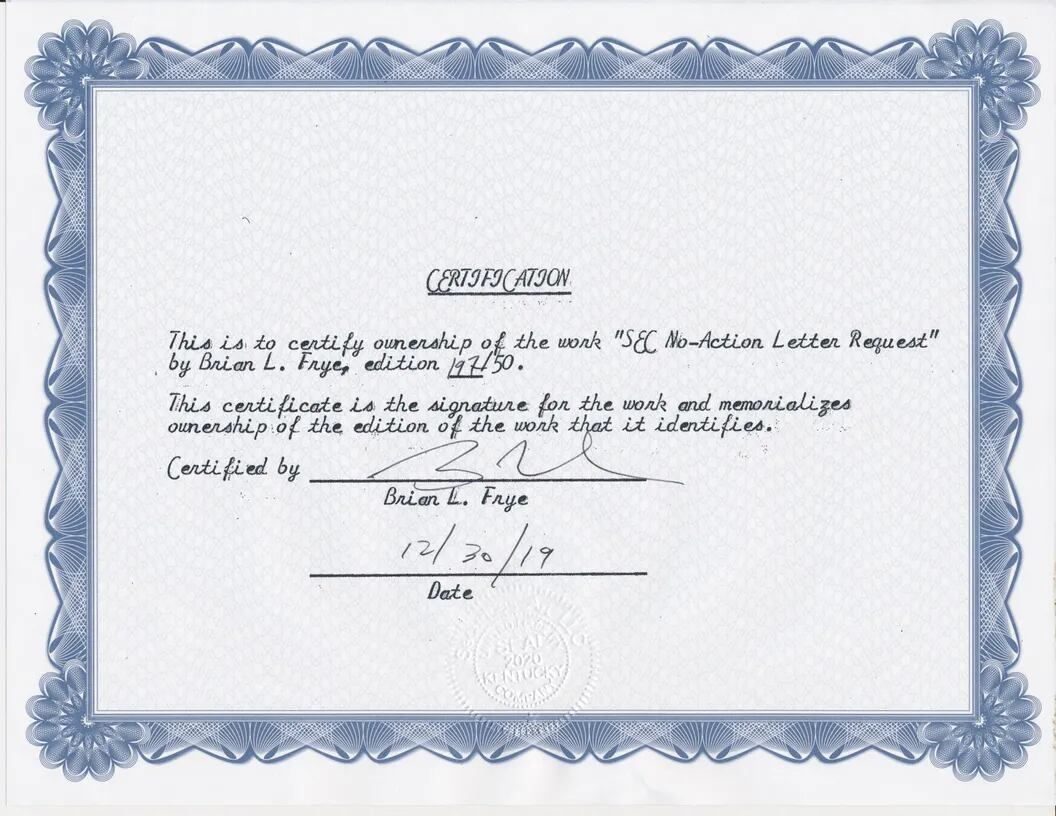
SEC No-Action Letter Request 2: The #NFT

By Allie Wiley

As of the Summer of 2024, Brian L. Frye is suing the Securities and Exchange Commission along with Jonathan Mann to confront the agency’s ability to regulate non-fungible tokens head on. The SEC has taken charge of regulating art that is sold as NFTs despite being created to protect investors.[1] The issue with the SEC regulating the NFT art market is two-fold. First, the definition of securities is too broad so it can easily incorporate NFTs under the wide net.[2] As it is presently, the definition includes anything that could be understood as an investment, wrapping the art world in with it. Now that NFTs are gaining popularity within the art community, the SEC has taken aim. Secondly, the new regulations of this corner of the art market are limiting artist’s abilities to make a living. For example, Mann, sells a daily song NFT as part of his livelihood.[3] Art is critical for society so hindering the ability to make money for artists will eventually lead to less people pursuing art. NFTs are just a new medium for artists to sell their art.

How the SEC Started Regulating NFTs

NFTs are typically exchanged using cryptocurrency where you can purchase a block on a blockchain.[4] When you purchase an NFT, you own a digital asset with software specific to your NFT.[5] If you categorize NFTs as a security like the SEC has, the Securities Act of 1933 requires sellers to perform a mandatory registration process for any sale of securities.[6] Under the broad definition of “security”, any type of art could be argued as this type of investment. NFTs offer a unique way to make money in the art market that was previously untappable before 2014.[7] With the way viral content has taken over our society, selling a song a day as a NFT has helped Jonathan Mann maintain the exclusivity of his work and has allowed him, along with other artists, to continue to prosper. While there is risk involved in the NFT market, that does not mean it requires regulations from the SEC. There is risk involved in any type of “investment” you make —from your house to your car— and the SEC does not regulate those. Due to the newness of NFTs, which first emerged in 2014, there has not been a lot of time to determine if NFT art is somewhat of a fad or if it will be commonplace in art collections in the future.[8] This case will bring NFTs one step closer to becoming a permanent medium artists can rely on.

Setting SEC-NFT Precedent: The Stoner Cats Lawsuit

Stoner Cats, an animated web series starring Mila Kunis and Ashton Kutcher, sold NFTs of the animated cats to help raise money for the web series.[9] According to the SEC, Stoner Cats 2 LLC sold 10,000 NFTs for $800, each making $8 million dollars in investments for the show, while also putting on a 2.5 percent royalty for each transaction after the original was sold.[10] Crypto currency assets have to be registered to help protect investors from fraud and other risks involved in investing.[11] This resulted in a settlement between the SEC and Stoner Cats 2 LLC.[12] This settlement sparked outrage in artists Brian Frye and Jonathan Mann.

The 2024 lawsuit is not the first time that Brian Frye has tried to elicit a response from the SEC. Frye had made an NFT titled SEC No-Action Letter Request to request an SEC no-action letter to demonstrate that digital art does not violate the securities laws that they have mandated.[13] Frye and Mann’s lawsuit has been filed in Louisiana federal court.[14] A preemptive federal lawsuit like this one can happen if you have a reasonable belief that the government is going to prejudice you or your interests in some way in the future.[15] This case filing is the much needed advocacy against government agency intervention and proves the effects when an agency oversteps its administrative bounds.

The Legal Implications of Frye and Mann’s Lawsuit

So the question begs, what do Brian Frye and Jonathan Mann want to accomplish with their pending lawsuit? As it stands now, the precedent set by the Stoner Cats case is that NFTs are unregistered securities. This case is truly about redefining securities and putting the SEC back into the lane from which it strayed to protect artistic freedom as art changes with new technology. The SEC was never meant to regulate the art market and hinders a buyer’s ability to invest in an artist’s career.[16] If Congress wanted the SEC to control the art market, Congress would have included that responsibility within the scope of the SEC’s duties.[17] After all, the art market has been around for thousands of years and NFTs are just another outlet for artistic expression. Frye and Mann are calling this government agency to explain what it is doing, hoping the courts will determine the breadth of the SEC’s role in the NFT art market. With the SEC’s current stance on NFTs, Jonathan Mann has been actively breaking the law since 2022.[18] Preemptively suing the SEC seems to be the best course of action since the SEC’s targets of NFT violations have no obvious correlation.[19] When anyone could be next, it is extremely valuable for every artist to pay attention as this lawsuit unfolds.

It could be argued that the popularity in NFT regulation is from the sudden uptick in major sales of works such as Everydays: The First 5000 Days in 2021 which sold for millions of dollars.[20] The SEC, so far, has been strategic in who it sues, choosing companies that have incentives to settle due to project deadlines or other reasons.[21] This has allowed the SEC to get away with not arguing their cases in front of judges to decide what their capacity of regulating NFTs is.[22]

If the SEC wins against Frye and Mann’s lawsuit, the art market could drastically change outside of the NFT corner. It would require artists to disclose any risks associated with purchasing their work, but does not offer what disclosing risks for art means or how that differs from risk associated with stocks.[23]

Artists, legal scholars, and NFT patrons are eagerly awaiting to learn about the outcome of this lawsuit and see if the U.S. Securities and Exchange Commission or Brian L. Frye and Jonathan Mann come out ahead.

About the Author:

Allie Wiley is an undergraduate student at Indiana University Bloomington where she is preparing for law school. She has an interest in cultural heritage law and intellectual property rights.

Suggested Readings

  • I’m Suing The SEC, Song Day, available at https://songaday.world/sec
  • Robyn Conti, What Is An NFT? Non-Fungible Tokens Explained, Forbes, available at ihttps://www.forbes.com/advisor/investing/cryptocurrency/nft-non-fungible-token/#:~:text=NFT%20stands%20for%20non%2Dfungible,or%20exchanged%20for%20one%20another

Bibliography:

  1. Mission, U.S. Securities and Exchange Commission (Aug 9. 2023). ↑
  2. Frye, Brian L., Why I Sued the SEC, Right Click Save (Sep 11, 2024). ↑
  3. Hoffman, David, Suing the SEC | Jonathan Mann & Brian Frye, Bankless (Jul 30, 2024). ↑
  4. Conti, Robyn, What Is An NFT? Non-Fungible Tokens Explained, Forbes Advisor (May 10,2024). ↑
  5. Klein, Jessica, ‘Should Art Be Regulated by the SEC?’: NFT Artists’ New Lawsuit Seeks Answers, Wired (Aug 26, 2024). ↑
  6. Legal Information Institute, Securities Act of 1933, Cornell Law School (Oct, 2023). ↑
  7. Manoylov, MK, A brief history of NFTs: From CryptoPunk to Bored Apes, The Block (Oct 18, 2023). ↑
  8. Id. ↑
  9. SEC Charges Creator of Stoner Cats Web Series for Unregistered Offering of NFTs, U.S. Securities and Exchange Commission (Sep 13, 2023). ↑
  10. Id. ↑
  11. Id. ↑
  12. Id. ↑
  13. Kinsella, Eileen, NFT Artists Sue SEC, Disputing Its Regulation of Digital Art Sales, Artnet (Jul 31, 2024). ↑
  14. Jonathan Mann and Brian L. Frye v. Securities and Exchange Commission, Eric I. Bustillo, Gary Gensler, Caroline A. Crenshaw, Jaime E. Lizárrage, Hester M. Peirce, and Mark T. Uyeda, in their official capacities, No. 2:24-cv-01881 (E.D. La. Jul 29, 2024). ↑
  15. Hoffman, David, Suing the SEC | Jonathan Mann & Brian Frye, Bankless (Jul 30, 2024). ↑
  16. Frye, Brian L., Why I Sued the SEC, Right Click Save (Sep 11, 2024). ↑
  17. Id. ↑
  18. Mann, Jonathan, I’m Suing the SEC, songaday (Aug 6,2024). ↑
  19. Id. ↑
  20. Frye, Brian L., Why I Sued the SEC, Right Click Save (Sep 11, 2024). ↑
  21. Id. ↑
  22. Hoffman, David, Suing the SEC | Jonathan Mann & Brian Frye, Bankless (Jul 30, 2024). ↑
  23. Kinsella, Eileen, NFT Artists Sue SEC, Disputing Its Regulation of Digital Art Sales, Artnet (Jul 31, 2024). ↑


Disclaimer: This article is for educational purposes only and is not meant to provide legal advice. Readers should not construe or rely on any comment or statement in this article as legal advice. For legal advice, readers should seek a consultation with an attorney.

Post navigation

Previous The U.S. Copyright Office: Artificial Intelligence and Emerging Challenges
Next Can a Duct-taped Banana be a Copyrightable Work of Art?

Related Posts

logo

Resale Royalty: To Act Or Not To Act; US Copyright Office Issues Notice re Public Hearing

April 1, 2013
photos from Japan

Intellectual Property Protections and the Art Market in Japan

February 21, 2025

Interns in the Arts

April 29, 2014
Center for Art Law
Center for Art Law

Follow us on Instagram for the latest in Art Law!

Don't miss our on our upcoming Bootcamp on Februar Don't miss our on our upcoming Bootcamp on February 4th! Check out the full event description below:

Join the Center for Art Law for an in-person, full-day training aimed at preparing lawyers for working with art market participants and understanding their unique copyright law needs. The bootcamp will be led by veteran art law attorneys, Louise Carron, Barry Werbin, Carol J. Steinberg, Esq., Scott Sholder, Marc Misthal, specialists in copyright law.

This Bootcamp provides participants -- attorneys, law students, law graduates and legal professionals -- with foundational legal knowledge related to copyright law for art market clients. Through a combination of instructional presentations and mock consultations, participants will gain a solid foundation in copyright law and its specificities as applied to works of visual arts, such as the fair use doctrine and the use of generative artificial intelligence tools.

🎟️ Grab tickets using the link in our bio!
The expansion of the use of collaborations between The expansion of the use of collaborations between artists and major consumer corporations brings along a myriad of IP legal considerations. What was once seen in advertisement initiatives  has developed into the creation of "art objects," something that lives within a consumer object while retaining some portion of an artists work. 

🔗 Read more about this interesting interplay in Natalie Kawam Yang's published article, including a discussion on how the LOEWE x Ghibli Museum fits into this context, using the link in our bio.
We can't wait for you to join us on February 4th! We can't wait for you to join us on February 4th!  Check out the full event description below:

Join the Center for Art Law for an in-person, full-day training aimed at preparing lawyers for working with art market participants and understanding their unique copyright law needs. The bootcamp will be led by veteran art law attorneys, Louise Carron, Barry Werbin, Carol J. Steinberg, Esq., Scott Sholder, Marc Misthal, specialists in copyright law. 

This Bootcamp provides participants -- attorneys, law students, law graduates and legal professionals -- with foundational legal knowledge related to copyright law for art market clients. Through a combination of instructional presentations and mock consultations, participants will gain a solid foundation in copyright law and its specificities as applied to works of visual arts, such as the fair use doctrine and the use of generative artificial intelligence tools.

🎟️ Grab tickets using the link in our bio!
Don't forget to grab tickets to our upcoming Collo Don't forget to grab tickets to our upcoming Colloquium, discussing the effectiveness of no strike designations in Syria, on February 2nd. Check out the full event description below:

No strike designations for cultural heritage are one mechanism by which countries seek to uphold the requirements of the 1954 Hague Convention. As such, they are designed to be key instruments in protecting the listed sites from war crimes. Yet not all countries maintain such inventories of their own whether due to a lack of resources, political views about what should be represented, or the risk of misuse and abuse. This often places the onus on other governments to create lists about cultures other than their own during conflicts. Thus, there may be different lists compiled by different governments in a conflict, creating an unclear legal landscape for determining potential war crimes and raising significant questions about the effectiveness of no strikes as a protection mechanism. 

Michelle Fabiani will discuss current research seeking to empirically evaluate the effectiveness of no strike designations as a protection mechanism against war crimes in Syria. Using data on cultural heritage attacks from the height of the Syrian Conflict (2014-2017) compiled from open sources, a no strike list completed in approximately 2012, and measures of underlying risk, this research asks whether the designations served as a protective factor or a risk factor for a given site and the surrounding area. Results and implications for holding countries accountable for war crimes against cultural heritage are discussed. 

🎟️ Grab tickets using the link in our bio!

#centerforartlaw #artlaw #culturalheritage #lawyer #legalreserach #artlawyer
Don't miss our up coming in-person, full-day train Don't miss our up coming in-person, full-day training aimed at preparing lawyers for working with art market participants and understanding their unique copyright law needs. The bootcamp will be led by veteran art law attorneys, Louise Carron, Barry Werbin, Carol J. Steinberg, Esq., Scott Sholder, Marc Misthal, specialists in copyright law. 

This Bootcamp provides participants -- attorneys, law students, law graduates and legal professionals -- with foundational legal knowledge related to copyright law for art market clients. Through a combination of instructional presentations and mock consultations, participants will gain a solid foundation in copyright law and its specificities as applied to works of visual arts, such as the fair use doctrine and the use of generative artificial intelligence tools.

🎟️ Grab tickets using the link in our bio! 

#centerforartlaw #artlaw #legal #research #lawyer #artlawyer #bootcamp #copyright #CLE #trainingprogram
In order to fund acquisitions of contemporary art, In order to fund acquisitions of contemporary art, The Phillips Collection sold seven works of art from their collection at auction in November. The decision to deaccession three works in particular have led to turmoil within the museum's governing body. The works at the center of the controversy include Georgia O'Keefe's "Large Dark Red Leaves on White" (1972) which sold for $8 million, Arthur Dove's "Rose and Locust Stump" (1943), and "Clowns et pony" an 1883 drawing by Georges Seurat. Together, the three works raised $13 million. Three board members have resigned, while members of the Phillips family have publicly expressed concerns over the auctions. 

Those opposing the sales point out that the works in question were collected by the museum's founders, Duncan and Marjorie Phillips. While museums often deaccession works that are considered reiterative or lesser in comparison to others by the same artist, the works by O'Keefe, Dove, and Seurat are considered highly valuable, original works among the artist's respective oeuvres. 

The museum's director, Jonathan P. Binstock, has defended the sales, arguing that the process was thorough and reflects the majority interests of the collection's stewards. He believes that acquiring contemporary works will help the museum to evolve. Ultimately, the controversy highlights the difficulties of maintaining institutional collections amid conflicting perspectives.

🔗 Click the link in our bio to read more.
Make sure to check out our newest episode if you h Make sure to check out our newest episode if you haven’t yet!

Paris and Andrea get the change to speak with Patty Gerstenblith about how the role international courts, limits of accountability, and if law play to protect history in times of war.

🎙️ Click the link in our bio to listen anywhere you get your podcasts!
Alexander Butyagin, a Russian archaeologist, was a Alexander Butyagin, a Russian archaeologist, was arrested by Polish authorities in Warsaw. on December 4th. Butyagin is wanted by Ukraine for allegedly conducting illegal excavations of Myrmekion, an ancient city in Crimea. Located in present-day Crimea, Myrmekion was an Ancient Greek colony dating to the sixth century, BCE. 

According to Ukrainian officials, between 2014 and 2019 Butyagin destroyed parts of the Myrmekion archaeological site while serving as head of Ancient Archaeology of the Northern Black Sea region at St. Petersburg's Hermitage Museum. The resulting damages are estimated at $4.7 million. Notably, Russia's foreign ministry has denounced the arrest, describing Poland's cooperation with Ukraine's extradition order as "legal tyranny." Russia invaded and annexed Crimea in 2014.

🔗 Read more by clicking the link in our bio

#centerforartlaw #artlaw #artcrime #artlooting #ukraine #crimea
Join us on February 18th to learn about the proven Join us on February 18th to learn about the provenance and restitution of the Cranach painting at the North Carolina Museum of Art.

A beloved Cranach painting at the North Carolina Museum of Art was accused of being looted by the Nazis. Professor Deborah Gerhardt will describe the issues at stake and the evidentiary trail that led to an unusual model for resolving the dispute.

Grab your tickets today using the link in our bio!

#centerforartlaw #artlaw #legal #legalresearch #museumissues #artwork
“In the depth of winter, I finally learned that wi “In the depth of winter, I finally learned that within me there lay an invincible summer."
~ Albert Camus, "Return to Tipasa" (1952) 

Camus is on our reading list but for now, stay close to the ground to avoid the deorbit burn from the 2026 news and know that we all contain invincible summer. 

The Center for Art Law's January 2026 Newsletter is here—catch up on the latest in art law and start the year informed.
https://itsartlaw.org/newsletters/january-newsletter-which-way-is-up/ 

#centerforartlaw #artlaw #lawyer #artlawyer #legalresearch #legal #art #law #newsletter #january
Major corporations increasingly rely on original c Major corporations increasingly rely on original creative work to train AI models, often claiming a fair use defense. However, many have flagged this interpretation of copyright law as illegitimate and exploitative of artists. In July, the Senate Judiciary Committee on Crime and Counterterrorism addressed these issues in a hearing on copyright law and AI training. 

Read our recent article by Katelyn Wang to learn more about the connection between AI training, copyright protections, and national security. 

🔗 Click the link in our bio to read more!
Join the Center for Art Law for an in-person, all- Join the Center for Art Law for an in-person, all-day  CLE program to train lawyers to work with visual artists and their unique copyright needs. The bootcamp will be led by veteran art law attorneys specializing in copyright law.

This Bootcamp provides participants -- attorneys, law students, law graduates and legal professionals -- with foundational legal knowledge related to copyright law for art market clients. Through a combination of instructional presentations and mock consultations, participants will gain a solid foundation in copyright law and its specificities as applied to works of visual arts, such as the fair use doctrine and the use of generative artificial intelligence tools. 

🎟️ Grab tickets using the link in our bio!
  • About the Center
  • Contact Us
  • Newsletter
  • Upcoming Events
  • Internship
  • Case Law Database
  • Log in
  • Become a Member
  • Donate
DISCLAIMER

Center for Art Law is a New York State non-profit fully qualified under provision 501(c)(3)
of the Internal Revenue Code.

The Center does not provide legal representation. Information available on this website is
purely for educational purposes only and should not be construed as legal advice.

TERMS OF USE AND PRIVACY POLICY

Your use of the Site (as defined below) constitutes your consent to this Agreement. Please
read our Terms of Use and Privacy Policy carefully.

© 2026 Center for Art Law