• About
    • Mission
    • Team
    • Boards
    • Mentions & Testimonials
    • Institutional Recognition
    • Annual Reports
    • Current & Past Sponsors
    • Contact Us
  • Resources
    • Article Collection
    • Podcast: Art in Brief
    • AML and the Art Market
    • AI and Art Authentication
    • Newsletter
      • Subscribe
      • Archives
      • In Brief
    • Art Law Library
    • Movies
    • Nazi-looted Art Restitution Database
    • Global Network
      • Courses and Programs
      • Artists’ Assistance
      • Bar Associations
      • Legal Sources
      • Law Firms
      • Student Societies
      • Research Institutions
    • Additional resources
      • The “Interview” Project
  • Events
    • Worldwide Calendar
    • Our Events
      • All Events
      • Annual Conferences
        • 2025 Art Law Conference
        • 2024 Art Law Conference
        • 2023 Art Law Conference
        • 2022 Art Law Conference
        • 2015 Art Law Conference
  • Programs
    • Visual Artists’ Legal Clinics
      • Art & Copyright Law Clinic
      • Artist-Dealer Relationships Clinic
      • Artist Legacy and Estate Planning Clinic
      • Visual Artists’ Immigration Clinic
    • Summer School
      • 2025
    • Internship and Fellowship
    • Judith Bresler Fellowship
  • Case Law Database
  • 2025 Year-End Appeal
  • Log in
  • Become a Member
  • Donate
  • 2025 Year-End Appeal
  • Log in
  • Become a Member
  • Donate
Center for Art Law
  • About
    About
    • Mission
    • Team
    • Boards
    • Mentions & Testimonials
    • Institutional Recognition
    • Annual Reports
    • Current & Past Sponsors
    • Contact Us
  • Resources
    Resources
    • Article Collection
    • Podcast: Art in Brief
    • AML and the Art Market
    • AI and Art Authentication
    • Newsletter
      Newsletter
      • Subscribe
      • Archives
      • In Brief
    • Art Law Library
    • Movies
    • Nazi-looted Art Restitution Database
    • Global Network
      Global Network
      • Courses and Programs
      • Artists’ Assistance
      • Bar Associations
      • Legal Sources
      • Law Firms
      • Student Societies
      • Research Institutions
    • Additional resources
      Additional resources
      • The “Interview” Project
  • Events
    Events
    • Worldwide Calendar
    • Our Events
      Our Events
      • All Events
      • Annual Conferences
        Annual Conferences
        • 2025 Art Law Conference
        • 2024 Art Law Conference
        • 2023 Art Law Conference
        • 2022 Art Law Conference
        • 2015 Art Law Conference
  • Programs
    Programs
    • Visual Artists’ Legal Clinics
      Visual Artists’ Legal Clinics
      • Art & Copyright Law Clinic
      • Artist-Dealer Relationships Clinic
      • Artist Legacy and Estate Planning Clinic
      • Visual Artists’ Immigration Clinic
    • Summer School
      Summer School
      • 2025
    • Internship and Fellowship
    • Judith Bresler Fellowship
  • Case Law Database
Home image/svg+xml 2021 Timothée Giet Art History image/svg+xml 2021 Timothée Giet Homage to Grand Central Anniversaries
Back

Homage to Grand Central Anniversaries

February 4, 2013
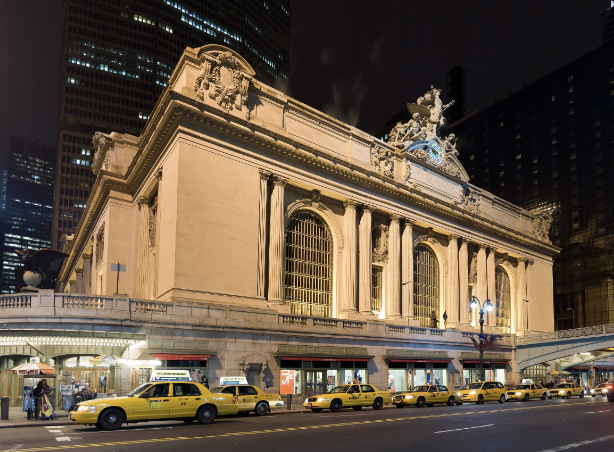
On February 1, 2013, New York celebrated the centennial anniversary of the Grand Central Terminal. It is arguably the most famous train station in the United States. Today nobody in his right mind would consider taking this beautiful landmark down. However, in the 1970s Grand Central was under real threat of demolition; it could have followed the tragic lead of the original Pennsylvania Station that was demolished fifty years ago, in 1963.

The survival of the majestic Grand Central Terminal in the heart of Manhattan is a testament to historic preservation. In 2013, we also mark the 50th anniversary of the demolition of the original Beaux-Arts building of the Pennsylvania Station and the 35th anniversary of the historic Supreme Court decision that saved Grand Central and others from destruction. In 1978, the United States Supreme court held that cities have the right to protect their historic buildings. The decision limited owner’s ability to sell or develop their property but it protected American landmarks and “legitimized preservation efforts” in the United States. It was not a unanimous decision, with Justices  Rehnquist and Stevens dissenting.

Following are excerpts from the 1978 decision of Penn Central Transportation Company versus New York City:

  • This case involves the application of New York City’s Landmarks Preservation Law to Grand Central Terminal (Terminal). The Terminal, which is owned by the Penn Central Transportation Co. and its affiliates (Penn Central), is one of New York City’s most famous buildings. Opened in 1913, it is regarded not only as providing an ingenious engineering solution to the problems presented by urban railroad stations, but also as a magnificent example of the French beaux-arts style.”
  • On August 2, 1967, following a public hearing, the Commission designated the Terminal a “landmark” and designated the  “city tax block” it occupies a “landmark site.” The Board of Estimate confirmed this action on September 21, 1967. Although appellant Penn Central had opposed the designation before the Commission, it did not seek judicial review of the final designation Grand Central Station, one of the great buildings of America, evokes a spirit that is unique in this City.
  • “It combines distinguished architecture with a brilliant engineering solution, wedded to one of the most fabulous railroad terminals of our time. Monumental in scale, this great building functions as well today as it did when built. In style, it represents the best of the French Beaux Arts.”
  • On January 22, 1968, appellant Penn Central, to increase its income, entered into a renewable 50-year lease and sublease agreement with appellant UGP Properties, Inc. (UGP), a wholly owned subsidiary of Union General Properties, Ltd., a United Kingdom corporation. Under the terms of the agreement, UGP was to construct a multistory office building above the Terminal. UGP promised to pay Penn Central $ 1 million annually during construction and at least $ 3 million annually thereafter. The rentals would be offset in part by a loss of some $ 700,000 to $ 1 million in net rentals presently received from concessionaires displaced by the new building. Appellants UGP and Penn Central then applied to the Commission for permission to construct an office building atop the Terminal.
  • Two separate plans, both designed by architect Marcel Breuer and both apparently satisfying the terms of the applicable zoning ordinance, were submitted to the Commission for approval.
  • The first, Breuer I, provided for the construction of a 55-story office building, to be cantilevered above the existing facade and to rest on the roof of the Terminal.
  • The second, Breuer II Revised, 17 called for tearing down a portion of the Terminal that included the 42d Street facade, stripping off some of the remaining features of the Terminal’s facade, and constructing a 53-story office building.
  • The Commission denied a certificate of no exterior effect on September 20, 1968. Appellants then applied for a certificate of “appropriateness” as to both proposals. After four days of hearings at which over 80 witnesses testified, the Commission denied this application as to both proposals.
  • The Appellate Division held that the restrictions on the development of the Terminal site were necessary to promote the legitimate public purpose of protecting landmarks and therefore that appellants could sustain their constitutional claims only by proof that the regulation deprived them of all reasonable beneficial use of the property.
  • …to the extent appellants have been denied the right to build above the Terminal, it is not literally accurate to say that they have been denied all use of even those pre-existing air rights. Their ability to use these rights has not been abrogated; they are made transferable to at least eight parcels in the vicinity of the Terminal, one or two of which have been found suitable for the construction of new office buildings. Although appellants and others have argued that New York City’s transferable development-rights program is far from ideal, 35 the New York courts here supportably found that, at least in the case of the Terminal, the rights afforded are valuable. While these rights may well not have constituted “just compensation” if a “taking” had occurred, the rights nevertheless undoubtedly mitigate whatever financial burdens the law has imposed on appellants and, for that reason, are to be taken into account in considering the impact of regulation.

Sources: Penn Cent. Transp. Co. v. New York City, 438 U.S. 104 (U.S. 1978); New York Times; ArtDaily.

Disclaimer: This article is for educational purposes only and is not meant to provide legal advice. Readers should not construe or rely on any comment or statement in this article as legal advice. For legal advice, readers should seek a consultation with an attorney.

Post navigation

Previous The Journey of Columbia University’s Rembrandt
Next Part I: Who Owns Street Art?

Related Posts

Astor’s Estate out of Probate

March 29, 2012

Ecuadorean President Rafael Correa To Yale University: Return Artifacts to Peru!

October 29, 2010

The Art of Black Lives Matter Activism: Part I

August 7, 2020
Center for Art Law
A Gift for You

A Gift for You

this Holiday Season

Celebrate the holidays with 20% off your annual subscription — claim your gift now!


Get your Subscription Today!
Guidelines AI and Art Authentication

AI and Art Authentication

Explore the new Guidelines for AI and Art Authentication for the responsible, ethical, and transparent use of artificial intelligence.

Download here
Center for Art Law

Follow us on Instagram for the latest in Art Law!

Did you know that Charles Dickens visited America Did you know that Charles Dickens visited America twice, in 1842 and in 1867? In between, he wrote his famous “A Tale of Two Cities,” foreshadowing upheavals and revolutions and suggesting that individual acts of compassion, love, and sacrifice can break cycles of injustice. With competing demands and obligations, finding time to read books in the second quarter of the 21st century might get increasingly harder. As we live in the best and worst of times again, try to enjoy the season of light and a good book (or a good newsletter).

From all of us at the Center for Art Law, we wish you peace, love, and understanding this holiday season. 

🔗 Read more by clicking the link in our bio!

#centerforartlaw #artlaw #legalresearch #artlawyer #december #newsletter #lawyer
Is it, or isn’t it, Vermeer? Trouble spotting fake Is it, or isn’t it, Vermeer? Trouble spotting fakes? You are not alone. Donate to the Center for Art Law, we are the real deal. 

🔗 Click the link in our bio to donate today!

#centerforartlaw #artlaw #legalresearch #endofyear #givingtuesday #donate #notacrime #framingartlaw
Whether legal systems are ready or not, artificial Whether legal systems are ready or not, artificial intelligence is making its way into the courtroom. AI-generated evidence is becoming increasingly common, but many legal professionals are concerned that existing legal frameworks aren't sufficient to account for ethical dilemmas arising from the technology. 

To learn more about the ethical arguments surrounding AI-generated evidence, and what measures the US judiciary is taking to respond, read our new article by Rebecca Bennett. 

🔗 Click the link in our bio to read more!

#centerforartlaw #artlaw #legalresearch #artlawyer #lawyer #aiart #courtissues #courts #generativeai #aievidence
Interested in the world of art restitution? Hear f Interested in the world of art restitution? Hear from our Lead Researcher of the Nazi-Era Looted Art Database, Amanda Buonaiuto, about the many accomplishments this year and our continuing goals in this space. We would love the chance to do even more amazing work, your donations can give us this opportunity! 

Please check out the database and the many recordings of online events we have regarding the showcase on our website.

Help us reach our end of year fundraising goal of $35K.

🔗 Click the link in our bio to donate ❤️🖤
Make sure to grab your tickets for our discussion Make sure to grab your tickets for our discussion on the legal challenges and considerations facing General Counsels at leading museums, auction houses, and galleries on December 17. Tune in to get insight into how legal departments navigate the complex and evolving art world.

The panel, featuring Cindy Caplan, General Counsel, The Jewish Museum, Jason Pollack, Senior Vice President, General Counsel, Americas, Christie’s and Halie Klein, General Counsel, Pace Gallery, will address a range of pressing issues, from the balancing of legal risk management with institutional missions, combined with the need to supervise a variety of legal issues, from employment law to real estate law. The conversation will also explore the unique role General Counsels play in shaping institutional policy.

This is a CLE Event. 1 Credit for Professional Practice Pending Approval.

🎟️ Make sure to grab your tickets using the link in our bio! 

#centerforartlaw #artlaw #legalresearch #generalcounsel #museumissues #artauctions #artgallery #artlawyer #CLE
While arts funding is perpetually scarce, cultural While arts funding is perpetually scarce, cultural heritage institutions particularly struggle during and after armed conflict. In such circumstances, funds from a variety of sources including NGOs, international organizations, national and regional institutions, and private funds all play a crucial role in protecting cultural heritage. 

Read our new article by Andrew Dearman to learn more about the organizations funding emergency cultural heritage protection in the face of armed conflict, as well as the factors hindering effective responses. 

🔗 Click the link in our bio to read more! 

#centerforartlaw #artlaw #legalresearch #lawyer #artlawyer #culturalheritage #armedconflict #UNESCO
Join the Center for Art Law in welcoming Attorney Join the Center for Art Law in welcoming Attorney and Art Business Consultant Richard Lehun as our keynote speaker for our upcoming Artist Dealer Relationships Clinic. 

The Artist-Dealer Relationships Clinic helps artists and gallerists negotiate effective and mutually-beneficial contracts. By connecting artists and dealers to attorneys, this Clinic looks to forge meaningful relations and to provide a platform for artists and dealers to learn about the laws that govern their relationship, as well as have their questions addressed by experts in the field.

After a short lecture, attendees with consultation tickets will be paired with a volunteer attorney for a confidential 20-minute consultation. Limited slots are available for the consultation sessions.
Today we held our last advisory meeting of the yea Today we held our last advisory meeting of the year, a hybrid, and a good wrap to a busy season. What do you think we discussed?
We are incredibly grateful to our network of attor We are incredibly grateful to our network of attorneys who generously volunteer for our clinics! We could not do it without them! 

Next week, join the Center for Art Law for our Artist-Dealer Relationships Clinic. This clinic is focused on helping artists navigate and understand contracts with galleries and art dealers. After a short lecture, attendees with consultation tickets will be paired with one of the Center's volunteer attorneys for a confidential 20-minute consultation. Limited slots are available for the consultation sessions.
'twas cold and still in Brooklyn last night and no 'twas cold and still in Brooklyn last night and not a creature was stirring except for dog walkers and their walkees... And then we reached 7,000 followers!
Don't miss this chance to learn more about the lat Don't miss this chance to learn more about the latest developments in the restitution of Nazi-looted art. Tune in on December 15th at noon ET to hear from our panel members Amanda Buonaiuto, Peter J. Toren, Olaf S. Ossmann, Laurel Zuckerman, and Lilah Aubrey. The will be discussing updates from the HEAR act, it's implications in the U.S., modifications from the German Commission, and the use of digital tools and data to advance restitution research and claims. 

🎟️ Click the link in our bio to get tickets!
Making news is easy. Solving art crimes is hard. R Making news is easy. Solving art crimes is hard. Running a nonprofit is even harder.

Donate to the Center for Art Law to help us meet our year end goal! 

🔗 Click the link in our bio to donate today!
  • About the Center
  • Contact Us
  • Newsletter
  • Upcoming Events
  • Internship
  • Case Law Database
  • Log in
  • Become a Member
  • Donate
DISCLAIMER

Center for Art Law is a New York State non-profit fully qualified under provision 501(c)(3)
of the Internal Revenue Code.

The Center does not provide legal representation. Information available on this website is
purely for educational purposes only and should not be construed as legal advice.

TERMS OF USE AND PRIVACY POLICY

Your use of the Site (as defined below) constitutes your consent to this Agreement. Please
read our Terms of Use and Privacy Policy carefully.

© 2025 Center for Art Law