• About
    • Mission
    • Team
    • Boards
    • Mentions & Testimonials
    • Institutional Recognition
    • Annual Reports
    • Current & Past Sponsors
    • Contact Us
  • Resources
    • Article Collection
    • Podcast: Art in Brief
    • AML and the Art Market
    • AI and Art Authentication
    • Newsletter
      • Subscribe
      • Archives
      • In Brief
    • Art Law Library
    • Movies
    • Nazi-looted Art Restitution Database
    • Global Network
      • Courses and Programs
      • Artists’ Assistance
      • Bar Associations
      • Legal Sources
      • Law Firms
      • Student Societies
      • Research Institutions
    • Additional resources
      • The “Interview” Project
  • Events
    • Worldwide Calendar
    • Our Events
      • All Events
      • Annual Conferences
        • 2025 Art Law Conference
        • 2024 Art Law Conference
        • 2023 Art Law Conference
        • 2022 Art Law Conference
        • 2015 Art Law Conference
  • Programs
    • Visual Artists’ Legal Clinics
      • Art & Copyright Law Clinic
      • Artist-Dealer Relationships Clinic
      • Artist Legacy and Estate Planning Clinic
      • Visual Artists’ Immigration Clinic
    • Summer School
      • 2025
    • Internship and Fellowship
    • Judith Bresler Fellowship
  • Case Law Database
  • 2025 Year-End Appeal
  • Log in
  • Become a Member
  • Donate
  • 2025 Year-End Appeal
  • Log in
  • Become a Member
  • Donate
Center for Art Law
  • About
    About
    • Mission
    • Team
    • Boards
    • Mentions & Testimonials
    • Institutional Recognition
    • Annual Reports
    • Current & Past Sponsors
    • Contact Us
  • Resources
    Resources
    • Article Collection
    • Podcast: Art in Brief
    • AML and the Art Market
    • AI and Art Authentication
    • Newsletter
      Newsletter
      • Subscribe
      • Archives
      • In Brief
    • Art Law Library
    • Movies
    • Nazi-looted Art Restitution Database
    • Global Network
      Global Network
      • Courses and Programs
      • Artists’ Assistance
      • Bar Associations
      • Legal Sources
      • Law Firms
      • Student Societies
      • Research Institutions
    • Additional resources
      Additional resources
      • The “Interview” Project
  • Events
    Events
    • Worldwide Calendar
    • Our Events
      Our Events
      • All Events
      • Annual Conferences
        Annual Conferences
        • 2025 Art Law Conference
        • 2024 Art Law Conference
        • 2023 Art Law Conference
        • 2022 Art Law Conference
        • 2015 Art Law Conference
  • Programs
    Programs
    • Visual Artists’ Legal Clinics
      Visual Artists’ Legal Clinics
      • Art & Copyright Law Clinic
      • Artist-Dealer Relationships Clinic
      • Artist Legacy and Estate Planning Clinic
      • Visual Artists’ Immigration Clinic
    • Summer School
      Summer School
      • 2025
    • Internship and Fellowship
    • Judith Bresler Fellowship
  • Case Law Database
Home image/svg+xml 2021 Timothée Giet Art History image/svg+xml 2021 Timothée Giet The Journey of Columbia University’s Rembrandt
Back

The Journey of Columbia University’s Rembrandt

February 4, 2013
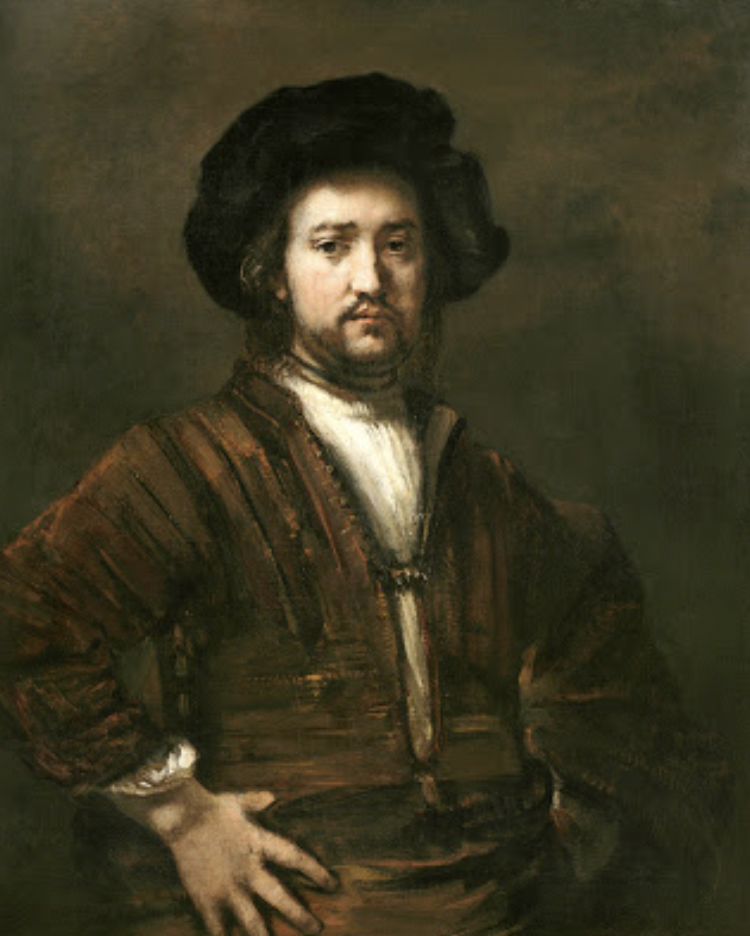
Rembrandt, “Portrait of a Man with Arms Akimbo,” 1658.

The Otto Naumann Limited gallery describes Rembrandt’s “Portrait of a Man with Akimbo” exquisitely on their website.  They write:

“Rembrandt’s Portrait of a Man dated 1658 is one of the last works from his late career left in private hands and also one of the master’s least known paintings.  A boldly conceived work painted in his most assured and painterly later manner, it depicts the sitter frontally and three quarter length with arms akimbo. The unidentified sitter meets the viewer’s gaze with a steady and confident expression, bordering on defiance.”

The gallery notes that “the provenance of the painting is notable.”  “Notable” is an understatement.  “Portrait of a Man with Arms Akimbo” has a sale history worthy of a novel.  Otto Naumann Ltd. traces the sale history of the painting back to 1798, but the provenance becomes juicy in 1939 when Huntington Hartford II, the A & P supermarket heir, purchased the painting.  In 1955, he donated the painting to Columbia University.

April 23, 1968– Columbia University students occupied five university buildings for
one weeks to protest to the Vietnam War; 712 students were arrested and over 100
injured during a police scuffle.  The students, however, guarded the Rembrandt
hanging above the university president’s desk.

At Columbia, the painting became famous in 1968 when Vietnam War protesters protected the painting, on display above the university president’s desk.  Following the protest, the painting was put into storage for safe keeping.  In stayed there, somewhere in the basement lairs of Columbia, until 1975 when it was “secretly” sold to J. Seward Johnson, son of the founder of Johnson & Johnson, for $1 million.  When The New York Times uncovered the sale, Columbia officially stated: “Columbia feels this is an appropriate time to transform the painting into an income-producing asset by adding the proceeds of its sale to the university’s endowment.”

Upon his death in 1983, Johnson’s third wife, Barbara Piasecka Johnson, inherited the painting.  The painting never appeared publicly while the Johnson’s owned the work.  The painting remained out of sight for 41 years: from 1968, when the Vietnam War protesters saved the priceless cultural icon until 2009, when Ms. Johnson sold the painting at Christie’s London.

The 2009 Christie’s sale was teeth clenching.  According to Carol Vogel’s New York Times report, Otto Naumann and Alfred Bader, a Milwaukee art collector, worked out a plan to purchase the painting jointly.  Vogel claims that the pair prepared to spend $40.3 million with a deal from Christie’s for extended terms of repayment.  But, on the day of the sale Christie’s withdrew the extended payment plan, possibly with some inside information.  This left Naumann and Bader high and dry.

Steven Wynn in front of one of
his prized painting.

When the hammer fell, the final bid was $33.2 million including Christie’s fees.  The winner: Steven Wynn, Las Vegas casino mogul and flamboyant collector.  The price set a new record for Rembrandt.

The painting is now back on the market.  It was unsuccessfully offered for sale at the European Art Fair in Maastricht for $47 million.  And now, the painting is publicly for sale at Otto Naumann Ltd.

The change of hands has created a firestorm.  Particularly between Jon Weiner of The Nation and Judith H. Dobrznski of Real Clear Arts.  Mr. Weiner labels Columbia as “barbarians” and “foolish” for selling the Rembrandt for pittance in 1975 when it is now offered for sale in the $47 million range.  He stated: “All Columbia undergrads were, and still are, required to take Art Humanities, a survey of masterpieces of Western art, including Rembrandt.  The purpose is to instill a respect for this great tradition.  Apparently that respect was not shared by the Columbia administration.”  Mr. Weiner uses the Columbia transaction as an example to prove that the sale of artwork by university’s is always a bad idea, referencing the scandal that surrounded the Rose Museum at Brandeis University.

Ms. Dobrznski responded quickly the next day writing that “Weiner looks a bit foolish himself.”  She continues: “Did Columbia make a bad deal?  Perhaps.  But I’d have to see what other Rembrandts were selling for in 1974– comparables are what counts, not current prices.  More important, as far as I can tell from his story, Columbia’s tale has little relevance to other colleges or universities, with art museums, and deaccessioning.  Rather than shed light, Wiener has simply confused the issue.  The issue needs light, not heat.”

Whether you believe that it was morally wrong for Columbia University to sell the painting, or that they were cheated with the $1 million sale, this story reminds us that art is a commodity to be bought, sold, and traded.  Art is an “income producing asset,” as Columbia stated in 1975, no matter the circumstances.

Sources: Otto Naumann Ltd.; Carol Vogel, “Casino Chief Said to Own Rembrandt,” The New York Times, December 19, 2009; Jon Weiner, “When Universities Sell Art: The Case of Columbia’s Rembrandt,” The Nation, January 21, 2013; Judith H. Dobrzynski, “Columbia University’s Big Mistake? Or Misconceptions about Deaccessioning?” Real Clear Arts, January 22, 2013.

Disclaimer: This article is for educational purposes only and is not meant to provide legal advice. Readers should not construe or rely on any comment or statement in this article as legal advice. For legal advice, readers should seek a consultation with an attorney.

Post navigation

Previous Three Suspects Arrested in Relation to the Kunsthal Museum Theft, Yet Paintings Remain MIA
Next U.S. Court of Appeals hears arguments regarding stolen Herzog artworks

Related Posts

A Museum in the Making: The Guggenheim Abu Dhabi

March 19, 2011
logo

Attention all Art Buyers – Caveat Emptor and then Emptor some more!

July 23, 2014

Google Goggles & Getty

July 2, 2011
Center for Art Law
A Gift for You

A Gift for You

this Holiday Season

Celebrate the holidays with 20% off your annual subscription — claim your gift now!


Get your Subscription Today!
Guidelines AI and Art Authentication

AI and Art Authentication

Explore the new Guidelines for AI and Art Authentication for the responsible, ethical, and transparent use of artificial intelligence.

Download here
Center for Art Law

Follow us on Instagram for the latest in Art Law!

Did you know that Charles Dickens visited America Did you know that Charles Dickens visited America twice, in 1842 and in 1867? In between, he wrote his famous “A Tale of Two Cities,” foreshadowing upheavals and revolutions and suggesting that individual acts of compassion, love, and sacrifice can break cycles of injustice. With competing demands and obligations, finding time to read books in the second quarter of the 21st century might get increasingly harder. As we live in the best and worst of times again, try to enjoy the season of light and a good book (or a good newsletter).

From all of us at the Center for Art Law, we wish you peace, love, and understanding this holiday season. 

🔗 Read more by clicking the link in our bio!

#centerforartlaw #artlaw #legalresearch #artlawyer #december #newsletter #lawyer
Is it, or isn’t it, Vermeer? Trouble spotting fake Is it, or isn’t it, Vermeer? Trouble spotting fakes? You are not alone. Donate to the Center for Art Law, we are the real deal. 

🔗 Click the link in our bio to donate today!

#centerforartlaw #artlaw #legalresearch #endofyear #givingtuesday #donate #notacrime #framingartlaw
Whether legal systems are ready or not, artificial Whether legal systems are ready or not, artificial intelligence is making its way into the courtroom. AI-generated evidence is becoming increasingly common, but many legal professionals are concerned that existing legal frameworks aren't sufficient to account for ethical dilemmas arising from the technology. 

To learn more about the ethical arguments surrounding AI-generated evidence, and what measures the US judiciary is taking to respond, read our new article by Rebecca Bennett. 

🔗 Click the link in our bio to read more!

#centerforartlaw #artlaw #legalresearch #artlawyer #lawyer #aiart #courtissues #courts #generativeai #aievidence
Interested in the world of art restitution? Hear f Interested in the world of art restitution? Hear from our Lead Researcher of the Nazi-Era Looted Art Database, Amanda Buonaiuto, about the many accomplishments this year and our continuing goals in this space. We would love the chance to do even more amazing work, your donations can give us this opportunity! 

Please check out the database and the many recordings of online events we have regarding the showcase on our website.

Help us reach our end of year fundraising goal of $35K.

🔗 Click the link in our bio to donate ❤️🖤
Make sure to grab your tickets for our discussion Make sure to grab your tickets for our discussion on the legal challenges and considerations facing General Counsels at leading museums, auction houses, and galleries on December 17. Tune in to get insight into how legal departments navigate the complex and evolving art world.

The panel, featuring Cindy Caplan, General Counsel, The Jewish Museum, Jason Pollack, Senior Vice President, General Counsel, Americas, Christie’s and Halie Klein, General Counsel, Pace Gallery, will address a range of pressing issues, from the balancing of legal risk management with institutional missions, combined with the need to supervise a variety of legal issues, from employment law to real estate law. The conversation will also explore the unique role General Counsels play in shaping institutional policy.

This is a CLE Event. 1 Credit for Professional Practice Pending Approval.

🎟️ Make sure to grab your tickets using the link in our bio! 

#centerforartlaw #artlaw #legalresearch #generalcounsel #museumissues #artauctions #artgallery #artlawyer #CLE
While arts funding is perpetually scarce, cultural While arts funding is perpetually scarce, cultural heritage institutions particularly struggle during and after armed conflict. In such circumstances, funds from a variety of sources including NGOs, international organizations, national and regional institutions, and private funds all play a crucial role in protecting cultural heritage. 

Read our new article by Andrew Dearman to learn more about the organizations funding emergency cultural heritage protection in the face of armed conflict, as well as the factors hindering effective responses. 

🔗 Click the link in our bio to read more! 

#centerforartlaw #artlaw #legalresearch #lawyer #artlawyer #culturalheritage #armedconflict #UNESCO
Join the Center for Art Law in welcoming Attorney Join the Center for Art Law in welcoming Attorney and Art Business Consultant Richard Lehun as our keynote speaker for our upcoming Artist Dealer Relationships Clinic. 

The Artist-Dealer Relationships Clinic helps artists and gallerists negotiate effective and mutually-beneficial contracts. By connecting artists and dealers to attorneys, this Clinic looks to forge meaningful relations and to provide a platform for artists and dealers to learn about the laws that govern their relationship, as well as have their questions addressed by experts in the field.

After a short lecture, attendees with consultation tickets will be paired with a volunteer attorney for a confidential 20-minute consultation. Limited slots are available for the consultation sessions.
Today we held our last advisory meeting of the yea Today we held our last advisory meeting of the year, a hybrid, and a good wrap to a busy season. What do you think we discussed?
We are incredibly grateful to our network of attor We are incredibly grateful to our network of attorneys who generously volunteer for our clinics! We could not do it without them! 

Next week, join the Center for Art Law for our Artist-Dealer Relationships Clinic. This clinic is focused on helping artists navigate and understand contracts with galleries and art dealers. After a short lecture, attendees with consultation tickets will be paired with one of the Center's volunteer attorneys for a confidential 20-minute consultation. Limited slots are available for the consultation sessions.
'twas cold and still in Brooklyn last night and no 'twas cold and still in Brooklyn last night and not a creature was stirring except for dog walkers and their walkees... And then we reached 7,000 followers!
Don't miss this chance to learn more about the lat Don't miss this chance to learn more about the latest developments in the restitution of Nazi-looted art. Tune in on December 15th at noon ET to hear from our panel members Amanda Buonaiuto, Peter J. Toren, Olaf S. Ossmann, Laurel Zuckerman, and Lilah Aubrey. The will be discussing updates from the HEAR act, it's implications in the U.S., modifications from the German Commission, and the use of digital tools and data to advance restitution research and claims. 

🎟️ Click the link in our bio to get tickets!
Making news is easy. Solving art crimes is hard. R Making news is easy. Solving art crimes is hard. Running a nonprofit is even harder.

Donate to the Center for Art Law to help us meet our year end goal! 

🔗 Click the link in our bio to donate today!
  • About the Center
  • Contact Us
  • Newsletter
  • Upcoming Events
  • Internship
  • Case Law Database
  • Log in
  • Become a Member
  • Donate
DISCLAIMER

Center for Art Law is a New York State non-profit fully qualified under provision 501(c)(3)
of the Internal Revenue Code.

The Center does not provide legal representation. Information available on this website is
purely for educational purposes only and should not be construed as legal advice.

TERMS OF USE AND PRIVACY POLICY

Your use of the Site (as defined below) constitutes your consent to this Agreement. Please
read our Terms of Use and Privacy Policy carefully.

© 2025 Center for Art Law