
25 Years of the Washington Principles: The Strides and Stumbles in Reclaiming Nazi-Confiscated Art
October 30, 2023
By Madeline Halgren
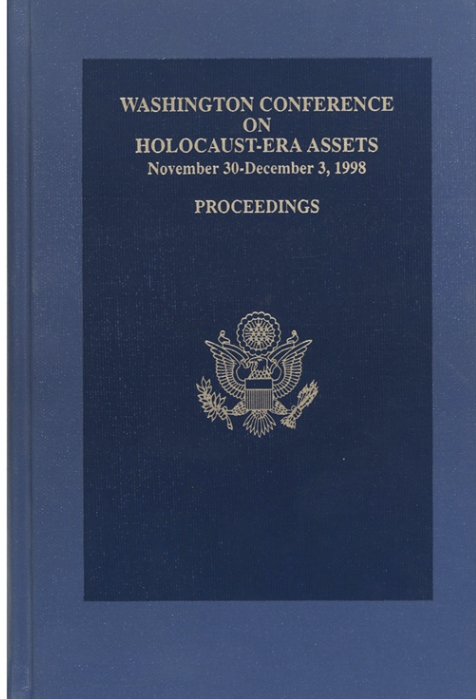
This year marks the 25th anniversary of the adoption of the Washington Principles at the Washington Conference on Holocaust-Era Assets. To put this into perspective, that is only a quarter of a century where countries have been urged through a written agreement to recover and return art and other cultural artifacts to those whose ancestors suffered Nazi persecution. This leaves a 53-year gap between their enactment and the fall of the Third Reich. In May of 1945, hundreds of thousands of pieces of work were discovered and restituted to their countries of origin. However, thousands of rightful owners could not be found.[1] It was not until 1998 that many nations decided to make a joint and pragmatic effort to ensure more Nazi-looted works were making their way to their rightful owners. Due to the encouragement of the Washington Principles, the efforts to recover art looted from private and public collections across the globe have grown exponentially.
Just looking at the efforts in 2023 is insightful: In January 2023, Christie’s announced a Year Long Global Programme in honor of the anniversary of the Principles.[2] They have been hosting various events, including a panel on the Washington Principles at Christie’s Paris in January and a discussion on provenance research at Christie’s London, this past summer. At the same time, Christie’s has come under fire for their decision to auction a jewelry collection from the estate of a woman whose husband had Nazi Affiliation.[3] Sotheby’s has also continued its partnership with the Louvre to fund provenance research to uncover whether almost 14,000 works were looted during the Nazi era.[4] In the Decorative Arts Department alone, 1,162 works have been researched, with most turning out to have clear provenances, but there is much work to be done within and outside this small sector of the museum.[5]
In reflecting on the creation of the Washington Principles and what their enactment has been able to do for the reclamation of art, concerns regarding provenance and ownership are brought into the limelight broaching the question – how does one ensure the rightful owner of a work is properly compensated? What efforts are (and are not) being made to shed light on the gaps in a work’s provenance and what implications does this have for the success of restitution efforts?
Before the Principles
Although the Washington Principles were an important stride in codifying standards for restitution efforts, individuals brought claims to reclaim Nazi-looted art long before their enactment. Menzel v. List, 24 N.Y.2d 91, (1969), was the first restitution case of its kind in the United States and brought forward important legal questions about the nuances of ownership and statute of limitations as they relate to matters of looted art. In the case, Erna Menzel brought suit in New York to recover a painting by Marc Chagall that was seized from her family’s apartment in Brussels while fleeing from the Nazis.

Questions at law regarding abandonment, seizure, the statute of limitations, and the United States State Doctrine were all considered with the court eventually finding Menzel the rightful owner, as List was never conveyed proper title to the work.[6] The case has been referred to as a “classic legal domino game” involving proper transfer of title and claims of ownership.[7]
While the Menzel case was satisfying in its outcome and shed light on restitution issues, there were still gaps to be filled to unify the standards for restitution efforts and help other rightful owners regain their property.[8]
Establishing the Washington Principles
The Washington Principles were formulated in early December 1998 when representatives from 44 countries, NGO representatives, and art market observers came together in Washington D.C. for the Washington Conference on Holocaust-Era Assets.[9] The principles set out 11 guidelines to address how Nazi-stolen property could be returned to their rightful owners.
The Principles define stolen property as artwork as well as books, writings, antiquities, and jewelry. The Principles encourage governments to resolve issues of stolen property by keeping an open record and archive of stolen works, publicizing art that has been found to have been confiscated by the Nazis to locate pre-War owners, and taking steps to achieve a just and fair solution for heirs of Nazi-looted artwork.[10]
One defect in the Principles’ efficacy is the fact that the agreement is non-binding. Although 44 countries have signed onto the principles, it is not mandatory that they follow the guidelines. The principles function as mere suggestions, and it is out of a signatory’s own good-faith efforts to implement practices in line with these principles.
Since the adoption of the principles, there has been a rise in transparency in provenance research findings and publicizing works found to have been looted. Five countries – Austria, France, Germany, the Netherlands, and the United Kingdom – have established national commissions to research works of art in public collections and facilitate restitution.[11] Further, private institutions in the United States, like the American Alliance of Museums (AAM), have established ethics codes regarding research and donations. Specifically, the AAM has a website – Nazi-Era Provenance Portal – listing 30,000 objects that transferred hands in Europe between 1933 and 1945 across 179 museums.[12] Another resource is the Association of Art Museum Directors, which provides an online registry for Nazi-Era Cultural Assets where one can see various works known to have been confiscated during the Nazi era and which museum they are currently housed at.[13]
However, some within the art industry believe the Principles have been completely ineffectual due to their scope centering too much on “museum-quality masterpieces,” non-binding quality, and focus on public appearance rather than the actual work of restitution.[14]
Private Efforts
In addition, slowly but surely, efforts in line with the Washington Principles are being made by privately owned players in the art market, in part responding to the growing demands for due diligence and complete provenance information, such as the leading auction houses, Christie’s and Sotheby’s.
Aside from the 25th Anniversary events, Christie’s Restitution Department, whose website states it “support[s] the resolution of restitution claims for consigned artworks – advocating in the spirit of the Washington Principles, for fair and amicable solutions,” engages in detailed provenance research to vet artworks being offered at auction.[15] Similarly, Sotheby’s Restitution Department works as noted working with provenance specialists to vet all works sold through them and regards the Washington Principles as their guide.
At the same time, both houses have been subject to various lawsuits regarding the selling of looted art. As recent as this past May, Sotheby’s was sued in regards to the 2019 sale of a Giovanni Battista Tiepolo painting.[16] The Plaintiff’s are heirs to a Jewish Art Gallery whose original owner fled Austria in 1938 and argue they only became aware of the painting’s whereabouts after the sale and that Sotheby’s provenance was “misleading.”[17]
Moreover, in June 2022, Christie’s was sued for the 2005 sale of The Penitent Magdalene by Adriaen van der Werff.[18] The owner approached Christie’s to sell the painting in 2017.[19] During this time, they traced the work back to Lionel Hauser who had 40 works of art seized by the Nazis from his home in 1942.[20] Christie’s informed him of the work’s current location and offered to split proceeds from the 2017 sale, but refused to return the work.[21] Hauser brought suit against Christie’s in French Court.[22] Ultimately, this past winter, the French Court ordered Christie’s to return the work.[23]
Despite these institutions engaging in restitution work, there are still many instances of misleading provenances or evasiveness in the restitution process as illustrated by recent suits against the two auction houses. Beyond continuing legal conflicts, the difficulties of provenance research and chain of title gaps still plague the reclamation process for many works.
Journey to Find the One True Owner
In a recent case, a German auction house, Neumeister, was preparing to sell a work by painter Frans Francken the Younger titled Sermon on the Mount. However, the auction house reached an impasse in its provenance research.[24] The question then became: what if the rightful heirs to art likely looted by the Nazis cannot be identified or found even when the work is known to have been looted?[25]

The provenance of the painting underwent years of research to no avail. One issue is the difficulty of tracing heirs from the Holocaust, as many direct heirs did not survive or relatives are so distant they do not know of their ancestor’s prior possessions.[26] The latter are often deemed “laughing heirs” because they are so distant from the decedent that they did not know or suffer from the loss. Many states in the U.S. have barred laughing heirs from taking property from distant relatives, but the issue is still an open matter. Should this concept then apply to Nazi-looted art? Should the true owner be a more direct descendant? Or should restitution efforts apply to even those seemingly unaffected?
It is also common practice that many dealers are unwilling to share the identity of those they sell to, which makes things much more difficult for provenance research.[27]
Further, provenance work is very expensive and many smaller galleries and private owners do not have the resources to look into art they own or are selling. Some animosity has been building between those in the art business and state institutions – specifically the German government. Katrin Stoll, owner and manager of Neumeister auction house, who came to acquire the Sermon on the Mount, expressed her view of the government of Berlin as “responsible as the successor to the Nazi regime…[and] they cannot expect us to do all this privately.”[28] Other scholars on provenance research have expressed similar sentiments, calling for public museums to buy the paintings and continue the research.[29]
The proposition to keep the artworks in public museums not only places the work in a place more capable of receiving the funding for the research but also keeps the work in the public eye – capable of being recognized by a potential rightful owner rather than getting lost in confidential private sales.
Looking Forward
While the Washington Principles have been effective at increasing public awareness as well as the transparency and publicity of many works of Nazi-looted art, the non-binding characteristic of the principles remains a hurdle to implementation. Additionally, while large, privately funded auction houses are able to engage in in-depth provenance research, many smaller art collectors and galleries are left without the resources to engage in restitution efforts fully. As restitution cases continue to take the spotlight in the news, it is reasonable to consider whether public institutions and governments should be required to play a bigger monetary role in ensuring Nazi-looted art returns home.
Beyond the guidelines themselves and their efficacy, incredibly nuanced legal issues have come to the surface regarding who can be considered a rightful heir, whether the statute of limitations can be extended for these heirs, and whether the claim is in the proper jurisdiction.
Further, how far can restitution go? While the Washington Principles and many restitution efforts hone in on Nazi-looted art and artifacts, the Nazis were not the only ones in history to have engaged in such thievery. Can and will restitution efforts be extended to other atrocities? It is hard to say as there are still roadblocks in place to reclaim just Nazi-stolen works.
Overall, the legal landscape for restitution has caught the public eye with more and more cases being publicized and more and more art returning home. The uptick in restitution efforts has had many positive outcomes which hopefully will continue in the future.
Suggested Reading and Resources:
- Washington Conference Principles on Nazi-Confiscated Art – United States Department of State, U.S. Department of State (2020), https://www.state.gov/washington-conference-principles-on-nazi-confiscated-art/
- Catherine Hickley, A painting looted at least once, from Hitler, is on the block The New York Times (2023), https://www.nytimes.com/2023/09/04/arts/design/a-painting-looted-at-least-once-from-hitler-is-on-the-block.html
- Reflecting on restitution: 25 years of the Washington Principles on Nazi confiscated art, Christie’s (2023), https://www.christies.com/events/reflecting-on-restitution-25-years-of-the-washington-principles/about?add_lang=en
- Zachary Small, Nazi cloud hangs over one of the largest jewelry sales in history The New York Times (2023), https://www.nytimes.com/2023/04/27/arts/design/heidi-horten-jewelry-christies-nazi-era.html
- Aurore Laborie, One family’s battle to be reunited with art looted by the Nazis CNN (2023), https://www.cnn.com/style/gimpel-family-art-restitution-france-nazis
- Resolutions of claims for nazi-era cultural assets, Association of Art Museum Directors, https://aamd.org/object-registry/resolution-of-claims-for-nazi-era-cultural-assets/browse
About the Author:
Madeline Halgren is a third-year law student at Loyola University Chicago School of Law. She studied Foreign Affairs and Public Policy at the University of Virginia and has developed a legal interest in how international law interacts with art and other intellectual property issues.
Sources and Citations:
- Holocaust restitution: Recovering stolen art, Recovering Stolen Art from the Holocaust, https://www.jewishvirtuallibrary.org/recovering-stolen-art-from-the-holocaust (last visited Oct 4, 2023). ↑
- Reflecting on restitution: 25 years of the Washington Principles on Nazi confiscated art, Christie’s (2023), https://www.christies.com/events/reflecting-on-restitution-25-years-of-the-washington-principles/about?add_lang=en (last visited Oct 4, 2023). ↑
- Zachary Small, Nazi cloud hangs over one of the largest jewelry sales in history The New York Times (2023), https://www.nytimes.com/2023/04/27/arts/design/heidi-horten-jewelry-christies-nazi-era.html (last visited Oct 4, 2023). ↑
- Sarah Hugounenq, Uncovering lost histories in partnership with the Louvre Sothebys.com (2023), https://www.sothebys.com/en/articles/uncovering-lost-histories-in-partnership-with-the-louvre (last visited Oct 5, 2023). ↑
- Ibid. ↑
- Anne-Marie Rhodes, Art Law and Transactions 181-188 Second Edition (2021). (The New York Court of Appeals adopted the more liberal “demand and refusal” standard for statute of limitations where the time does not run until the claimant demands the item’s return and it is refused versus the discovery standard which dictates that a claim for stolen work begins when the work is known to have been stolen. Further, The United States State Doctrine bars the Judicial Branch from examining the validity of a taking of property within its own territory by a sovereign government. However, the Court found that at the time of the taking, it did not fulfill the elements to preclude the U.S. Judiciary from examining the case). ↑
- Daniel Grant, Collecting art? beware the wrinkles The New York Times (1987), https://www.nytimes.com/1987/11/29/business/personal-finance-collecting-art-beware-the-wrinkles.html (last visited Oct 4, 2023). ↑
- For further information, see in depth discussion of Hickenlooper Amendment and Act of State Doctrine not discussed here: https://lawecommons.luc.edu/cgi/viewcontent.cgi?article=2453&context=luclj. ↑
- Reflecting on restitution: 25 years of the Washington Principles on Nazi confiscated art, Christie’s (2023), https://www.christies.com/events/reflecting-on-restitution-25-years-of-the-washington-principles/about?add_lang=en (last visited Oct 4, 2023). ↑
- Washington Conference principles on nazi-confiscated art – united states department of state, U.S. Department of State (2020), https://www.state.gov/washington-conference-principles-on-nazi-confiscated-art/ (last visited Oct 4, 2023). ↑
- Elizabeth Campbell, The washington principles 20 years later: Some progress but not enough Arts, Humanities & Social Sciences (2019), https://liberalarts.du.edu/art-collection-ethics/news-events/all-articles/washington-principles-20-years-later-some-progress-not-enough (last visited Oct 4, 2023). ↑
- Elizabeth Campbell, The washington principles 20 years later: Some progress but not enough Arts, Humanities & Social Sciences (2019), https://liberalarts.du.edu/art-collection-ethics/news-events/all-articles/washington-principles-20-years-later-some-progress-not-enough (last visited Oct 4, 2023). ↑
- Resolutions of claims for nazi-era cultural assets, Association of Art Museum Directors, https://aamd.org/object-registry/resolution-of-claims-for-nazi-era-cultural-assets/browse (last visited Oct 4, 2023). ↑
- Noah Charney, 20 years on, it’s time to admit our rules for handling Nazi-looted art have failed Observer (2018), https://observer.com/2018/11/washington-principles-nazi-looted-art-failed-what-went-wrong/ (last visited Oct 4, 2023). ↑
- Reclaiming lost history anniversary of the washington principles 12612, Christie’s (2023), https://www.christies.com/en/stories/reclaiming-lost-history-25-years-of-the-washington-b3cde6088c1c4acd81b4c2e65262081b (last visited Oct 4, 2023). ↑
- Colin Moynihan, Sotheby’s Provenance Disputed in Claim by Heirs for Art Lost in Nazi Era (2023), https://www.nytimes.com/2023/05/19/arts/design/sothebys-provenance-nazi-art.html (last visited Oct 24, 2023). ↑
- Ibid. ↑
- Sarah Cascone. A French Court Has Ordered Christie’s to Restitute an Adriaen Van Der Werff Painting That Was Stolen During World War II (2023), https://news.artnet.com/art-world/french-court-orders-restitution-of-adriaen-van-der-werff-nazi-looted-painting-christies-2249849 (last visited Oct 24, 2023). ↑
- Ibid. ↑
- Ibid. ↑
- Ibid. ↑
- Ibid. ↑
- Ibid. ↑
- Catherine Hickley, A painting looted at least once, from Hitler, is on the block The New York Times (2023), https://www.nytimes.com/2023/09/04/arts/design/a-painting-looted-at-least-once-from-hitler-is-on-the-block.html (last visited Oct 4, 2023). ↑
- Ibid. ↑
- Catherine Hickley, A painting looted at least once, from Hitler, is on the block The New York Times (2023), https://www.nytimes.com/2023/09/04/arts/design/a-painting-looted-at-least-once-from-hitler-is-on-the-block.html (last visited Oct 4, 2023).. ↑
- Ibid. ↑
- Ibid. ↑
- Ibid. ↑
Disclaimer: This article is for educational purposes only and is not meant to provide legal advice. Readers should not construe or rely on any comment or statement in this article as legal advice. For legal advice, readers should seek a consultation with an attorney.


You must be logged in to post a comment.