• About
    • Mission
    • Team
    • Boards
    • Mentions & Testimonials
    • Institutional Recognition
    • Annual Reports
    • Current & Past Sponsors
    • Contact Us
  • Resources
    • Article Collection
    • Podcast: Art in Brief
    • AML and the Art Market
    • AI and Art Authentication
    • Newsletter
      • Subscribe
      • Archives
      • In Brief
    • Art Law Library
    • Movies
    • Nazi-looted Art Restitution Database
    • Global Network
      • Courses and Programs
      • Artists’ Assistance
      • Bar Associations
      • Legal Sources
      • Law Firms
      • Student Societies
      • Research Institutions
    • Additional resources
      • The “Interview” Project
  • Events
    • Worldwide Calendar
    • Our Events
      • All Events
      • Annual Conferences
        • 2026 Art Law Conference
        • 2025 Art Law Conference
        • 2024 Art Law Conference
        • 2023 Art Law Conference
        • 2022 Art Law Conference
        • 2015 Art Law Conference
  • Programs
    • Visual Artists’ Legal Clinics
      • Art & Copyright Law Clinic
      • Artist-Dealer Relationships Clinic
      • Artist Legacy and Estate Planning Clinic
      • Visual Artists’ Immigration Clinic
    • Summer School
      • 2026
      • 2025
    • Internship and Fellowship
    • Judith Bresler Fellowship
  • Case Law Database
  • Log in
  • Become a Member
  • Donate
  • Log in
  • Become a Member
  • Donate
Center for Art Law
  • About
    About
    • Mission
    • Team
    • Boards
    • Mentions & Testimonials
    • Institutional Recognition
    • Annual Reports
    • Current & Past Sponsors
    • Contact Us
  • Resources
    Resources
    • Article Collection
    • Podcast: Art in Brief
    • AML and the Art Market
    • AI and Art Authentication
    • Newsletter
      Newsletter
      • Subscribe
      • Archives
      • In Brief
    • Art Law Library
    • Movies
    • Nazi-looted Art Restitution Database
    • Global Network
      Global Network
      • Courses and Programs
      • Artists’ Assistance
      • Bar Associations
      • Legal Sources
      • Law Firms
      • Student Societies
      • Research Institutions
    • Additional resources
      Additional resources
      • The “Interview” Project
  • Events
    Events
    • Worldwide Calendar
    • Our Events
      Our Events
      • All Events
      • Annual Conferences
        Annual Conferences
        • 2026 Art Law Conference
        • 2025 Art Law Conference
        • 2024 Art Law Conference
        • 2023 Art Law Conference
        • 2022 Art Law Conference
        • 2015 Art Law Conference
  • Programs
    Programs
    • Visual Artists’ Legal Clinics
      Visual Artists’ Legal Clinics
      • Art & Copyright Law Clinic
      • Artist-Dealer Relationships Clinic
      • Artist Legacy and Estate Planning Clinic
      • Visual Artists’ Immigration Clinic
    • Summer School
      Summer School
      • 2026
      • 2025
    • Internship and Fellowship
    • Judith Bresler Fellowship
  • Case Law Database
Home image/svg+xml 2021 Timothée Giet Art law image/svg+xml 2021 Timothée Giet A Case for Law as an Artistic Medium
Back

A Case for Law as an Artistic Medium

December 28, 2017

logo

By Caroline I. Keegan.

The contemporary art industry and the legal community differ notably in their conceptions of art. The two worlds do not agree on what art is, a disagreement that causes some artwork to have no legal protections, while giving a legal pass to other artists to create works the art world may wish would be disbanded. At the intersection of art and law, artists find inspiration and new ways to express themselves using law as their tool.

The legal world’s conception of “visual art” is spelled out by the U.S. Copyright Act and is both a traditionalist and reductionist take on the subject:

A “work of visual art” is—

(1) a painting, drawing, print or sculpture, existing in a single copy, in a limited edition of 200 copies or fewer that are signed and consecutively numbered by the author, or, in the case of a sculpture, in multiple cast, carved, or fabricated sculptures of 200 or fewer that are consecutively numbered by the author and bear the signature or other identifying mark of the author; or

(2) a still photographic image produced for exhibition purposes only, existing in a single copy that is signed by the author, or in a limited edition of 200 copies or fewer that are signed and consecutively numbered by the author.;…

Moreover, copyright protection extends to a narrower subset, “original works of authorship fixed in any tangible medium of expression…” This reductionist idea of art was not invented by the courts; it is reflective of a very traditional view of art and authorship.

Many artists find this legal definition of art, embodied in U.S. copyright law, problematic. In response, there exists works that challenge that conception. Some of these artists have incorporated legal discourse surrounding their work into the medium. Other artists use carve- outs in the law to receive legal “permission” to create their controversial works. Others have exhibited literal legal documents as artwork. Following is select examples of artworks created with law as the material.

Law Provides a Platform for Artworks

Certain artists use law in their works as a platform to question traditional views of authorship and originality also expressed in copyright law. In the 1960’s, normative definitions of art began to crumble and artists began to re-interpret the essence of art. Then and now, appropriation artists would copy the visual aspects of a preexisting work to express ideas about ownership and authorship or, in the case of parody, often about the prior work specifically.  Many of these works, arguably intentionally, found their way into court, forcing viewers to give affirmative opinions as to whether they constituted art.

Art historian Arthur Danto presents an excellent example of this idea; a dancer performs a dance move that mirrors someone ironing a skirt. What happens is that ironing a skirt is what the dancer’s movements mean, that is what is embodied in the movements. This is not the case when someone irons a skirt, the action of ironing a skirt is performed to free a skirt of wrinkles and that is not what the dancer did. The dance piece, although entirely imitative, is an independent piece of artwork (aesthetic or intrinsic quality irrelevant).

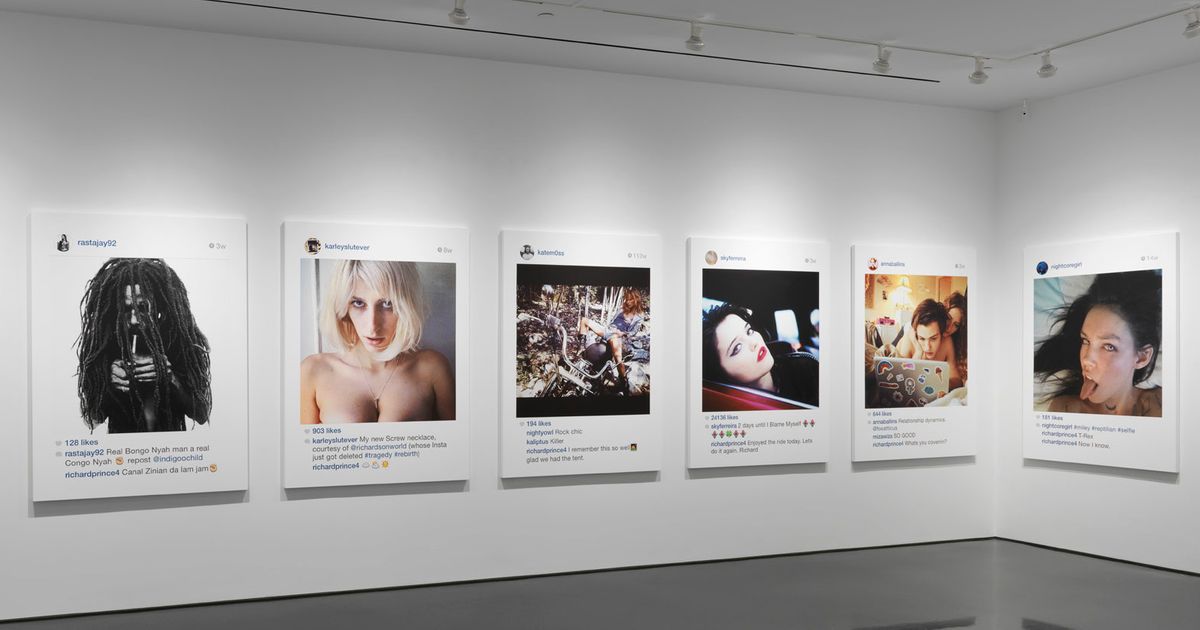
Many appropriation artists use judicial structure as their one of their artistic mediums. At the forefront of this is Richard Prince. After being party to a number of law suits, think Canal Zone series, and having well-known art law counsel, it is fair to assume Prince is well aware of the legal line his work pushes (and occasionally crosses). Reaching record numbers at auction, it is also safe to assume Prince is able to afford licensing agreements to avoid such litigation. It appears artists like Prince knowingly invite the law into their studios, embracing it as part of the process and a crucial layer to the pieces. Years after Prince’s first copyright dispute in a courtroom setting, in 2015, Prince added comments to other people’s Instagram posts, took screenshots of the photos with his comments underneath, enlarged them, and sold them for hundreds of thousands of dollars.

Screen Shot 2017-12-28 at 10.14.37 AM.png
Richard Prince,“New Portraits” (2015)

Patent attorney, John Arsenault, has already looked over the potential legal issues explained: “although it looks like a case of outright plagiarism, [it] might be a little more complex if it were argued in a legal context. When I first saw it, I thought it was cut and dry, but then I looked again and saw what was captured specifically, and the commentary under it, then it creates a question. A silly question, especially given that he has sold these for money, but there you go.” This “question” Arsenault is referring to is the crux of Prince’s work, and the reason the law plays such an important role in forcing answers. The question here is, of course, what constitutes originality and who is an author.

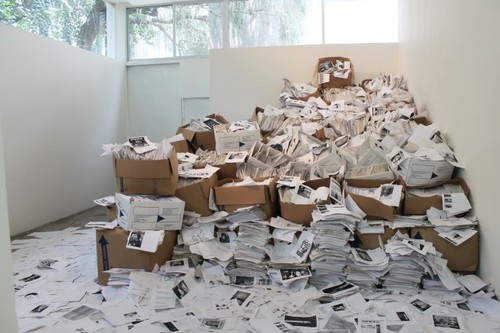
Kenneth Goldsmith, a poet and conceptual artist, is likewise completely engaged in the question of authorship and originality. Goldsmith’s poetry is a decree against copyright, the legal boundaries placed on appropriation, and the judicial view of “originality.” He prefaces his work by declaring that he has no restrictions on his work, he celebrates the copying and sharing of his poetry. Goldsmith highlights that restriction on the dissemination of work harms the longevity of its existence, and advocates for greater access and sharing of artistic ideas than the law allows. Goldsmith posted a link on his own Facebook to a copy of one of his poetry books that had been translated into Spanish and shared online; he commented “Lovely to see my book pirated in Spanish. #freeculture.” Goldsmith’s works are described as better thought about than read as the base of his poetry is directly copied from various unauthorized sources, often creating absolutely mundane and simultaneously provocative art. For instance, one piece that received much attention was “Printing out the Internet” where Goldsmith asked his online audience to print out pages from the internet and send them to a specific gallery. Goldsmith puts it, “context is the new content.”
Screen Shot 2017-12-28 at 10.17.55 AM
Kenneth Goldsmith, “Printing out the Internet” (2013)

Utilizing a legal platform as a medium to re-negotiate an existing piece of work provokes established categories. These artists portend the end of traditional (and legal) views of art by rejecting the crux of it: originality, ownership, and authenticity.

When Law Protects Creation

In some instances, laws protect artists that create work objectionable in the art world, for example, because other artist’s works are mocked in the process. We know these works as parody. The law addresses parodic works in the Fair Use doctrine, section 107 of the Copyright Act, which reads: “the fair use of a copyrighted work, including such use by reproduction in…for purposes such as criticism, comment…is not an infringement of copyright.” This is accompanied by a four factor test to determining if a work falls into this caveat.

Jeff Koons is often seen as a seminal example of an artist who is well aware of how the law will play a role in his parodic art. Koons now employs lawyers before, during, and after the creation of his works to evaluate the legality of each step of his process, allowing him to incorporate the judicial system into his process. Koons argued in his affidavit in Rogers v. Koons, a case in which another artist accused Koons of copyright infringment,that “my paintings are not about objects or images that I might invent, but rather about how we relate to things that we actually experience…Therefore, in order to make statements about contemporary society and in order for the artwork to be valid, I must use images from the real world. I must present real things that are actually in our mass consciousness”. Koons has a necessity of referencing existing material to create his work, and he is able to use the law to protect such work.

Nathan Fielder, writer and comedian, likewise utilizes the law in his work for parodic effect. Fielder uses legal loopholes as the essence of his work. His most momentous piece that exemplifies law-as-medium is “Dumb Starbucks”. Through the first part of Fielder’s video piece he speaks to a lawyer about parody law, and begins working on an art piece that would mimic an entire Starbucks store, placing “dumb” in front of every drink title, logo, and retail item in the mock store. Despite the inherent risk in appropriating existing art works, artists such as Fielder and Koons educate themselves on the judicial issues of their work and the evidence suggests they embrace them as part of their work.  

Law to Subvert

In a 2017 video piece, “Shipping Logistics Company,” Fielder attempts to avoid import tax law concerning smoke detectors by labeling smoke detectors as tax-exempt musical instruments. In an elaborate scheme, Fielder creates a band with a member playing the smoke detector, achieves notoriety for the band by developing a news-worthy fake controversy with the oil company Shell, and rebrands smoke detectors with new packaging and videos on how to play them as an instrument. Fielder talks specifically about his utilization of the law in his work in an interview. He explains his work is about “finding a loophole that’s technically legal but one step ahead of anything anyone else has thought about.” Fielder uses the legality of his work as a stage to highlight a larger social problem, as art often does. Fielder laments that people often find any legal loophole to make money, regardless of any moral or ethical issue that comes along with it, if a scheme is legal and makes money, it will be exploited. With law as the medium, Fielder’s works do just that, challenging viewers to question his actions and engage in a critical discourse about the work.

Screen Shot 2017-12-28 at 10.31.13 AM
Seth Siegelaub and Robert Projansky “Artist’s Contract” (1971)

Seth Siegelaub, art dealer and curator,  utilized law as a medium in his work “Artist’s Reserved Rights Transfer and Sale Agreement,” otherwise known as the “Artist’s Contract,” was drafted in 1971 by Siegelaub and lawyer Robert Projansky.

Cameron Rowland likewise has a contract based work titled “Disgorgement” (2016). The Museum of Modern Art’s website lists the medium for the piece as “Reparations Purpose Trust, Aetna Shares.” The trust purchased 90 actual shares in the insurance company Aetna, which had formerly issued life insurance policies on slaves to owners of slaves. The piece is symbolic for emphasizing the continuous impact of slavery on the United States. Rowland’s actual framed work that exists on the wall is simply the contract for such shares, while the shares, as they exist beyond the framed work, are serve as actual restitution to the families of former slaves. 

Screen Shot 2017-12-28 at 10.51.53 AM
Cameron Rowland, “Disgorgement” (2016).

In this way the work exists far beyond the relationship between the work on the wall, and the viewer, which Art in America dub “socially illuminating value.”

Carey Young’s works Declared Void and Declared Void II are in essence large scale interactive vinyl contractual agreements posted on walls. Declared Void states

BY ENTERING THE ZONE CREATED BY THIS DRAWING, AND FOR THE PERIOD YOU REMAIN THERE, YOU DECLARE AND AGREE THAT THE US CONSTITUTION WILL NOT APPLY TO YOU.

Accompanying the text, is a marked off area. Likewise, Declared Void II states

BY ENTERING THE ZONE CREATED BY THIS DRAWING, AND FOR THE PERIOD YOU REMAIN THERE, YOU DECLARE AND AGREE THAT YOU ARE A CITIZEN OF THE UNITED STATES OF AMERICA.

Young explores the monolithic power of the legal system through these artworks. The works were displayed in a show titled “Legal Fictions,” a title which truly gets to the heart of the pieces. The text is drafted in legalese, and gives the impression that it is true and enforceable, yet, of course, stepping into the zones ascribed to the texts absolutely does not result in the proposed outcomes. The statements and associated acts are legal fictions which simply invite the viewer to interact with the idea of how law moderates your life and identity.

Screen Shot 2017-12-28 at 10.25.34 AM
Taryn Simon, “Memorandum of Understanding between the Royal Government of Cambodia and the Government of Australia Relating to the Settlement of Refugees in Cambodia. Ministry of Interior, Phnom Penh, Cambodia, September 26, 2014”

Taryn Simon’s 2015 exhibition Paperwork and the Will of Capital presented itself as a group of archival-style photo and sculpture works that documented agreement meetings in international juridical history. For the series, Simon recreated bouquets present on the tables where world leaders were brokering deals. She then photographed the bouquets, and paired them with text summarizing the legal element and archiving the species of plant. By pairing the legal texts with visual element, the work did not simply record pivotal moments but through archival methodology, effectively reacted to it and highlighted the artifice of both the bouquets as a stand in for the natural and the meetings respectively. The legal text, incorporated as a medium in the works, pair with the soft flowers to give meaningful context to the images.

Conclusion

Artists use law as an artistic medium by taking advantage of the platform a court room can offer a work, utilizing the protections the law affords them, and embracing the creative potential of legal documents to formulate works that have tangible consequence beyond a museum wall. Using law as an artistic medium in producing artwork is not new or rare, however the law’s centricity to these artistic projects is often treated as subordinate to the greater artistic idea. The above examples establish the trend of artists recognizing the capacity for law to be artistic, or inspiring. To conclude with a thought (and Andy Warhol parody) by a law school professor: “Working in law is art, making law is art, and good law is the best art.”

About the Author: Caroline I. Keegan received her Juris Doctor Degree at Fordham University School of Law, and holds a Bachelor of Arts in History and Criticism of Art. Caroline was a Fellow in the Art & Law Program, the Center for Art Law, and the Research Center for Arts & Culture. Caroline previously worked at the Museum of Modern Art, the Metropolitan Museum of Art, the Brooklyn Museum of Art, Volunteer Lawyers for the Arts and, most recently, the legal department of the Calder Foundation. Caroline currently works on art and corporate matters at Kurzman Eisenberg Corbin & Lever, LLP.

Disclaimer: This article is for educational purposes only and is not meant to provide legal advice. Readers should not construe or rely on any comment or statement in this article as legal advice. For legal advice, readers should seek a consultation with an attorney.

Post navigation

Previous The Making of the Moral Rights Case: The Factual and Legal Background of the 5Pointz Trial
Next Rights: Investigating and Prosecuting Kleptocracy in Malaysia

Related Art Law Articles

The Legal and Economic Landscape of Federal Arts Funding Lauren Stein
Art lawNEA

Endowments for the Arts: Shrinking Legal and Economic Landscape of Federal Arts Funding

May 4, 2026
Center for Art Law Canada Pledges Resale Royalty
Art lawCanadaresale royalty

Canada pledges an artist’s resale royalty—can the United States follow “suite”?

April 9, 2026
Abraham and Isaac Returned Home Center for Art Law
Art law

Abraham and Isaac: Sculptures returned home after Spanish Supreme Court decision

April 8, 2026
Center for Art Law
What the Heck is Copyright (2)

What is Copy, Right?

2026 Annual Conference

Let’s explore Visual Art, AI, and the Law in the 21st Century together.


Reserve Your Ticket TODAY
Guidelines AI and Art Authentication

AI and Art Authentication

Explore the Guidelines for AI and Art Authentication for the responsible, ethical, and transparent use of artificial intelligence.

Download here
Center for Art Law

Follow us on Instagram for the latest in Art Law!

Whose collections? Whose heritage? What happens wh Whose collections? Whose heritage? What happens when the present confronts colonial memory? Join us in Zurich for a special screening of "Elephants & Squirrels," a documentary following Sri Lankan artist Deneth Piumakshi Veda Arachchige as she traces looted artifacts and human remains of the indigenous Wanniyala-Aetto people, held in Swiss museum collections for over a century, and fights for their return home.

Film director Gregor Brändli and the artist will open the evening with reflections on colonial collecting, cultural heritage, and the ethics of museum stewardship.

📅 May 12, 2026 | 18:00 – 21:00
📍 schwarzescafé | Luma Westbau, Limmatstrasse 270, Zurich

This event is free to attend and is offered as part of the CineLöwenbräukunst series. Link in bio for more information.

#ArtLaw #CulturalHeritage #Restitution #Repatriation #Zurich #FilmScreening #ColonialHistory #MuseumEthics 

#MuseumEthics
Join us on May 27th at Brooklyn Law School for our Join us on May 27th at Brooklyn Law School for our Annual Art Law Conference 2026: What is Copy, Right? 

We are very excited to introduce you to the topic and speakers for, Panel 1: So Inappropriate — Lessons About Copyright Law and Art: First There Was Art, Then Copyright, Then Fair Use… and Now AI?

From early copyright doctrines to contemporary fair use debates, this panel examines how artists and lawyers have navigated questions of ownership, appropriation, and originality in visual art. Panelists will explore key developments in copyright law affecting traditional artistic practices, from borrowing and remixing to transformative use, while also considering how emerging technologies, including AI, are beginning to reshape long‑standing legal frameworks and artistic norms.

Moderator: Irina Tarsis, Founder, Center for Art Law
Speakers: Vivek Jayaram, Founder, Jayaram Law; Vincent Wilcke, Pace Gallery; Greg Allen, Artist and writer 

Reserve your tickets using the link in our bio or by visiting our website itsartlaw.org 🎟️ 
See you soon!
Next stop: Venice. The 61st Biennale has been maki Next stop: Venice. The 61st Biennale has been making waves and headlines for weeks and the doors have not even opened yet. The jury refused to award prizes and resigned nine days before the opening over geopolitical controversies. Some artists boycott while others show up even if unwelcome. Some pavilions will be empty, some will not be open to the public… Sources of funds, sources of inspiration, so many questions, so much on display for critical eyes. Meanwhile the boats are waiting for anyone lucky enough to find themselves in the floating world.

Help us reflect on the Biennale by sharing your art law stories.

#ArtLaw #Venice #Biennale2026 #ArtWorld #BiennaleofDissent #LaSerenissima #GoldenLion #SeeArtThinkArtLaw
Center for Art Law is very pleased to welcome Prof Center for Art Law is very pleased to welcome Professor Ben Zhao as the Keynote Speaker for our Annual Art Law Conference 2026! 

Ben Zhao is the Neubauer Professor of Computer Science at the University of Chicago where he, and a team of researchers at the university, developed NightShade & Glaze, two data-poisoning tools which protects artists' work from being scraped for AI data training. 

Professor Zhao will discuss tools, such as NightShade, which can assist in defending art in the age of AI. 

The 2026 conference will focus on copyright law as it relates to visual art, artificial intelligence, and the rapidly evolving legal landscape of the 21st century. The program will begin with Professor Zhao's keynote address, followed by three substantive panels designed to build on one another throughout the afternoon. In addition, we will host a curated group of exhibitors featuring databases, legal tools, and technology platforms relevant to artists’ rights, copyright, and AI. The program will conclude with a reception, providing time for continued discussion, networking, and engagement among speakers, exhibitors, and attendees. 

We hope you join us! Reserve your tickets now using the link in our bio 🎟️ 

#centerforartlaw #artlaw #copyrightlaw
A huge thank you to our hosts and incredible speak A huge thank you to our hosts and incredible speakers who made this London panel discussion truly special! 🙏✨ 🇬🇧 🇺🇦 

We were so fortunate to hear from:

🎤 Rakhi Talwar | RTalwar Compliance
🎤 Raminta Dereskeviciute | McDermott Will & Schulte
🎤 Daryna Pidhorna, Lawyer & Analyst | The Raphael Lemkin Society
🎤 Timothy Kompancheko | Bernard, Inc.
🎤 Yuliia Hnat | Museum of Contemporary Art NGO
🎤 Irina Tarsis | Center for Art Law

Your insights, expertise, and passion made this a conversation we won't forget. Thank you for sharing your time and knowledge with us! 💫

Bottom Line: the art market has power and responsibility. Our panel "Art, Money, and the Law: Sanctions & AML Enforcement in 2026" tackled the hard questions around money laundering, sanctions compliance, and what's at stake for art market participants in today's regulatory landscape.

⚠️ Regulators are watching and "history has it's eyes on you..." too We don't have to navigate the legal waters alone. Let's keep the conversation going.

What was your biggest takeaway? 

#ArtLaw #AMLCompliance #Sanctions #ArtMarket #ArtAndMoney #Enforcement2026
At the Center for Art Law we are preparing for our At the Center for Art Law we are preparing for our Annual Art Law Conference 2026, "What is Copy, Right? Visual Art, AI, and the Law in the 21st Century", and we hope you are as excited as we are! The event will take place on May 27th at Brooklyn Law School. 

In addition to the panels throughout the day, which will offer insights into the rapidly shifting landscape of art and copyright law, our conference will feature exhibitors showcasing resources for promoting artists' rights, and a silent auction aimed at bolstering the Center's efforts. 

We would like to invite you to take part in and support this year's Annual Art Law Conference by being an exhibitor or sponsor. We express our sincere appreciation to all of our sponsors, exhibitors and you! 

Find more information and reserve your tickets using the link in our bio! See you soon!
In this episode, we speak with art market expert D In this episode, we speak with art market expert Doug Woodham to unpack how Jean-Michel Basquiat became one of the most enduring cultural icons of our time.

Moving beyond his rise in 1980s New York, this episode focuses on what happened after his death. We explore how his estate, led by his father, shaped his legacy through control of supply, copyright, and narrative; how early collectors and market forces drove the value of his work; and how museums and media cemented his place in art history.

Together, we explore the bigger question: is creating great art enough, or does becoming an icon require an entire ecosystem working behind the scenes?

🎙️ Check out the podcast anywhere you get your podcasts using the link in our bio!

Also, please join us on May 27  for the highly anticipated Art Law Conference 2026, held at Brooklyn Law School and Online (Hybrid). Entitled “What is Copy, Right? Visual Art, AI, and the Law in the 21st Century,” this year’s conference explores the evolving relationship between visual art, copyright law, and artificial intelligence!

#centerforartlaw #artlaw #artlawyer #podcast #legal #research #legalresearch #newepisode #artmarket #basquiat
Amy Sherald cancelled her mid-career retrospective Amy Sherald cancelled her mid-career retrospective, scheduled at the National Portrait Gallery (NPG) in D.C., after a curatorial controversy over the potential removal of her recent work, "Trans Forming Liberty" (2024). Sherald denounced the attempt to remove this work as a blatant and intentional erasure of trans lives. 

This is one of the best examples and the most illustrative examples of the current administration's growing efforts to control the Smithsonian Institution's programming. In this climate of political tension, how do cultural institutions defend themselves against censorship and keep their curatorial independence?

📚 Click the link in our bio to read more!

#centerforartlaw #artlaw #legal #artlawyer #legalreserach #artcuration #curatorialindependance #censorship
Grab 15% off tickets the upcoming bootcamp on Arti Grab 15% off tickets the upcoming bootcamp on Artist-Dealer Relations, now available online!! 

Center for Art Law’s Art Lawyering Bootcamp: Artist-Dealer Relationships is an in-person, full-day training aimed at preparing lawyers for working with visual artists and dealers, in the unique aspects of their relationship. The bootcamp will be led by veteran attorneys specializing in art law.

This Bootcamp provides participants -- attorneys, law students, law graduates and legal professionals -- with foundational legal knowledge related to the main contracts and regulations governing dealers' and artists' businesses. Through a combination of instructional presentations and mock consultations, participants will gain a solid foundation in the specificities of the law as applied to the visual arts.

Bootcamp participants will be provided with training materials, including presentation slides and an Art Lawyering Bootcamp handbook with additional reading resources.

Art Lawyering Bootcamp participants with CLE tickets will receive New York CLE credits upon successful completion of the training modules. CLE credits pending board approval.

🎟️ Grab tickets using the link in our bio!

Get 15% off using the code: Final15 

#centerforartlaw #artlaw #legal #research #lawyer #artlawyer #bootcamp #artistdealer #CLE #trainingprogram
On the night of April 15–16, 2026 alone, Russia se On the night of April 15–16, 2026 alone, Russia sent hundreds of drones and missiles on sleeping cities across Ukraine, killing and injuring dozens of civilians. War is funded in part by individuals who have important artworks in their personal collections. This full-scale invasion of Ukraine, now in its fifth year, daily exacts a grave toll on Ukrainian lives and cultural heritage, while fundamentally disrupting European commerce. In response, art market participants have adapted their practices, most have accepted, if not always embraced, the need to scrutinize the source of funds and the ultimate beneficiaries of their transactions. Yet there is a growing sense that parts of the trade are holding their breath, waiting to see when they might safely return to dealing with the oligarchs who continue to fund the Russian war machine.

For art market participants operating in the UK, compliance is no longer a peripheral concern, it is a legal imperative. Regulators are watching, the consequences of non-compliance increasingly extend beyond administrative penalties into criminal liability, and private-public partnerships offer the most credible path toward a more resilient and trustworthy market. 

Join us on April 24th for a panel discussion in London on the current state of AML enforcement and sanctions.

🎟️ Grab your tickets using the link in our bio!

#centerforartlaw #artlaw #artlawyer #lawyer #artcrime #london #artissues #museumissues
Sotheby's sold Modigliani’s Portrait de Leopold Zb Sotheby's sold Modigliani’s Portrait de Leopold Zborowski to Cahn in 2003 for the low price of about $1.55 million. In 2016, Cahn claimed he was verbally informed about authenticity issues with the painting by Sotheby's. The parties did make an agreement regarding Cahn reselling with Sotheby's for a guaranteed price in exchange for releasing the auction house from all claims related to the painting. Cahn claims that he attempted to set this process in motion in June 2025, but he received no response. Cahn now seeks damages totaling $2.67 million, plus interest and attorneys’ fees, for breach of contract. 

Through this dispute, Vivianne Diaz's article highlights a bigger issue in the art market by explaining how forgeries negatively affect both collectors and auction houses, and how auction houses need to be more careful, but most importantly, proactive in their authentication determinations.

📚 Click the link in our bio to read more!

#centerforartlaw #artlaw #artlawyer #legalresearch #art #Modigliani #LeopoldZborowski #sothebys
Don't miss our upcoming April 20th bootcamp on Art Don't miss our upcoming April 20th bootcamp on Artist-Dealer Relations, now available online!!

Center for Art Law’s Art Lawyering Bootcamp: Artist-Dealer Relationships is an in-person, full-day training aimed at preparing lawyers for working with visual artists and dealers, in the unique aspects of their relationship. The bootcamp will be led by veteran attorneys specializing in art law.

This Bootcamp provides participants -- attorneys, law students, law graduates and legal professionals -- with foundational legal knowledge related to the main contracts and regulations governing dealers' and artists' businesses. Through a combination of instructional presentations and mock consultations, participants will gain a solid foundation in the specificities of the law as applied to the visual arts.

Bootcamp participants will be provided with training materials, including presentation slides and an Art Lawyering Bootcamp handbook with additional reading resources.

Art Lawyering Bootcamp participants with CLE tickets will receive New York CLE credits upon successful completion of the training modules. CLE credits pending board approval.

🎟️ Grab tickets using the link in our bio!

#centerforartlaw #artlaw #legal #research #lawyer #artlawyer #bootcamp #artistdealer #CLE #trainingprogram
  • About the Center
  • Contact Us
  • Newsletter
  • Upcoming Events
  • Internship
  • Case Law Database
  • Log in
  • Become a Member
  • Donate
DISCLAIMER

Center for Art Law is a New York State non-profit fully qualified under provision 501(c)(3)
of the Internal Revenue Code.

The Center does not provide legal representation. Information available on this website is
purely for educational purposes only and should not be construed as legal advice.

TERMS OF USE AND PRIVACY POLICY

Your use of the Site (as defined below) constitutes your consent to this Agreement. Please
read our Terms of Use and Privacy Policy carefully.

© 2026 Center for Art Law

Loading Comments...

You must be logged in to post a comment.