
Framing the Future? Disney and Universal Challenge Midjourney over AI-Generated Imagery
June 26, 2025
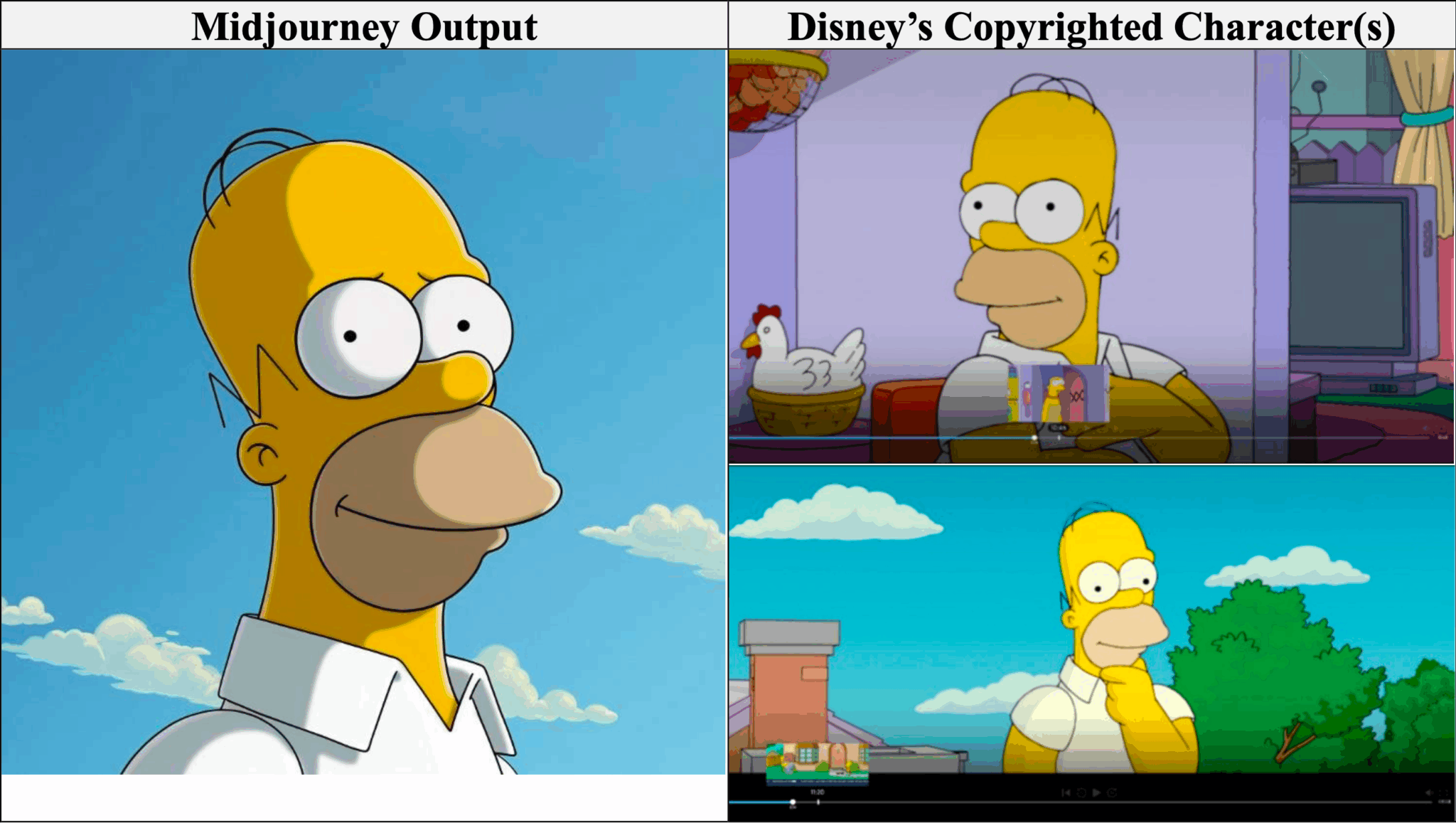
Image source: Screenshot from Disney and Universal’s complaint.
By Lulu Yang
Earlier this month, Disney and Universal filed a lawsuit in the U.S. District Court for the Central District of California against Midjourney, Inc., an AI image-generation platform, alleging both direct and secondary copyright infringement.[1] The core allegation is that Midjourney’s generative AI tools unlawfully reproduce and distribute images incorporating the plaintiffs’ copyrighted characters without authorization. Midjourney did not immediately respond to media inquiries on the day the complaint was filed.[2] As of June 18, it has neither filed an answer nor disclosed its legal representation, and no court proceedings have been scheduled.[3]
This high-profile case marks another significant confrontation between copyright law and emerging generative AI technologies, raising questions about the evolving boundaries of digital creativity in visual content.
Facts Alleged in the Complaint
Midjourney, Inc. is a technology company based in San Francisco that offers an artificial intelligence-based image generation tool (“the Image Service”) to paying subscribers. The service began as a bot accessible through the Discord platform and was later made available through Midjourney’s own website in or around October 2023. On the website, users submit written prompts to the Image Service, which then generates images in response. Generated images are displayed and made available for download. Midjourney offers multiple subscription plans, ranging from $10 to $120 per month. Each subscription provides a set amount of processing time on Graphics Processing Units (GPU). More expensive plans include more processing time. Users may also purchase additional GPU time. In addition to delivering images directly to users, the Image Service also features an “Explore” page on Midjourney’s website, where selected user-generated images are publicly displayed. Midjourney uses this page to showcase image outputs and promote its service.
The key issue is that the Image Service can generate images in response to prompts that reference characters, names, or descriptions associated with plaintiffs’ copyrighted entertainment properties. However, no licensing agreement exists between the parties. Prior to filing suit, plaintiffs contacted Midjourney and requested that it implement technical safeguards to prevent the generation and display of content based on their works. They proposed two methods: rejecting certain prompts and screening generated outputs. Although Midjourney allegedly already uses content filters for categories such as violence and nudity, it declined to adopt similar restrictions in response to Plaintiffs’ requests.
More concerning to the plaintiffs is Midjourney’s development of a video-generation service and has begun training that system using audiovisual material. The upcoming service is expected to generate videos that incorporate visual elements associated with the plaintiff’s properties.[4]
Plaintiffs’ Legal Claims
The plaintiffs accuse Midjourney of both direct infringement for the unauthorized reproduction and public display of copyrighted content and secondary infringement for inducing users to generate and distribute infringing content under the U.S. Copyright Act, 17 U.S.C. § 101 et seq. In addition to damages, plaintiffs also seek injunctive relief to stop Midjourney’s alleged ongoing copyright infringement and to compel the company to implement technological measures that would prevent future infringement.[5]
1. Direct Infringement
The plaintiffs allege that Midjourney has directly infringed their copyrights by reproducing, displaying, and distributing unauthorized copies and derivative works of their protected characters. To support their claims, the complaint includes numerous side-by-side comparisons illustrating that Midjourney’s image outputs are substantially similar to, and derivative of, the plaintiffs’ copyrighted characters. The crux of the allegation is that Midjourney’s AI-generated images feature recognizable copyrighted characters and are made publicly available for download and display on its platform.
The plaintiffs further contend that Midjourney’s system was trained on their copyrighted works. As a result, although users input prompts to generate images, Midjourney is the entity that creates and disseminates the allegedly infringing content. The company also uses these outputs to promote its services and attract paid subscribers, which, according to plaintiffs, underscores its status as a direct infringer.
2. Secondary Infringement
The plaintiffs also assert that Midjourney is secondarily liable for copyright infringement because it induces, contributes to, and materially benefits from the infringing activities of its users by charging subscription fees.
The plaintiffs allege that Midjourney has actual and constructive knowledge that users frequently generate unauthorized copies and derivative works based on the plaintiffs’ copyrighted characters. However, it continues to facilitate the infringing conduct by providing access to its model. The plaintiffs claim that Midjourney has the technical capabilities to do so. For example, while it uses technological measures to block outputs involving violence or nudity, it has refused to adopt similar measures to prevent the copying, public display, or distribution of Plaintiffs’ copyrighted characters. Moreover, it continues maintaining public repositories where infringing images are shared and displayed.
Concord Music Group v. Anthropic PBC
While this lawsuit has drawn significant public attention, as some legal commentators have observed, “in terms of law, there is nothing ground-breaking in this lawsuit.”[6] Disney’s and Universal’s claims are largely the same as those made by other plaintiffs in prior AI copyright litigation in the US.[7]
A closely comparable case in the music industry is Concord Music Group v. Anthropic PBC.[8] In this case, several large music publishers alleged that Anthropic’s AI chatbot, Claude, copies song lyrics without permission. Similarly, the complaint claims both direct and secondary copyright infringement.[9] Anthropic argues that it already has systems in place to prevent this from happening.[10]
To date, the court has not addressed the direct infringement yet, but it considered and dismissed the claims of both contributory and vicarious infringement based on the plaintiff’s failure to allege a specific act of direct infringement by a third party, which is a necessary element for both theories.[11]
Nonetheless, a significant development of Anthropic is the parties’ stipulated partial injunction in December 2024, which prohibits Anthropic from outputting any copyrighted lyrics through its Claude models, including full lyrics, substantial excerpts, or closely mimicked content.[12] The company must maintain and apply existing guardrails to prevent such outputs across all current and future versions of Claude.[13] While the injunction restricts generation and display of protected lyrics, it does not prohibit Anthropic from using lyrics in training data. However, Anthropic is required to respond to copyright holders’ notices and implement timely corrective measures.[14]
Turning to Disney v. Midjourney, although the plaintiffs allege that Midjourney declined to implement content filters despite direct outreach[15], now that litigation has begun, might the parties be heading toward a similar partial resolution? In addition, unlike in Anthropic, Midjourney’s “Explore” feature may be sufficient to establish this element. If the case proceeds to trial, the court is likely to address more substantive aspects of platform liability. Key issues may involve what constitutes “constructive knowledge” in the context of generative AI and user conduct, and whether the platform retains the right and ability to control infringing activity.
An Emphasis on the Output-Based Infringement
Compared with other generative AI litigations, including Concord Music Group v. Anthropic PBC, it’s worth noting Disney and Universal place a much stronger emphasis on output-side infringement rather than input-side.[16] This case deliberately centers on visuals, rather than the training model.[17]
Compared to literary or musical works, visual content offers a natural advantage in pursuing an output-based infringement theory. It lends itself to direct, side-by-side comparison; precisely the strategy emphasized in the complaint. Such an approach allows courts to more readily assess substantial similarity between AI-generated images and protected works.
From a legal strategy perspective, focusing on output-based infringement may offer a more tractable path for plaintiffs. First, since questions surrounding training data are already being actively contested in other courts, any resulting precedent could have a decisive impact.[18] Also, while the application of fair use doctrine to large-scale AI training remains unsettled, courts are far more familiar with established doctrines such as substantial similarity and derivative works. Accordingly, AI-generated visuals bearing strong resemblance to protected characters could more easily satisfy traditional infringement standards. In practical terms, a favorable ruling for plaintiffs could directly “compel AI companies to build actual guardrails.”[19] Ultimately, the entertainment industry’s primary objective may not be to eliminate generative AI, but rather to secure a share of its economic benefits.[20] However, if Midjourney raises a fair use defense, the case may necessarily reopen the thornier input-based questions surrounding training data.
Final Thoughts
In the digital era, revolutions take place when we don’t even notice. The rise of e-commerce platforms has brought profound changes to the art market. Blockchain technology and NFTs introduced a radically new lens on ownership and provenance. Now, a new frontier has emerged: the scope of copyright protection in an age where human-created imagery can be instantly reimagined by non-human intelligence.[21]
Disney and Universal, both heavyweights in the entertainment industry, stepping in as plaintiffs underscores the reality that AI has started affecting the entire entertainment ecosystem.[22] Their decision to target Midjourney, rather than tech giants like OpenAI, may reflect a strategic move to avoid being pulled into a resource-intensive lawsuit.[23] In comparison, Midjourney is a relatively small AI company; thus it seems to present a more manageable legal target. Still, the legal and cultural implications of this case are profound.
Will generative AI reshape authorship and production in visual art, much like Napster disrupted the music industry and led to new licensing paradigms?[24] Will a categorical fair use doctrine emerge for generative AI?[25] Or, though much less likely, will the courts curtail it outright through strict judicial intervention? The answer remains uncertain, hinging on whether the parties proceed to trial and how courts ultimately balance innovation with protection.
06/21/2025 updates: A week after being sued by Disney, Midjourney launches a video generator.[26]
About the Author:
Lulu Yang is a Summer 2025 Legal Intern at Center for Art Law. She is currently a rising 2L student at the University of Minnesota Law School. She is licensed in New York State and Mainland China. Lulu is building a career in media, entertainment and technology law, with a current research focus on legal issues surrounding generative AI.
She can be reached at yang9474@umn.edu.
Sources:
- Eileen Kinsella, A.I. Generator Midjourney Hit With Copyright Suit From Disney and Universal, artnet (June 12, 2025), available at https://news.artnet.com/art-world/midjourney-sued-by-disney-and-universal-copyright-2656439 ↑
- Blake Montgomery, Disney and Universal sue AI image creator Midjourney, alleging copyright infringement, The Guardian (June 11, 2025), available at https://www.theguardian.com/technology/2025/jun/11/disney-universal-ai-lawsuit; Will Oremus, What Hollywood wants from the AI industry, The Washington Post (June 12, 2025), available at https://www.washingtonpost.com/politics/2025/06/12/disney-universal-suit-midjourney-ai-copyright/?utm_source=chatgpt.com ↑
- Disney Enterprises Inc. v. Midjourney Inc., 2:25-cv-05275, (C.D. Cal.). The case docket is available at https://www.courtlistener.com/docket/70513159/disney-enterprises-inc-v-midjourney-inc/ ↑
- Complaint, Disney Enterprises Inc. v. Midjourney Inc., No. 2:25-cv-05275 (C.D. Cal. filed June 11, 2025). The full document is available at https://storage.courtlistener.com/recap/gov.uscourts.cacd.973999/gov.uscourts.cacd.973999.1.0_3.pdf ↑
- Id. ↑
- Anthony Leung, The Empire Strikes Back – Disney & Universal v Midjourney, Lexology (June 17, 2025), available at https://www.lexology.com/library/detail.aspx?g=f49c7e7c-c562-4c6c-9c9c-52b5e83ef94f#:~:text=In%20essence%2C%20Disney%20and%20Universal,of%20Disney’s%20and%20Universal’s%20works ↑
- Such as Concord Music Group, Inc. v. Anthropic PBC, 3:23-cv-01092, (M.D. Tenn.); Thomson Reuters Enterprise Centre GmbH v. ROSS Intelligence Inc., 1:20-cv-00613, (D. Del.); The New York Times Company v. Microsoft Corporation, 1:23-cv-11195, (S.D.N.Y.); Authors Guild v. OpenAI Inc., 1:23-cv-08292, (S.D.N.Y.). ↑
- Concord Music Group, Inc. v. Anthropic PBC, 5:24-cv-03811, (N.D. Cal.). Case docket is available at https://www.courtlistener.com/docket/68889092/concord-music-group-inc-v-anthropic-pbc/ ↑
- Complaint at ¶¶ 111-146, Concord Music Grp., Inc. v. Anthropic PBC, No. 3:23-cv-01092 (M.D. Tenn. filed Oct. 18, 2023). The full document is available at https://storage.courtlistener.com/recap/gov.uscourts.cand.431519/gov.uscourts.cand.431519.1.0_1.pdf ↑
- Blake Brittain, Anthropic fires back at music publishers’ AI copyright lawsuit, Reuters (June 17, 2025), available at https://www.reuters.com/legal/litigation/anthropic-fires-back-music-publishers-ai-copyright-lawsuit-2024-01-17/?utm_source=chatgpt.com ↑
- Safia Hassain, IP/ENTERTAINMENT CASE LAW UPDATES: Concord Music Group, Inc. v. Anthropic PBC, Loeb & Loeb LLP (March 25, 2025), available at https://www.loeb.com/en/insights/publications/2025/04/concord-music-group-inc-v-anthropic-pbc?utm_source=chatgpt.com. Order Granting Motion to Dismiss with Leave to Amend, Concord Music Group, Inc. v. Anthropic PBC, 5:24-cv-03811, (N.D. Cal. Mar. 26, 2025). https://storage.courtlistener.com/recap/gov.uscourts.cand.431519/gov.uscourts.cand.431519.322.0.pdf ↑
- Shani Rivoux, et al., Lyric or Leave It: Anthropic Tries to Strike a Chord with the Music Industry, Pillsbury (February 4, 2025), available at https://www.pillsburylaw.com/en/news-and-insights/anthropic-copyright-claude-ai.html ↑
- Id. ↑
- Id. ↑
- Complaint at ¶¶ 3, 11, 206, Disney Enterprises Inc. v. Midjourney Inc., No. 2:25-cv-05275 (C.D. Cal. filed June 11, 2025). The full document is available at https://storage.courtlistener.com/recap/gov.uscourts.cacd.973999/gov.uscourts.cacd.973999.1.0_3.pdf ↑
- Anthony Leung, The Empire Strikes Back – Disney & Universal v Midjourney, Lexology (June 17, 2025), available at https://www.lexology.com/library/detail.aspx?g=f49c7e7c-c562-4c6c-9c9c-52b5e83ef94f#:~:text=In%20essence%2C%20Disney%20and%20Universal,of%20Disney’s%20and%20Universal’s%20works ↑
- Eriq Gardner, The Real Reason Bob Iger Declared War on A.I., Puck (June 17, 2025), available at https://puck.news/why-disney-and-nbcuniversal-finally-sued-over-ai/?utm_campaign=1 ↑
- Id. ↑
- Id. ↑
- Will Oremus, What Hollywood wants from the AI industry, The Washington Post (June 12, 2025), available at https://www.washingtonpost.com/politics/2025/06/12/disney-universal-suit-midjourney-ai-copyright/?utm_source=chatgpt.com ↑
- Adrian Jabbary et al., AI, art and the law: new frontiers in creativity and IP, The Global Legal Post (May 23, 2025), available at https://www.globallegalpost.com/news/ai-art-and-the-law-new-frontiers-in-creativity-and-ip-875197916#:~:text=AI%27s%20growing%20role%20in%20art%20creation%20and%20curation%20presents%20exciting,creators%2C%20human%20and%20machine%20alike ↑
- Anthony Leung, The Empire Strikes Back – Disney & Universal v Midjourney, Lexology (June 17, 2025), available at https://www.lexology.com/library/detail.aspx?g=f49c7e7c-c562-4c6c-9c9c-52b5e83ef94f#:~:text=In%20essence%2C%20Disney%20and%20Universal,of%20Disney’s%20and%20Universal’s%20works ↑
- Id. ↑
- See Anthony Leung, The Empire Strikes Back – Disney & Universal v Midjourney, Lexology (June 17, 2025), available at https://www.lexology.com/library/detail.aspx?g=f49c7e7c-c562-4c6c-9c9c-52b5e83ef94f#:~:text=In%20essence%2C%20Disney%20and%20Universal,of%20Disney’s%20and%20Universal’s%20works (suggesting the possibility); Tyler Larson, Has AI Art Generated the Next Napster? Analyzing Civil and Criminal Liability for Prompt Marketplace Participants, 46 UC LAW SF COMM. & ENT. L.J. 89 (2024). Available at: https://repository.uclawsf.edu/hastings_comm_ent_law_journal/vol46/iss2/2 (offering a more explicit endorsement). ↑
- Eriq Gardner, The Real Reason Bob Iger Declared War on A.I., Puck (June 17, 2025), available at https://puck.news/why-disney-and-nbcuniversal-finally-sued-over-ai/?utm_campaign=1 ↑
- Edward Lee, A week after being sued by Disney, Midjourney launches video generator. Risky business?, Chat GPT Is Eating the World (June 20, 2025), available at https://chatgptiseatingtheworld.com/2025/06/20/a-week-after-being-sued-by-disney-midjourney-launches-video-generator/. ↑
Disclaimer: This article is for educational purposes only and is not meant to provide legal advice. Readers should not construe or rely on any comment or statement in this article as legal advice. For legal advice, readers should seek a consultation with an attorney.


