
Guerrilla Hacking the Art World: Legal Issues in Unsanctioned Augmented Reality in Museums and Public Art
September 15, 2022
By Tyler Heneghan
As technology advances, time spent on smartphones and tablets only increases. Museums and artists take note, and with the help of readily available technology, the art world continues to venture into the world of augmented reality (“AR”). Museums and companies like Snapchat collaborate with artists and technology startups to bring AR art to museums and public spaces through visitors’ own smartphones and tablets. Increasing available AR technology also means that artists and technology gurus can dabble in bringing their augmented creations to museums and public spaces without an invitation from the hosting institutions, some of which are unauthorized by the museums and original artists. This practice is often referred to as guerrilla hacking, and might have unwelcome consequences. What risks does unauthorized augmented reality pose to museums? Should and how do museums and artists react to guerrilla hacking? What legal recourse exists for museums and artists on the “wrong end” of unsanctioned AR; what defenses exist for the guerrilla hackers? Addressing those questions begins with understanding AR and analyzing two guerrilla hacks of the Museum of Modern Art (“MoMA”) and Jeff Koons’s AR Balloon Dog.
Augmented Reality: What is it and why might museums be interested?
Unlike virtual reality, where a viewer with eye goggles is transformed into a digital world, AR has the ability to enhance creativity when it shows both reality and an altered reality overlayed (or “augmented”) upon one another, thus allowing users to see more than what they can already see.[1] The actual artwork and exhibition space is not physically altered in the process.[2] AR accommodates mandated and recommended social distancing, requires only the museumgoers’ smartphone or tablet, and can be utilized both indoors and outdoors.[3] “Bringing exhibitions to life,” AR art attracts visitors, offers interactive learning experiences, renovates museum spaces, informs museumgoers of historic facts, virtually renovates historic places, and provides a lively, virtual splash to artworks in museum collections.[4]
For example, in 2017, The Pérez Art Museum Miami (“PAMM”) unveiled their first AR experience, Invasive Species by Felice Grodin, and continued the exhibition throughout the government-mandated museum shutdown in 2020.[5] PAMM found that AR engaged groups of museumgoers, including strangers conversing over their experiences, was enjoyed by museumgoers of all ages and worked in preexisting indoor and outdoor exhibition spaces without overwriting the physical spaces.[6] While AR provides additional information and visualizations to traditional museum experiences, not all AR has the consent of the museums where it exists and artists whose artworks it overlays.[7]
Guerrilla Hacking: unsanctioned augmented reality around the museum and public art
With Apple’s ARKit and Google’s ARCore, among others, placing new AR technologies and possibilities in the hands of the public, the accessibility is raising questions in the art world.[8] One major question is whether or not museums and artists should react against guerrilla hacking or embrace unauthorized AR as a new form of viewer engagement. Art historian Maxwell Anderson finds “[m]useums . . . striving for relevance, because the world is increasingly splintered and competing at offerings,” and authorized and unauthorized AR offers museums a way to avoid obsolescence.[9]

After The Metropolitan Museum of Art (“The Met”) experienced an AR invasion of Vincent van Gogh’s First Steps, after Millet (1890), the museum allowed the experience to continue without legal action.[10] Former Chief Digital Officer Loic Tallon noted that so long as the AR experiences are in good taste, “it’s not really worth fighting against it, because gravity is not working in [The Met’s] favor.”[11] However, not all museums and artists welcome guerrilla hackers with such open arms; the MoMAR, Hacking the Heist, and Sebastian Errazuriz AR experiences at the MoMA and Central Park, respectively, illustrate two instances that could rise to legal action.
The Museum of Modern Art
From March 2 to May 10, 2018, eight artists, known as MoMAR, digitally renovated the MoMA’s Jackson Pollock (“Pollock”) room into an AR gallery experience, all without the MoMA’s permission.[12] MoMAR’s guerrilla hack installation Hello, we’re from the internet (2018) intended to speak out against elitism and exclusivity in the art world by overlaying seven Pollock paintings with AR art using their open-source app MoMAR.[13] According to Damjanski, one of MoMAR’s eight artists, the art collective’s main drives behind the exhibition were to democratize open spaces and “recognize that the term ‘open to the public’ is not an invitation but a declaration of values. Values that are not our own.”[14]


MoMAR held the unsanctioned opening reception on the MoMA’s fifth floor room devoted to Pollock, and the collective encouraged visitors to download their app on the Google Play Store.[15] One of the guerrilla hacks from artist Gabriel Barcia-Colombo turned Pollock’s White Light (1954) into a game with skeletons climbing up the sides of the painting, commenting on the fact that this was one of Pollock’s last paintings before his death.[16] If the AR user loses, Apple’s rainbow wheel appears with “PAINTERS BLOCK” flashing across the screen, again commenting on Pollock’s tormented dealings with artistic block later in his career.[17]
Damjanski stated that “[MoMAR] literally are trying to claim the space,” and that the art collective were not worried about retaliation from MoMA.[18] He emphasized that “[MoMA] can’t do anything against us,” and “[Pollock] would appreciate it. He was far out there.”[19] MoMA security guards appeared confused but made no efforts to stop Hello, we’re from the internet’s three-month unauthorized AR exhibition.[20] Pointing to MoMAR’s belief of a lack of legal implications, Barcia-Colombo stated, “[MoMAR’s] AR work added an extra layer of digitization by hacking the pre-existing work to reveal the work of artists who are experimenting with a new form.”[21]
Central Park and Snapchat ART x Jeff Koons’s AR Balloon Dog

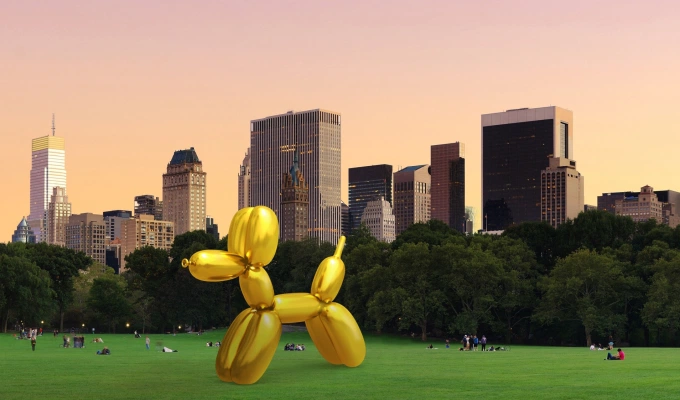
On October 3, 2017, Snapchat ART and Jeff Koons (“Koons”) collaborated to bring AR Balloon Dog (2017) to Snapchat users using Cimage, an Israeli AR startup.[22] Snapchat geo-pinned an AR-version of Koons’s iconic balloon dog pop-art sculpture in Manhattan’s Central Park.[23] Some art critics and artists were frustrated with corporations like Snapchat placing and monetizing digital art wherever they wish. Graffiti artist Sebastian Errazuriz (“Errazuriz”) responded by “vandalizing” Koons’s AR Balloon Dog within two days of the release in what may be the world’s first AR vandalism.[24] Errazuriz overlayed the augmented balloon dog with graffiti using his own ARNYC app.[25] Errazuriz shared his frustrations on Instagram: “For a company to have the freedom to GPS tag whatever they want is an enormous luxury that we should not be giving out for free. The virtual public space belongs to us, we should charge them rent.”[26]
Legal Issues and Affirmative Defenses Surrounding Guerrilla Hacking
MoMA has not pursued legal action against MoMAR and their unauthorized AR. Furthermore, Errazuriz’s frustrations seemed directed towards Snapchat more so than Koons, and Koons never publicly initiated legal action against his AR vandalizer. Many art world critics find this non-litigation approach a smart one, as reacting too quickly or too aggressively might distance the museums and artists from the AR creators who bring visitors to their museums and the potential for collaboration (like Cuseum’s work for PAMM). It could also distance the museums and artists from their patrons and fans, as well.[27] Although these three unauthorized AR acts did not lead to legal action, did the guerrilla hackers expose themselves to legal risk? Copyright infringement, infringing on an artist’s moral rights, and “virtual trespassing” are three arguments likely to be made by artists and museums experiencing unauthorized AR.
Copyright Infringement
Unsanctioned AR generates somewhat novel issues involving derivative works.[28] Federal copyright law provides copyright owners “the exclusive rights to do and to authorize . . . [the preparation] of derivative works based upon the copyrighted work.”[29] A derivative work is defined as:
a work based upon one or more preexisting works, such as a translation, musical arrangement, dramatization, fictionalization, motion picture version, sound recording, art reproduction, abridgment, condensation, or any other form in which a work may be recast, transformed, or adapted. A work consisting of editorial revisions, annotations, elaborations, or other modifications which, as a whole, represent an original work of authorship, is a “derivative work.”[30]
However, all artworks published in the United States before 1926 are now in the public domain and no longer protected under federal copyright law, including derivative works.[31] This is due to federal copyright law protecting works published prior to 1978 for ninety-five years from the date of publication.[32] “Copyright in a work created on or after January 1, 1978, subsists from its creation and . . . endures for a term consisting of the life of the [artist] and 70 years after the [artist]’s death.”[33] Though a museum may own the artworks in its collection, it does not own the copyrights to those artworks. Museums, and thus users looking to overlay AR over the copyrighted art, must secure permission from the copyright holder as well as the owner of the artwork, unless the works are in the public domain.[34]
Copyright infringement may occur through derivative works when guerrilla hackers combine their unsanctioned AR artwork with the original artwork to create a new artwork or change the market for the original artwork. Moreover, guerrilla hackers may be rising to that level of derivative work creation when overlaying their AR art over an original art that is currently protected by federal copyright law.[35] Unlike traditional derivative works, guerrilla hackers’ AR art does not permanently alter the work unless users screenshot the AR.[36] Very limited case law treats short-lived changes to copyright-protected works as infringing the copyright owners’ right to their derivative works.[37] Courts have yet to investigate “whether and under what circumstances a user’s subjective view of a derivative work not visible to others—or the facilitation of such an act—constitutes copyright infringement.”[38]
Potential copyright infringers have at their disposal an affirmative defense for fair use, although there is no direct case law holding how fair use plays out in guerrilla hacking.[39] Fair use includes using a copyrighted artwork “for purposes such as criticism, comment, news reporting, teaching (including multiple copies for classroom use), scholarship, or research,” and is not copyright infringement.[40]
The first fair use factor calls upon the potential infringer’s work to be “transformative” or have a strong sense of parody, criticism, or commentary.[41] The second factor focuses on the content being reused in the potentially infringing work with fair use weakening as the creativeness of the original work increases.[42] The third factor looks at how much of the original work is incorporated in the potentially infringing work with higher percentages weighing against fair use.[43] Finally, the fourth factor looks at whether or not the potentially infringing work might negatively affect the market for the original work.[44]
Firstly, Pollock’s artworks in the MoMA were created prior to 1978, and this copyright protection lasts for ninety-five years after the artwork’s creation.[45] Pollock created all of the artworks, including White Light (1954), within the past seventy years.[46] Thus, all of the artworks are protected under federal copyright law, although without Pollock’s will or the original sales agreements to the eight artworks, it remains unclear who owns those copyrights.
Being that MoMAR’s unauthorized AR directly comments on the elitism of the artworld, and Barcia-Colombo’s guerrilla hack directly comments on Pollock’s painters block near the end of his life, individual defenses for fair use could be made.[47] Given that courts have not clearly defined fair use, relying on it as a defense in the even further undetermined area of AR would be quite the risk and lead to lengthy and expensive litigation if MoMA pursued legal action against MoMAR.[48]
Secondly, Koons created AR Balloon Dog in 2017, and he is alive.[49] Thus, the artwork falls within federal copyright protection.[50] Errazuriz’s AR graffiti overlayed on AR Balloon Dog derives itself from the original work, and Koons or Snapchat could certainly add extra layers to the original much like Errazuriz’s graffiti.[51] Thus, a court is likely to find the guerrilla hack graffiti to be copyright infringement. Similar to MoMAR’s fair use defense, Errazuriz’s defense would be weakened by the fact that he is commenting on the commercialization of public art spaces as opposed to Koons’s original work.[52] Given the added uncertainty of how a court would apply fair use to unauthorized AR artwork over another AR artwork, litigation would prove costly and time consuming, something that Snapchat has the resources to pursue.
Artist’s Moral Rights
Codified in 1990 under 17 U.S.C. §§ 101, 106A, 113, the Visual Artists Rights Act of 1990 (“VARA”) provides “moral rights” of attribution and integrity to artists’ “work of visual art” which override fair use protections.[53] The right of attribution includes rights (1) “to claim authorship of that work” and (2) “to prevent the use of his or her name as the author of any work of visual art which he or she did not create.”[54] The right of integrity provides the artist “the right to prevent the use of his or her name as the author of the work of visual art in the event of a distortion, mutilation, or other modification of the work which would be prejudicial to his or her honor or reputation.”[55] VARA also grants artists of “recognized stature” the right to prevent the intentional or grossly negligent destruction of their artworks.[56]
The moral rights that VARA provides cannot be transferred but they are often waived by artists to obtain commissions.[57] Moreover, artworks created after June 1, 1991 provide the artists with moral rights for the life of the artist, but artworks created before June 1, 1991 provide the moral rights extending seventy years past the artist’s death so long as the artist did not transfer title to the artworks prior to June 1, 1991.[58] If the artist transferred title by selling or assigning ownership of the art prior to June 1, 1991, the artist does not have moral rights in those works.[59]
Pollock nor his heirs have moral rights under VARA since he died and the artworks in question were all sold numerous times before acquisition by the MoMA.[60] Koons’s potential moral rights are a different story, considering he is alive. However, the contractual obligations between Snapchat and Koons are unknown, and Koons may have waived his moral rights.[61] Alternatively, Koons and Snapchat might be joint authors, potentially making them co-owners of the moral rights.[62] Congress members certainly did not envision AR art in 1990, as augmented art is not expressly mentioned as a “work of art,” and thus Koons and Snapchat would need to argue that the definition is not exhaustive but encompasses augmented art that is virtually visual art.[63] If a court finds Koons and Snapchat to have moral rights under VARA, Errazuriz’s guerrilla hacked-graffiti could rise to the level of “intentional distortion, mutilation, or other modification” negatively affecting Koons and Snapchat’s “honor or reputation.”[64]
Virtual Trespassing
“Virtual trespassing” is a new property law concept that accompanied the public availability of AR and led to a class action against Nintendo and Niantic’s Pokémon Go in 2017.[65] Aggrieved homeowners argued that Pokémon Go encouraged players to trespass on private property, causing nuisances.[66] The homeowners claimed “a ‘continuing invasion’ of [their private] properties and [that these invasions] interfered with their owners’ ‘use and enjoyment’ of their land.”[67] The class action between Nintendo and Niantic and disgruntled homeowners ultimately settled with a private settlement agreement.[68] Given the settlement, the legality for someone placing AR on private property is still unknown.
Koons’s AR Balloon Dog was geo-tagged to Central Park and thus not within the purview of any potential “virtual trespass” claim.[69] MoMA is considered private space and therefore falls within potential “virtual trespass” claims.[70] Given that Hello, we’re from the internet did not summon large crowds that caused a nuisance, potential litigation would be directed towards whether or not the museum owns the right to the virtual and augmented spaces within their museum walls, going to the root of Errazuriz’s critique of Snapchat’s free use of public space through AR.[71] Can a private landowner own the virtual and augmented spaces within their land, and can they exclude others from creating virtual and augmented works within those spaces? Courts have yet to litigate the property law issue, but academics are beginning to voice their opinions.[72]
Potentially Aggressive Responses to Stop Guerrilla Hackers
The clouded nature of unsanctioned AR surrounding the museum world and public art could not be clearer. Nevertheless, museums and artists have contract powers to “reclaim” augmented space. An obvious remedy to inhibit AR users, although not necessarily the guerrilla hackers, would be through an adhesion contract for museumgoers. Adhesion contracts are contracts “drafted by one party (usually a business with stronger bargaining power) and signed by another party (usually one with weaker bargaining power, usually a consumer in need of goods or services).”[73] Some museums currently have rules against photography and touching artworks, and thus museums could include additional rules banning AR apps, unsanctioned AR apps, or smartphones.[74] Of course, these stricter policies are not likely to be seen well in the eyes of a museum’s patrons and potentially inhibits museums from venturing into AR exhibitions like PAMM and Grodin’s Invasive Species.[75] Artists could negotiate specific provisions within their contracts with museums, identifying specifically what types of AR can and cannot be placed on their artworks. As PAMM’s Deputy Director of Marketing and Public Engagement Christina Boomer Vazquez signified, “there’s also the issue of respecting the artists that are on view and the impact that [AR] would have on that artist and that work. [AR] can alter the whole context and conversation of that artist’s work.”[76] Artworks in public spaces would have a difficult time limiting unauthorized AR through contracts given their public nature, although Koons and Snapchat could have similar contractual language not allowing guerrilla hacks on their collaborated AR creations. Nevertheless, courts would have a difficult time determining the enforceability of these adhesion contracts, particularly for public artworks, and museums would do well to avoid upsetting their patrons.
Conclusion
Augmented reality offers museum visitors, museums and artists a new and creative medium to express themselves and welcome new audiences of all ages and backgrounds. All new and readily accessible technologies come with uncertainty in the law and AR is no different in this regard. Over the past several years, artists, art collectives, and technology startups have engaged in unsanctioned AR at MoMA and Central Park as well as numerous other cultural institutions. Some cultural institutions voiced their displeasure at these initiatives but museums and artists have yet to bring a legal complaint about guerrilla hacking. Copyright infringement, VARA, and “virtual trespassing” are three claims that courts litigating guerrilla hacking in the future may see. As with many intellectual property proceedings, a case-by-case determination would lead to lengthy and costly litigation. With museums and artists seeing the potential benefits of AR, allowing fun and creative unsanctioned AR may be a wiser decision than ousting the guerrilla hackers and their apps’ users.
About the Author: Tyler Heneghan (Spring 2021 Legal Intern at the Center for Art Law),is a Registered Professional Archaeologist with a J.D. from Boston University School of Law and currently a Ph.D. student in Cultural Heritage and Preservation Studies at Rutgers University. Tyler served as the editor in chief of the Boston University International Law Journal and successfully convinced school administration to offer both American Indian Law and Art Law for students at BU School of Law. This article was initially prepared for his Art Law term paper and later adapted for publication.
Bibliography:
- See Brothers in Law: Augmented Reality, Danzinger, Danzinger & Muro, LLP (May 28, 2016), https://danziger.com/?p=588. ↑
- See Danzinger, Danzinger & Muro, LLP, supra note 1. ↑
- See Augmented Reality (AR) Exhibition, Pérez Art Museum Miami, https://www.pamm.org/ar (last visited Apr. 23, 2021); Danzinger, Danzinger & Muro, LLP, supra note 1; see also Exhibit A. ↑
- Anastasia Morozova, How to Use Augmented Reality in Museums: Examples and Use Cases, Jasoren, https://jasoren.com/how-to-use-augmented-reality-in-museums-examples-and-use-cases/ (last visited Apr. 23, 2021); Miranda Katz, Augmented Reality is Transforming Museums (Apr. 23, 2018, 12:00 PM), https://www.wired.com/story/augmented-reality-art-museums/ (noting that Cuseum brought Grodin’s AR creation to life with Apple’s ARKit); see also Press Release, The Metropolitan Museum of Art, The Metropolitan Museum of Art and Verizon Launch Interactive Virtual Experience (Jan. 21, 2021), https://www.metmuseum.org/press/news/2021/the-met-unframed (describing five-week limited run of The Met’s first sanctioned AR experience, The Met Unframed). ↑
- Invasive Species features four site-specific digital installations that “analyze the relationship between physical and mental territories.” The four AR experiences include an invasive species of jellyfish overlapping PAMM’s gardens, hidden messages drawing upon the destructive impacts that nonnative species cause to Floridian environments, and a transformative look into a climate change-affected ecosystem. See Pérez Art Museum Miami, supra note 3. ↑
- See Charlotte Coates, How Museums are Using Augmented Reality, MuseumNext (Sept. 17, 2020), https://www.museumnext.com/article/how-museums-are-using-augmented-reality/; see also M. Thérèse Vento, General Counsel, Pérez Art Museum Miami, Exhibits in 2021: Engaging Audiences through New Technologies, Presentation at Legal Issues in Museum Administration (Mar. 11, 2021) (notes taken by author). ↑
- See, e.g., Mack DeGeurin, Internet Artists Invaded the MoMA With a Guerrilla Augmented Reality Exhibit, Vice Media Group (Mar. 5, 2018, 10:14 AM), https://www.vice.com/en/article/y3gbmb/ftc-and-46-states-in-massive-antitrust-suit (explaining guerrilla hacking at the MoMA); Katz, supra note 4 (mentioning The Met’s take on AR invasion of Vincent Van Gogh’s First Steps, after Millet); Sarah Cascone, Paintings Stolen in America’s Biggest Art Heist Have Returned to Their Frames—Thanks to Augmented Reality, Artnet News (Mar. 26, 2018), https://news.artnet.com/art-world/stolen-gardner-paintings-augmented-reality-1252211 (explaining unsanctioned AR experience at the Gardner Museum). ↑
- See Jason Tanz, Apple Bets the Future of Augmented Reality Will Be on Your Phone, WIRED (Aug. 7, 2017), https://www.wired.com/story/arkit-augmented-reality/; David Pierce, Google Joins the Augmented Reality Party with ARCore, WIRED (Aug. 29, 2017), https://www.wired.com/story/google-joins-the-augmented-reality-party-with-arcore/. ↑
- Katz, supra note 4. ↑
- See id.; see also Exhibit C. ↑
- Katz, supra note 4. ↑
- See DeGeurin, supra note 7. ↑
- Group Show: Hello, we’re from the internet, MoMAR, http://momar.gallery/exhibitions/werefromtheinternet.html (last visited Apr. 24, 2021); see DeGeurin, supra note 7. ↑
- About, MoMAR, http://momar.gallery/about.html (last visited Apr. 24, 2021); DeGeurin, supra note 7. ↑
- See Group Show: Hello, we’re from the internet, supra note 22; DeGeurin, supra note 7. ↑
- See id.; Jackson Pollock, White Light, 1954, Museum of Modern Art, https://www.moma.org/collection/works/79481 (last visited Apr. 24, 2021); see also Exhibit D. ↑
-
DeGeurin, supra note 7; see Jackson Pollock, White Light, 1954, supra note 16; see also Exhibit D. ↑
-
DeGeurin, supra note 7. ↑
-
Id. ↑
-
Id. ↑
-
Id. ↑
-
See Lucas Matney, Jeff Koons’s Augmented Reality Snapchat Artwork Gets ‘Vandalized’, TechCrunch (Oct. 8, 2017), https://techcrunch.com/2017/10/08/jeff-koons-augmented-reality-snapchat-artwork-gets-vandalized/; Josh Constine, Snapchat to Launch Augmented Reality Art Platform Tomorrow, TechCrunch (Oct. 2, 2017), https://techcrunch.com/2017/10/02/snapchat-art/?_ga=2.267789960.742026985.1619294880-1822026050.1619294880; see also Exhibit B. ↑
-
Constine, supra note 22. ↑
-
See Matney, supra note 22; Anna Codrea-Rado, Virtual Vandalism: Jeff Koons’s ‘Balloon Dog’ is Graffiti-Bombed, N.Y Times (Oct. 10, 2017, 12:00 AM), https://www.nytimes.com/2017/10/10/arts/design/augmented-reality-jeff-koons.html; see also Exhibit B. ↑
-
See Codrea-Rado, supra note 24. ↑
-
Codrea-Rado, supra note 24; see Sebastian Errazuriz (@sebastianstudio), Instagram (Oct. 6, 2017), https://www.instagram.com/p/BZ7Bng4jk0C/?utm_source=ig_web_copy_link (video of Errazuriz explaining reasons behind guerilla hacking Koons’s AR Balloon Dog). ↑
-
Katz, supra note 4. ↑
-
See 17 U.S.C. § 101 (defining derivative works); 17 U.S.C. § 103(b) (discussing the subject matter of copyright in reference to derivative works); 17 U.S.C. § 106(2) (identifying derivative works as an exclusive right to copyright owners). ↑
-
17 U.S.C. § 106(2). ↑
- 17 U.S.C. § 101. ↑
- See 17 U.S.C. § 303 (describing federal copyright protections for works created prior to January 1, 1978). ↑
-
Id. ↑
-
17 U.S.C. § 302(a). ↑
-
Rights & Reproductions, Johnson Museum of Art, https://museum.cornell.edu/rights-reproductions#:~:text=The%20Museum%2C%20though%20it%20owns,the%20owner%20of%20the%20work. (last updated Apr. 24, 2019); see 17 U.S.C. § 303. ↑
-
See Mark A. Lemley & Eugene Volokh, Law, Virtual Reality, and Augmented Reality, 166 UPenn L. Rev. 1051, 1112 (2018). ↑
-
See id.; see generally Copyright Act of 1976, Pub. No. 94-553, 90 Stat. 2541 (codified throughout 17 U.S.C. §§ 101-810; 44 U.S.C. §§ 505, 2113; 18 U.S.C. § 2318). ↑
-
Lemley & Volokh, supra note 44, at 1112-13 (citing Micro Star v. Formgen Inc., 154 F.3d 1107, 1109, 1114 (9th Cir. 1998); Lewis Galoob Toys, Inc. v. Nintendo of Am., Inc., 964 F.2d 965, 968 (9th Cir. 1992); Atari, Inc. v. N. Am. Philips Consumer Elecs. Corp., 672 F.2d 607, 617 (7th Cir. 1982)). ↑
-
Id. at 113. ↑
-
See 17 U.S.C. § 107 (outlining fair use under federal copyright law). ↑
-
See Johnson Museum of Art, supra note 34. Factors considered for fair use include: (1) the purpose and character of the use, including whether such use is of a commercial nature or is for nonprofit educational purposes;
(2) the nature of the copyrighted work;(3) the amount and substantiality of the portion used in relation to the copyrighted work as a whole; and
(4) the effect of the use upon the potential market for or value of the copyrighted work.17 U.S.C. § 107. ↑
-
More Information on Fair Use, U.S. Copyright Office, https://www.copyright.gov/fair-use/more-info.html (last updated Oct. 2020); see 17 U.S.C. § 107. ↑
- U.S. Copyright Office, supra note 41; see 17 U.S.C. § 107. ↑
- U.S. Copyright Office, supra note 41; see 17 U.S.C. § 107. ↑
- U.S. Copyright Office, supra note 41; see 17 U.S.C. § 107. ↑
- See 17 U.S.C. § 303; Jackson Pollock, White Light, 1954, supra note 17. ↑
- Jackson Pollock, White Light, 1954, supra note 16. ↑
- See DeGeurin, supra note 7. ↑
- See Danzinger, Danzinger & Muro, LLP, supra note 1. ↑
- See 17 U.S.C. § 302(a); Matney, supra note 22. ↑
- See 17 U.S.C. § 302(a); Matney, supra note 22. ↑
- See 17 U.S.C. §§ 101, 103(b), 106(2); Sebastian Errazuriz (@sebastianstudio), Instagram (Oct. 5, 2017), https://www.instagram.com/p/BZ4Zx6pDvVv/?utm_source=ig_web_copy_link. ↑
- See U.S. Copyright Office, supra note 41; see 17 U.S.C. § 107; see also Sebastian Errazuriz (@sebastianstudio), Instagram (Oct. 6, 2017), https://www.instagram.com/p/BZ7Bng4jk0C/?utm_source=ig_web_copy_link (video of Errazuriz explaining reasons behind guerilla hacking Koons’s AR Balloon Dog). ↑
- 17 U.S.C. §§ 101, 106A, 113; see 17 U.S. Code § 107 (noting that VARA overrides fair use defenses). A “work of visual art” is: (1) a painting, drawing, print, or sculpture, existing in a single copy, in a limited edition of 200 copies or fewer that are signed and consecutively numbered by the author, or, in the case of a sculpture, in multiple cast, carved, or fabricated sculptures of 200 or fewer that are consecutively numbered by the author and bear the signature or other identifying mark of the author; or(2) a still photographic image produced for exhibition purposes only, existing in a single copy that is signed by the author, or in a limited edition of 200 copies or fewer that are signed and consecutively numbered by the author.17 U.S.C. §§ 101 (defining “work of art” and includes exceptions to “work of art”). ↑
- 17 U.S.C. § 106A(a). ↑
- 17 U.S.C. § 106A(a). ↑
- 17 U.S.C. § 106A(a). ↑
- 17 U.S.C. § 106A(e); see VARA – The Visual Artists Rights Act of 1990, Krigel & Krigel, P.C. Law Offices (Feb. 15, 2015), https://www.krigelandkrigel.com/vara-the-visual-artists-rights-act-of-1990/. ↑
- 17 U.S.C. § 106A(d); see Krigel & Krigel, P.C. Law Offices, supra note 57. ↑
- 17 U.S.C. § 106A(d); see Krigel & Krigel, P.C. Law Offices, supra note 57. ↑
- 17 U.S.C. § 106A(d); see Matney, supra note 22. ↑
- 17 U.S.C. § 106A(e); see Matney, supra note 22. ↑
- 17 U.S.C. § 106A(b); see Matney, supra note 22. ↑
- 17 U.S.C. § 101; see Matney, supra note 22. ↑
- 17 U.S.C. § 106A(a)(3); see Constine, supra note 22; Sebastian Errazuriz (@sebastianstudio), Instagram (Oct. 5, 2017), https://www.instagram.com/p/BZ4Zx6pDvVv/?utm_source=ig_web_copy_link. ↑
- See Katz, supra note 4; Pokémon Go ‘trespass’ legal action settled in US, BBC News (Dec. 3, 2018), https://www.bbc.com/news/technology-46426930; see generally Class Action Complaint, In re Pokémon Go Nuisance Litigation, No. 3:16-cv-04300-JD (N.D. Cal. July 29, 2016) (copy available at https://drive.google.com/file/d/1fRFBJhbjDvxaFLuGQXWZlPn-X2CF8kni/view?usp=sharing). ↑
- See Katz, supra note 4; BBC News, supra note 65; see generally Class Action Complaint, In re Pokémon Go Nuisance Litigation, No. 3:16-cv-04300-JD. ↑
- BBC News, supra note 65; see generally Class Action Complaint, In re Pokémon Go Nuisance Litigation, No. 3:16-cv-04300-JD. ↑
- BBC News, supra note 65. ↑
- See Matney, supra note 22; Katz, supra note 4. ↑
- DeGeurin, supra note 7; Katz, supra note 6 ↑
- See Katz, supra note 6; Matney, supra note 22; Sebastian Errazuriz (@sebastianstudio), Instagram (Oct. 6, 2017), https://www.instagram.com/p/BZ7Bng4jk0C/?utm_source=ig_web_copy_link (video of Errazuriz explaining reasons behind guerilla hacking Koons’s AR Balloon Dog). ↑
-
See Elizabeth F. Judge & Tenille E. Brown, A Right Not to Be Mapped? Augmented Reality, Real Property, and Zoning, 7 Laws 1 (2018) (open access version available at https://www.mdpi.com/2075-471X/7/2/23/htm); Declan T. Conroy, Property Rights in Augmented Reality, 24 Mich. Telecom. & Tech. L. Rev. 17 (2017); Travis Alley, Pokémon Go: Emerging Liability Arising From Virtual Trespass for Augmented Reality Applications, 4 Tex. A&M J. Prop. L. 273 (2018), for a discussion on the property rights in augmented reality. ↑
- Adhesion Contract (Contract of Adhesion), Legal Information Institute, https://www.law.cornell.edu/wex/adhesion_contract_(contract_of_adhesion)#:~:text=An%20adhesion%20contract%20(also%20called,need%20of%20goods%20or%20services). (last visited Apr. 25, 2021). ↑
- See Katz, supra note 6. ↑
- See Katz, supra note 6; see also Pérez Art Museum Miami, supra note 2. ↑
- See Katz, supra note 6. ↑
Disclaimer: This article is for educational purposes only and is not meant to provide legal advice. Readers should not construe or rely on any comment or statement in this article as legal advice. For legal advice, readers should seek a consultation with an attorney.


You must be logged in to post a comment.