
Lifting the Veil: What are the due diligence requirements for the Art Market in the United States?
July 26, 2022
By: Blake Konkol
In the modern era, art is increasingly viewed as an asset class. The growing trend of utilizing non-fungible goods for pecuniary benefit has been exemplified by the recent boom in sales of Non-Fungible Tokens around cryptocurrency markets. In the tangible field, the trend of utilizing art as a store of wealth has presented law enforcement with a difficult predicament—how to prevent illicit actors from employing art as an investment vehicle for illegitimate ends. Easy to transport, subjective in value, and incredibly appreciable, art appears to be a very attractive vehicle to launder money. That may be changing.
In recent years, the art market has faced a sharp increase in scrutiny and regulatory oversight in the United States, United Kingdom, and the European Union.[1] Attempts to curb circulation of illicit funds within the art market by sanctioned persons are becoming more and more common. Most recently, in connection with the Russian military actions on the territory of Ukraine, the United States Office of Foreign Assets Control (OFAC) has placed hundreds of individuals on sanctioned persons lists, which operate to limit listed individuals’ access to financial markets.[2] The most recent development of U.S. regulation has been seen following the July 2020 report by the Senate Committee on Homeland Security and Governmental Affairs on Money Laundering (ML) in the Art Market. ML is “the process by which criminals disguise the original ownership and control of the proceeds of criminal conduct by making such proceeds appear to have derived from a legitimate source.[3]” The report explained that the art market is a ripe field for such ML efforts by illicit actors.[4] Citing the veil of secrecy that is so characteristic of arts industries, the bipartisan report focused on a case study of Russian oligarchs Arkady and Boris Rotenberg.[5]
Brothers Rotenberg, who maintain close ties to Russian President Valdamir Putin, were able to avoid sanctions imposed on them by the U.S. government in March of 2014 by employing agents to deal on their behalf.[6] The report explained how Arkady and Boris were able to utilize intermediaries and offshore companies to hide their identities in order to conduct $91 Million in post-sanction transactions, $18 million of which resulted from the art market.[7]
Paintings including Pichet et Journal by Georges Braque ($2.9 million), Femme et Enfant by Marc Chagall ($1.1 million), and Henry Moore’s Three Figures: Internal/External Forms ($605,000), were among the works purchased by the oligarchs despite the sanctions.[8] Two years ago, the Rotenberg case study exemplified the concerns that governmental bodies held about the opacity of art markets for decades. Now, the recent invasion of Ukraine and evolving AML regulations in the United Kingdom have further motivated the U.S. to address ML concerns more specifically.[9]
US REGULATION
Following the example of the European Union in passing the 5th EU Directive,[10] United States legislators introduced a bill to impede illicit actors from using the art market to launder ill-acquired funds. The Anti-Money Laundering Act of 2020 (AMLA), enacted on January 1, 2021 as part of the William M. (Mac) Thornberry National Defense Authorization Act for Fiscal Year 2021,[11] amends the 1970 Bank Secrecy Act (BSA)[12] to include antiquities dealers in the definition of “financial institutions.”[13] The amended definition now includes any “person engaged in the trade of antiquities, including an advisor, consultant, or any other person who engages as a business in the solicitation or the sale of antiquities.”[14] For now, not all art market participants are considered “financial institutions” or are touched by related regulations. While the definition captures antiquities dealers, consignors, and intermediaries, it does include artists or other entities that do not directly handle financial aspects of art transactions. The definition now subjects transactors in antiquities to a higher level of scrutiny, which includes reporting and record keeping requirements originally reserved for banks, insurance companies, and other traditional financial institutions.[15]
Applicable art market participants are now subject to the Customer Due Diligence Requirements for Financial Institutions (CDD Rule).”[16] The CDD Rule has three core requirements. The rule mandates covered financial institutions to establish and maintain written policies and procedures that are reasonably designed to:
(1) ascertain and verify the identities of customers and ultimate beneficial owners;
(2) understand the nature and purpose of customer relationships to develop customer risk profiles; and
(3) conduct ongoing monitoring to identify and report suspicious transactions and, on a risk basis, to maintain and update customer information.[17]
Such due diligence standards aim to ensure art market participants are not inadvertently utilized in ML efforts by illicit actors who cloud their identities through opaque structures and intermediaries.
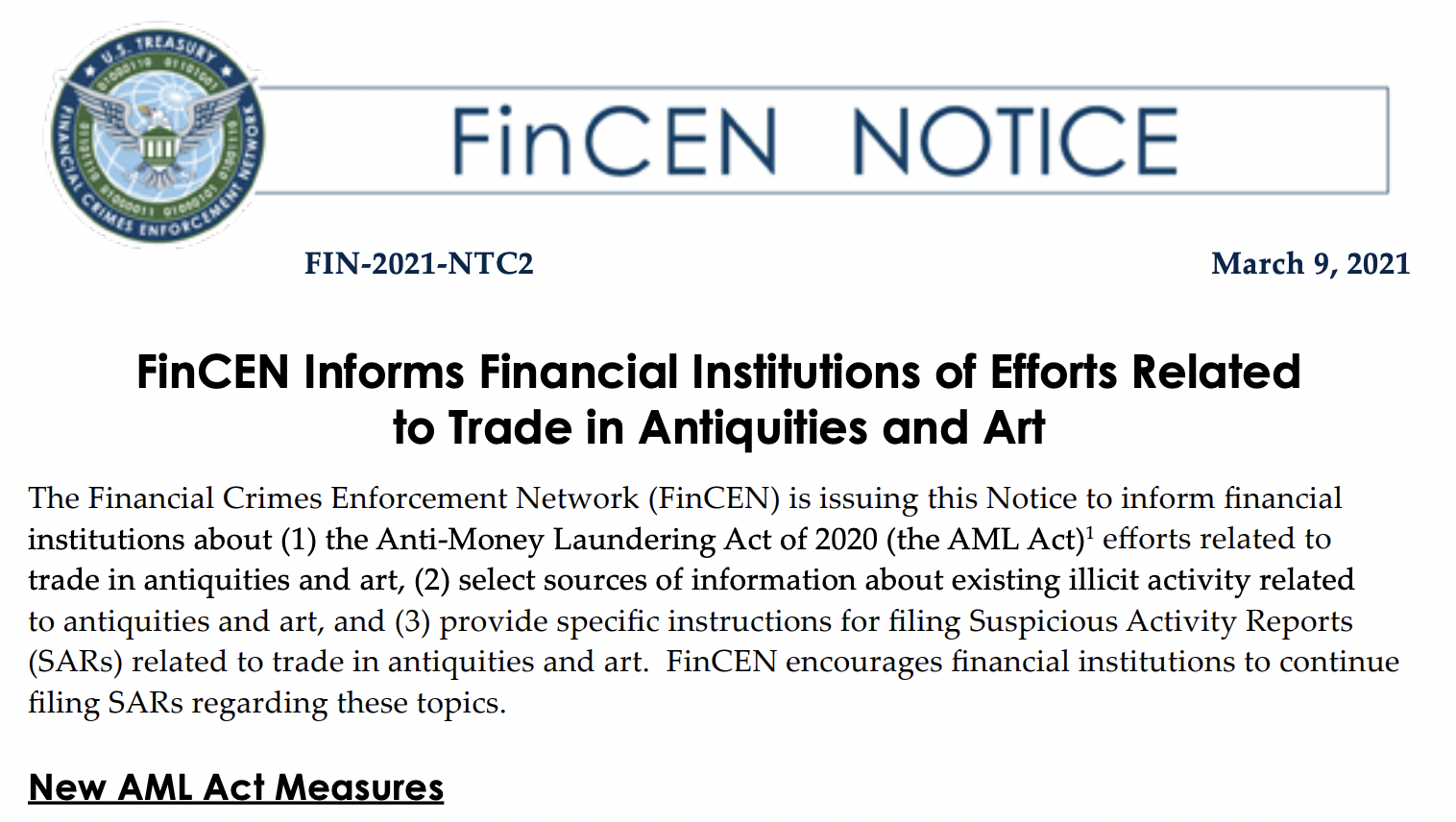
Regarding the third requirement, suspicious behavior is reported through Suspicious Activity Reports (SARs). SARs should be filed by art market participants in response to questionable conduct (red flags) raised by interactions with parties to an art-related transaction. These reports should include all “available details that may assist in the identification of the (1) objects connected to the financial transactions, (2) other transactions or proposed transactions that may involve antiquities or art, and (3) any other relevant information.” These reports should also include identifying details regarding the actual purchasers, intermediaries or agents, the transaction amount(s), and any beneficial owners of transacting entities.[18] SARs serve as a streamline for oversight by government agencies seeking to minimize ML.
Another example of AMLA 2020 regulations involves the mandated identification and registration of the owners of limited liability companies, which will make it more difficult for embezzlers to hide behind shell corporations for transactions in art.[19] In addition to these duties imposed on antiquities dealers, AMLA 2020 ordered the Department of the Treasury to conduct a study of the art market, generally, to determine whether similar due diligence requirements should be imposed on art dealers.
OVERALL RISK ASSESSMENT OF THE ART MARKET
The U.S. Department of the Treasury’s 2022 study (the 2022 Study), ultimately “found some evidence of ML risk in the institutional high-value art market but found little evidence of [Terror Financing[20]] risk.”[21] While the study found that, even though some institutional art market participants have inherent incentives to collect client information before dealings, self-incentivising programs are unregulated, may be ineffective, and could be suspended at any time.[22] Private art dealers, the 2022 Study continued, relied on anything from “gut feelings” and intuition to legal counsel and background checks to spot red flags.[23] Such variation in ways that art market participants dealt with ML subterfuge illuminated the need for codified regulations, explained the study.[24]
The 2022 Study further explained that, through art market common practices, certain sectors of the market are at less of a risk for facilitating ML than others. Those sectors at a higher risk include: auction houses, online marketplaces, museums/universities/nonprofits, third party intermediaries, and art finance institutions.[25] The ability to identify a beneficial owner is more difficult in these fields because of their long-standing history of opacity in dealings.[26] Conversely, those sectors at lower risk for the facilitation of ML include: galleries, art fairs, banks, free trade zones, and art storage facilities. The study cites the commonality of in-person exchanges, previously implemented regulations, and personal relationships as the reason for lower risk in these sectors.[27] Surprisingly, the study ultimately concluded that other areas of financial transactions deserved more focus for the implementation of AML/CFT regulations than the art market.[28]
Entitled Study of the Facilitation of Money Laundering and Terror Finance Through the Trade in Works of Art,[29] the 2022 Study explained that such aspects that make the art market most vulnerable to ML efforts include the opacity, anonymity and confidentiality of transactions involving art.[30] These factors, coupled with the transportability and subjective value of art in the international market, allow sanctioned or otherwise regulated individuals to launder funds through art. The study references the 2005 bankruptcy of Banco Santos in Brazil where founder Edemar Cid Ferreira was able to avoid government seizure of an $8 million Basquait painting[31] by shipping it to the U.S. in a crate valued on customs forms at $100.[32] The study explained that border authorities are often not equipped to appraise art in order to verify valuations on customs documents. Also, shipping art internationally can be accomplished with ease because of the relative transportability of much art compared to other high-value goods. Further, the “human element” of many art transactions allows oft-unintentional loopholes for illicit actors to exploit. Therefore, the objective of much regulation in this arena seeks to create a new art market milieu: one of self-governance and transparency.
RED FLAGS
In a trade that flourishes on handshakes and impulse acquisition decisions based on aesthetics, lore and gut feelings about a party can no longer hold water with respect to due diligence. Asking direct questions such as “where is the money coming from?”, “who is the ultimate beneficiary of the entity that is buying/selling?”, and “what personal-identification documentation can you provide?” are progressively becoming the new norm. Uncovering the identities of beneficial owners can prove challenging, particularly for entities with smaller resource bases. Therefore, the best way to prevent liability in the newfound push against ML in the art industry is to stay vigilant for possible red flags. The Responsible Art Market Initiative (RAM) has published guidelines to help art market participants apply such a risk-based approach. RAM’s guidance lists possible red flags, including:
- Individuals who and entities that wish to transact in art at extreme prices (both low and inflated);
- Clients who ask probing questions about an art market participant’s reporting procedures for suspicious activity, financial matters, and tax processes;
- A lack of proof regarding valid ownership of a work;
- Clients who suggest highly complex procedures for executing a sale or purchase;
- Buyers who arrange payments to or from third parties,
- If third parties are involved, request information and verified documentation to establish a link between a third party and the beneficial owner;
- Any exchange involving Politically Exposed Persons (PEPs), persons known to be subject to criminal or regulatory investigation or people proximate to the same;
- New clients from high risk jurisdictions or jurisdictions where ML regulations are less stringent;
- Any exchange involving offshore companies, trusts, foundations, or associations;
- Any use of an intermediary on behalf of an undisclosed beneficial owner.
When any of these red flags are present over the course of a transaction, enhanced due diligence efforts including additional documentation, verification, etc. is necessary.[33]
These red flags are not the only way due diligence is to be bolstered in the coming years. The 2022 study proposed regulatory and non-regulatory oversight options for the art market as well. Such regulatory options include (1) providing government support for the creation and enhancement of private sector information-sharing programs to encourage transparency among art market participants and (2) updating guidance and training for law enforcement, customs enforcement, and asset recovery agencies.[34] Non-regulatory options would focus on (1) using targeted recordkeeping and reporting requirements to support information collection and ML activity analyses and (2) applying comprehensive AML/CFT measures to certain art market participants.
Stricter regulations and delineated best practices are assuring, now more than ever, that dirty money cannot flow through trade in nonfungible assets. It is likely that such regulations will not be constrained to antiquities much longer. The Enablers Act, (“Establishing New Authorities for Businesses Laundering and Enabling Risks to Security Act,”) introduced as H.R. 5525 by Rep. Tom Malinowski on October 8, 2021, seeks to further expand the definition of “financial institution” under the BSA to include, any “person engaged in the trade in works of art, antiques, or collectibles, including a dealer, advisor, consultant, custodian, gallery, auction house, museum, or any other person who engages as a business in the solicitation or the sale of works of art, antiques, or collectibles.[35]” The push for transparency in the art industry seems to have just begun. Sellers and buyers who wish to remain forces in the art field must now integrate due diligence into their general business practices not only to avoid fines and censure but also to cultivate a reputation worthy of the well-meaning art market actors who characterize the industry.
Many dealers in the art community fear that these new regulations will pose a threat to the status-quo of interactions with their clients.[36] Some professionals even cite their reputation for anonymity as the basis for their business model.[37] Now with due diligence requirements imposed by FinCEN, that long-standing business model is ousted.[38] As explained, intermediaries may no longer conceal the identity of their client, offshore accounts will experience greater scrutiny, and third party-related transactions will require adequate documentation to send and receive funds on behalf of parties. Identifying ultimate beneficial owners will be the crux of dealings in art moving forward. The veil between seller and buyer, which has so-long been characteristic of dealings in art, is being torn down. While the primary push regarding these new regulations is market participant education and compliance development, the ways this shift will impact the art market long-term have yet to be seen.
Disclaimer: This article is intended for general information only and is not meant to provide legal advice. Readers should not construe or rely on any comment or statement in this article as legal advice. Opinions expressed are those of the author.
About the Author: Blake Konkol is a law student at the Pennsylvania State University and holds a B.A. in Art History from the University of Florida. Blake is a 2022 Summer legal intern at the Center for Art Law. In addition to his studies, Blake enjoys the outdoors, podcasts, vibrant artwork, and botany.
This article has been written under the review and guidance of Sophie Balaÿ, Attorney at Law and CFCS, VIDOCQ.
Select Sources [pending update]:
- Ethan Stern, “Anti-Money Laundering Regulation in the Art Market,” Columbia Business Law Review (Apr. 22, 2020), https://journals.library.columbia.edu/index.php/CBLR/announcement/view/309
- “OFFICE OF FOREIGN ASSETS CONTROL Specially Designated Nationals and Blocked Persons List” available at https://www.treasury.gov/ofac/downloads/sdnlist.pdf.
- “FinCEN Informs Financial Institutions of Efforts Related to Trade in Antiquities and Art” (March 9, 2021) available at https://www.fincen.gov/sites/default/files/2021-03/FinCEN%20Notice%20on%20Antiquities%20and%20Art_508C.pdf
- Steve Schindler & Katie Wilson-Milne, “How Anti-Money Laundering Regulations are Hitting the Art Market in the United Kingdom and What Participants Can Do to Comply, The Art Law Podcast,” (June 2, 2021), Apple Podcasts Link.
- What is Money Laundering?, Int’l Compliance Ass’n, https://www.int-comp.org/careers/your-career-in-aml/what-is-money-laundering/ [https://perma.cc/FBB7-U5K4
Footnotes:
-
Ethan Stern, Anti-Money Laundering Regulation in the Art Market, Columbia Business Law Review (Apr. 22, 2020), https://journals.library.columbia.edu/index.php/CBLR/announcement/view/309 ↑
-
U.S. Dept. of Treasury, Office of Foriegn Assets Control, Specially Designated Nationals and Blocked Persons List (July 22, 2022), available at https://www.treasury.gov/ofac/downloads/sdnlist.pdf ↑
-
What is Money Laundering?, Int’l Compliance Ass’n, https://www.int-comp.org/careers/your-career-in-aml/what-is-money-laundering/ [https://perma.cc/FBB7-U5K4 ↑
-
Committee on Homeland Security and Governmental Affairs, Permanent Subcommittee on Investigations, Staff Report: The Art Industry and U.S. Policies that Undermine Sanctions (2020), available at https://www.hsgac.senate.gov/imo/media/doc/2020-07-29%20PSI%20Staff%20Report%20-%20The%20Art%20Industry%20and%20U.S.%20Policies%20that%20Undermine%20Sanctions.pdf ↑
-
Id. at 3. ↑
-
Id. at 1. ↑
-
Id. at 116. ↑
-
Committee on Homeland Security and Governmental Affairs, Permanent Subcommittee on Investigations, Staff Report: The Art Industry and U.S. Policies that Undermine Sanctions at 116 (2020), available at https://www.hsgac.senate.gov/imo/media/doc/2020-07-29%20PSI%20Staff%20Report%20-%20The%20Art%20Industry%20and%20U.S.%20Policies%20that%20Undermine%20Sanctions.pdf ↑
-
Increased regulations aim not only at actors within Russian spheres but also at otherwise sanctioned individuals in varying international spheres. ↑
-
The United Kingdom has begun to impose hefty fines not just on entities that transact with suspicious parties but on market participants that do not follow the letter of novel due diligence compliance laws themselves. (See: Poppy Kemp’s article) ↑
-
116 P.L. 283, 2021 Enacted H.R. 6395, 116 Enacted H.R. 6395, 134 Stat. 3388. ↑
-
Bank Secrecy Act legislation includes: 12 U.S.C. 1829b; 12 U.S.c. 1951-1959; 31 U.S.C. 5311-5314; 31 U.S.C. 5316-5336. ↑
-
While commercial banks and insurance companies have been characteristic “financial institutions,” the BSA’s definition also includes transactors such as travel agencies, jewelers, and pawnbrokers. (See: https://bsaaml.ffiec.gov/manual/Appendices/05) ↑
-
BSA at §6110(a)(1)(b) (H.R. 6395, 116) ↑
-
Hannah Miller, National Defense Authorization Act Imposes Anti-Money Laundering Regulations on Antiquities Market and Calls For Study on Role of Art Market in Money Laundering, Hughes Hubbard & Reed Art Law (Jan. 11, 2021), https://www.hhrartlaw.com/2021/01/national-defense-authorization-act-imposes-anti-money-laundering-regulations-on-antiquities-market-and-calls-for-study-on-role-of-art-market-in-money-laundering/ ↑
-
FinCEN, FinCEN Reminds Financial Institutions that the CDD Rule Becomes Effective Today, Financial Crimes Enforcement Network (May 11, 2018), https://www.fincen.gov/news/news-releases/fincen-reminds-financial-institutions-cdd-rule-becomes-effective-today#:~:text=FinCEN%20issued%20the%20CDD%20Rule%2C%20which%20amends%20Bank,their%20illicit%20activities%20and%20launder%20their%20ill-gotten%20gains ↑
-
Id. ↑
-
Id. ↑
-
The US Art Market is Largely Unregulated, but New AML Legislation Means We’re In for a Reckoning, Arternal, https://arternal.com/blog/the-us-art-market-is-largely-unregulated-but-new-aml-legislation-means-were-in-for-a-reckoning/ ↑
-
Terror Financing, while determined not to be a legitimate risk within the art market, entails provisioning funds to terrorism-related actors. Often, ML and TF risks compound with one another because both require skirting similar regulations intended to oust such illegal activity. ↑
-
U.S. Dept. of the Treasury, Study of the Facilitation of Money Laundering and Terror Financing Through the Trade in Works of Art at 1, (Feb. 2022), https://home.treasury.gov/system/files/136/Treasury_Study_WoA.pdf ↑
-
Committee on Homeland Security and Governmental Affairs, Permanent Subcommittee on Investigations, Staff Report: The Art Industry and U.S. Policies that Undermine Sanctions at 6 (2020), available at https://www.hsgac.senate.gov/imo/media/doc/2020-07-29%20PSI%20Staff%20Report%20-%20The%20Art%20Industry%20and%20U.S.%20Policies%20that%20Undermine%20Sanctions.pdf ↑
-
Id. ↑
-
Id. ↑
-
U.S. Dept. of the Treasury, Study of the Facilitation of Money Laundering and Terror Financing Through the Trade in Works of Art at 11-25, (Feb. 2022), https://home.treasury.gov/system/files/136/Treasury_Study_WoA.pdf ↑
-
Id. ↑
-
Id. ↑
-
U.S. Dept. of the Treasury, Study of the Facilitation of Money Laundering and Terror Financing Through the Trade in Works of Art at 1, (Feb. 2022), https://home.treasury.gov/system/files/136/Treasury_Study_WoA.pdf ↑
-
U.S. Dept. of the Treasury, Study of the Facilitation of Money Laundering and Terror Financing Through the Trade in Works of Art, (Feb. 2022), https://home.treasury.gov/system/files/136/Treasury_Study_WoA.pdf ↑
-
Art Advisory, Advisory and Guidance on Potential Sanctions Risks Arising from Dealings in High-Value Artwork at 20, United States Department of the Treasury (Oct. 30, 2020), https://home.treasury.gov/system/files/126/ofac_art_advisory_10302020.pdf ↑
-
The US Art Market is Largely Unregulated, but New AML Legislation Means We’re In for a Reckoning, Arternal, https://arternal.com/blog/the-us-art-market-is-largely-unregulated-but-new-aml-legislation-means-were-in-for-a-reckoning/ ↑
-
U.S. Dept. of the Treasury, Study of the Facilitation of Money Laundering and Terror Financing Through the Trade in Works of Art at 4, (Feb. 2022), https://home.treasury.gov/system/files/136/Treasury_Study_WoA.pdf ↑
-
Responsible Art Market (RAM), Red Flags List (2017), http://responsibleartmarket.org/wp/wp-content/uploads/2017/01/RED-FLAG-LISTS_web.pdf ↑
-
U.S. Dept. of the Treasury, Study of the Facilitation of Money Laundering and Terror Financing Through the Trade in Works of Art (Feb. 2022), https://home.treasury.gov/system/files/136/Treasury_Study_WoA.pdf ↑
-
Nicholas O’Donnell, “ENABLERS Act” Pursues Art Market but Threatens Longstanding Protections Against Government Intrusion, JDSUPRA (July 21, 2022), https://www.jdsupra.com/legalnews/enablers-act-pursues-art-market-but-3546971/. ↑
-
Steve Schindler & Katie Wilson-Milne, “How Anti-Money Laundering Regulations are Hitting the Art Market in the United Kingdom and What Participants Can Do to Comply, The Art Law Podcast,” (June 2, 2021), Apple Podcasts: https://podcasts.apple.com/us/podcast/the-art-law-podcast/id1336581302?i=1000540338475 ↑
-
Id. ↑
-
Id. ↑
Disclaimer: This article is for educational purposes only and is not meant to provide legal advice. Readers should not construe or rely on any comment or statement in this article as legal advice. For legal advice, readers should seek a consultation with an attorney.


