• About
    • Mission
    • Team
    • Boards
    • Mentions & Testimonials
    • Institutional Recognition
    • Annual Reports
    • Current & Past Sponsors
    • Contact Us
  • Resources
    • Article Collection
    • Podcast: Art in Brief
    • AML and the Art Market
    • AI and Art Authentication
    • Newsletter
      • Subscribe
      • Archives
      • In Brief
    • Art Law Library
    • Movies
    • Nazi-looted Art Restitution Database
    • Global Network
      • Courses and Programs
      • Artists’ Assistance
      • Bar Associations
      • Legal Sources
      • Law Firms
      • Student Societies
      • Research Institutions
    • Additional resources
      • The “Interview” Project
  • Events
    • Worldwide Calendar
    • Our Events
      • All Events
      • Annual Conferences
        • 2026 Art Law Conference
        • 2025 Art Law Conference
        • 2024 Art Law Conference
        • 2023 Art Law Conference
        • 2022 Art Law Conference
        • 2015 Art Law Conference
  • Programs
    • Visual Artists’ Legal Clinics
      • Art & Copyright Law Clinic
      • Artist-Dealer Relationships Clinic
      • Artist Legacy and Estate Planning Clinic
      • Visual Artists’ Immigration Clinic
    • Summer School
      • 2026
      • 2025
    • Internship and Fellowship
    • Judith Bresler Fellowship
  • Case Law Database
  • Log in
  • Become a Member
  • Donate
  • Log in
  • Become a Member
  • Donate
Center for Art Law
  • About
    About
    • Mission
    • Team
    • Boards
    • Mentions & Testimonials
    • Institutional Recognition
    • Annual Reports
    • Current & Past Sponsors
    • Contact Us
  • Resources
    Resources
    • Article Collection
    • Podcast: Art in Brief
    • AML and the Art Market
    • AI and Art Authentication
    • Newsletter
      Newsletter
      • Subscribe
      • Archives
      • In Brief
    • Art Law Library
    • Movies
    • Nazi-looted Art Restitution Database
    • Global Network
      Global Network
      • Courses and Programs
      • Artists’ Assistance
      • Bar Associations
      • Legal Sources
      • Law Firms
      • Student Societies
      • Research Institutions
    • Additional resources
      Additional resources
      • The “Interview” Project
  • Events
    Events
    • Worldwide Calendar
    • Our Events
      Our Events
      • All Events
      • Annual Conferences
        Annual Conferences
        • 2026 Art Law Conference
        • 2025 Art Law Conference
        • 2024 Art Law Conference
        • 2023 Art Law Conference
        • 2022 Art Law Conference
        • 2015 Art Law Conference
  • Programs
    Programs
    • Visual Artists’ Legal Clinics
      Visual Artists’ Legal Clinics
      • Art & Copyright Law Clinic
      • Artist-Dealer Relationships Clinic
      • Artist Legacy and Estate Planning Clinic
      • Visual Artists’ Immigration Clinic
    • Summer School
      Summer School
      • 2026
      • 2025
    • Internship and Fellowship
    • Judith Bresler Fellowship
  • Case Law Database
Home image/svg+xml 2021 Timothée Giet Our articles image/svg+xml 2021 Timothée Giet AL Clippings image/svg+xml 2021 Timothée Giet Liquidating Assets When the Asset is an Andy Warhol
Back

Liquidating Assets When the Asset is an Andy Warhol

May 4, 2013

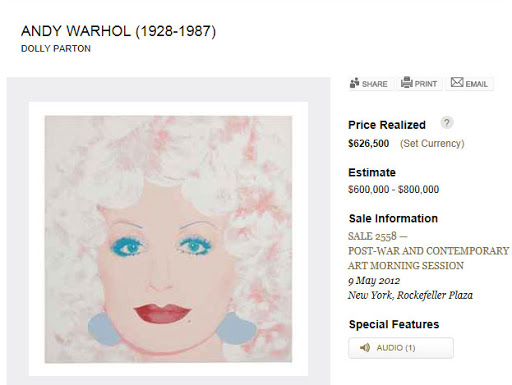
Andy Warhol, Portrait of Dolly Parton, from Christie’s May 2012
Post-War and Contemporary Art Morning Session.  The
provenance lists that the Andy Warhol Foundation sold it to a
private collector (now known as Chris Schoen).
Bank of America has filed a complaint against real estate developers Chris Schoen and Hal Barry in Atlanta after they defaulted on their $4.5 million loan.  They are requiring Schoen and Barry to liquidate assets—these assets include four paintings owned by Schoen appraised by Christie’s at $3.1 million. In addition, the bank is calling foul: at the May 2012 Christie’s Contemporary Art Sale Schoen sold his Portrait of Dolly Parton by Andy Warhol for $626,500 (Sale 2558, Lot 158) and failed to report the income to the bank. Bank of America is seeking Schoen’s four remaining paintings, the $626,500 profit from the Warhol sale, attorney’s fees, interest of $424 per day, and complete repayment. The lawsuit filed in the Northern District of Georgia Atlanta Division on April 22, 2013, Bank of America v. Barry Real Estate Companies, Inc., Bstwenty, LLC, Christian B. Shoen and Harold V. Barry, states:

“Plaintiff desires to repossess and sell the Artwork and is entitled to take possession of the Artwork and any proceeds from the sale of Artwork, possession of which has been wrongfully withheld from Plaintiff by Schoen. Schoen has advised Plaintiff that he will not sell or turnover the remaining Artwork in his possession, custody or control and has failed to turn over the $555,000.00 (net) generated from the May 2012 sale of the Portrait of Dolly Parton…. Schoen’s failure and/or refusal to relinquish control and possession of the Artwork and proceeds therefore is in bad faith, constitutes stubborn litigiousness, and has caused Plaintiff unnecessary trouble and expense thereby entitling Plaintiff to recover its expenses of litigation, including reasonable attorney’s fees and costs pursuant to O.C.G.A § 13-6-11.”

Hal Barry celebrating the opening of his helipad in Atlanta. 
When Schoen and Barry applied for the loan in 2007, they used the paintings as collateral–promising the artwork and its sale proceeds to cover the loan in the event of default.  

The use of artwork as collateral is becoming more common—both banks and auction houses have special departments to appraise artwork and special requirements to define artwork as collateral on loan applications. The art as collateral business has boomed with the recent economic downturn.  Where individuals seeking a loan would have previously used a house or property as a guarantee, now use artwork.  In some cases, artwork can be the only valuable asset remaining.  
However, the risks and results of art based loans have proven to be disastrous for many borrowers. These include:
  • High interests rates that can range from 9% to 25%


  • Borrowers can only lend 40% of the artwork’s value


  • Borrowers must personally guarantee each art loan, which is not the case in mortgages


  • The value of art work changes with the seasons and popular taste very quickly- therefore when borrowers default on loans they are forced to sell their artwork at a time when the market may be poor and end up selling them below market value


  • Banking practices in this area are unregulated and highly litigious: Marc Porter of Christie’s told The New York Times, “It’s a rough-and-tumble corner of the business.”


The fable of such a disastrous outcome is Annie Leibovitz highly publicized default.  Leibovitz took out a loan from the Art Capital Group in 2008, using her New York City properties, existing photographs, and future photographs– including their copyright as a guarantee.  She defaulted and the Art Capital Group sued for breach of contract on July 28, 2009.  Leibovitz was able to settle by selling portions of her real estate and a small amount of photographs– all when the art and real estate markets were low.  The original loan was for $24 million.  During refinancing Leibovitz continued to pay 44% interest, totally $16 million over the course of 18 months.   
Annie Leibovitz in front of her portrait of Demi Moore.


Some banks, however, argue that using artwork as collateral opens new doors to clients who would not normally be granted a loan.  For example, banks advertise that by using artwork as collateral museums (with their boards permission) can use loans to bridge budget gaps and make large purchases to expand their collections.  At a time when most museums are struggling financially and not able to sell artworks to cover overhead, loans guaranteed with artwork can be a viable solution.  Many banks believe that they are providing a service to museums in need- the knights in shining armor with a hidden agenda.  According to Gerald Peters, a collector himself, “The game they have to play is rough.  But the service they are providing is real, and there’s demand for it.” 
Art based loans are also becoming increasingly popular as tools for art speculation.  The art saavy are trading art like hedge funds with the hope of quick profit.  Most art advisors discourage these practices because of the high risk.  Constanze Kubern, a London based art advisor, stated: 

“It’s a commonly used fund management tool; if you know a market is going up, and you can get a lending rate that is below that percentage, then you take on leverage [ie: a loan] to make a profit.  Unfortunately, you cannot pin down the value of a piece of art as precisely as that of a daily traded commodity, and therefore [borrowing] can prove quite difficult when it comes to managing an art collection.” 

Chris Shoen
Many banks are aggressive in pursuing repayment of art based loans, and it is not surprising that Barry and Schoen are now on Bank of America’s radar.Barry and Schoen hardly have a leg to stand on since they signed the Pledge Agreement using artwork as the security. When loans default, lawsuits follow; when the collateral is artwork, the asset is liquidated like any other property Bank of America, the attorneys of Hall Barry and Chris Schoen, and Christie’s have all refused to comment on the lawsuit.
Sources: “Bank of America Sues Atlanta Developer, Eyes Dolly Parton Portrait Proceeds,” Atlanta Business Chonicle, April 24, 2013; “Companies Default on Loans, Bank of America Goes After its Artwork,” ABC news, April 26, 2013; “Need a loan? Use Your Art,” The Art Newspaper, September, 28, 2012; “Photographer Annie Leibovitz Must Repay $24 Million Loan by Tuesday,” The Huffington Post, September 6, 2009; Christie’s Sale Results, Sale 2558, Lot 158; “That Old Master? It’s at the Pawn Shop,” The New York Times, February 23, 2009; “Art Capital Made at Least $16 Million Off Annie Leibovitz,” Reuters, April 6, 2010.

Disclaimer: This article is for educational purposes only and is not meant to provide legal advice. Readers should not construe or rely on any comment or statement in this article as legal advice. For legal advice, readers should seek a consultation with an attorney.

Post navigation

Previous Guardianship of Zao Wou-ki’s Estate in Dispute
Next Part II: UNESCO Forced to Consider Street Art as Cultural Heritage

Related Art Law Articles

CfAL photo from Rietberg Museum
Art law

Inspiration and Investment: The Benin Bronzes in Western Art and the Market

September 21, 2026
Italy's Bill 2834 A Pathway Toward Restituting Jewish Owned Art
Art lawItalylegislative historyNazi-era looted art

Italy’s Bill 2834: A Pathway Toward Restituting Jewish-Owned Art

September 17, 2026
CfAL Office Photo
AL Clippings

New York City’s Salary Transparency Law In Effect (2022)

September 17, 2026
Center for Art Law
AML Guide 2025

AML Guide 2025

Explore our updated AML Survey with key insights on how evolving regulations impact the art market.

Download here
Center for Art Law

Follow us on Instagram for the latest in Art Law!

The Gelman Collection, one of the most significant The Gelman Collection, one of the most significant collections of modern Mexican art, is at the center of an ongoing legal and financial controversy. With works by Frida Kahlo, Diego Rivera, María Izquierdo, and others, the collection raises complex questions about the protections afforded to National Artistic Monuments under Mexican law. 

Paula Gutierrez de Villasante examines what the collection's uncertain future could mean for Mexico’s cultural heritage. 

📚Read the full article at the link in our bio!

#ArtLaw #CulturalHeritage #MexicanArt #FridaKahlo #ArtFinance
Learn about Artist Corporations-- exploring what t Learn about Artist Corporations-- exploring what they are, how they work, and the legal and practical considerations for artists!

Please note, this is a hybrid event. Participants are welcome to attend either in person or online via Zoom..

Join the Center for Art Law for Artist Corporations: A New Legal Framework for Creative Practice, a conversation exploring the Colorado Artist Companies Act and what it could mean for artists, lawyers, policymakers, and the broader creative economy.

In 2025, Colorado enacted Senate Bill 133, creating the Artist Corporation (A-Corp); a first-of-its-kind legal business structure designed specifically to recognize and support artists and creative professionals. The legislation offers a new model for balancing artistic practice with sustainable business and legal protections, raising important questions about how the law can better serve creative communities.

Join us for a discussion featuring Lindsay Korotkin, Yancey Strickler, and Sarah Darlene, who will examine the origins of the Artist Corporation, the legislative process behind its creation, and its practical implications for working artists. Drawing on their respective backgrounds in law, advocacy, entrepreneurship, and artistic practice, the panelists will discuss how this innovative legal framework came to fruition, how artists may benefit from it, and whether similar legislation could shape the future of creative industries beyond Colorado.

Following the panel discussion, attendees will have the opportunity to participate in a live audience Q&A as well as a Networking Reception. 

🎟️ Grab your tickets today using the link in our bio!

#centerforartlaw #artlaw #colorado #artistissues
For more than two decades, thousands of counterfei For more than two decades, thousands of counterfeit works attributed to Canadian Anishinaabe artist Norval Morrisseau circulated through galleries, auctions, and private collections. The resulting forgery scandal has made authenticating Morrisseau’s work increasingly difficult and raised larger questions about protecting artists' legacies and the integrity of the art market. 

In her article, Victoria Cook examines the history of the Morrisseau forgery ring and how emerging technologies could help distinguish genuine works from fakes. 

📚 Read the full article at the link in our bio!

1st 📷: Norval Morrisseau, Observations of the Astral World (c. 1994), acrylic on canvas, 236 x 514 cm, National Gallery of Canada, Ottawa

#ArtLaw #ArtForgery #NorvalMorrisseau #IndigenousArt #CanadianArt
Don't miss grabbing tickets for our upcoming Collo Don't miss grabbing tickets for our upcoming Colloquium with Dr Michail Risvas, Lecturer in Law and Co-Director of the Centre for International Law and Globalisation at the University of Southampton, on the growing role of arbitration in the art and cultural heritage sector. 

Drawing on his research and practical examples, Professor Risvas will examine how arbitration is being used to resolve a broad range of art-related and cultural heritage disputes. The program will compare arbitration with traditional litigation, exploring the advantages and limitations of each forum.

Through discussion of case examples and emerging trends, participants will gain a practical understanding of when arbitration may offer a more effective path than litigation and how alternative dispute resolution is shaping the future of art and cultural heritage law.

🎟️ Grab your tickets today using the link in our bio!!

#centerforartlaw #artlaw #legal #artlawyer #lawyer #arbitration #artmarket #artist #culturalheritage
Join the Center for Art Law along with Dr Michail Join the Center for Art Law along with Dr Michail Risvas, Lecturer in Law and Co-Director of the Centre for International Law and Globalisation at the University of Southampton, on the growing role of arbitration in the art and cultural heritage sector. Drawing on his research and practical examples, Professor Risvas will examine how arbitration is being used to resolve a broad range of art-related and cultural heritage disputes. The program will compare arbitration with traditional litigation, exploring the advantages and limitations of each forum.

Through discussion of case examples and emerging trends, participants will gain a practical understanding of when arbitration may offer a more effective path than litigation and how alternative dispute resolution is shaping the future of art and cultural heritage law.

🎟️ Grab your tickets today using the link in our bio!!

#centerforartlaw #artlaw #legal #artlawyer #lawyer #arbitration #artmarket #artist #culturalheritage
And just like that, we’ve reached the end of an in And just like that, we’ve reached the end of an inaugural ART & LAW INTENSIVE ✨

Five-day program filled with challenging questions, fascinating discussions, new perspectives, and meaningful encounters at the intersection of visual art and law.

Grateful for the conversations, the knowledge shared, and everyone who made this experience so enriching. 

Until the next chapter in February!
Our last (August) newsletter received excellent vi Our last (August) newsletter received excellent viewing (in September). Welcome back from vacations! You may be pleased to know that our ART x LAW INTENSIVE in Zurich went as promised and we were delighted to have shared with and learned from so many wonderful experts, colleagues, and fellow travelers. Special guests came from North and South America, across Europe, even India and UAE. Without skipping a beat, today we onboard our Fall 2026 Interns, students from Cardozo, NYU, Smith College and other schools, and we are pleased to welcome our 2026-2027 Judith Bresler Fellow, Alexander Stanfield.

Please take a look at our SEPTEMBER newsletter and plan to join us this fall for in person or online events. Thank you to all who have reached out and offered to volunteer over the summer and recently. We are humbled by the growing interest and will keep offering learning and hands-on opportunities as the size of our organization permits. Stay calm and … 

📚 Click the link in our bio to get a curated collection of art law news, our most recent published articles, upcoming events, and much more!!

#centerforartlaw #artlaw #newsletter #september #legalresearch
What does it take to report and write a story abou What does it take to report and write a story about stolen art, war, and the people caught at the center of it?

In our latest episode of Art in Brief, Andrea and Paris are joined by Matthew Campbell, award-winning reporter for Bloomberg Businessweek and author of The Man Who Stole the Gods, to discuss his years-long investigation into the looting and trafficking of ancient Khmer artifacts from Cambodia.

We talk about Matthew’s research and reporting process, why he chose to center the story around the book’s main characters, and how he approached telling the stories of complicated figures with nuance and empathy.

🎙️ Listen to the latest episode of Art in Brief and find additional resources including a link to Matthew's book at the link in our bio!

#podcast #centerforartlaw #artinbrief #bloomberg #artcrime
What happens to an artist’s work, archives, and in What happens to an artist’s work, archives, and intellectual property after they’re gone? 

Day 2 of the 2026 CPAL Conference brought together lawyers, appraisers, foundation leaders, and arts professionals to tackle the practical realities of preserving artists’ legacies. Topics included estate planning and appraisals, copyright, archives, and the financial realities of running an artist foundation. One message was especially clear: legacy preservation starts long before an artist’s death. 

📚Read Ian Silverstein’s recap of the conference at the link in our bio!

#WYWH #ArtLaw #ArtistEstates #ArtLawConference #ArtAndLaw
Don't miss out on our upcoming Workshop on fiducia Don't miss out on our upcoming Workshop on fiduciary duties within artist-dealer relationships with speaker Aaron Haines!

This workshop will explore the fiduciary duties of gallerists toward their clients and will clarify the distinctions between contract-based relationships and the broader fiduciary obligations gallerists owe, including transparency, prudence, and the prohibition of undisclosed profits. It will also examine common conflicts of interest in the art world and how these fiduciary duties come into play. 

🎟️ Grab your tickets today using the link in our bio!

#centerforartlaw #artlaw #artlawyer #legalresearch #legal #workshop #artistrights #artist #artdealer
The Wilbur J. Cohen Federal Building in Washington The Wilbur J. Cohen Federal Building in Washington, D.C. houses five murals and four reliefs by artists including Ben Shahn and Philip Guston. 
The building is now among federal properties currently slated for sale as the government accelerates selling federal real estate. 

What happens to artworks that are physically inseparable from the buildings they were created for? And what does their uncertain future mean for America’s cultural landscape?

📚 Read Sam Brady-Myerov’s latest article at the link in our bio!

#ArtLaw #CenterforArtLaw #NewDealArt #PublicArt #CulturalHeritage
Did you know the portrait of George Washington on Did you know the portrait of George Washington on the $1 bill traces back to a painting by Gilbert Stuart? 

As the US celebrates its 250th anniversary, one of our latest articles explores how Stuart fought to control the reproduction of his Washington portraits at a time when U.S. copyright law did not yet protect paintings. 

📚 Read the full article by Hannah Gadway at the link in our bio! 

#ArtLaw #America250 #GilbertStuart #GeorgeWashington #CopyrightLaw
  • About the Center
  • Contact Us
  • Newsletter
  • Upcoming Events
  • Internship
  • Case Law Database
  • Log in
  • Become a Member
  • Donate
DISCLAIMER

Center for Art Law is a New York State non-profit fully qualified under provision 501(c)(3)
of the Internal Revenue Code.

The Center does not provide legal representation. Information available on this website is
purely for educational purposes only and should not be construed as legal advice.

TERMS OF USE AND PRIVACY POLICY

Your use of the Site (as defined below) constitutes your consent to this Agreement. Please
read our Terms of Use and Privacy Policy carefully.

© 2026 Center for Art Law