
Protecting Culture in Times of Conflict
April 8, 2024
By Eric J. Simon
Armed conflicts can potentially destroy not only human lives but also entire cultures. As Dr. Patty Gerstenblith, Distinguished Research Professor of Law at DePaul University, stated during her keynote address at the Kernochan Center’s symposium on Protecting Cultural Property, the significance of the destruction of cultural heritage sites “lies in the people.”[1] This destruction weakens communities and compromises opportunities for peace and reconciliation.[2] It was not until 1954 at the Convention for the Protection of Cultural Property in the Event of Armed Conflict (the “1954 Hague Convention”) that cultural property gained significant protection.[3] Seventy years ago, at the 1954 Hague Convention, a “multilateral treaty was dedicated exclusively to the protection of cultural heritage in times of peace as well as during an armed conflict.”[4] This treaty paved the way for the prosecution of Ahmad al-Faqi al-Mahdi (“al-Mahdi”), which was the first successful prosecution focused exclusively on the criminal destruction of cultural property.[5] This article will focus on the historical background of cultural property protection, the effects of the 1954 Hague Convention, and al-Mahdi’s prosecution.
Legal Protections for Cultural Property

To best understand the current status of cultural heritage protection, it is essential to examine its relevant history. During the French Revolution (1789-1793), the French government nationalized many art collections and created a system for selecting which works were artistically and culturally significant.[6] These collections were seized through unorganized looting, until 1794, when the French government appointed a commission to find “important monuments and science.”[7] The commission would seize objects from “museums, churches, and private collections” and decide whether to keep, destroy, or sell them.[8] However, following Napoleon’s defeat at the Battle of Waterloo in 1815, the French were forced to return pieces of their looted collection to their respective countries.[9] The French conditioned the return of the pieces on the works being made accessible to the public.[10]
Moreover, in the case of Marquis de Somerueles, the Admiralty Court of Halifax recognized the intrinsic value some pieces of property have not just for a singular nation, but for “mankind at large.”[11] In 1813, the American vessel, Marquis de Somerueles, was carrying cargo from the Italian Academy of Arts when it was captured by the British.[12] The United States successfully petitioned the Admiralty Court of Halifax to have the cargo be returned to the United States.[13] The Court held that the arts and sciences are entitled to protection as “an exception to the severe rights of warfare.”[14] Together the Napoleonic Era and the Marquis de Somerueles ruling established a precedent for excluding art from spoils of war; if it is taken, it must be returned.[15]
The Lieber Code of 1863, established by the Union Army and US President Abraham Lincoln, recognized a shift away from “mere moral condemnation” towards actual legal ramifications for destruction of cultural property.[16] While the Lieber Code was mainly unsuccessful in practice, it inspired the codification of binding international rules for the protection of cultural property.[17]
This codification occurred in the Hague Rules of 1899 and 1907, and eventually the 1919 Treaty of Versailles.[18] Together, they established that there is “individual criminal responsibility,” domestically and internationally, for violating the law and customs of war.[19] Then, in 1943, the Allied nations established the United Nations War Crimes Commission (“UNWCC”), to clarify questions left from the Treaty of Versailles, but primarily to assist in the preparation of war crime cases.[20] Throughout World War II, the UNWCC interacted closely with the Vaucher Commission to gather information relating to the damage, destruction, and looting of cultural materials and to index suspects who were involved in the destruction of cultural property.[21]
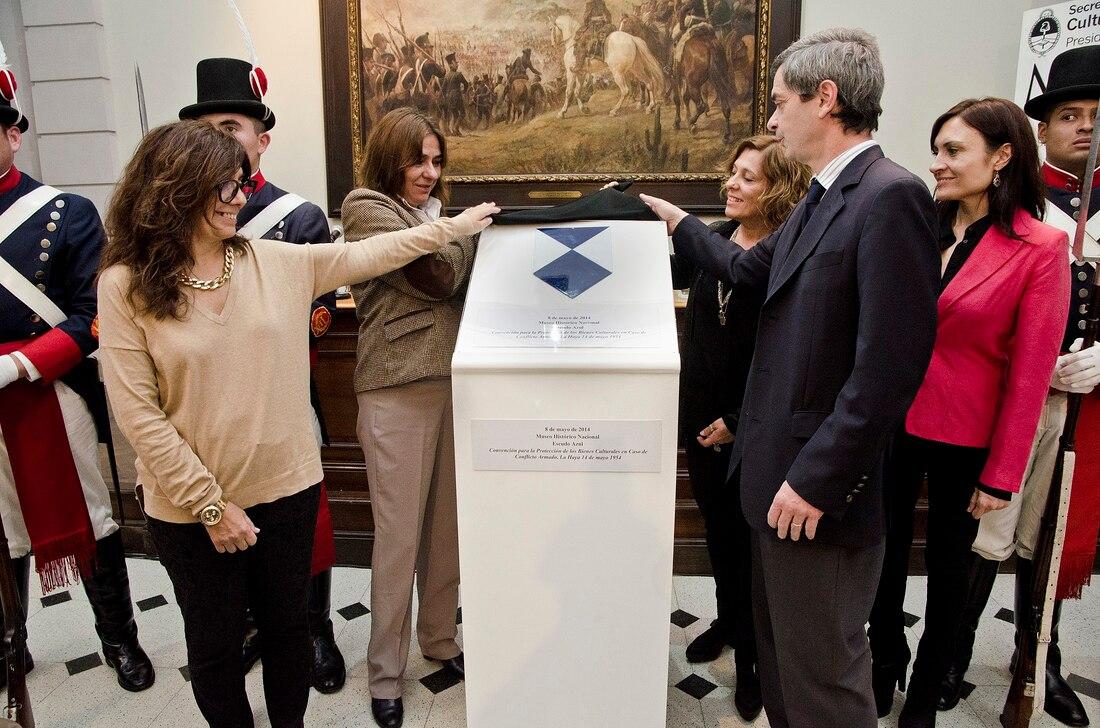
On May 14, 1954, in the aftermath of WWII, the 1954 Hague Convention was adopted.[22] Under the 1954 Hague Convention, “cultural property” is defined as “movable or immovable property of great importance to the cultural heritage of every people.”[23] The 1954 Hague Convention applies in the event of international armed conflict and requires the signed parties to “safeguard” and “respect” cultural property.[24] It effectively created obligations in times of peace and in times of war.[25] According to Articles 16 and 17 of the 1954 Hague Convention, a state can place the distinctive emblem of the Convention on a piece of property to note that it is under special protection.[26] There must also be an authorization signed by the High Contracting Party of the 1954 Hague Convention with the emblem to be considered legitimate.[27] While the 1954 Hague Convention prohibits parties from destroying cultural property, there is a military necessity exception.[28]

Due to the rules of international humanitarian law, the 1954 Hague Convention and its precedents cannot be coherently applied unless individual nations implement them in their domestic and criminal law.[29] Criminal law plays a vital role in enforcement because it holds the individual accountable.[30] However, due to the broad discretion given to signatory nations, the lack of a clear list of offenses, and the lack of jurisdictional grounds within the 1954 Hague Convention, enforcement was extremely difficult.[31]
Consequently, the Second Protocol was created to improve enforcement.[32] The Second Protocol clarified that the military necessity exception may only be utilized if the cultural property advances a military objective and if destroying the cultural property is the only way to obtain the desired military advantage.[33] The Second Protocol also defines five acts that must be criminal offenses under each nation’s laws, and it clarifies the jurisdictional grounds.[34] While the Second Protocol is vital to protecting cultural property and heritage, the United States has not ratified it.
With the Second Protocol paving the way for implementation, establishing a permanent international court was one of the remaining key features of international humanitarian law. On July 17, 1998, one hundred and sixty nations adopted the Rome Statute, a treaty that established the International Criminal Court (“ICC”).[35] The ICC is a permanent court that does not replace national criminal justice systems but rather is an investigative court that only prosecutes when a nation is unable to or refuses to.[36] The ICC has jurisdiction over genocide, war crimes, crimes against humanity, and the crime of aggression.[37] The act of “intentionally directing attacks against buildings dedicated to religion, education, art, science, or charitable purposes, historical monuments or hospitals” is considered a war crime and recently was the subject of an ICC prosecution against al-Mahdi.[38]
Prosecuting Cultural Property Destruction

In Prosecutor v. Ahmad al-Faqi al-Mahdi, the ICC convicted al-Mahdi for the war crime of “intentionally directing attacks against 10 buildings of a religious and historical character in Timbuktu, Mali.”[39] In January 2012, rebel groups in Mali took control over part of the county, and by April, the regional capital of Timbuktu was taken over by the Ansar Dine, a Malian jihadist group and ally of Al Qaeda, where they established the local government, Hesbah.[40] As commander of the Hesbah, al-Mahdi destroyed ten buildings of a religious and historical character in Timbuktu, Mali, and was charged solely under Art. 8(2)(e)(iv) of the Rome Statute.[41]
Al-Mahdi was the first international case focused on the destruction of historical and religious monuments.[42] Under Art. 8(2)(e)(iv), the Prosecution must prove that:
- The perpetrator directed an attack;
- The object of the attack was one or more buildings dedicated to religion, education, art, science or charitable purposes, historic monuments, hospitals or places where the sick and wounded are collected, which were not military objectives;
- The perpetrator intended such building or buildings dedicated to religion, education, art, science or charitable purposes, historic monuments, hospitals or places where the sick and wounded are collected, which were not military objectives, to be the object of the attack;
- The conduct took place in the context of and was associated with an armed conflict not of an international character; and
- The perpetrator was aware of factual circumstances that established the existence of an armed conflict.[43]
The ICC Prosecutors introduced an overwhelming amount of evidence, including self-incriminating videos and interviews.[44] Prior to the launch of the attacks, al-Mahdi wrote and presented a sermon dedicated to the destruction of the mausoleums.[45] While at one of the destroyed sites, al-Mahdi told present journalists that “if a tomb is higher than the others, it must be leveled […] we are going to rid the landscape of anything that is out of place.”[46] While being interviewed at another site, al-Mahdi announced that “[w]hat you see here is one of the ways of eradicating superstition, heresy, and all things or subterfuge which can lead to idolatry.”[47] In light of the amount of self-incriminating evidence and the Prosecution’s ability to corroborate the evidence, al-Mahdi pleaded guilty.[48]

While considering sentencing, the ICC heard testimony from a Malian expert in cultural matters and a UNESCO witness who testified to the importance of the sites destroyed.[49] They classified Timbuktu as an “emblematic city with a mythical dimension” at the “heart of Mali’s cultural heritage.”[50] The destroyed mausoleums and cultural sites “were among the most cherished buildings of the city” and were frequently used as pilgrimage sites.[51] Therefore, the ICC concluded that the sites were not only religious but also contained symbolic and emotional value.[52] Furthermore, nine out of ten of the destroyed sites were UNESCO World Heritage sites.[53] Thus their destruction affected not only the people of Mali but also the international community at large. The ICC balanced the effect of this destruction against al-Mahdi’s cooperation during the trial, his admission of guilt, and the overwhelming evidence directed at him and sentenced him to 9 years of imprisonment.[54]
Effect of al-Mahdi
The al-Mahdi case signifies that the destruction of cultural property is a serious war crime and that there will be accountability for these actions. In the wake of al-Mahdi, the Prosecutor of the ICC, Fataou Bensouda, published the Office of the Prosecutor’s Policy on Cultural Heritage.[55] The policy is a commitment to continue to recognize the importance of investigating and prosecuting crimes against cultural heritage.[56]
The policy is a substantial document that states, “crimes against and affecting cultural heritage are a pervasive feature of the atrocities within the [ICC’s] jurisdiction.”[57] The policy recognizes that cultural heritage includes tangible and intangible expressions of human life.[58] The main objectives of the policy are to clarify the applications and interpretation of the rules, strengthen the protection and prevention of harm to these sites, systematically coordinate the protection of cultural heritage, contribute to international jurisprudence, and raise awareness of the importance of cultural heritage.[59]
Conclusion
The law surrounding cultural heritage has a robust and complex history. At its core is the recognition that cultural sites and property must be protected during times of peace and conflict. “[T]hat all peoples are united by common bonds, their cultures pieced together in a shared heritage, and concerned that this delicate mosaic may be shattered at any time.”[60] Humanity is represented in people and in the objects they build and treasure.
Suggested Readings
- Dr. Patty Gerstenblith, Cultural Objects and Reparative Justice: A Legal Historical Analysis (Cultural Heritage Law and Policy) (2024). (book)
- José Antonio González Zarandona, Emma Cunliffe, and Melathi Saldin, The Routledge Handbook of Heritage Destruction (2023). (book)
- James Cuno & Thomas G. Weiss, Cultural Heritage and Mass Atrocities (2022). (book)
About the Author
Eric J. Simon is a second-year law student at Brooklyn Law School, where he is a member of the Moot Court Honor Society and a staff editor for the Journal of Law & Policy.
Select Sources:
- Dr. Patty Gerstenblith, Professor, DePaul College of Law, Keynote Address at the Kernochan Center for Law, Media, and the Arts Symposium: Protecting Cultural Property: The 1954 Hague Convention at 70 (March 1, 2024). ↑
- The Hague Convention, UNESCO (March 4, 2024 at 2:30 PM) available at https://en.unesco.org/protecting-heritage/convention-and-protocols/1954-convention. ↑
- Id. ↑
- Id. ↑
- Joseph Powderly, Prosecuting Heritage Destruction (July 13, 2022) available at https://www.getty.edu/publications/cultural-heritage-mass-atrocities/downloads/pages/CunoWeiss_CHMA_part-4-25-powderly.pdf ↑
- Cynthia Prieur, Napoleon’s Appropriation of Italian Cultural Treasures, Smarthistory (Oct. 24, 2020) available at https://smarthistory.org/napoleon-italy-culture-looting/. ↑
- Id. ↑
- Id. ↑
- Id. ↑
- Id. ↑
- Marquis de Somerules, 181 (UK, Vice-Admiralty Court of Halifax 1813) available at http://www.kentlaw.edu/faculty/sharding/classes/HardingPropandCultureF2009/CourseDocs/Marquis.pdf. ↑
- Id. at 180. ↑
- Id. at 183. ↑
- Id. at 181. ↑
- Dr. Patty Gerstenblith, supra note 1. ↑
- Joseph Powderly, Prosecuting Heritage Destruction, 431 (July 13, 2022) available at https://www.getty.edu/publications/cultural-heritage-mass-atrocities/downloads/pages/CunoWeiss_CHMA_part-4-25-powderly.pdf. ↑
- Id. ↑
- Id. at 431-32. ↑
- Id. at 432. ↑
- Id. at 432-33. The 2011 reveal of the UNWCC’s archive showed it had a more active involvement in “compiling case files and lists of possible suspects relating to the commission of crimes against cultural heritage” than merely advising. Id. ↑
- Id. at 433-34. ↑
- Benjamin Charlier and Tural Mustafayev, International Humanitarian Law and the Protection of Cultural Property, 384 (July 13, 2022) available at https://www.getty.edu/publications/cultural-heritage-mass-atrocities/downloads/pages/CunoWeiss_CHMA_part-4-22-charlier-mustafayev.pdf. ↑
- Hague Convention for the Protection of Cultural Property in the Event of Armed Conflict art. 1(a), May 14,1954, 240 U.N.T.S. 1956. ↑
- Charlier, supra note 22, at 385. ↑
- Charlier, supra note 22, at 385. ↑
- Hague Convention for the Protection of Cultural Property in the Event of Armed Conflict, supra note 22, at art. 16-17. ↑
- Hague Convention for the Protection of Cultural Property in the Event of Armed Conflict, supra note 22, at art. 17(4). ↑
- Hague Convention for the Protection of Cultural Property in the Event of Armed Conflict, supra note 22, at art. 4(2). ↑
- Charlier, supra note 22, at 386. ↑
- Id. ↑
- Id. at 386-87. ↑
- Id. at 387. ↑
- Second Protocol to The Hague Convention of 1954 for the Protection of Cultural Property in the Event of Armed Conflict art. 6(a), Mar. 26, 1999, 2253 U.N.T.S 172, 214 available at https://treaties.un.org/doc/Publication/UNTS/Volume%202253/v2253.pdf. ↑
- Charlier, supra note 21, at 387. ↑
- Understanding the International Criminal Court, The International Criminal Court 10 (2020) available at https://www.icc-cpi.int/sites/default/files/Publications/understanding-the-icc.pdf. ↑
- Id. ↑
- Id. at 23-24. ↑
- Id. at 24; see also Prosecutor v. Ahmad Al Faqi Al Mahdi, No. ICC-01/12-01/15, Judgment & Sentence (Sept. 27, 2016) available at https://www.icc-cpi.int/sites/default/files/CourtRecords/CR2016_07244.PDF. ↑
- Prosecutor v. Ahmad Al Faqi Al Mahdi, 130 Harv. L. Rev. 7, 1978-79 (May 2017). ↑
- Id. ↑
- Ahmad Al Faqi Al Mahdi at ¶ 10. ↑
- Id. at ¶ 13. ↑
- Id. ↑
- Ronald Niezen, Using Digital Evidence to Prosecute War Crimes, National Magazine (June 8, 2023), available at https://www.nationalmagazine.ca/en-ca/articles/law/opinion/2023/using-digital-evidence-to-prosecute-war-crimes#:~:text=ICC%20prosecutors%20relied%20heavily%20on,large%20amount%20of%20self%2Dincrimination. ↑
- Int’l Cim. Ct., Summary of the Judgment and Sentence in the case of The Prosecutor v. Ahmad Al Faqi Al Mahdi, ¶ 20 (2016) available at https://www.icc-cpi.int/sites/default/files/itemsDocuments/160926Al-MahdiSummary.pdf. ↑
- Ahmad Al Faqi Al Mahdi at ¶ 38(iii). ↑
- Id. at ¶ 38(viii). ↑
- Id. at ¶ 11. ↑
- Int’l Crim. Ct., Summary of the Judgment and Sentence in the case of The Prosecutor v. Ahmad Al Faqi Al Mahdi, ¶ 37 (2016) available at https://www.icc-cpi.int/sites/default/files/itemsDocuments/160926Al-MahdiSummary.pdf. ↑
- Id. ↑
- Id. ↑
- Id. at ¶ 38. ↑
- Id. at ¶ 22. ↑
- Id. at ¶ 68. ↑
- Int’l Crim. Ct., ICC Prosecutor, Fatou Bensouda, publishes Policy on Cultural Heritage: “Cultural heritage is the repository of the human experience throughout the ages. To protect it, is to pay homage to the basic fabric of civilisation and civilizational practice” (2021) available at https://www.icc-cpi.int/news/icc-prosecutor-fatou-bensouda-publishes-policy-cultural-heritage-cultural-heritage-repository. ↑
- Id. ↑
- The Office of the Prosecutor, Policy on Cultural Heritage, 4 (June 2021) available at https://www.icc-cpi.int/sites/default/files/itemsDocuments/20210614-otp-policy-cultural-heritage-eng.pdf. ↑
- Id. ↑
- Id. ↑
- Int’l Crim. Ct., Rome Statute of the Int’l Crim. Ct, Preamble (1998) available at https://www.icc-cpi.int/sites/default/files/RS-Eng.pdf. ↑
Disclaimer: This article is for educational purposes only and is not meant to provide legal advice. Readers should not construe or rely on any comment or statement in this article as legal advice. For legal advice, readers should seek a consultation with an attorney.


You must be logged in to post a comment.