
Redefining Restitution: France’s Legal Shift on Nazi-Looted Art
July 25, 2025
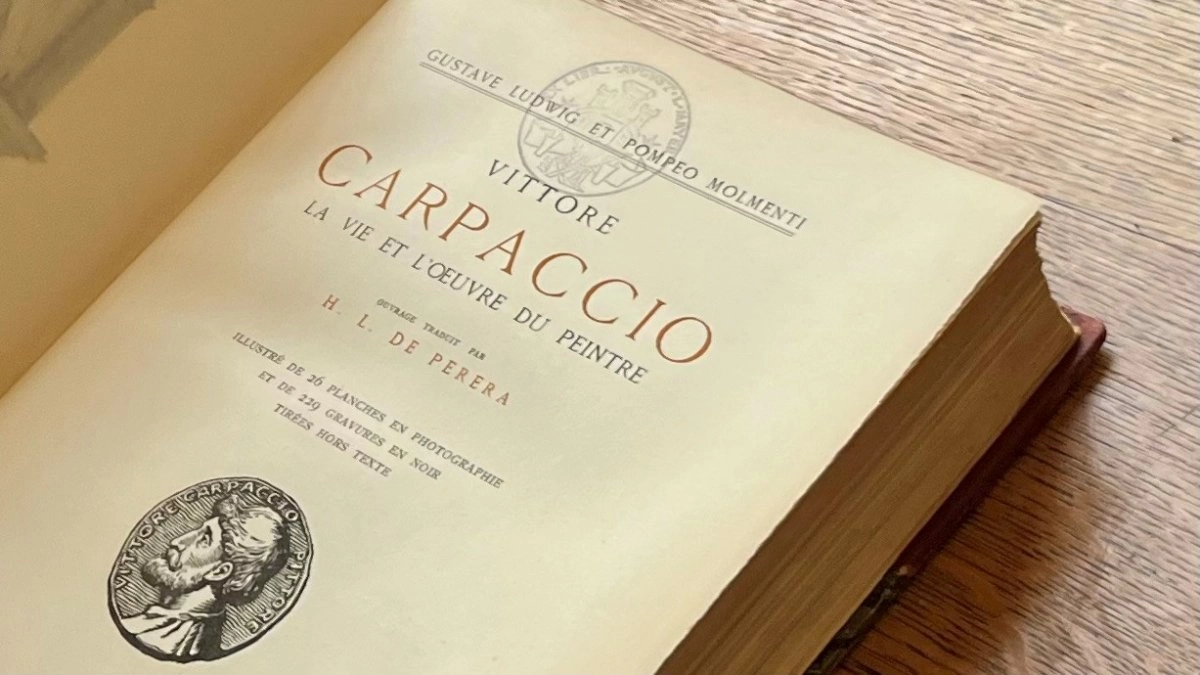
Vittore Carpaccio: La Vie et l’Œuvre du Peintre, Gustave Ludwig & Pompeo Molmenti, H.L. de Perera trans., published c. early 20th c. © CIVS / Bibliothèque nationale de France. This volume, looted from Jewish bookseller Leo Blumenreich during the Nazi era, was among the first items restituted under France’s 2023 restitution law.
By Justine Chen
In the decades since the end of World War II, Nazi-looted art has remained a persistent issue; thousands of artworks from Jewish families during the Holocaust remain unreturned, either lost in time or entangled in legal and bureaucratic red tape. In France, one of the countries deeply affected by Nazi art plunder, the restitution process has historically been slow and cumbersome, constrained by legal doctrines that prioritize the inalienability of public collections over the rights of dispossessed families. While France was one of the signatories of the non-binding 1998 Washington Principles, restitution efforts have not been always successful or prompt.
That seems to have changed in July 2023, when the French Parliament unanimously passed Law No. 2023-650. For the first time, French public institutions were granted the authority to return Nazi-looted artworks without requiring parliamentary approval,[1] marking a fundamental shift in policy, practice, and principle.
Historical Context
Between 1940 and 1944, the German occupying forces confiscated an estimated 100,000 artworks and cultural objects from Jewish families, dealers, and collectors across France[2] through organizations such as Einstazstab Reichsleiter Rosenberg (ERR).[3] These looted works ranged from Old Masters to modernist pieces, many of which were funneled into private collections, German museums, or storage depots like the Jeu de Paume in Paris.[4]
After the war, France recovered approximately 60,000 artworks from Germany through Allied restitution efforts. Of these, around 45,000 were returned to rightful owners or heirs, and roughly 13,000 unclaimed items were sold to the state. The remaining pieces, roughly 2,000 artworks, were placed in state custody as part of the Musées Nationaux Récupération (MNR) collection, intended for future restitution.[5] Yet for decades, that goal remained largely unfulfilled.
One of the most significant legal barriers to restitution was France’s “principle of inalienability,”[6] the constitutional rule that public collections are permanent and cannot be altered or diminished. This rule meant that even when a looted work was identified in a public museum’s collection, its return required a specific act of Parliament before the work could be repatriated, a process often mired in delay and political hesitation. As a result, many legitimate claims languished, not because of contested ownership, but due to bureaucratic and legal rigidity.
The Provisions under the New Law
Law No. 2023-650 streamlines the restitution process with four central articles:
- Article 1: The law applies to cultural goods in public collections that were looted or acquired under duress as a result of antisemitic persecution between 1933 and 1945, and have been proven to have been unjustly acquired, regardless of current ownership by public institutions.
- Article 2: Restitution is authorized based on a recommendation by the CIVS (Commission for the Restitution of Property and the Compensation of Victims of Anti-Semitic Spoliations) [est. 1999], without further parliamentary action.
- Article 3: The transfer of property does not create rights for third parties (e.g. heirs of current possessors without valid title cannot contest the restitution), protecting the transfer from legal contestation.
- Article 4: The law took effect immediately upon its publication in the Official Journal on July 23, 2023.
This legal framework eliminates the need for case-by-case legislation, removing a major hurdle for claimants and institutions alike.
Implementation and Early Impact
Since the law’s enactment, France has taken visible steps to implement its new framework for art restitution. While the full administrative process is still developing, early indications suggest that the law is already having a transformative impact on institutional practices and public accountability.
In 2024, a decree expanded CIVS’s statutory authority to recommend the restitution of public-collections items under the law.[7] CIVS has since begun operationalizing this expanded role through real-world applications. One notable case involved the return of a looted book held by the Bibliothèque nationale de France (BnF) -a 16th-century Latin edition of De arte rhetorica by Aristotle, identified as belonging to Jewish-German bookseller Leo Blumenreich.[8] The restitution was officially carried out in April 2024, marking one of the first public acts of repatriation under the new law.[9]
The CIVS collaborated with BnF and descendants of Blumenreich to trace the provenance of the volume, which had been looted during the Nazi regime and acquired by the BnF in 1953.[10] This case exemplifies how the new law empowers cultural institutions and state actors to act swiftly and decisively once a rightful claim is verified, and also highlights the central role of libraries and archives in restitution efforts, not only museums.[11]
The Ministry of Culture has reiterated its commitment to restitution, announcing increased support for provenance research and the mobilization of resources across national museums,[12] and the World Jewish Restitution Organization celebrated the new law as “holding the promise of rectifying historical injustices.”[13]
A Comparative Lens
France’s approach contrasts with other major jurisdictions.
Germany maintains a centralized advisory body, the Advisory Commission on the return of cultural property seized as a result of Nazi persecution, especially Jewish property, exists to recommend restitutions.[14] However, Germany’s system remains decentralized in practice, with final decisions left to individual institutions or municipalities.[15] While the Commission has issued dozens of recommendations since its founding in 2003,[16] the non-binding nature of its opinions and lack of uniform enforcement mechanisms have led to criticism and uneven application.[17] Still, Germany is often regarded as a leader in acknowledging historical accountability, and many of its major museums have invested heavily in provenance research.[18]
In contrast, the United Kingdom lacks both a dedicated statutory restitution mechanism and a binding restitution policy for national collections. Though the Spoliation Advisory Panel,[19] established in 2000, offers recommendations on claims, these are non-binding and subject to ministerial discretion. Compounding this lack of a statutory mechanism is the legal barrier posed by the British Museum Act 1963 and similar statutes,[20] which prohibit national institutions from permanently deaccessioning objects, even if wrongfully acquired. The result is a system that often requires creative workarounds, such as long-term loans or moral settlements, rather than full restitution.
In the United States, there is no national commission or centralized restitution process.[21] Instead, provenance research is left to individual institutions, and no strict enforcement mechanism for restitution exists.[22] Claimants typically pursue civil litigation, often invoking theories such as conversion, unjust enrichment, or replevin. However, litigation is costly, slow, and often limited by statutes of limitation or evidentiary burdens.[23] As a result, many institutions opt for voluntary settlement agreements, brokered outside the courtroom. This approach prioritizes institutional autonomy but often places the burden of action squarely on the claimants.
By contrast, France offers a centralized, legally binding, and administratively streamlined model, reflecting a commitment to redress that goes beyond symbolic gestures.
Broader Implications
The passage of Law No. 2023-650 reverberates far beyond France, signaling broader shifts in how governments and cultural institutions can reckon with their colonial and wartime pasts. For the art market, the new legal environment increases scrutiny on provenance and introduces financial risk for acquiring objects with unresolved histories.[24]
For cultural institutions, the law reinforces expectations of transparency and moral responsibility. It aligns France’s national policy with the 1998 Washington Principles on Nazi-Confiscated Art, which urged “just and fair solutions” to restitution claims. In doing so, France has provided one of the clearest examples to date of a government turning soft law into enforceable domestic action.[25]
On the other hand, while Law No. 2023-650 signals a major shift in France’s approach to Holocaust-era restitution, it also highlights the uneven pace of progress across other domains of cultural justice. Notably, the legal and ethical tools used to return Nazi-looted art have not yet been extended to colonial-era collections, particularly African cultural heritage held in French institutions.[26] Although political commitments were made in recent years and expert recommendations issued, a comprehensive framework law for colonial-era restitution remains stalled.
This contrast is revealing. The same principle of inalienability that once blocked the return of Nazi-looted art continues to delay the restitution of artifacts taken during colonial rule. Law 2023-650 shows that legal reform is possible when there is sufficient political will. The question now is whether France’s commitment to restitution will evolve beyond the Holocaust context toward a more inclusive and consistent approach to redressing historical wrongs.
Conclusion
Ultimately, France’s 2023 restitution law offers a replicable model for jurisdictions grappling with similar legacies, not only of Nazi-era theft, but of colonial dispossession, forced sales, or other forms of cultural expropriation. More than a technical reform, it is a promising shift in the role of public institutions in redressing the past, and shaping a more transparent future for cultural heritage governance.
Suggested Readings
Devorah Lauter, France’s New Restitution Law for Nazi-Looted Art Reveals the Country’s Inconsistent Efforts in Dealing with Its Complicated Past, Art News (Oct. 9, 2023)
UGGC Avocats, Year in review: Art Law in France, Lexology (Jan. 12, 2024)
About the Author
Justine is an LL.M candidate at Université Paris-Panthéon-Assas, and a J.D. candidate at Boston University School of Law. She holds a B.A. in Political Science from UCLA. Her academic interests include the intersection of international law and art, cultural heritage and provenance, and museum-related issues.
Referenced Sources:
- Loi n° 2023-650 du 21 juillet 2023 relative à la restitution de certains biens culturels ayant fait l’objet de spoliations intervenues entre 1933 et 1945, J.O., 23 juill. 2023, p. 12345 (Fr.), available at https://www.legifrance.gouv.fr/jorf/id/JORFTEXT000047874541. ↑
- Id. ↑
- Einsatzstab Reichsleiter Rosenberg (ERR), The ERR at the Jeu de Paume, ERR Project, https://www.errproject.org/jeudepaume/about/err.php. ↑
- Loyola University Maryland, The Jeu de Paume and the Nazi Era: Museum, Occupation Depot, and Cultural Archive, Loyola Digital Humanities Projects, http://docproj.loyola.edu/jdp/index.html. ↑
- Catherine Hickley, France’s New Repatriation Law for Nazi-Looted Art Reveals the Country’s Inconsistent Efforts in Dealing with Its Complicated Past, ARTnews (Oct. 9, 2023), https://www.artnews.com/art-news/news/new-french-restitution-law-nazi-looted-art-complicated-history-1234681413/. ↑
- Dawn Lui, The Legality of Stolen Cultural Property Reparation: A Case Study of France’s New Heritage Code, St. Andrews Law Review (Dec. 10, 2023), https://www.standrewslawreview.com/post/the-legality-of-stolen-cultural-property-reparation-a-case-study-of-france-s-new-heritage-code. ↑
- Commission pour l’indemnisation des victimes de spoliations, February 1, 2024: New Purviews, New Name, New Deliberative Panel (Feb. 1, 2024), https://www.civs.gouv.fr/en/february-1-2024-new-purviews-new-name-new-deliberative-panel-civs ↑
- Restitution d’un livre spolié retrouvé par la BnF, Commission pour la restitution des biens et l’indemnisation des victimes de spoliations antisémites (CIVS), June 13, 2025, https://www.civs.gouv.fr/restitution‑livre‑spolie‑bnf ↑
- Id. ↑
- Id. ↑
- Id. ↑
- Barry Petersen, Fighting for the Return of Nazi‑Looted Art, CBS News, (Mar. 14, 2025), https://www.cbsnews.com/news/fighting-for-the-return-of-nazi-looted-art/. ↑
- World Jewish Restitution Organization, WJRO Statement on New French Law on Holocaust‑Era Art (July 24, 2023), https://www.wjro.org.il/wjro-statement-on-new-french-law-on-holocaust-era-art/. ↑
- Beratende Kommission, Commission on the Return of Cultural Property Seized as a Result of Nazi Persecution, https://www.beratende-kommission.de/en/commission#. ↑
- Id. ↑
- Beratende Kommission and Koordinierungsstelle Magdeburg, Common Statement on the Handling of Looted Cultural Goods (June 2023), https://kulturgutverluste.de/sites/default/files/2023-06/Common-Statement.pdf. ↑
- Institute of Art & Law, German Advisory Commission on Nazi-Looted Art, (Mar. 20, 2024) https://ial.uk.com/german-advisory-commission/ ↑
- Id. ↑
- UK Government, Spoliation Advisory Panel, GOV.UK, https://www.gov.uk/government/groups/spoliation-advisory-panel ↑
- Jiayang Fan, The UK Has a 60‑Year‑Old Law Prohibiting Repatriation of Art—Is It About to Change?, The Observer (Feb. 11, 2023), https://observer.com/2023/02/the-uk-has-a-60-year-old-law-prohibiting-repatriation-of-art-is-that-about-to-change/#:~:text=Under%20the%20act%2C%20the%20British,to%20the%20museum’s%20deaccessioning%20policy ↑
- Robin Pogrebin, United States Weighs a National Panel to Revive Nazi‑Looted Art Claims, N.Y. Times (Dec. 18, 2024), https://www.nytimes.com/2024/12/18/arts/design/united-states-nazi-art-restitution-panel.html#:~:text=Though%20national%20panel%20decisions%20have,of%20art%20and%20cultural%20property.%E2%80%9D ↑
- Hickley, supra note 5. ↑
- Id. ↑
- Jewish Claims Conference, Restitution Law Overview, Claims Conference (Oct. 9, 2024), https://www.claimscon.org/restitution-law/. ↑
- Withers Worldwide, Art Restitution ADR: Mechanisms to Solve Nazi‑Looted Art Cases, Withers Worldwide (July 17, 2023), https://www.withersworldwide.com/en-gb/insight/read/art-restitution-adr-mechanisms-to-solve-nazi-looted-art-cases/. ↑
- Michael Guerrin, France is pathetically putting the brakes on the restitution of art to Africa which is inevitable, Le Monde (Apr. 28, 2024), https://www.lemonde.fr/en/opinion/article/2024/04/28/france-is-pathetically-putting-the-brakes-on-the-restitution-of-art-to-africa-which-is-inevitable_6669791_23.html ↑
Disclaimer: This article is for educational purposes only and is not meant to provide legal advice. Readers should not construe or rely on any comment or statement in this article as legal advice. For legal advice, readers should seek a consultation with an attorney.


