• About
    • Mission
    • Team
    • Boards
    • Mentions & Testimonials
    • Institutional Recognition
    • Annual Reports
    • Current & Past Sponsors
    • Contact Us
  • Resources
    • Article Collection
    • Podcast: Art in Brief
    • AML and the Art Market
    • AI and Art Authentication
    • Newsletter
      • Subscribe
      • Archives
      • In Brief
    • Art Law Library
    • Movies
    • Nazi-looted Art Restitution Database
    • Global Network
      • Courses and Programs
      • Artists’ Assistance
      • Bar Associations
      • Legal Sources
      • Law Firms
      • Student Societies
      • Research Institutions
    • Additional resources
      • The “Interview” Project
  • Events
    • Worldwide Calendar
    • Our Events
      • All Events
      • Annual Conferences
        • 2026 Art Law Conference
        • 2025 Art Law Conference
        • 2024 Art Law Conference
        • 2023 Art Law Conference
        • 2022 Art Law Conference
        • 2015 Art Law Conference
  • Programs
    • Visual Artists’ Legal Clinics
      • Art & Copyright Law Clinic
      • Artist-Dealer Relationships Clinic
      • Artist Legacy and Estate Planning Clinic
      • Visual Artists’ Immigration Clinic
    • Summer School
      • 2026
      • 2025
    • Internship and Fellowship
    • Judith Bresler Fellowship
  • Case Law Database
  • Log in
  • Become a Member
  • Donate
  • Log in
  • Become a Member
  • Donate
Center for Art Law
  • About
    About
    • Mission
    • Team
    • Boards
    • Mentions & Testimonials
    • Institutional Recognition
    • Annual Reports
    • Current & Past Sponsors
    • Contact Us
  • Resources
    Resources
    • Article Collection
    • Podcast: Art in Brief
    • AML and the Art Market
    • AI and Art Authentication
    • Newsletter
      Newsletter
      • Subscribe
      • Archives
      • In Brief
    • Art Law Library
    • Movies
    • Nazi-looted Art Restitution Database
    • Global Network
      Global Network
      • Courses and Programs
      • Artists’ Assistance
      • Bar Associations
      • Legal Sources
      • Law Firms
      • Student Societies
      • Research Institutions
    • Additional resources
      Additional resources
      • The “Interview” Project
  • Events
    Events
    • Worldwide Calendar
    • Our Events
      Our Events
      • All Events
      • Annual Conferences
        Annual Conferences
        • 2026 Art Law Conference
        • 2025 Art Law Conference
        • 2024 Art Law Conference
        • 2023 Art Law Conference
        • 2022 Art Law Conference
        • 2015 Art Law Conference
  • Programs
    Programs
    • Visual Artists’ Legal Clinics
      Visual Artists’ Legal Clinics
      • Art & Copyright Law Clinic
      • Artist-Dealer Relationships Clinic
      • Artist Legacy and Estate Planning Clinic
      • Visual Artists’ Immigration Clinic
    • Summer School
      Summer School
      • 2026
      • 2025
    • Internship and Fellowship
    • Judith Bresler Fellowship
  • Case Law Database
Home image/svg+xml 2021 Timothée Giet Art law image/svg+xml 2021 Timothée Giet Shaping History: Monument-Toppling, Racial Justice and the Law
Back

Shaping History: Monument-Toppling, Racial Justice and the Law

December 2, 2019

By Center for Art Law

Two years after the 2017 “Unite the Right” white supremacist rally in Charlottesville, including the terror killing of counter-protestor Heather Heyer, the culprit confederate statues of Robert E. Lee (Henry Shrady and Leo Lentelli, 1924) and Thomas “Stonewall” Jackson (Charles Keck, 1921) (the “Statues”) have been allowed to stay in situ. A judgment issued in September 2019 by Judge Richard E. Moore in the Charlottesville Circuit Court has given them the protection of the law by means of a permanent injunction against their removal.[1] This holding overrides the 2017 Charlottesville City Council decision to remove the statues, which raises broad questions around the relationship between democracy, politics, and the law. But the less abstract issue, and one that illuminates important aspects of contemporary American society, is that of “monument-toppling,” an act whereby protestors try to physically take down a public monument in an act of activism.
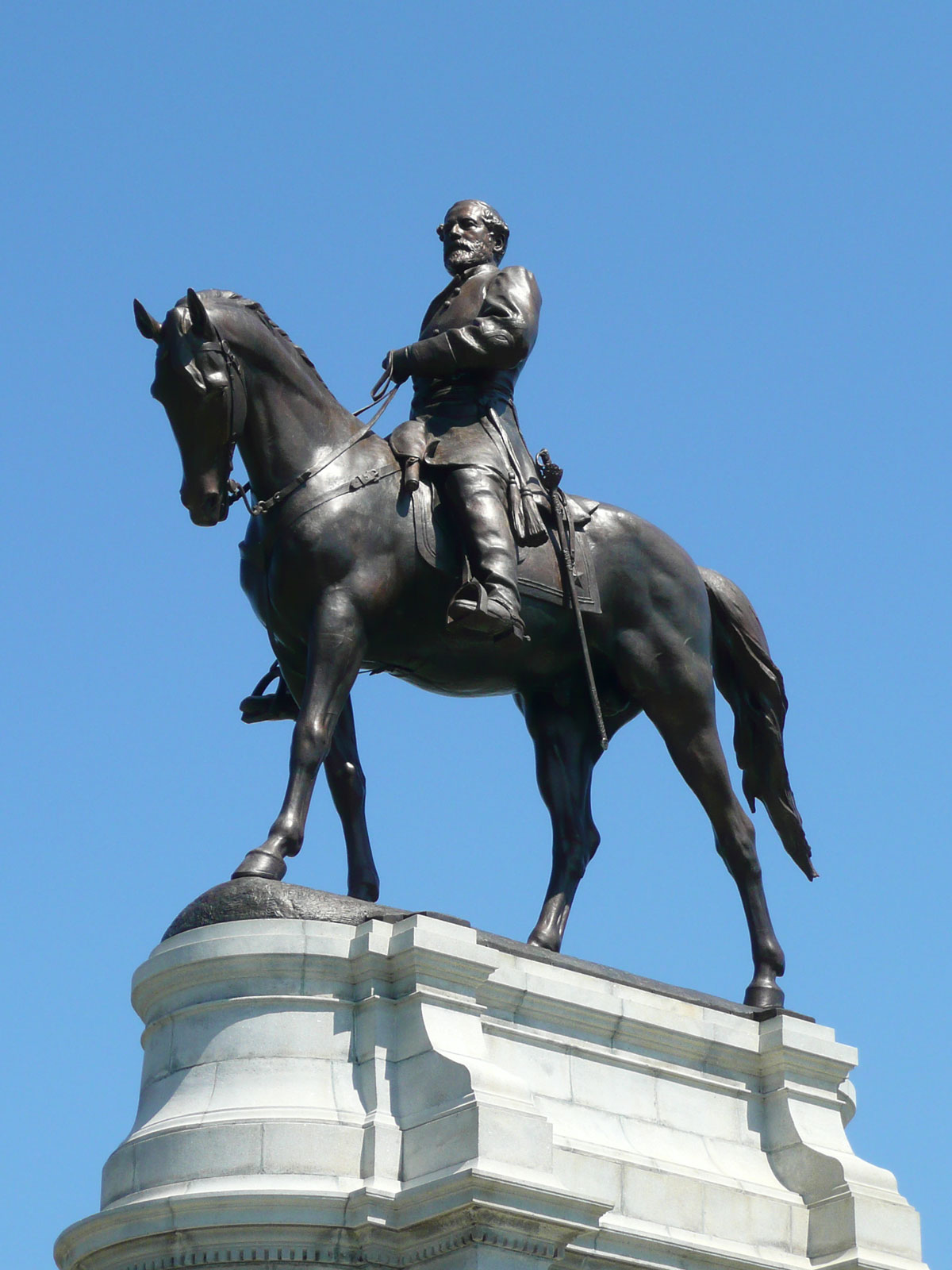
Statue of Robert E. Lee, Monument Ave., Richmond, VA, June 2009. Source.

The last few years have seen a growing mainstream discourse around race in America. The 2016 election proved to be a catalyst for much of this political energy. Several confederate statues across the country have been toppled (including Roger Taney in Maryland; Robert E. Lee and Albert Sidney in Johnston, Texas; and “Old Joe” in Florida), and other cultural works have been removed from public view, including Yale’s stained glass windows depicting a slavery scene in the dining hall of Calhoun College. Last summer, student protestors toppled the confederate statue of “Silent Sam” at the University of North Carolina, an event described by an alumna as a “joyous moment,” and by university officials as “unacceptable,” “dangerous,” “incomprehensible” and “unlawful.”[2] Just this October, George Washington High School Alumni Association sued the San Francisco Unified School District Board of Education over its vote to remove a mural depicting slavery and genocide in the school. (Read more on New-Deal era murals here and here).

How does the law, in fact, regulate or restrict monument-toppling? In Charlottesville, the law used by Judge Moore to protect the confederate statues was a local law enacted in 1904, Va. Code § 15.2-1812, which protects “monuments or memorials for any war or conflict” from interference[3]. In North Carolina, the relevant law is the Cultural History Artifact Management and Patriotism Act of 2015, signed by Republican governor Pat McCory in 2015, which prevents the removal or relocation of an “object of remembrance”[4] without the approval of the North Carolina Historical Commission. Although these are different state laws, the underlying idea is the same – memorials or monuments that are deemed by the state to have politico-historical significance or value are to stay where they are.

What do these laws mean? Are they reasonable and constitutional? Are they neutral laws, only concerned with the objective preservation of a shared heritage, of beautiful sculptural works, of important historical memorials?

Historical Context

To contextualize the present dilemma, we must look back in time. Confederate monuments were erected at significant stages of American history, including the Jim Crow era (1870s to 1960s) and the civil rights movement (1940s to late 1960s). This timing is far from coincidental – the American Historical Association describes their erection during the Jim Crow era as “part and parcel of the initiation of legally mandated segregation and widespread disenfranchisement across the South”, intended “to intimidate African Americans politically and isolate them from the mainstream of public life.”[5] These dates coincide with the devastating terrorist violence and murder perpetrated by the Ku Klux Klan and their ilk in Southern states. The statues’ erection during the civil rights movement served “similar purposes.”[6] The Confederacy itself, which these monuments pay homage to, is not an apolitical historical event – it was an organization of several states that declared secession from the United States in response to a perceived threat to the institution of slavery. Its ideology, described in a speech in 1861 by Alexander H. Stephens, Vice-President of the Confederacy, was based “upon the great truth that the negro is not equal to the white man; that slavery, subordination to the superior race, is his natural and normal condition.”[7] According to many scholars and historians, confederate monuments were instituted as a deliberate assertion of white domination over Black lives – to either reinforce the white supremacist status quo, as in the Jim Crow era, or to resist legal threats to it, as during the civil rights movement.

Silent Sam on the Campus of the University of North Carolina at Chapel Hill, 2017. Source: Martin Kraft (photo.martinkraft.com), CC BY-SA 3.0 via Wikimedia Commons.

The impulse to topple these monuments today, consequently, should be understandable in light of their history. And the redesigning of public space by means of effacing, destroying or relocating public symbols and monuments is a tradition that goes back centuries. Famously, the end of the Ba’ath dictatorship in Iraq was marked in mainstream media by the US army staging the toppling of Saddam Hussein’s bronze statue (April 9, 2003). Statues of Soviet leaders have been toppled in Ukraine (December 8, 2013), Romania (March 1990), Tajikistan (May 30, 2011), Ethiopia (May 1991), Hungary (October 23, 1956). A statue of Christopher Columbus was toppled in Venezuela in October 2004; student protestors in South Africa toppled a statue of colonialist Cecil John Rhodes in April 2015. Reevaluation has affected the city landscapes in America as well. As recently as 2018, a sculpture in J. Marion Sims was removed from New York City’s Central Park and moved to the place where the now infamous doctor is buried. There exists, therefore, a precedent for confederate monument-toppling.

Arguments Against Removal: Historical Memory

Opponents of monument-toppling often argue that the removal of the monuments amounts to an erasure of history. This is a point made by historians like Dr. Michele Bogart: these monuments may serve a useful purpose in reminding us of a dark past and they should be preserved, regardless of how ‘offensive’ they might be. But the question of how monuments convey history is a vexed one. As Waitman Wade Beorn, a Holocaust and genocide studies historian, notes, someone ignorant of this history of America might be “forgiven” for thinking that the confederates won, given the ubiquity of the monuments (about 1,500 in the US) and their heroic style.[8] Wade Beorn also comments on the general scarcity of memorials to the people enslaved and victimized by the Confederacy. He observes that the “memorial landscape” in Germany – a country that has to grapple with a somewhat similar brutal white supremacist past – honors the victims.[9] In Beorn’s opinion, memorials in Germany convey “loss, sadness and grief,”[10] with historical context, meaning and thought.

Alternative: Contextualization

Consequently, confederate monument-toppling represents a rebellion against the way contemporary America chooses to remember its past. As an alternative to toppling, monuments could hypothetically be recontextualized, as Paul Cooper, author and journalist, points out.[11] For example, one way in which the Robert E. Lee monument could accurately and meaningfully communicate America’s history is by relocating it to a museum, with real and holistic educational information alongside it.[12] Another option would be to de-pedestalize it and surround it by images of the two hundred Black men who escaped slavery, joined the US Army & helped defeat Lee, as John Edwin Mason, a University of Virginia history professor, suggests.[13] But this recontextualization would only be possible after an honest and fulsome reckoning with America’s past – a reckoning that would be “democratically agreed” by the country.[14] The United States are not there yet: the current President Donald J. Trump recently described these confederate statues as “beautiful” and reflective of the “great culture of our country.”[15] According to Susan Neiman, philosopher and writer, part of the reason Germany does not have nostalgic monuments to Nazis is due to its nuanced confrontation of its past.[16] Until such a reckoning happens in the US, Cooper suggests these monuments will and should keep falling.[17]

States Laws and Confederate Monuments

State laws step in to prevent exactly this, i.e. monument toppling. Alabama (2017),[18] Mississippi (2013),[19] North Carolina (2015),[20] South Carolina (2012),[21] Tennessee (2013, updated 2016),[22] and Virginia (2017)[23] have all passed state laws to obstruct, or, in the cases of Alabama and North Carolina, prohibit altogether, the removal or alteration of public Confederate monuments. To return to the questions previously raised, are such regulations neutral and sensible?

On the one hand, these laws are often written in a depoliticized manner, with no specific references to actual monuments, events, people or groups. There are general and facially inoffensive allusions to war, conflict and history. On the other hand, these statutes imagine confederate monuments as memorials, or solemn objects of remembrance, which ultimately sends a resonant political message about America’s history and the way it should be remembered. In this case, the communication takes the form of heroically memorializing white oppressors and fully obscuring Black victims.

Unveiling of the Confederate Monument, Orange County, North Carolina, June 2, 1913. North Carolina Postcard Collection (P052), North Carolina Collection Photographic Archives, Wilson Library, UNC-Chapel Hill. Source.

Does this mean that preservation laws are totally irredeemable? The North Carolina Cultural History Artifact Management and Patriotism Act of 2015[24] contains two exceptions to its bar against interference with monuments: (1) when appropriate measures are required by the State to preserve the object and (2) when relocation is necessary for public construction and other renovation works. One solution could be to add a further exception: when a democratic decision, such as a vote, has been made to remove or relocate the monument for historical, social, or political purposes. This would have given the 2017 Charlottesville City Council vote both political and legal weight.

Federal Law and Confederate Monuments

Federal jurisprudence presents more problems, however. The U.S Supreme Court in Pleasant Grove City v. Summum (2009) analyzed monuments in public parks as “government speech.”[25] This means that the government speaks through them, and that this speech is protected from free speech challenges. Confederate monuments, therefore, falls into this category. This presents a troubling conclusion when the idea of the government speaking through monuments is combined with the reality of the confederate monuments’ intentional white supremacy. In Pleasant Grove, Justice Alito emphasizes the fluidity of monuments’ meanings as well as their interpretive quality, which mitigates the obvious implication that the government intends its speech to be racist.[26] The government speech doctrine puts confederate statues outside the scope of free speech challenges. These monuments occupy a special and more protected position, legally and politically, than other forms of speech.

To reframe the conversation: is there any legal argument for the removal of these statues? The template for this would be a 2019 Alabama decision which, interestingly, turned the First Amendment conversation on its head. In State of Alabama v. City of Birmingham, Judge Michael Graffeo criticized the absence of a provision in the Alabama Memorial Preservation Act[27] to remove monuments that convey a pro-Confederacy message.[28] He analyzed the government speech doctrine as it relates to confederate monuments and concluded that a state law that “renders pro-Confederate speech immune from a [city’s] local political process that rejects a message of white supremacy”[29] is denying a city its right to government speech. As such, the Constitution’s vision to protect “an open marketplace where ideas, most especially political ideas, may compete without government interference”[30] is compromised, violating the First Amendment. This decision illuminates some contradictions within First Amendment law. It may seem somewhat dissonant that local communities are unable to make decisions regarding racist monuments in their public life, while the Ku Klux Klan may march freely, burning crosses and displaying swastikas, all with the full protection of the police.

Concluding Thoughts

The most difficult question of all is whether ‘legalizing’ monument-toppling would go anyway in challenging the social structures that underlie their protection now. Part of the power in monument-toppling appears to lie in its very illegality; the law is a tangible indicator of the ‘establishment’ that institutes contemporary white supremacy. If monument-toppling were legal and confederate monuments around the country were quietly removed without any real fuss around their meaning and history, it is confusing to imagine whether any proper confrontation of America’s past would actually occur. Further, historians and critical scholars underline that while minor legal reforms may occur, those often simply create an illusion of progress without actually reforming the status quo.

Society has complex ways of understanding its historical traumas and present-day injustices. We can look to public spaces to understand some of its consciousness and imaginations, regardless of whether our monuments are standing or whether they have fallen. The law cannot single-handedly change the social fabric of America, but it can be critically evaluated and located within a broader political context. The conversation around monument-toppling should not begin or end with the law, and one must look at the historic and contemporary injustice in America to fully understand its value.


References:

  1. Payne v. City of Charlottesville, No. CL 17-145 (Va. Cir. Ct. Sept. 11, 2019). ↑
  2. Jesse James Deconto and Alan Blinder, ‘Silent Sam’ Confederate Statue Is Toppled at University of North Carolina (New York Times, 21 August 2018) <https://www.nytimes.com/2018/08/21/us/unc-silent-sam-monument-toppled.html&gt; accessed 7 November 2019 ↑
  3. Va. Code Ann. § 15.2-1812 (2017). ↑
  4. Cultural History Artifact Management and Patriotism Act of 2015 § 3(c), 2015 N.C. Sess. Laws 170. ↑
  5. American Historical Association, ‘AHA Statement on Confederate Monuments’ (American Historical Association, 28 August 2017) <https://www.historians.org/news-and-advocacy/aha-advocacy/aha-statement-on-confederate-monuments&gt; accessed 7 November 2019. ↑
  6. ibid. ↑
  7. Alexander H. Stephens, ‘Cornerstone Address, March 21, 1861’ in Franke Moore (ed.) The Rebellion Record: A Diary of American Events with Documents, Narratives, Illustrative Incidents, Poetry, etc. (vol. 1., New York: O.P. Putnam, 1862) 44 – 46. ↑
  8. Waitman Wade Beorn, ‘U.S. put its Silent Sams on pedestals. Germany honored not the defeated but the victims.’ (Washington Post, September 11 2018) <https://www.washingtonpost.com/outlook/2018/09/11/us-put-its-silent-sams-pedestals-germany-honored-not-defeated-victims/&gt; accessed 7 November 2019. ↑
  9. ibid. ↑
  10. ibid. ↑
  11. Paul Cooper, ‘What to Do With a Heinous Statue’ (Foreign Policy, August 17 2017) <https://foreignpolicy.com/2017/08/17/what-to-do-with-a-heinous-statue-trump-confederate-robert-e-lee-nazi-soviet/&gt; accessed 7 November 2019. ↑
  12. ibid. ↑
  13. John Edwin Mason (Twitter, 15 August 2017) <https://twitter.com/johnedwinmason/status/897469063747817473&gt; accessed 7 November 2019 ↑
  14. Paul Cooper, ‘What to Do With a Heinous Statue’ (Foreign Policy, August 17 2017) <https://foreignpolicy.com/2017/08/17/what-to-do-with-a-heinous-statue-trump-confederate-robert-e-lee-nazi-soviet/&gt; accessed 7 November 2019. ↑
  15. Jeremy Diamond, ‘Trump Calls Removal of Confederate Monuments ‘so foolish’’ (CNN Politics, August 17 2017) <https://www.cnn.com/2017/08/17/politics/trump-tweet-confederate-statues/index.htmll&gt; accessed 1 December 2019 ↑
  16. Susan Neiman, ‘There Are No Nostalgic Nazi Memorials’ (The Atlantic, September 14 2019) <https://www.theatlantic.com/ideas/archive/2019/09/germany-has-no-nazi-memorials/597937/&gt; accessed 1 December 2019 ↑
  17. Paul Cooper, ‘What to Do With a Heinous Statue’ (Foreign Policy, August 17 2017) <https://foreignpolicy.com/2017/08/17/what-to-do-with-a-heinous-statue-trump-confederate-robert-e-lee-nazi-soviet/&gt; accessed 7 November 2019. ↑
  18. Ala. Code §§ 41-9-231, et. seq. (1975). ↑
  19. M.S. Code § 55-15-81 (2013). ↑
  20. Cultural History Artifact Management and Patriotism Act of 2015 § 3(c), 2015 N.C. Sess. Laws 170. ↑
  21. S.C. Code § 10-1-165 (2012). ↑
  22. Tenn. Code Ann. § 4-1-412 (2016). ↑
  23. Va. Code Ann. § 15.2-1812 (2017). ↑
  24. Cultural History Artifact Management and Patriotism Act of 2015 § 3(c), 2015 N.C. Sess. Laws 170. ↑
  25. Pleasant Grove City v. Summum, 555 U.S. 460, 129 S. Ct. 1125 (2009). ↑
  26. ibid, at 473-78. ↑
  27. Ala. Code §§ 41-9-231, et. seq. (1975). ↑
  28. State of Alabama v City of Birmingham, No. CV 17-903426-MGG (Ala. Cir. Ct. Jan. 14, 2019) (order nulling statute). ↑
  29. ibid, at 6. ↑
  30. N.Y. State Bd. of Elections v. Lopez Torres, 549 U.S. 1204 (2007). ↑

Additional readings:

  • Olivia Taylor, ‘Art in the Courtroom: Dealing with New Deal-era Murals – Part I’ (Center for Art Law, November 18 2018) <https://itsartlaw.org/2018/11/15/art-in-the-courtroom-dealing-with-new-deal-era-murals-part-i/>
  • Olivia Taylor, ‘Art in the Courtroom: Dealing with New Deal-era Murals – Part II’ (Center for Art Law, November 18 2018) <https://itsartlaw.org/2019/01/14/art-in-the-courtroom-dealing-with-new-deal-era-murals-part-ii/>
  • Susan Neiman, ‘Learning from the Germans: Race and the Memory of Evil’ (2019)
  • Dane Kennedy, ‘What Should We Do With Confederate Monuments?’ (American Historical Association October 30 2017) <https://www.historians.org/publications-and-directories/perspectives-on-history/october-2017/what-should-we-do-with-confederate-monuments>

Disclaimer: The opinions expressed in this publication are those of the author. They do not purport to reflect the opinions or views of the Center for Art Law or its members.

Disclaimer: This article is for educational purposes only and is not meant to provide legal advice. Readers should not construe or rely on any comment or statement in this article as legal advice. For legal advice, readers should seek a consultation with an attorney.

Post navigation

Previous WYWH: Fall 2019 Art Law Events
Next Update: Repatriation of Cambodian Art

Related Art Law Articles

Center for Art Law Canada Pledges Resale Royalty
Art lawCanadaresale royalty

Canada pledges an artist’s resale royalty—can the United States follow “suite”?

April 9, 2026
Abraham and Isaac Returned Home Center for Art Law
Art law

Abraham and Isaac: Sculptures returned home after Spanish Supreme Court decision

April 8, 2026
Charities Act 2022 Screenshot
Art law

Changes in U.S. and U.K. Restitution Laws are Afoot, Museums are Worried, Claimants are Cautiously Optimistic, ADR Practitioners are Attentive – Where Does This Leave us?

April 6, 2026
Center for Art Law
What the Heck is Copyright (2)

What is Copy, Right?

2026 Annual Conference

Let’s explore Visual Art, AI, and the Law in the 21st Century together.


Reserve Your Ticket TODAY
Guidelines AI and Art Authentication

AI and Art Authentication

Explore the Guidelines for AI and Art Authentication for the responsible, ethical, and transparent use of artificial intelligence.

Download here
Center for Art Law

Follow us on Instagram for the latest in Art Law!

In this episode, we speak with art market expert D In this episode, we speak with art market expert Doug Woodham to unpack how Jean-Michel Basquiat became one of the most enduring cultural icons of our time.

Moving beyond his rise in 1980s New York, this episode focuses on what happened after his death. We explore how his estate, led by his father, shaped his legacy through control of supply, copyright, and narrative; how early collectors and market forces drove the value of his work; and how museums and media cemented his place in art history.

Together, we explore the bigger question: is creating great art enough, or does becoming an icon require an entire ecosystem working behind the scenes?

🎙️ Check out the podcast anywhere you get your podcasts using the link in our bio!

Also, please join us on May 27  for the highly anticipated Art Law Conference 2026, held at Brooklyn Law School and Online (Hybrid). Entitled “What is Copy, Right? Visual Art, AI, and the Law in the 21st Century,” this year’s conference explores the evolving relationship between visual art, copyright law, and artificial intelligence!

#centerforartlaw #artlaw #artlawyer #podcast #legal #research #legalresearch #newepisode #artmarket #basquiat
Amy Sherald cancelled her mid-career retrospective Amy Sherald cancelled her mid-career retrospective, scheduled at the National Portrait Gallery (NPG) in D.C., after a curatorial controversy over the potential removal of her recent work, "Trans Forming Liberty" (2024). Sherald denounced the attempt to remove this work as a blatant and intentional erasure of trans lives. 

This is one of the best examples and the most illustrative examples of the current administration's growing efforts to control the Smithsonian Institution's programming. In this climate of political tension, how do cultural institutions defend themselves against censorship and keep their curatorial independence?

📚 Click the link in our bio to read more!

#centerforartlaw #artlaw #legal #artlawyer #legalreserach #artcuration #curatorialindependance #censorship
Grab 15% off tickets the upcoming bootcamp on Arti Grab 15% off tickets the upcoming bootcamp on Artist-Dealer Relations, now available online!! 

Center for Art Law’s Art Lawyering Bootcamp: Artist-Dealer Relationships is an in-person, full-day training aimed at preparing lawyers for working with visual artists and dealers, in the unique aspects of their relationship. The bootcamp will be led by veteran attorneys specializing in art law.

This Bootcamp provides participants -- attorneys, law students, law graduates and legal professionals -- with foundational legal knowledge related to the main contracts and regulations governing dealers' and artists' businesses. Through a combination of instructional presentations and mock consultations, participants will gain a solid foundation in the specificities of the law as applied to the visual arts.

Bootcamp participants will be provided with training materials, including presentation slides and an Art Lawyering Bootcamp handbook with additional reading resources.

Art Lawyering Bootcamp participants with CLE tickets will receive New York CLE credits upon successful completion of the training modules. CLE credits pending board approval.

🎟️ Grab tickets using the link in our bio!

Get 15% off using the code: Final15 

#centerforartlaw #artlaw #legal #research #lawyer #artlawyer #bootcamp #artistdealer #CLE #trainingprogram
On the night of April 15–16, 2026 alone, Russia se On the night of April 15–16, 2026 alone, Russia sent hundreds of drones and missiles on sleeping cities across Ukraine, killing and injuring dozens of civilians. War is funded in part by individuals who have important artworks in their personal collections. This full-scale invasion of Ukraine, now in its fifth year, daily exacts a grave toll on Ukrainian lives and cultural heritage, while fundamentally disrupting European commerce. In response, art market participants have adapted their practices, most have accepted, if not always embraced, the need to scrutinize the source of funds and the ultimate beneficiaries of their transactions. Yet there is a growing sense that parts of the trade are holding their breath, waiting to see when they might safely return to dealing with the oligarchs who continue to fund the Russian war machine.

For art market participants operating in the UK, compliance is no longer a peripheral concern, it is a legal imperative. Regulators are watching, the consequences of non-compliance increasingly extend beyond administrative penalties into criminal liability, and private-public partnerships offer the most credible path toward a more resilient and trustworthy market. 

Join us on April 24th for a panel discussion in London on the current state of AML enforcement and sanctions.

🎟️ Grab your tickets using the link in our bio!

#centerforartlaw #artlaw #artlawyer #lawyer #artcrime #london #artissues #museumissues
Sotheby's sold Modigliani’s Portrait de Leopold Zb Sotheby's sold Modigliani’s Portrait de Leopold Zborowski to Cahn in 2003 for the low price of about $1.55 million. In 2016, Cahn claimed he was verbally informed about authenticity issues with the painting by Sotheby's. The parties did make an agreement regarding Cahn reselling with Sotheby's for a guaranteed price in exchange for releasing the auction house from all claims related to the painting. Cahn claims that he attempted to set this process in motion in June 2025, but he received no response. Cahn now seeks damages totaling $2.67 million, plus interest and attorneys’ fees, for breach of contract. 

Through this dispute, Vivianne Diaz's article highlights a bigger issue in the art market by explaining how forgeries negatively affect both collectors and auction houses, and how auction houses need to be more careful, but most importantly, proactive in their authentication determinations.

📚 Click the link in our bio to read more!

#centerforartlaw #artlaw #artlawyer #legalresearch #art #Modigliani #LeopoldZborowski #sothebys
Don't miss our upcoming April 20th bootcamp on Art Don't miss our upcoming April 20th bootcamp on Artist-Dealer Relations, now available online!!

Center for Art Law’s Art Lawyering Bootcamp: Artist-Dealer Relationships is an in-person, full-day training aimed at preparing lawyers for working with visual artists and dealers, in the unique aspects of their relationship. The bootcamp will be led by veteran attorneys specializing in art law.

This Bootcamp provides participants -- attorneys, law students, law graduates and legal professionals -- with foundational legal knowledge related to the main contracts and regulations governing dealers' and artists' businesses. Through a combination of instructional presentations and mock consultations, participants will gain a solid foundation in the specificities of the law as applied to the visual arts.

Bootcamp participants will be provided with training materials, including presentation slides and an Art Lawyering Bootcamp handbook with additional reading resources.

Art Lawyering Bootcamp participants with CLE tickets will receive New York CLE credits upon successful completion of the training modules. CLE credits pending board approval.

🎟️ Grab tickets using the link in our bio!

#centerforartlaw #artlaw #legal #research #lawyer #artlawyer #bootcamp #artistdealer #CLE #trainingprogram
The historic Bayeux Tapestry, conserved in Normand The historic Bayeux Tapestry, conserved in Normandy, France, is scheduled to be loaned from the Bayeux Museum to the British Museum for ten months beginning in the fall of 2026. This is the first time the tapestry will have returned to the UK in over 900 years. 

This loan, authorized by France, has raised multiple controversies, particularly over conservation concerns. Nevertheless, it has been made possible through a combination of factors, including improved conservation techniques, enhanced transport precautions, comprehensive loan agreements, insurance, and the application of relevant protective laws. 

Check out our recent article by Josie Goettel to read more about this historic loan regarding not only in its symbolic significance, but also in its technical complexity.

📚 Click the link in our bio to read more!

#centerforartlaw #artlaw #artlawyer #lawyer #legalresearch #legal #museumissues #bayeuxtapisserie #bayeuxtapestry #britishmuseum #bayeuxmuseum
Due to decreasing government funding and increasin Due to decreasing government funding and increasing operational costs, philanthropic giving is more essential than ever. Since the current administration took office, one-third of museums nationwide have lost government grants and contracts. These losses have set off a domino effect of difficult decisions, including laying off staff, cancelling public programming, and delaying maintenance and repairs. 

Many art museums are also still recovering from financial losses incurred during the Covid-19 Pandemic. This recent article by Kamée Payton explores how noncash charitable donation alternatives are used by cultural institutions as financing, and how noncash charitable donations can prove mutually beneficial for both donors and recipients—particularly in terms of tax treatment.

📚 Click the link in our bio to read more! 

#centerforartlaw #artlaw #artlawyer #lawyer #legalresearch #museumissues #taxes #donations #taxtreatment
Brief newsletter instead of a list of abbreviation Brief newsletter instead of a list of abbreviations and dates (here is looking at you, AML and KYC, London, NY, Rome). A laconic message that as days are getting longer and we are charmed by sunshine, blooms, and prospects of holidays, the man-made world does not fail to disappoint (don’t believe me? put aside art law and read world news), and all that during the springtime.

On a high note, we are grateful to our Spring Interns who are finishing up their stint with the Center in a couple of weeks, well done! Together we invite you to the upcoming events in person and online. Come FY2027 (a.k.a. June), we will introduce you to the Summer Class and new Advisors. Hang in there through April and May, take notes, don’t forget – we are living in the best of times and the worst of times. Again. 

🔗 Check out our April newsletter, using the link in our bio, to get a curated collection of art law news, our most recent published articles, upcoming events, and much more!!

#centerforartlaw #artlaw #artlawyer #lawyer #artissues #newsletter #april #legalresearch
When we take a holiday from talking about art law When we take a holiday from talking about art law in New York City, we talk about art law in other places. Recently our Judith Bresler Fellow, Kamée Payton attended the London Art Fair. Below is a snippet of her experience:

"I had the wonderful opportunity to attend the London Art Fair this past weekend where I met many incredible artists and art market participants. I was proud to represent the Center for Art Law in conversations with other attendees. It was an absolute delight to see what contemporary artists are contributing to the art world."

#centerforartlaw #artlaw #london #artfair #londonartfair #uk #nyc #artlawyer #legalresearch
Check out our recent article by Lauren Stein revie Check out our recent article by Lauren Stein reviewing Amy Werbel’s "Lust on Trial: Censorship and the Rise of American Obscenity in the Age of Anthony Comstock." Werbel's book showcases a portrait of Anthony Comstock, America’s first professional censor, a man obsessed with purity and self-control who regarded masturbation as a sign of moral corruption. 

Read more about this public figure and Werbel's telling of his life including the impact he had on the US's early attempts to curtail desire in the decades before World War I, in Lauren's review. 

 📚 Click the link in our bio to read more! 

#centerforartlaw #artlaw #artlawyer #lawyer #legalresearch #bookreview #censorship #artistissues
One of our interns, Jacqueline, stopped by the Mor One of our interns, Jacqueline, stopped by the Morgan after the blizzard to catch their exhibition, “Caravaggio’s Boy with a Basket of Fruit in Focus." In partnership with the Foundation for Italian Art and Culture (FIAC) and on loan from the Galleria Borghese in Rome, this is the first time in decades that Caravaggio's early masterpiece has come to the United States. 

"The Morgan is just two blocks away from my university, the Graduate Center. The library and museum have been a rich resource for me, representing an institution that honors the rich legacy of its collector, while also maintaining exciting rotating exhibitions," Jacqueline said. 

The painting is in conversation with other works by those who influenced Caravaggio and those he subsequently inspired. The exhibition's sparkling 3-month run comes to a close April 19.

📚 Check out more information on the exhibition using the link in our bio!

#centerforartlaw #artlaw #artmuseum #caravaggio #themorgan #nyc #artlawyer #legalresearch
  • About the Center
  • Contact Us
  • Newsletter
  • Upcoming Events
  • Internship
  • Case Law Database
  • Log in
  • Become a Member
  • Donate
DISCLAIMER

Center for Art Law is a New York State non-profit fully qualified under provision 501(c)(3)
of the Internal Revenue Code.

The Center does not provide legal representation. Information available on this website is
purely for educational purposes only and should not be construed as legal advice.

TERMS OF USE AND PRIVACY POLICY

Your use of the Site (as defined below) constitutes your consent to this Agreement. Please
read our Terms of Use and Privacy Policy carefully.

© 2026 Center for Art Law
 

Loading Comments...
 

You must be logged in to post a comment.