
“Shhhhhh”: Kat Von D and Tattoo Fan Art – Sedlik v. Von Drachenberg (2021)
April 16, 2024
By Alexandra Materia
Tattoos place another wrinkle into the realm of copyright law and their interaction with the fair use defense. Famously in Andy Warhol Foundation for the Visual Arts, Inc. v. Goldsmith Justice Kagan passionately dissented from her majority justices to argue that Warhol’s use of the Prince photograph was not fair use because “[i]t will stifle creativity of every sort. It will impede new art and music and literature. It will thwart the expression of new ideas and the attainment of new knowledge.”[1] This dissent serves as not only a warning, but it also places artists in potential conflict due to industry and community norms. Even though community norms are not directly dictated by the law, the tattoo industry has relevant and important norms to note, especially considering the recently decided Sedlik v. Drachenberg case.
Who and What Events Lead to this Copyright Infringement Case?
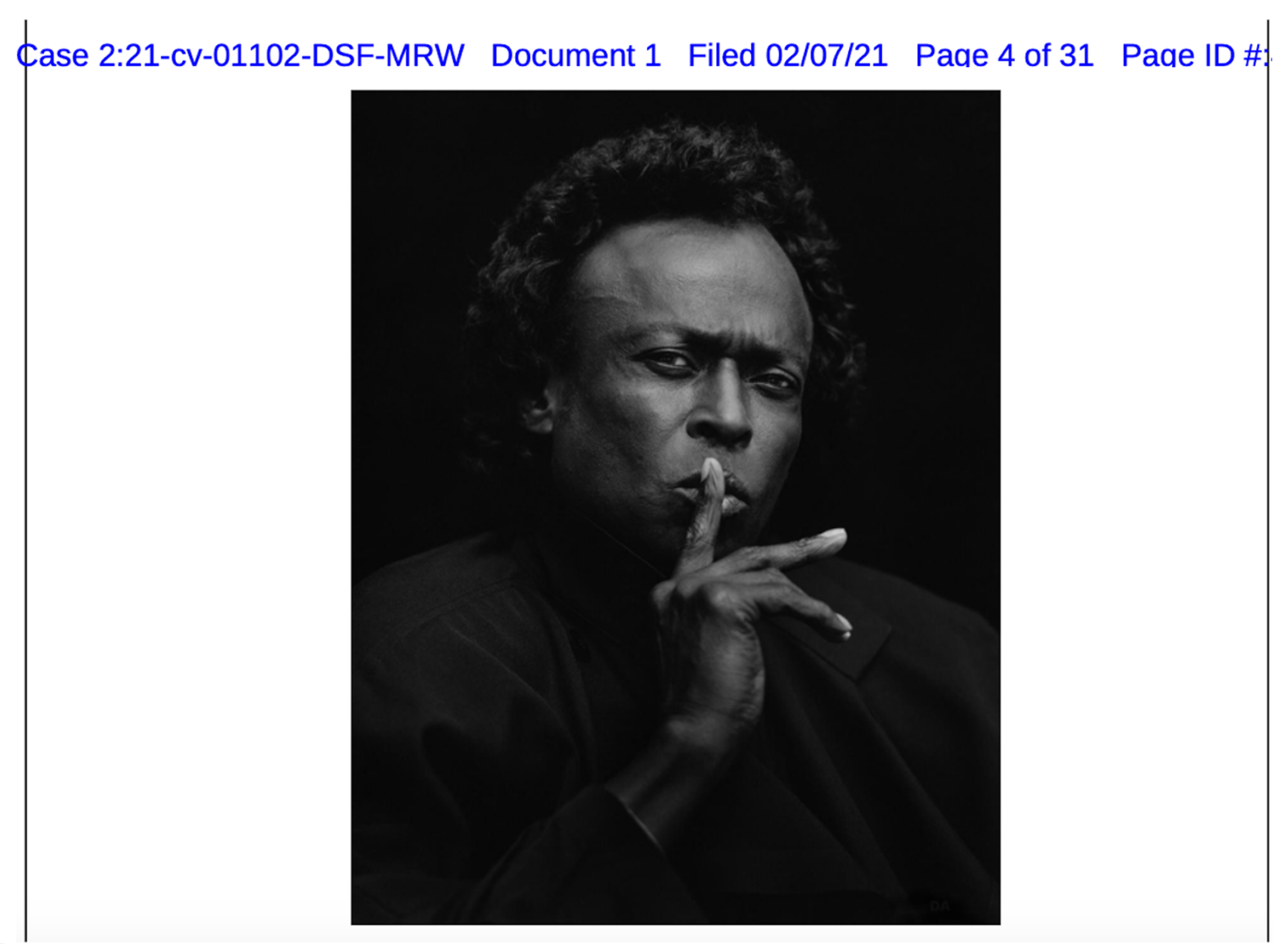
A photograph of Miles Davis, captured by Jeff Sedlik (“Sedlik”), was used as a reference image when Katherine Von Drachenberg’s (“Kat Von D”) close friend came to her and asked for a tattoo. Sedlik sued Kat Von D for not only producing a tattoo based on his image free of charge but for posting her work on social media.[2] The photograph of Miles Davis (“Davis”) features him touching one of his fingers to his lips, making the “shhh” gesture. Kat Von D stated that the tattoo produced for her friend was “completely different” than the original photo of this jazz icon captured by Sedlik.[3] Currently, Kat Von D has almost 10 million Instagram followers, and her career highlights include being featured on multiple television series about tattoos, creating and launching a makeup brand, writing a children’s book, starting a shoe line, and most recently, releasing an album.[4] At the time the alleged copyright infringement took place, Kat Von D posted to her multiple social media platforms an image of her working on the tattoo in question for her friend. On Instagram alone, the post has almost 86,000 likes and remains on her page as of (March 13, 2024).[5] Sedlik’s lawyers argued that when Kat Von D posted the image to her social media platforms, she promoted her own brand through the use of Sedlik’s copyrighted photo.


The Tattoo Industry and Fan Art Distinction
The significance of this case marks not only a fair use question post-Warhol decision but also the use of social media for tattoo artists. Community and industry norms that tattoo artists and their clients participate in are essential to the experience of this creative form of expression. For example, getting a tattoo is more than just walking in, sitting down, and telling the artist what you want. Getting a custom tattoo “requires the client and tattooer to spend many hours in a physically–and occasionally emotionally–intimate setting.”[6] Kat Von D’s lawyers even argued the proposition of a fifth fair use factor “Personal Expression and Bodily Integrity.” This factor considers the fundamental rights to bodily expression and how tattoos and its processes are expressions protected by the First Amendment.[7] It is not insignificant that Kat Von D’s lawyers are teasing out both the physical art and the process in which tattoos are created as factors that add value to their meaning. This idea is synonymous with Kat Von D’s explanation of her experience of tattooing her friend. Kat Von D stated:
I’m literally tattooing my friend with his favorite trumpet player because it means a lot to him. I made zero money off it. I’m not mass-producing anything. I think there is a big difference. It’s fan art. I consider this fan art. So, I see it as different than a corporation taking advantage of an artist. That’s not what I’m doing.[8]
This distinction of “fan art” that Kat Von D is describing sheds light on the conflict between tattoo industry norms and elements of infringement. The idea of using another artist’s work without their permission for inspiration is “commonplace”[9] and reflects the tension between the formalities of copyright law and how this group of artists creates creative work. In the context of defense, it would be dangerous for tattoo artists to compromise their own industry norms to comply with copyright law because copyright does not create creative expression, it is present to foster and protect expression.
Impact of the Warhol Case
Justice Kagan’s words hold a truth, and we see this being played out in the context of tattoos. Inspiration, to a degree, is not filtered, and the act of the tattoo community being inspired by another artist’s work is supported.[10] In this case, the jury found in favor of Kat Von D holding that the use of Sedlik’s image and social media post tipped in favor of fair use and the fact that Kat Von D did not charge her friend was pertinent.[11] Unlike the Warhol estate, Kat Von D did not gain any financial benefit by using Sedlik’s copyrighted image. Notably, in Warhol, the court reasoned that under factor one of the fair use analysis, Warhol’s recasting of the original Prince photo was not transformative.[12] Under the fair use analysis, four factors are considered (1) the purpose and character of the use; (2) nature of the copyrighted work; (3) amount and substantiality of the portion used; and (4) the effect of the use.[13] The first factor specifically considers whether the use is commercial or non-commercial and if the use is transformative (adds new, meaning, message, or purpose).[14] None of these factors alone are dispositive but the first and fourth factors are most influential in determining fair use.[15] It is interesting to consider the question of whether Kat Von D’s tattoo transformed Sedlik’s original image. Kat Von D stated that while she used the photo as a starting point, she created a different image by adding in smoke and negative space to Davis’ hair; she also had additional inspiration from one of Davis’ albums.[16] Does this really cause a transformation? A tattoo artist would probably say yes it does with the argument that it tells a different story. Certainly, the tattoo in question here tells a story that was important to Kat Von D’s friend.
In this case, the implications of the jury ruling in an opposite manner (in favor of Sedlik) on the tattoo industry would be very significant because every time a person goes to a tattoo parlor with an image, the risk of infringing on a copyrighted work would increase.[17] This kind of substantial impact on tattoo artists and their customers arguably stifles, as Justice Kagan warned, the creative expression process in this industry. Industry community norms are not written laws, however, with such a ruling, the tattoo industry would not be protected by copyright law and its creative process would be rendered unfeasible and invalidated, at least when someone comes in with an image that has special meaning and inspires them.
What Does the Future Hold for the Tattoo Industry?
Following the verdict, Sedlik’s attorney stated that the case has “nothing to do with tattoos” and is instead about “copying other’s protected works” and that the tattoo industry would not be hurt with the opposite ruling.[18] These statements get at distinction that Justice Kagan makes in her dissent in Warhol. While there are measures in place to allow artists to license original work, sometimes these license fees and conditions serve as a barrier to other artists being able to access the work.[19] However, Justice Kagan points out that transformative use is a different issue.[20] Tattoo artists, such as Kat Von D, use images (like the Davis photo) as inspiration without obtaining permission from the original copyright holder, and this plays a role in how tattooing as an art form is currently practiced. The tattoo industry is protected for now; however, this case calls into question how community and industry norms impact the creative artistic process. Even with a verdict in her favor, Kat Von D stated that she is hesitant to ever tattoo again. [21] Despite a win under the law, creative expression may be stifled because of the threat of having it be taken away. Tattoo artists currently retain the ability to play a role in storytelling and this verdict allows their industry’s creative process to flourish.
Suggested Readings
- Edvard Pettersson, Kat Von D defends use of Miles Davis photo for friend’s tattoo, Courthouse News Service (Jan. 24, 2024), available at
- https://www.courthousenews.com/kat-von-d-defends-use-of-miles-davis-photo-for-friends-tattoo/.
- Miles Davis-Bio, National Endowment for the Arts, (last visited Mar. 17, 2024), available at https://www.arts.gov/honors/jazz/miles-davis.
- Jeff Sedlik, Artificial Intelligence and Machine Learning, (last visited Mar. 17, 2024), available at https://www.aimlmediaadvocacy.com/profile/jeffs.
- SEDLIK v. VON DRACHENBERG, No. 2: 21-cv-01102-DSF-MRW (C.D. Cal. Jan. 30, 2024).
- SEDLIK v. VON DRACHENBERG, No. 2: 21-cv-01102-DSF-MRWx (C.D. Cal. Aug. 30, 2021).
About the Author
Alexandra (Alex) Materia is a 2nd year law student at New England Law | Boston. Alex received her B.A in Legal Studies and a minor in Art History from American University in Washington D.C. She serves as the President of the Art and Fashion Law Society at her law school. Alex has a passion for the intersection between art and law and helping to protect the creative expression of all artists.
Select Sources:
- Andy Warhol Foundation for the Visual Arts, Inc. v. Goldsmith, 598 U.S. 508, (2023). ↑
- Aaron Moss, Kat Von D Tattoo Infringement Trial Begins (and Ends!): What You Need To Know, Copyright Lately (Jan. 23, 2024), available at https://copyrightlately.com/kat-von-d-tattoo-infringement-trial-begins-what-you-need-to-know/. ↑
- Nancy Dillon, Kat Von D Claims Miles Davis Tattoo is ‘Fair Use’ At Unusual Copyright Trial, Rolling Stone (Jan. 23, 2024), available at https://www.rollingstone.com/music/music-news/kat-von-d-miles-davis-tattoo-copyright-trial-1234952729/. ↑
- Amanda Krause, Inside the Life of Kat Von D, the Controversial Tattoo Artist Who Ditched the Occult and Is Covering Her Ink, Business Insider (Oct. 4, 2023), available at https://www.businessinsider.com/kat-von-d-life-and-career-2020-10. ↑
- Nancy Dillon, Kat Von D Claims Miles Davis Tattoo is ‘Fair Use’ At Unusual Copyright Trial, Rolling Stone (Jan. 23, 2024), available at https://www.rollingstone.com/music/music-news/kat-von-d-miles-davis-tattoo-copyright-trial-1234952729/. ↑
- Aaron Perzonski, Tattoos, Norms, and Implied Licenses, 107 Minn. Law. Rev. 104 (2023), https://minnesotalawreview.org/wp-content/uploads/2023/03/Perzanowski_Final.pdf. ↑
- Aaron Moss, Kat Von D Tattoo Infringement Trial Begins (and Ends!): What You Need To Know, Copyright Lately (Jan. 23, 2024), available at https://copyrightlately.com/kat-von-d-tattoo-infringement-trial-begins-what-you-need-to-know/. ↑
- Nancy Dillon, Kat Von D Testifies at Miles Davis Tattoo Trial: ‘I Consider This Fan Art’, Rolling Stone (Jan. 24, 2024), available at https://www.rollingstone.com/music/music-news/kat-von-d-testifies-miles-davis-tattoo-copyright-trial-1234953919/. ↑
- Aaron Perzonski, Tattoos, Norms, and Implied Licenses, 107 Minn. Law. Rev. 104, 123-124 (2023), https://minnesotalawreview.org/wp-content/uploads/2023/03/Perzanowski_Final.pdf. ↑
- Matthew Beasley, Who Owns Your Skin: Intellectual Property Law and Norms Among Tattoo Artists, 85 S. Cal. L. Rev. 1137, 1169 (2012), https://southerncalifornialawreview.com/2012/05/02/who-owns-your-skin-intellectual-property-law-and-norms-among-tattoo-artists-note-by-matthew-beasley/. ↑
- Nicholas Holmes, Tattoos and Copyright-Think Before You Ink?, Caldwell (Feb. 5, 2024) available at https://caldwelllaw.com/news/tattoos-and-copyright-think-before-you-ink/. ↑
- Michelle Mancino Marsh and Lindsay Korotkin, A Blow to Pop Art: Case Review of Warhol v. Goldsmith, Center for Art Law (May. 10, 2021), available at https://itsartlaw.org/2021/05/10/a-blow-to-pop-art-case-review-of-warhol-v-goldsmith-2021/.; Andy Warhol Foundation for the Visual Arts, Inc. v. Goldsmith, (598 U.S. 508, 2023).; Andy Warhol Found. for Visual Arts, Inc. v. Goldsmith, Center for Art Law, (last visited Mar. 17, 2024), available at https://itsartlaw.org/case-law-database/?t=Andy%20Warhol%20Found.%20for%20Visual%20Arts,%20Inc.%20v.%20Goldsmith. ↑
- 17 U.S. C. § 107 (2012), available at https://www.law.cornell.edu/uscode/text/17/107. ↑
- What is Fair Use?, Copyright Alliance, (last visited Mar. 16, 2024), available at https://copyrightalliance.org/faqs/what-is-fair-use/. ↑
- What is Fair Use?, Copyright Alliance, (last visited Mar. 16, 2024), available at https://copyrightalliance.org/faqs/what-is-fair-use/. ↑
- Nancy Dillon, Kat Von D Testifies at Miles Davis Tattoo Trial: ‘I Consider This Fan Art’, Rolling Stone (Jan. 24, 2024), available at https://www.rollingstone.com/music/music-news/kat-von-d-testifies-miles-davis-tattoo-copyright-trial-1234953919/. ↑
- Sopan Deb, Kat Von D Wins Copyright Trial Over Miles Davis Tattoo, N.Y. Times (Jan. 27, 2024), available at https://www.nytimes.com/2024/01/27/arts/kat-von-d-miles-davis-tattoo-copyright-trial.html. ↑
- Associated Press, Kat Von D Beats Photographer’s Copyright Lawsuit Over Miles Davis Tattoo, Billboard (Jan. 26, 2024), available at https://www.billboard.com/business/legal/kat-von-d-wins-miles-davis-tattoo-copyright-trial-1235590901/. ↑
- Andy Warhol Foundation for the Visual Arts, Inc. v. Goldsmith, 598 U.S. 508, 1312 (2023). ↑
- Id. ↑
- Associated Press, Kat Von D Beats Photographer’s Copyright Lawsuit Over Miles Davis Tattoo, Billboard (Jan. 26, 2024), available at https://www.billboard.com/business/legal/kat-von-d-wins-miles-davis-tattoo-copyright-trial-1235590901/. ↑
Disclaimer: This article is for educational purposes only and is not meant to provide legal advice. Readers should not construe or rely on any comment or statement in this article as legal advice. For legal advice, readers should seek a consultation with an attorney.


You must be logged in to post a comment.