• About
    • Mission
    • Team
    • Boards
    • Mentions & Testimonials
    • Institutional Recognition
    • Annual Reports
    • Current & Past Sponsors
    • Contact Us
  • Resources
    • Article Collection
    • Podcast: Art in Brief
    • AML and the Art Market
    • AI and Art Authentication
    • Newsletter
      • Subscribe
      • Archives
      • In Brief
    • Art Law Library
    • Movies
    • Nazi-looted Art Restitution Database
    • Global Network
      • Courses and Programs
      • Artists’ Assistance
      • Bar Associations
      • Legal Sources
      • Law Firms
      • Student Societies
      • Research Institutions
    • Additional resources
      • The “Interview” Project
  • Events
    • Worldwide Calendar
    • Our Events
      • All Events
      • Annual Conferences
        • 2026 Art Law Conference
        • 2025 Art Law Conference
        • 2024 Art Law Conference
        • 2023 Art Law Conference
        • 2022 Art Law Conference
        • 2015 Art Law Conference
  • Programs
    • Visual Artists’ Legal Clinics
      • Art & Copyright Law Clinic
      • Artist-Dealer Relationships Clinic
      • Artist Legacy and Estate Planning Clinic
      • Visual Artists’ Immigration Clinic
    • Summer School
      • 2026
      • 2025
    • Internship and Fellowship
    • Judith Bresler Fellowship
  • Case Law Database
  • Log in
  • Become a Member
  • Donate
  • Log in
  • Become a Member
  • Donate
Center for Art Law
  • About
    About
    • Mission
    • Team
    • Boards
    • Mentions & Testimonials
    • Institutional Recognition
    • Annual Reports
    • Current & Past Sponsors
    • Contact Us
  • Resources
    Resources
    • Article Collection
    • Podcast: Art in Brief
    • AML and the Art Market
    • AI and Art Authentication
    • Newsletter
      Newsletter
      • Subscribe
      • Archives
      • In Brief
    • Art Law Library
    • Movies
    • Nazi-looted Art Restitution Database
    • Global Network
      Global Network
      • Courses and Programs
      • Artists’ Assistance
      • Bar Associations
      • Legal Sources
      • Law Firms
      • Student Societies
      • Research Institutions
    • Additional resources
      Additional resources
      • The “Interview” Project
  • Events
    Events
    • Worldwide Calendar
    • Our Events
      Our Events
      • All Events
      • Annual Conferences
        Annual Conferences
        • 2026 Art Law Conference
        • 2025 Art Law Conference
        • 2024 Art Law Conference
        • 2023 Art Law Conference
        • 2022 Art Law Conference
        • 2015 Art Law Conference
  • Programs
    Programs
    • Visual Artists’ Legal Clinics
      Visual Artists’ Legal Clinics
      • Art & Copyright Law Clinic
      • Artist-Dealer Relationships Clinic
      • Artist Legacy and Estate Planning Clinic
      • Visual Artists’ Immigration Clinic
    • Summer School
      Summer School
      • 2026
      • 2025
    • Internship and Fellowship
    • Judith Bresler Fellowship
  • Case Law Database
Home image/svg+xml 2021 Timothée Giet Art law image/svg+xml 2021 Timothée Giet Six of one, half a dozen of the other? Comparing two Art Law Resources
Back

Six of one, half a dozen of the other? Comparing two Art Law Resources

June 14, 2018

By Jennie Nadel

New Kid on the Block

Getting the Deal Through (GTDT) is a London-based website that provides users with updates on laws and regulations, published by Law Business Research and a number of other publications. The website, managed by Law Business Research Limited (http://lbresearch.com/), solicits lawyers and law firms from around the world to synthesize legal information.
Screen Shot 2018-06-14 at 3.58.23 PM

Their research platform can be useful for a variety of audiences including law firms, universities, regulators, and corporate counsel providing assistance to legal query. Currently, GTDT covers information on 150 countries across 90 practice areas with an audience of around 200,000 including in-house and private practice lawyers. The practice areas span a wide variety of topics including acquisition finance, commercial contracts, copyright, intellectual property & antitrust, mergers & acquisitions, patents, and more. The website content is organized by practice area, then jurisdiction. Information is presented as responses to series of Q&A to help users find information and is designed to take complex subjects and strip them down into understandable summaries. Each practice area is developed by a contributing editor and a leading practitioner in the field. The website offers a compare tool that allows users to make comparisons of the same practice area but in different regions of the world, which is especially handy for those interested in the international exchange of art. It also contains updated information and trends for each country at the bottom of the page.

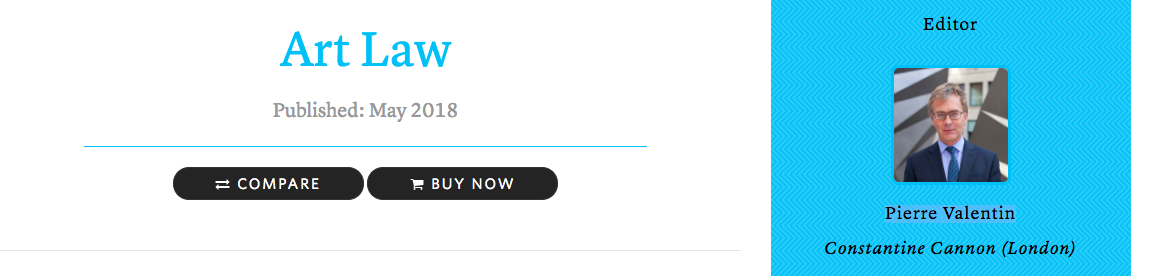
In 2018, GTDT launched a new page for Art Law practice. This resource is edited by Pierre Valentin, partner at Constantine Cannon LLP in charge of the Art & Cultural Property Law Group practice. The Art Law practice area page posits 49 questions with 12 sets of answers available corresponding to 12 countries such as China, Turkey, France, Switzerland, and the United States, including both California and New York. These questions range from the most common subjects surrounding the buying and selling of art to queries of cultural patrimony, museums, auctions, etc. The answers given for “The United States – New York” page are offered by Amelia Brankov, counsel at Frankfurt Kurnit Klein & Selz.

Screen Shot 2018-06-14 at 3.58.13 PM

2nd ed. The Art Collecting Legal Handbook

GTDT’s Art Law Q&A’s are akin to the 2013 and 2016 editions of the “The Art Collecting Legal Handbook” the reference book edited by Bruno Boesch and Massimo Sterpi. The 2013 Handbook was designed to help the collector navigate art collections in an international framework and offered a useful introduction to art law themes for a number of countries including Argentina, Greece, Israel, Japan, and Mexico. While art collecting and preservation has become increasingly transnational, legal frameworks and practices remain fairly local. The book addresses these issues with the aim to provide collectors with knowledge on a wide array of jurisdictions. The United States – New York section of the Handbook was compiled by Ambre Nérinck-Seltzer, attorney at Nerinck Seltzer Law as well as John Charles Thomas, attorney and former Supreme Court Justice of Virginia.

How do the two resources compare?

The 2018 GTDT art law resource is similar to the information provided in the Boesch/Sterpi Handbook. They both use the Q&A style format; however, the 2013 Handbook book includes fewer questions – , only 32 –  and thus fewer answers, while the online resource contains 49. The answers vary in length depending on the nature of the question and its relevance to the country.

Both the GTDT website and 2013 Handbook contain a fair amount of overlap in terms of questions. For example, both explore the need to conduct due diligence on behalf of the seller, laws regarding fakes and forgeries, protection against Holocaust-based claims, copyright, and tax import and export laws. One point of departure is that the 2013 Handbook seems to contain more pointed questions surrounding repatriation of art works and restitution claims. Furthermore, the Handbook helpfully creates subject headings before questions to more easily navigate the various topics including: cultural heritage and the art market, purchase and export, sale, art philanthropy, tax, etc. The Handbook also consists of a list of information and references such as principal laws and regulations, law enforcement authorities, as well as a few collector and trade associations.

Cost/Benefit Analysis

As some of the materials in the 2013 Handbook, now 5 years later, may be outdated, a second edition from 2016 is available. The market value of the original 2013 Handbook retails for $150 on Amazon. The 2nd edition is only $106.55 (plus shiping).

By contrast, the GTDT offers its materials for free during a brief trial period, though this is not available for individual students. Individuals interested in the content long-term need to create a single-user account with a company email address. For companies, organizations, or law schools interested in using the website, price is available upon inquiry. Lastly, for 2-month unlimited access to all content, the price is $850.

Final Thoughts

Overall both the website and the Handbook offer similar information in the Q&A-style format, answering basic art law questions. The pros of GTDT include the comparison tool to quickly contrast the same question from one country to the next and the accessibility of an online format with the inclusion of many other legal practice areas and jurisdictions besides art law. The Handbook requires only a single payment to own the book; however, it cannot be updated like a website can. It might be more cost effective as it retails for $150 rather than a 2-month access available for $850. However, those with a work email can take advantage of GTDT’S free in-house counsel. One of the features available in the Handbook is a list of resources and references to each country’s law and government authorities as well as collector and trade associations relevant to that specific country. Lastly, the Handbook offers legal advice for 21 countries while GTDT only offers 12 (though not all of the 12 countries listed in GTDT are available in the handbook).

* * *

The Center for Art Law is pleased to note that contributors to both of the resources have participated in our past events. Massimo Sterpi, one of the co-editors of the The Art Collecting Legal Handbook, was our distinguished speaker at a program held at Ascent Contemporary Projects on November 15, 2014. Amelia Brankov, one of the contributors to the 2018 GTDT resource, spoke at the Center for Art Law Summer 2017 program on negotiating contracts between artists and galleries.

Resources:

  • Bruno Boesch and Massimo Sterpi, eds., The Art Collecting Legal Handbook (2016), available at on Amazon
  • Bruno Boesch and Massimo Sterpi, eds., The Art Collecting Legal Handbook (2013), available on Amazon
  • Pierre Valentin, ed., Getting the Deal Through: Art Law, available at here.

About the Author: Jennie Nadel is a Summer 2018 intern at the Center for Art Law. She graduated from Johns Hopkins University in 2018 majoring in History of Art with a double minor in Museums & Society and Visual Arts. She will be pursuing her M.A. in Contemporary Art at Sotheby’s Institute in the Fall.

Disclaimer: This article is for educational purposes only and is not meant to provide legal advice. Readers should not construe or rely on any comment or statement in this article as legal advice. For legal advice, readers should seek a consultation with an attorney.

Post navigation

Previous Bull’s-Eye: Making Heads or Tails of the Manhattan DA’s Antiquities Trafficking Unit
Next Leaving a Mark: Artistic Expression, New Media in Protest and Law

Related Art Law Articles

Center for Art Law Canada Pledges Resale Royalty
Art lawCanadaresale royalty

Canada pledges an artist’s resale royalty—can the United States follow “suite”?

April 9, 2026
Abraham and Isaac Returned Home Center for Art Law
Art law

Abraham and Isaac: Sculptures returned home after Spanish Supreme Court decision

April 8, 2026
Charities Act 2022 Screenshot
Art law

Changes in U.S. and U.K. Restitution Laws are Afoot, Museums are Worried, Claimants are Cautiously Optimistic, ADR Practitioners are Attentive – Where Does This Leave us?

April 6, 2026
Center for Art Law
What the Heck is Copyright (2)

What is Copy, Right?

2026 Annual Conference

Let’s explore Visual Art, AI, and the Law in the 21st Century together.


Reserve Your Ticket TODAY
Guidelines AI and Art Authentication

AI and Art Authentication

Explore the Guidelines for AI and Art Authentication for the responsible, ethical, and transparent use of artificial intelligence.

Download here
Center for Art Law

Follow us on Instagram for the latest in Art Law!

At the Center for Art Law we are preparing for our At the Center for Art Law we are preparing for our Annual Art Law Conference 2026, "What is Copy, Right? Visual Art, AI, and the Law in the 21st Century", and we hope you are as excited as we are! The event will take place on May 27th at Brooklyn Law School. 

In addition to the panels throughout the day, which will offer insights into the rapidly shifting landscape of art and copyright law, our conference will feature exhibitors showcasing resources for promoting artists' rights, and a silent auction aimed at bolstering the Center's efforts. 

We would like to invite you to take part in and support this year's Annual Art Law Conference by being an exhibitor or sponsor. We express our sincere appreciation to all of our sponsors, exhibitors and you! 

Find more information and reserve your tickets using the link in our bio! See you soon!
In this episode, we speak with art market expert D In this episode, we speak with art market expert Doug Woodham to unpack how Jean-Michel Basquiat became one of the most enduring cultural icons of our time.

Moving beyond his rise in 1980s New York, this episode focuses on what happened after his death. We explore how his estate, led by his father, shaped his legacy through control of supply, copyright, and narrative; how early collectors and market forces drove the value of his work; and how museums and media cemented his place in art history.

Together, we explore the bigger question: is creating great art enough, or does becoming an icon require an entire ecosystem working behind the scenes?

🎙️ Check out the podcast anywhere you get your podcasts using the link in our bio!

Also, please join us on May 27  for the highly anticipated Art Law Conference 2026, held at Brooklyn Law School and Online (Hybrid). Entitled “What is Copy, Right? Visual Art, AI, and the Law in the 21st Century,” this year’s conference explores the evolving relationship between visual art, copyright law, and artificial intelligence!

#centerforartlaw #artlaw #artlawyer #podcast #legal #research #legalresearch #newepisode #artmarket #basquiat
Amy Sherald cancelled her mid-career retrospective Amy Sherald cancelled her mid-career retrospective, scheduled at the National Portrait Gallery (NPG) in D.C., after a curatorial controversy over the potential removal of her recent work, "Trans Forming Liberty" (2024). Sherald denounced the attempt to remove this work as a blatant and intentional erasure of trans lives. 

This is one of the best examples and the most illustrative examples of the current administration's growing efforts to control the Smithsonian Institution's programming. In this climate of political tension, how do cultural institutions defend themselves against censorship and keep their curatorial independence?

📚 Click the link in our bio to read more!

#centerforartlaw #artlaw #legal #artlawyer #legalreserach #artcuration #curatorialindependance #censorship
Grab 15% off tickets the upcoming bootcamp on Arti Grab 15% off tickets the upcoming bootcamp on Artist-Dealer Relations, now available online!! 

Center for Art Law’s Art Lawyering Bootcamp: Artist-Dealer Relationships is an in-person, full-day training aimed at preparing lawyers for working with visual artists and dealers, in the unique aspects of their relationship. The bootcamp will be led by veteran attorneys specializing in art law.

This Bootcamp provides participants -- attorneys, law students, law graduates and legal professionals -- with foundational legal knowledge related to the main contracts and regulations governing dealers' and artists' businesses. Through a combination of instructional presentations and mock consultations, participants will gain a solid foundation in the specificities of the law as applied to the visual arts.

Bootcamp participants will be provided with training materials, including presentation slides and an Art Lawyering Bootcamp handbook with additional reading resources.

Art Lawyering Bootcamp participants with CLE tickets will receive New York CLE credits upon successful completion of the training modules. CLE credits pending board approval.

🎟️ Grab tickets using the link in our bio!

Get 15% off using the code: Final15 

#centerforartlaw #artlaw #legal #research #lawyer #artlawyer #bootcamp #artistdealer #CLE #trainingprogram
On the night of April 15–16, 2026 alone, Russia se On the night of April 15–16, 2026 alone, Russia sent hundreds of drones and missiles on sleeping cities across Ukraine, killing and injuring dozens of civilians. War is funded in part by individuals who have important artworks in their personal collections. This full-scale invasion of Ukraine, now in its fifth year, daily exacts a grave toll on Ukrainian lives and cultural heritage, while fundamentally disrupting European commerce. In response, art market participants have adapted their practices, most have accepted, if not always embraced, the need to scrutinize the source of funds and the ultimate beneficiaries of their transactions. Yet there is a growing sense that parts of the trade are holding their breath, waiting to see when they might safely return to dealing with the oligarchs who continue to fund the Russian war machine.

For art market participants operating in the UK, compliance is no longer a peripheral concern, it is a legal imperative. Regulators are watching, the consequences of non-compliance increasingly extend beyond administrative penalties into criminal liability, and private-public partnerships offer the most credible path toward a more resilient and trustworthy market. 

Join us on April 24th for a panel discussion in London on the current state of AML enforcement and sanctions.

🎟️ Grab your tickets using the link in our bio!

#centerforartlaw #artlaw #artlawyer #lawyer #artcrime #london #artissues #museumissues
Sotheby's sold Modigliani’s Portrait de Leopold Zb Sotheby's sold Modigliani’s Portrait de Leopold Zborowski to Cahn in 2003 for the low price of about $1.55 million. In 2016, Cahn claimed he was verbally informed about authenticity issues with the painting by Sotheby's. The parties did make an agreement regarding Cahn reselling with Sotheby's for a guaranteed price in exchange for releasing the auction house from all claims related to the painting. Cahn claims that he attempted to set this process in motion in June 2025, but he received no response. Cahn now seeks damages totaling $2.67 million, plus interest and attorneys’ fees, for breach of contract. 

Through this dispute, Vivianne Diaz's article highlights a bigger issue in the art market by explaining how forgeries negatively affect both collectors and auction houses, and how auction houses need to be more careful, but most importantly, proactive in their authentication determinations.

📚 Click the link in our bio to read more!

#centerforartlaw #artlaw #artlawyer #legalresearch #art #Modigliani #LeopoldZborowski #sothebys
Don't miss our upcoming April 20th bootcamp on Art Don't miss our upcoming April 20th bootcamp on Artist-Dealer Relations, now available online!!

Center for Art Law’s Art Lawyering Bootcamp: Artist-Dealer Relationships is an in-person, full-day training aimed at preparing lawyers for working with visual artists and dealers, in the unique aspects of their relationship. The bootcamp will be led by veteran attorneys specializing in art law.

This Bootcamp provides participants -- attorneys, law students, law graduates and legal professionals -- with foundational legal knowledge related to the main contracts and regulations governing dealers' and artists' businesses. Through a combination of instructional presentations and mock consultations, participants will gain a solid foundation in the specificities of the law as applied to the visual arts.

Bootcamp participants will be provided with training materials, including presentation slides and an Art Lawyering Bootcamp handbook with additional reading resources.

Art Lawyering Bootcamp participants with CLE tickets will receive New York CLE credits upon successful completion of the training modules. CLE credits pending board approval.

🎟️ Grab tickets using the link in our bio!

#centerforartlaw #artlaw #legal #research #lawyer #artlawyer #bootcamp #artistdealer #CLE #trainingprogram
The historic Bayeux Tapestry, conserved in Normand The historic Bayeux Tapestry, conserved in Normandy, France, is scheduled to be loaned from the Bayeux Museum to the British Museum for ten months beginning in the fall of 2026. This is the first time the tapestry will have returned to the UK in over 900 years. 

This loan, authorized by France, has raised multiple controversies, particularly over conservation concerns. Nevertheless, it has been made possible through a combination of factors, including improved conservation techniques, enhanced transport precautions, comprehensive loan agreements, insurance, and the application of relevant protective laws. 

Check out our recent article by Josie Goettel to read more about this historic loan regarding not only in its symbolic significance, but also in its technical complexity.

📚 Click the link in our bio to read more!

#centerforartlaw #artlaw #artlawyer #lawyer #legalresearch #legal #museumissues #bayeuxtapisserie #bayeuxtapestry #britishmuseum #bayeuxmuseum
Due to decreasing government funding and increasin Due to decreasing government funding and increasing operational costs, philanthropic giving is more essential than ever. Since the current administration took office, one-third of museums nationwide have lost government grants and contracts. These losses have set off a domino effect of difficult decisions, including laying off staff, cancelling public programming, and delaying maintenance and repairs. 

Many art museums are also still recovering from financial losses incurred during the Covid-19 Pandemic. This recent article by Kamée Payton explores how noncash charitable donation alternatives are used by cultural institutions as financing, and how noncash charitable donations can prove mutually beneficial for both donors and recipients—particularly in terms of tax treatment.

📚 Click the link in our bio to read more! 

#centerforartlaw #artlaw #artlawyer #lawyer #legalresearch #museumissues #taxes #donations #taxtreatment
Brief newsletter instead of a list of abbreviation Brief newsletter instead of a list of abbreviations and dates (here is looking at you, AML and KYC, London, NY, Rome). A laconic message that as days are getting longer and we are charmed by sunshine, blooms, and prospects of holidays, the man-made world does not fail to disappoint (don’t believe me? put aside art law and read world news), and all that during the springtime.

On a high note, we are grateful to our Spring Interns who are finishing up their stint with the Center in a couple of weeks, well done! Together we invite you to the upcoming events in person and online. Come FY2027 (a.k.a. June), we will introduce you to the Summer Class and new Advisors. Hang in there through April and May, take notes, don’t forget – we are living in the best of times and the worst of times. Again. 

🔗 Check out our April newsletter, using the link in our bio, to get a curated collection of art law news, our most recent published articles, upcoming events, and much more!!

#centerforartlaw #artlaw #artlawyer #lawyer #artissues #newsletter #april #legalresearch
When we take a holiday from talking about art law When we take a holiday from talking about art law in New York City, we talk about art law in other places. Recently our Judith Bresler Fellow, Kamée Payton attended the London Art Fair. Below is a snippet of her experience:

"I had the wonderful opportunity to attend the London Art Fair this past weekend where I met many incredible artists and art market participants. I was proud to represent the Center for Art Law in conversations with other attendees. It was an absolute delight to see what contemporary artists are contributing to the art world."

#centerforartlaw #artlaw #london #artfair #londonartfair #uk #nyc #artlawyer #legalresearch
Check out our recent article by Lauren Stein revie Check out our recent article by Lauren Stein reviewing Amy Werbel’s "Lust on Trial: Censorship and the Rise of American Obscenity in the Age of Anthony Comstock." Werbel's book showcases a portrait of Anthony Comstock, America’s first professional censor, a man obsessed with purity and self-control who regarded masturbation as a sign of moral corruption. 

Read more about this public figure and Werbel's telling of his life including the impact he had on the US's early attempts to curtail desire in the decades before World War I, in Lauren's review. 

 📚 Click the link in our bio to read more! 

#centerforartlaw #artlaw #artlawyer #lawyer #legalresearch #bookreview #censorship #artistissues
  • About the Center
  • Contact Us
  • Newsletter
  • Upcoming Events
  • Internship
  • Case Law Database
  • Log in
  • Become a Member
  • Donate
DISCLAIMER

Center for Art Law is a New York State non-profit fully qualified under provision 501(c)(3)
of the Internal Revenue Code.

The Center does not provide legal representation. Information available on this website is
purely for educational purposes only and should not be construed as legal advice.

TERMS OF USE AND PRIVACY POLICY

Your use of the Site (as defined below) constitutes your consent to this Agreement. Please
read our Terms of Use and Privacy Policy carefully.

© 2026 Center for Art Law
 

Loading Comments...
 

You must be logged in to post a comment.