
The Public Domain and Immersive Art: How Copyright Law Impacts Interactive Art Experiences
March 23, 2023
By Laura Dowdy
Introduction
On December 31st, each year, new creative works enter the public domain. [1] This means that while some artists/creators lose the right to preclude others from copying a work, others can create new works that utilize aspects of previously copyrighted works. When artists and creators create derivative works, such as films, novels, and plays, which are based on or reference aspects of a work in the public domain, the world gets to experience new expressions of creativity that would otherwise be prohibited as infringing upon the artists’ intellectual property rights.
It may help to think of the public domain as a qualification rather than a location. Works that are not protectable by any intellectual property laws, including copyright, trademark, or patent laws, are included in the public domain. When a creative work, such as a painting, sculpture, photograph, song, or book, is in the public domain, anyone can freely use, share, or adapt it without permission from its author. Copyright laws vary by country, but generally, works that are protected by copyright law fall into the public domain 70 years after the author’s death. [3]
Today, some of the world’s most revered artworks are in the public domain, freely available for copying and distribution for monetary gain. For example, Vincent Van Gogh, born March 30, 1853, in Zundert, Netherlands, painted The Starry Night in June 1889. The artist died on July 29th, 1890 in Auvers-sur-Oise, France. Because Van Gogh passed away over 70 years ago (132 years ago at the time this article was written), a reproduction of The Starry Night (1889), currently on display in the Museum of Modern Art in New York, is now in the public domain. The same methodology applies to works created by artists such as Gustav Klimt (born July 14, 1862, in Baumgarten, Vienna, Austria; died February 6, 1918, Vienna, Austria), and to literary works such as The Great Gatsby (1925) by F. Scott Fitzgerald (born September 24, 1896, in Saint Paul, Minnesota; died December 21, 1940, in Los Angeles, California).
Legal Frameworks

Although there is no law that will provide copyright protection for the author of a work in every country, several rules exist that provide a global framework for copyright law. For example, the Berne Convention for the Protection of Literary and Artistic Works began in 1866 at an international assembly in Bern, Switzerland. There, ten European countries gathered to establish a set of legal principles to govern copyright protection for authors of creative works. The Berne Convention establishes minimum protections for creators of works including but not limited to the right to make adaptations and arrangements of the work, perform it in public, adapt it into musical works, broadcast it, and make reproductions in any manner or form.
The Convention also provides for “moral rights”, which means that the creator of the work retains the right object to portrayals or modifications of the work that are prejudicial to the author’s honor or reputation. The Berne Convention proscribes a minimum duration of protection for 50 years after the author’s death. This number provides a floor, rather than a ceiling, of protection. However, when an author of a work is a national of a country whose copyright protections are longer, the longer term supersedes the 50-year term provided by the Berne Convention. For example, the United States’s general copyright duration is 70 years after the death of the author, and Mexico’s duration is 100 years after the death of the author.
Copyright protections apply to works differently by country, and each country has its own standards for how and when a work can enter the public domain. However, the most common reasons for a work to enter the public domain [4] in the United States are:
- The type of work is not eligible for protection under copyright laws;
- The copyright expired;
- The work was made by an office or official of the U.S. Government;
- The owner of the copyright did not renew the copyright registration in a timely manner or intentionally forfeited their rights to the work.
Once a work enters the public domain, ownership of the copyright expires. Any person or company is free to use, copy, and distribute the art. For example, someone may find a reproduction/image of Gustav Klimt’s The Kiss (1907-1908), which is currently housed in the Österreichische Galerie Belvedere, online, print it, and sell it outside of any museum to the general public. This commercial exploitation of a work created by a known artist is permissible under copyright law because the artist’s works are in the public domain.
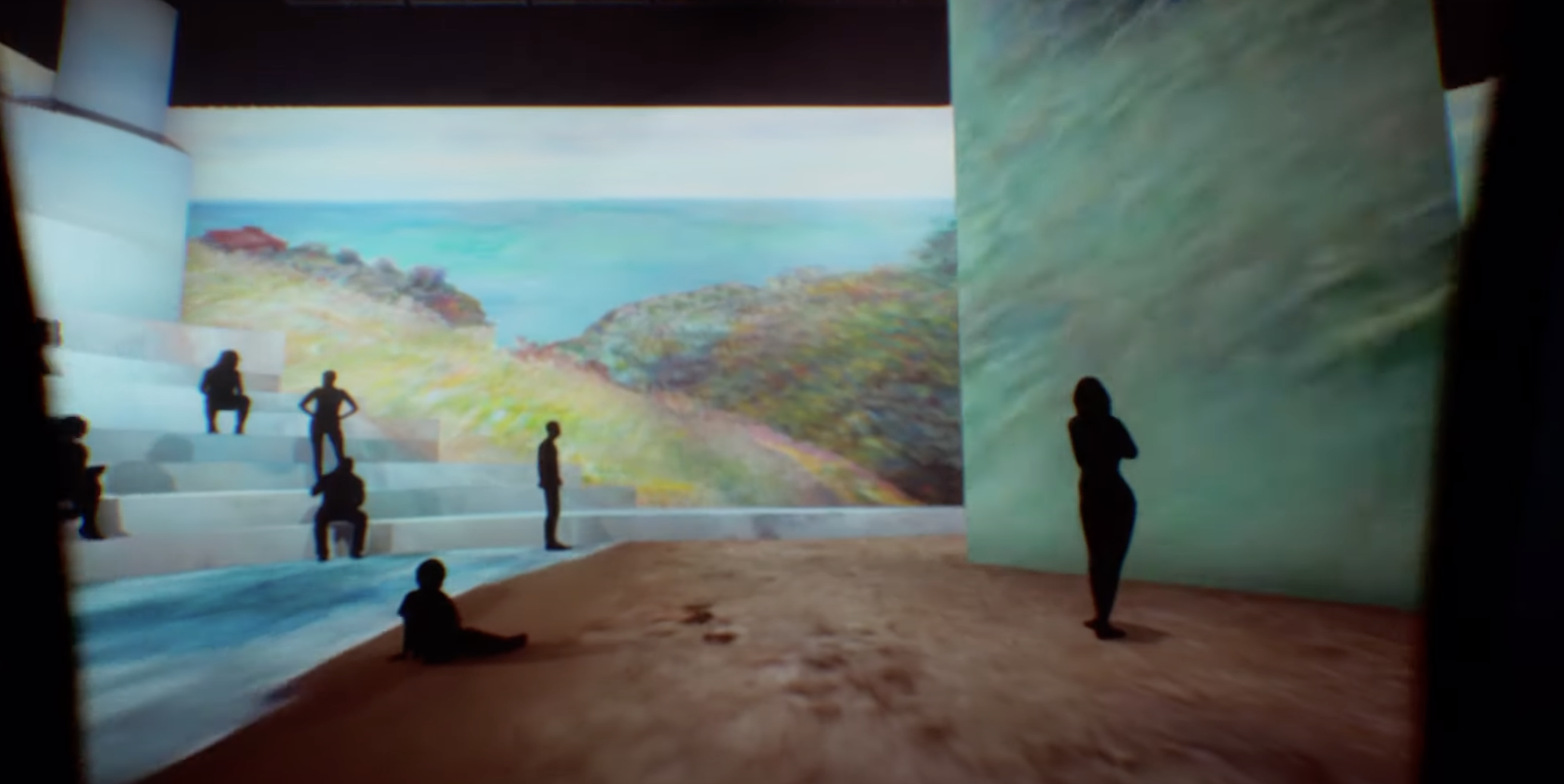
Instead of printing a photo as the example above mentions, however, immersive art experiences are a newly popularized and commercialized form of creative works that have largely been based on works in the public domain. Furthermore, certain aspects of these experiences may be protected under copyright law.
The Rise of Public Domain Art in Immersive Art Experiences
Although immersive art experiences are not new, they have become popular in recent years. In 2012, Culturespaces Digital, a company specializing in immersive art experiences, began producing digital art exhibits in the Carrières des Lumières in France. The company focused on different noteworthy artists each year; in 2013, Culturespaces opened an immersive exhibit highlighting Gustav Klimt. Other exhibits featured Vincent Van Gogh in 2019, Paul Cezanne in 2021, and Claude Monet in 2022, all of whose art is in the public domain.
Other companies have followed, creating immersive art exhibits around the world. The Immersive Van Gogh Exhibit, which was created and designed by contemporary immersive artist, Massimiliano Siccardi, focuses solely on the life and work of Vincent Van Gogh, and acts as a traveling exhibit, visiting different larger cities across North America. Because Van Gogh’s works are in the public domain, it is permissible under copyright law for anyone to create an immersive experience featuring the artist, which is evident in the many companies that have Van Gogh-specific immersive exhibits. Immersive experience companies such as Superblue, which opened in Miami in 2021, is a physical space dedicated to showcasing the works of different artists through digital immersive art technology. Australia-based, Grande Experiences, offers companies the option of obtaining a license to host one of their immersive art shows in any city, featuring artists such as Dali, Monet, and DaVinci, and also has permanent immersive art venues in Melbourne and Indianapolis. Their business model allows companies to lease the right to use and profit from their immersive experiences. The immersive entertainment industry, estimated to be valued at over $61.8 billion, according to the HERE Institute’s 2020 annual report, is highly profitable because it eliminates high costs associated with moving and insuring physical artwork, especially those of famous artists.
The digital technology that creates these immersive art experiences allows visitors to feel transported into the art itself. For instance, viewers might feel physically present in a field of Van Gogh’s sunflowers or walk over the bridge Monet painted in the water lily garden. Immersive experiences also often offer 360-degree projections of landmark paintings and works of art, as well as mega-size screens that allow viewers to sit under and around the paintings to fully experience the creative magnitude of classic masterpieces. Coupled with the lighting and sound that is engineered specifically for each exhibit and artist, the sensory experience becomes fully immersive.
Copyright Protection for Immersive Art Experiences
People may be interested in reproducing art that has fallen into the public domain for several reasons. For example, with famous artists such as Salvador Dali or Leonardo DaVinci, whose works are in the public domain, immersive art companies attract a wide audience and therefore stand to profit from both the name recognition and from the opportunity to create a new experience for viewers, portraying the art on a larger scale, and in an amplified way. Some companies have successfully registered for copyright protection for their immersive art exhibits. For example, Belgium-based company, Dirty Monitor registered its immersive art project, Van Gogh Immersive Exhibition, in 2017 with the U.S. Copyright Office, (registration number PA0002347152). Thus, although no one may obtain copyright registration for reproducing a copy of one of Van Gogh’s paintings, companies such as Dirty Monitor are able to obtain copyright protection for the aspects of a reproduction that are independently copyrightable. For example, Dirty Monitor did not register the photographs of Van Gogh’s paintings that they used in their exhibit, but they did register all other cinematographic material, the additional new footage, and the production as a motion picture. Because immersive art companies create so many different elements involved in the exhibit, such as lighting design, sound effects and musical scores, and video and virtual reality, they are able to obtain copyright protection for the way in which they express art that is in the public domain. When these companies have copyright-protected immersive art experiences, they also retain the right to preclude others from creating immersive art exhibits that copy elements of their exhibits, known as “compilation” and “derivatives.” This is because copyright law protects not only the original artworks themselves but also derivative works that are created based on the original artworks. See the U.S. Copyright Office’s explanation of “Copyright in Derivative Works and Compilations.”
Derivative works include works that are based on or incorporate the original artwork, such as reproductions, adaptations, and translations. For example, an immersive art exhibit wherein images of a Klimt painting or one of the gardens in a Monet painting are displayed through a virtual reality headset, with the addition of elements such as sound recordings and special lighting, may be considered a derivative work that is protected by copyright law. The U.S. Copyright Office defines derivative works as:
“A derivative work is a work based on or derived from one or more already existing works. Common derivative works include translations, musical arrangements, motion picture versions of literary material or plays, art reproductions, abridgments, and condensations of preexisting works. Another common type of derivative work is a “new edition” of a preexisting work in which the editorial revisions, annotations, elaborations, or other modifications represent, as a whole, an original work.” [5]
In some cases, the owners of the original works may also have intellectual property rights in the immersive art experience itself. For example, all texts and illustrations published on the website of the Klimt Foundation are still protected under copyright law, while Klimt’s painting, The Kiss is in the public domain in the United States because it was published (or registered with the U.S. Copyright Office) before January 1, 1928. On the other hand, immersive art experience companies such as Klimt: The Immersive Experience, claim copyright protection, although no registration can be found on the U.S. Copyright Office’s database.
Additionally, copyright protection may expire for the original artwork, but the derivative work may still be protected because it was created within the protected period of time. Additionally, fair use and other exceptions to copyright law may apply to certain uses of the original artwork or derivative works, such as when the art is displayed or reproduced for educational or non-commercial purposes.
Infringement and Immersive Art
Some creators of immersive art experiences have encountered copyright infringement issues, including teamLab, a Japanese art collective that sued the for-profit Museum of Dream Space (MODS) in 2019 (teamLab Inc. v. Museum of Dream Space, LLC et al), for copying its immersive art exhibit. In January 2023, teamLab declared a victory in their lawsuit after a California court found that there was substantial similarity between the MODS immersive exhibit and the teamLab exhibit, such that there was significant evidence of copying. However, teamLab’s exhibits do not include art from the public domain, and therefore, proving infringement for an immersive art company that bases its exhibits on art in the public domain would require a finding that the company accused of infringement copied the particular expression of the immersive experience, rather than copying the public domain art itself or the idea of an immersive art experience featuring a particular public domain artwork.
In summary, immersive art experiences featuring artwork from the public domain has become a highly lucrative and popular way in which people are consuming art. In the coming months and years, as technology continues to advance and art continues to fall into the public domain, it is probable that more infringement suits will arise, and therefore, copyright laws will need to be refined to adapt to these challenges.
Selected Sources
- Jenkins, J., & Tucker, N., Public Domain Day 2023, Duke University School of Law, https://web.law.duke.edu/cspd/publicdomainday/2023/.
- Rich Stim, The Public Domain – Copyright Overview, Stanford Copyright and Fair Use Center, https://fairuse.stanford.edu/overview/public-domain/.
- How Long Does Copyright Protection Last? (FAQ). (n.d.). U.S. Copyright Office, https://www.copyright.gov/help/faq/faq-duration.html.
- Jessie Ball duPont Library: Copyright: All You Need to Know: Public Domain and Open Access Resources. (Jun. 30, 2022), https://library.sewanee.edu/c.php?g=240692&p=1600520.
- Circular 14: Copyright in Derivative Works and Compilations. U.S. Copyright Office, https://www.copyright.gov/circs/circ14.pdf.
Disclaimer: This and all articles are intended as general information, not legal advice, and offer no substitution for seeking representation.
About the Author:
Laura Dowdy, Legal Intern with the Center for Art Law, is a second-year law student at New England Law | Boston, concentrating on Intellectual Property law, especially art, copyright, and trademark law. She can be reached at laura.dowdy@nesl.edu.
Disclaimer: This article is for educational purposes only and is not meant to provide legal advice. Readers should not construe or rely on any comment or statement in this article as legal advice. For legal advice, readers should seek a consultation with an attorney.


You must be logged in to post a comment.