• About
    • Mission
    • Team
    • Boards
    • Mentions & Testimonials
    • Institutional Recognition
    • Annual Reports
    • Current & Past Sponsors
    • Contact Us
  • Resources
    • Article Collection
    • Podcast: Art in Brief
    • AML and the Art Market
    • AI and Art Authentication
    • Newsletter
      • Subscribe
      • Archives
      • In Brief
    • Art Law Library
    • Movies
    • Nazi-looted Art Restitution Database
    • Global Network
      • Courses and Programs
      • Artists’ Assistance
      • Bar Associations
      • Legal Sources
      • Law Firms
      • Student Societies
      • Research Institutions
    • Additional resources
      • The “Interview” Project
  • Events
    • Worldwide Calendar
    • Our Events
      • All Events
      • Annual Conferences
        • 2026 Art Law Conference
        • 2025 Art Law Conference
        • 2024 Art Law Conference
        • 2023 Art Law Conference
        • 2022 Art Law Conference
        • 2015 Art Law Conference
  • Programs
    • Visual Artists’ Legal Clinics
      • Art & Copyright Law Clinic
      • Artist-Dealer Relationships Clinic
      • Artist Legacy and Estate Planning Clinic
      • Visual Artists’ Immigration Clinic
    • Summer School
      • 2026
      • 2025
    • Internship and Fellowship
    • Judith Bresler Fellowship
  • Case Law Database
  • Log in
  • Become a Member
  • Donate
  • Log in
  • Become a Member
  • Donate
Center for Art Law
  • About
    About
    • Mission
    • Team
    • Boards
    • Mentions & Testimonials
    • Institutional Recognition
    • Annual Reports
    • Current & Past Sponsors
    • Contact Us
  • Resources
    Resources
    • Article Collection
    • Podcast: Art in Brief
    • AML and the Art Market
    • AI and Art Authentication
    • Newsletter
      Newsletter
      • Subscribe
      • Archives
      • In Brief
    • Art Law Library
    • Movies
    • Nazi-looted Art Restitution Database
    • Global Network
      Global Network
      • Courses and Programs
      • Artists’ Assistance
      • Bar Associations
      • Legal Sources
      • Law Firms
      • Student Societies
      • Research Institutions
    • Additional resources
      Additional resources
      • The “Interview” Project
  • Events
    Events
    • Worldwide Calendar
    • Our Events
      Our Events
      • All Events
      • Annual Conferences
        Annual Conferences
        • 2026 Art Law Conference
        • 2025 Art Law Conference
        • 2024 Art Law Conference
        • 2023 Art Law Conference
        • 2022 Art Law Conference
        • 2015 Art Law Conference
  • Programs
    Programs
    • Visual Artists’ Legal Clinics
      Visual Artists’ Legal Clinics
      • Art & Copyright Law Clinic
      • Artist-Dealer Relationships Clinic
      • Artist Legacy and Estate Planning Clinic
      • Visual Artists’ Immigration Clinic
    • Summer School
      Summer School
      • 2026
      • 2025
    • Internship and Fellowship
    • Judith Bresler Fellowship
  • Case Law Database
Home image/svg+xml 2021 Timothée Giet Art law image/svg+xml 2021 Timothée Giet The Sarr-Savoy Report & Restituting Colonial Artifacts
Back

The Sarr-Savoy Report & Restituting Colonial Artifacts

January 31, 2019

By Clara Cassan.

In 1885, The General Act that emerged from the Berlin conference read as follows: “The Signatory Powers exercising sovereign rights or authority in African territories will continue to watch over the preservation of the native populations and to supervise the improvement of the conditions of their moral and material well-being” (Article 11).[i] The text was signed by the United States and thirteen European nations, including France, with the intention of “protecting” African countries and enabling free trade and transit through the continent. Its language gives us a clear illustration of colonization, one’s appropriation of a place without its owner’s consent, which, more simply, can also be defined as theft. The conference gave way to the division Africa endured until the 1970s. France acquired Algeria, Tunisia, Morocco, most of the northern Sub Saharan countries, and Madagascar.

Amongst European material appropriations were artworks and sacred objects of various African communities. French colonizers imported these acquisitions to France and slowly integrated them into their national collections. Some objects entered the Louvre Museum, while others reflecting “the history of manners and customs” of colonized countries were placed in the newly created musée d’Ethnographie du Trocadéro, near the Eiffel Tower. As these importations scattered across France, the government organized “colonial exhibitions,” attracting tourism and contributing to the country’s growing economy. Paris consequently experienced the birth and expansion of specialized institutions, starting with the Colonial Museum in 1931. Today’s Musée du Quai Branly – Jacques Chirac, in Paris, is a concentration of 70,000 Sub Saharan African treasures, which represent about two-thirds of the African objects still held in France. Most of the institution’s artworks originate from Tchad, Madagascar, Mali, and Benin.
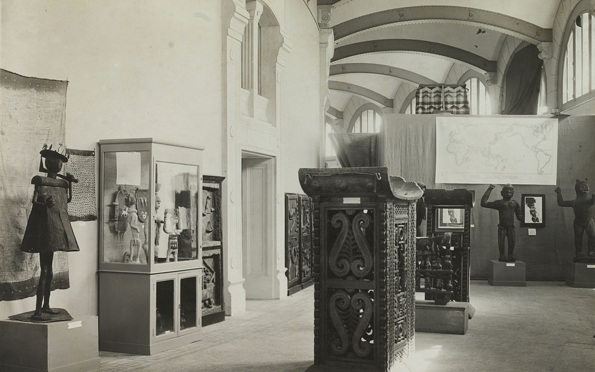
Part of the Musée d’Ethnographie du Trocadéro’s exhibition on French-colonial artworks, 1931. © Musée du Quai Branly

In November 2017, French President Emmanuel Macron undertook his first political visit to several African countries since the beginning of his mandate. His tour began in Ouagadougou, Burkina Faso, where he gave a speech at the University of Ouagadougou[ii] that planted the seeds for what is now one of France’s most sensitive cultural topics. On November 23rd of that year, Macron expressed his desire for the temporary or permanent restitution of African cultural heritage throughout the next five years. Back then, this sounded like mere political politeness; but only a few months after his address to Sub-Saharan Africa, Macron commissioned a report, today known as the Sarr-Savoy Report, from academics and researchers Bénédicte Savoy and Felwine Sarr to implement the return of thousands of artworks. It was published on November 21, 2018, and two days later, Macron announced that Benin’s 2016 restitution requests would be promptly answered with the return of 26 artworks that have been in France since the colonial period. Director of the Fondation Zinsou for Contemporary Art in Cotonou, Marie-Cécile Zinsou, hopes for a rebalancing of African art’s presence across the world so that, she says, Benin is not the only place in the world that does not hold Beninese objects.[iii]

The Report

The Sarr-Savoy Report On the Restitution of African Cultural Heritage, Toward a New Relational Ethics[iv] is a 252-page bilateral agreement between France and certain African countries. The document is divided into three main parts: (1) To Restitute, (2) Restitutions and Collections, and (3) Accompanying Returns.


Felwine Sarr and Bénédicte Savoy at the Collège de France in Paris, on March 21, 2018. © Alain Jocard/AFP

The second part, “Restitutions and Collections”, draws a three-step process towards effective restitutions. The first phase was launched on the report’s publication date and asks French public museums to create thorough inventories of all the Sub Saharan artworks they possess, in the hopes of reaching as much transparency as possible. These lists will then be sent to the relevant African countries. A lack of response from one of these countries will be read as an unwillingness to collaborate. By Spring 2019, these inventories should be completed and publicly accessible online. Thirdly, starting November 2022, France will be returning all claimed artworks.

Effects on the Law of Inalienability

The Report sparked defensive criticism from Western countries. One fear was that the Report’s implementation might entail modifying the French Code of Heritage and, more specifically, limit the principle that has protected its public domain for nearly five hundred years. The inalienability rule in question was originally written to protect the French crown’s property. It was temporarily overruled under the French Revolution and resurged in the 19th century. The law still fully applies today, preventing individuals and other countries from taking possession of public goods and monuments. The former Minister of Foreign Affairs, Jean-Marc Ayrault, relied on this old principle to avoid Benin’s first requests in 2006. Part 3 of The Sarr-Savoy Report finds different ways to skirt this sacrosanct law. It recalls this text was solely meant to protect national property and notes that the African objects in question never belonged to France and, thus, were never a part of its national heritage. The authors also suggest using the “law of exception” that was brandished in 2010 to return 16 Maori heads to New Zealand, after a vote by the French legislature.

Foreign Governments’ Response

European governments expressed another, more practical fear. If African goods were returned, what was to become of their collections? Would the Musée du Quai Branly be reduced to empty shelves? France’s former Minister of Culture, Jean-Jacques Aillagon, shared this concern in an op-ed for Le Figaro, calling the Report “a manifesto, built on the assumptions and involvement of the authors, leaving hardly any place for contradiction.” Of course, the Report never suggests such a drastic solution. The point is to reach a healthier balance between both continent’s possessions and to move forward in their political and cultural relations.

Sarr and Savoy’s call for transparency from public institutions will also help identify which objects were stolen, bought, or acquired during colonization. These stages will avoid unnecessarily emptying the Musée du Quai Branly, for example. Unfortunately, even if an entity is found to hold illegitimate artworks, it will not be legally forced to return it. International conventions such as UNESCO’s 1970 Convention on the Means of Prohibiting and Preventing the Illicit Import, Export and Transport of Ownership of Cultural Property[vi] only apply to circulations post-1970. Acts performed during colonization are long prescribed. Despite potential legal modifications, the international community will have to rely on the country’s ethics and good faith. Though the report has no legal force at the moment, it has laid out practical solutions that can hardly be ignored. In an interview with the Swiss media[vii], lawyer and Director of The Art-Law Centre in Geneva, Marc-André Renold, said President Macron’s strong diplomatic commitment towards certain African countries would likely pressure him into modifying French law in light of Sarr and Savoy’s suggestions.

The Art World’s Response

Part of the art world sees European museums as the proper environment for “universal exhibits.” They argue that Africa’s objects will be best preserved and admired in institutions with greater means. Yet, a country’s ability to welcome its own heritage should be measured by the country itself. The African continent has over 500 museums that are still waiting to be heard. Keeping the litigious artworks locked in Europe would only maintain the infantilization Africa has been a victim of.

Museum directors also responded to the Report and raise the issue that French museums are primarily government-owned. By contrast, US museums are privately owned and answer to boards and trustees. However, the Report still reinforces how museums and their directors must be transparent about the nature and origins of the collections.

Nonetheless, Alexandre Giquello, a primitive art expert at French auction house Binoche et Giquello, finds the report reflects a misconception of the art market[viii]. He explains that auction houses and art dealers want to avoid the circulation of looted, stolen, or suspicious works at all costs. According to him, ninety percent of African goods were acquired through regular and barter sales, donations, or exchanges during the colonization era. In his address to Burkina Faso, Macron had talked about the possibility of “temporary restitutions” of Africa’s heritage, as if to promise skeptical European actors, like Mr. Giquello, that France will not be infinitely deprived of these works. The expression sounds absurd, but the applicability of proper restitutions in this case is also debatable. The notion of restitution implies returning an object to its legitimate owner. However, as Nigerian-American artist Toyin Ojih Odutola recently explained to The New York Times, the artworks will not necessarily be returning to where they came from simply because their provenance is not always identifiable.[ix] Territorial reconfigurations gave way to untracked commerce, which will only complicate future restitution ambitions. Instead of entirely brushing off the idea of “temporary restitutions,” the Report finds a middle ground by embracing it as a transitory solution until legal dispositions are enacted to enable definitive returns to Africa.

Against this backlash, Felwine Sarr and Bénédicte Savoy spoke up to say that their ideas have been oversimplified and that the media are inciting fears. With the yellow-jacket movements still taking place in France, accusations aimed at the President include his unreliability and detachment from life’s daily realities. However, on the subject of art restitutions, Macron has been surprisingly efficient and is the first Western President to put his foot in the door of a public and risky issue. Actual advancements will now depend upon African countries’ willingness to cooperate and take possession of their – or their neighboring countries’ – heritage. Whatever the outcome, Macron’s actions are unveiling political relations from anachronistic masks.


[i] General Act of the Berlin Conference on West Africa, 26 February 1885. Available here.

[ii] Emmanuel Macron’s speech at the University of Ouagadougou on November 28, 2017. Text and video available here.

[iii] Catherine Frammery, “Faudra-t-il un jour vider les musées suisses?”, Le Temps, December 6, 2018. Available here.

[iv] The Sarr-Savoy Report On the Restitution of African Cultural Heritage, Toward a New Relational Ethics. Full English text available here.

[v] Alexandre Edip, “DÉBAT : LA FRANCE DOIT-ELLE RESTITUER SES OEUVRES À L’AFRIQUE ?”, Capital, Polémik Section (November 28, 2018). Article available here.

[vi] Convention on the Means of Prohibiting and Preventing the Illicit Import, Export and Transfer of Ownership of Cultural Property 1970. Full text available here.

[vii] Sylvie Lambelet, “Un rapport français incite à la restitution du patrimoine africain”, RTS Culture Radio Interview and Article (November 27, 2018). Interview and article available here.

[viii] Culturebox, “Rapport Savoy-Sarr: un plan en 3 phases pour la restitution de 90.000 objets africains présents dans les musées français”, FranceTV Info (November 23, 2018). Interview available here.

[ix] Jason Farago, “Artwork Taken From Africa, Returning to a Home Transformed”, The New York Times, Art & Design Section (January 3, 2019). Full article available here.[

[x] Id.

Further readings:

Kate Brown, “‘The Idea Is Not to Empty Museums’: Authors of France’s Blockbuster Restitution Report Say Their Work Has Been Misrepresented”, Artnet News (January 24, 2019). Available here.

Selected press articles here.

About the Author: Clara Cassan is French-American. She holds a graduate degree in European Intellectual PropertyLaw and Art History from Paris I, Sorbonne University. She began an LL.M degree at Fordham University in Intellectual Property and Information Technology Law in January 2019, after working as an intern with Cahill, Cossu, Noh & Robinson, LLP.

Disclaimer: This article is for educational purposes only and is not meant to provide legal advice. Readers should not construe or rely on any comment or statement in this article as legal advice. For legal advice, readers should seek a consultation with an attorney.

Post navigation

Previous Art in the Courtroom: Dealing with New Deal-Era Murals – Part II
Next Op-Ed: Art Historical Due Diligence To Resolve Cultural Heritage Disputes

Related Art Law Articles

Center for Art Law
What the Heck is Copyright (2)

What is Copy, Right?

2026 Annual Conference

Let’s explore Visual Art, AI, and the Law in the 21st Century together.


Reserve Your Ticket TODAY
Guidelines AI and Art Authentication

AI and Art Authentication

Explore the Guidelines for AI and Art Authentication for the responsible, ethical, and transparent use of artificial intelligence.

Download here
Center for Art Law

Follow us on Instagram for the latest in Art Law!

Join us on May 27th at Brooklyn Law School for our Join us on May 27th at Brooklyn Law School for our Annual Art Law Conference 2026: What is Copy, Right? 

We are very excited to introduce you to the topic and speakers for, Panel 1: So Inappropriate — Lessons About Copyright Law and Art: First There Was Art, Then Copyright, Then Fair Use… and Now AI?

From early copyright doctrines to contemporary fair use debates, this panel examines how artists and lawyers have navigated questions of ownership, appropriation, and originality in visual art. Panelists will explore key developments in copyright law affecting traditional artistic practices, from borrowing and remixing to transformative use, while also considering how emerging technologies, including AI, are beginning to reshape long‑standing legal frameworks and artistic norms.

Moderator: Irina Tarsis, Founder, Center for Art Law
Speakers: Vivek Jayaram, Founder, Jayaram Law; Vincent Wilcke, Pace Gallery; Greg Allen, Artist and writer 

Reserve your tickets using the link in our bio or by visiting our website itsartlaw.org 🎟️ 
See you soon!
Next stop: Venice. The 61st Biennale has been maki Next stop: Venice. The 61st Biennale has been making waves and headlines for weeks and the doors have not even opened yet. The jury refused to award prizes and resigned nine days before the opening over geopolitical controversies. Some artists boycott while others show up even if unwelcome. Some pavilions will be empty, some will not be open to the public… Sources of funds, sources of inspiration, so many questions, so much on display for critical eyes. Meanwhile the boats are waiting for anyone lucky enough to find themselves in the floating world.

Help us reflect on the Biennale by sharing your art law stories.

#ArtLaw #Venice #Biennale2026 #ArtWorld #BiennaleofDissent #LaSerenissima #GoldenLion #SeeArtThinkArtLaw
Center for Art Law is very pleased to welcome Prof Center for Art Law is very pleased to welcome Professor Ben Zhao as the Keynote Speaker for our Annual Art Law Conference 2026! 

Ben Zhao is the Neubauer Professor of Computer Science at the University of Chicago where he, and a team of researchers at the university, developed NightShade & Glaze, two data-poisoning tools which protects artists' work from being scraped for AI data training. 

Professor Zhao will discuss tools, such as NightShade, which can assist in defending art in the age of AI. 

The 2026 conference will focus on copyright law as it relates to visual art, artificial intelligence, and the rapidly evolving legal landscape of the 21st century. The program will begin with Professor Zhao's keynote address, followed by three substantive panels designed to build on one another throughout the afternoon. In addition, we will host a curated group of exhibitors featuring databases, legal tools, and technology platforms relevant to artists’ rights, copyright, and AI. The program will conclude with a reception, providing time for continued discussion, networking, and engagement among speakers, exhibitors, and attendees. 

We hope you join us! Reserve your tickets now using the link in our bio 🎟️ 

#centerforartlaw #artlaw #copyrightlaw
A huge thank you to our hosts and incredible speak A huge thank you to our hosts and incredible speakers who made this London panel discussion truly special! 🙏✨ 🇬🇧 🇺🇦 

We were so fortunate to hear from:

🎤 Rakhi Talwar | RTalwar Compliance
🎤 Raminta Dereskeviciute | McDermott Will & Schulte
🎤 Daryna Pidhorna, Lawyer & Analyst | The Raphael Lemkin Society
🎤 Timothy Kompancheko | Bernard, Inc.
🎤 Yuliia Hnat | Museum of Contemporary Art NGO
🎤 Irina Tarsis | Center for Art Law

Your insights, expertise, and passion made this a conversation we won't forget. Thank you for sharing your time and knowledge with us! 💫

Bottom Line: the art market has power and responsibility. Our panel "Art, Money, and the Law: Sanctions & AML Enforcement in 2026" tackled the hard questions around money laundering, sanctions compliance, and what's at stake for art market participants in today's regulatory landscape.

⚠️ Regulators are watching and "history has it's eyes on you..." too We don't have to navigate the legal waters alone. Let's keep the conversation going.

What was your biggest takeaway? 

#ArtLaw #AMLCompliance #Sanctions #ArtMarket #ArtAndMoney #Enforcement2026
At the Center for Art Law we are preparing for our At the Center for Art Law we are preparing for our Annual Art Law Conference 2026, "What is Copy, Right? Visual Art, AI, and the Law in the 21st Century", and we hope you are as excited as we are! The event will take place on May 27th at Brooklyn Law School. 

In addition to the panels throughout the day, which will offer insights into the rapidly shifting landscape of art and copyright law, our conference will feature exhibitors showcasing resources for promoting artists' rights, and a silent auction aimed at bolstering the Center's efforts. 

We would like to invite you to take part in and support this year's Annual Art Law Conference by being an exhibitor or sponsor. We express our sincere appreciation to all of our sponsors, exhibitors and you! 

Find more information and reserve your tickets using the link in our bio! See you soon!
In this episode, we speak with art market expert D In this episode, we speak with art market expert Doug Woodham to unpack how Jean-Michel Basquiat became one of the most enduring cultural icons of our time.

Moving beyond his rise in 1980s New York, this episode focuses on what happened after his death. We explore how his estate, led by his father, shaped his legacy through control of supply, copyright, and narrative; how early collectors and market forces drove the value of his work; and how museums and media cemented his place in art history.

Together, we explore the bigger question: is creating great art enough, or does becoming an icon require an entire ecosystem working behind the scenes?

🎙️ Check out the podcast anywhere you get your podcasts using the link in our bio!

Also, please join us on May 27  for the highly anticipated Art Law Conference 2026, held at Brooklyn Law School and Online (Hybrid). Entitled “What is Copy, Right? Visual Art, AI, and the Law in the 21st Century,” this year’s conference explores the evolving relationship between visual art, copyright law, and artificial intelligence!

#centerforartlaw #artlaw #artlawyer #podcast #legal #research #legalresearch #newepisode #artmarket #basquiat
Amy Sherald cancelled her mid-career retrospective Amy Sherald cancelled her mid-career retrospective, scheduled at the National Portrait Gallery (NPG) in D.C., after a curatorial controversy over the potential removal of her recent work, "Trans Forming Liberty" (2024). Sherald denounced the attempt to remove this work as a blatant and intentional erasure of trans lives. 

This is one of the best examples and the most illustrative examples of the current administration's growing efforts to control the Smithsonian Institution's programming. In this climate of political tension, how do cultural institutions defend themselves against censorship and keep their curatorial independence?

📚 Click the link in our bio to read more!

#centerforartlaw #artlaw #legal #artlawyer #legalreserach #artcuration #curatorialindependance #censorship
Grab 15% off tickets the upcoming bootcamp on Arti Grab 15% off tickets the upcoming bootcamp on Artist-Dealer Relations, now available online!! 

Center for Art Law’s Art Lawyering Bootcamp: Artist-Dealer Relationships is an in-person, full-day training aimed at preparing lawyers for working with visual artists and dealers, in the unique aspects of their relationship. The bootcamp will be led by veteran attorneys specializing in art law.

This Bootcamp provides participants -- attorneys, law students, law graduates and legal professionals -- with foundational legal knowledge related to the main contracts and regulations governing dealers' and artists' businesses. Through a combination of instructional presentations and mock consultations, participants will gain a solid foundation in the specificities of the law as applied to the visual arts.

Bootcamp participants will be provided with training materials, including presentation slides and an Art Lawyering Bootcamp handbook with additional reading resources.

Art Lawyering Bootcamp participants with CLE tickets will receive New York CLE credits upon successful completion of the training modules. CLE credits pending board approval.

🎟️ Grab tickets using the link in our bio!

Get 15% off using the code: Final15 

#centerforartlaw #artlaw #legal #research #lawyer #artlawyer #bootcamp #artistdealer #CLE #trainingprogram
On the night of April 15–16, 2026 alone, Russia se On the night of April 15–16, 2026 alone, Russia sent hundreds of drones and missiles on sleeping cities across Ukraine, killing and injuring dozens of civilians. War is funded in part by individuals who have important artworks in their personal collections. This full-scale invasion of Ukraine, now in its fifth year, daily exacts a grave toll on Ukrainian lives and cultural heritage, while fundamentally disrupting European commerce. In response, art market participants have adapted their practices, most have accepted, if not always embraced, the need to scrutinize the source of funds and the ultimate beneficiaries of their transactions. Yet there is a growing sense that parts of the trade are holding their breath, waiting to see when they might safely return to dealing with the oligarchs who continue to fund the Russian war machine.

For art market participants operating in the UK, compliance is no longer a peripheral concern, it is a legal imperative. Regulators are watching, the consequences of non-compliance increasingly extend beyond administrative penalties into criminal liability, and private-public partnerships offer the most credible path toward a more resilient and trustworthy market. 

Join us on April 24th for a panel discussion in London on the current state of AML enforcement and sanctions.

🎟️ Grab your tickets using the link in our bio!

#centerforartlaw #artlaw #artlawyer #lawyer #artcrime #london #artissues #museumissues
Sotheby's sold Modigliani’s Portrait de Leopold Zb Sotheby's sold Modigliani’s Portrait de Leopold Zborowski to Cahn in 2003 for the low price of about $1.55 million. In 2016, Cahn claimed he was verbally informed about authenticity issues with the painting by Sotheby's. The parties did make an agreement regarding Cahn reselling with Sotheby's for a guaranteed price in exchange for releasing the auction house from all claims related to the painting. Cahn claims that he attempted to set this process in motion in June 2025, but he received no response. Cahn now seeks damages totaling $2.67 million, plus interest and attorneys’ fees, for breach of contract. 

Through this dispute, Vivianne Diaz's article highlights a bigger issue in the art market by explaining how forgeries negatively affect both collectors and auction houses, and how auction houses need to be more careful, but most importantly, proactive in their authentication determinations.

📚 Click the link in our bio to read more!

#centerforartlaw #artlaw #artlawyer #legalresearch #art #Modigliani #LeopoldZborowski #sothebys
Don't miss our upcoming April 20th bootcamp on Art Don't miss our upcoming April 20th bootcamp on Artist-Dealer Relations, now available online!!

Center for Art Law’s Art Lawyering Bootcamp: Artist-Dealer Relationships is an in-person, full-day training aimed at preparing lawyers for working with visual artists and dealers, in the unique aspects of their relationship. The bootcamp will be led by veteran attorneys specializing in art law.

This Bootcamp provides participants -- attorneys, law students, law graduates and legal professionals -- with foundational legal knowledge related to the main contracts and regulations governing dealers' and artists' businesses. Through a combination of instructional presentations and mock consultations, participants will gain a solid foundation in the specificities of the law as applied to the visual arts.

Bootcamp participants will be provided with training materials, including presentation slides and an Art Lawyering Bootcamp handbook with additional reading resources.

Art Lawyering Bootcamp participants with CLE tickets will receive New York CLE credits upon successful completion of the training modules. CLE credits pending board approval.

🎟️ Grab tickets using the link in our bio!

#centerforartlaw #artlaw #legal #research #lawyer #artlawyer #bootcamp #artistdealer #CLE #trainingprogram
The historic Bayeux Tapestry, conserved in Normand The historic Bayeux Tapestry, conserved in Normandy, France, is scheduled to be loaned from the Bayeux Museum to the British Museum for ten months beginning in the fall of 2026. This is the first time the tapestry will have returned to the UK in over 900 years. 

This loan, authorized by France, has raised multiple controversies, particularly over conservation concerns. Nevertheless, it has been made possible through a combination of factors, including improved conservation techniques, enhanced transport precautions, comprehensive loan agreements, insurance, and the application of relevant protective laws. 

Check out our recent article by Josie Goettel to read more about this historic loan regarding not only in its symbolic significance, but also in its technical complexity.

📚 Click the link in our bio to read more!

#centerforartlaw #artlaw #artlawyer #lawyer #legalresearch #legal #museumissues #bayeuxtapisserie #bayeuxtapestry #britishmuseum #bayeuxmuseum
  • About the Center
  • Contact Us
  • Newsletter
  • Upcoming Events
  • Internship
  • Case Law Database
  • Log in
  • Become a Member
  • Donate
DISCLAIMER

Center for Art Law is a New York State non-profit fully qualified under provision 501(c)(3)
of the Internal Revenue Code.

The Center does not provide legal representation. Information available on this website is
purely for educational purposes only and should not be construed as legal advice.

TERMS OF USE AND PRIVACY POLICY

Your use of the Site (as defined below) constitutes your consent to this Agreement. Please
read our Terms of Use and Privacy Policy carefully.

© 2026 Center for Art Law

Loading Comments...

You must be logged in to post a comment.