
Wandering Horses: Legal issues surrounding the exportation of Chinese antiquities
November 13, 2023
By Yihao Ding


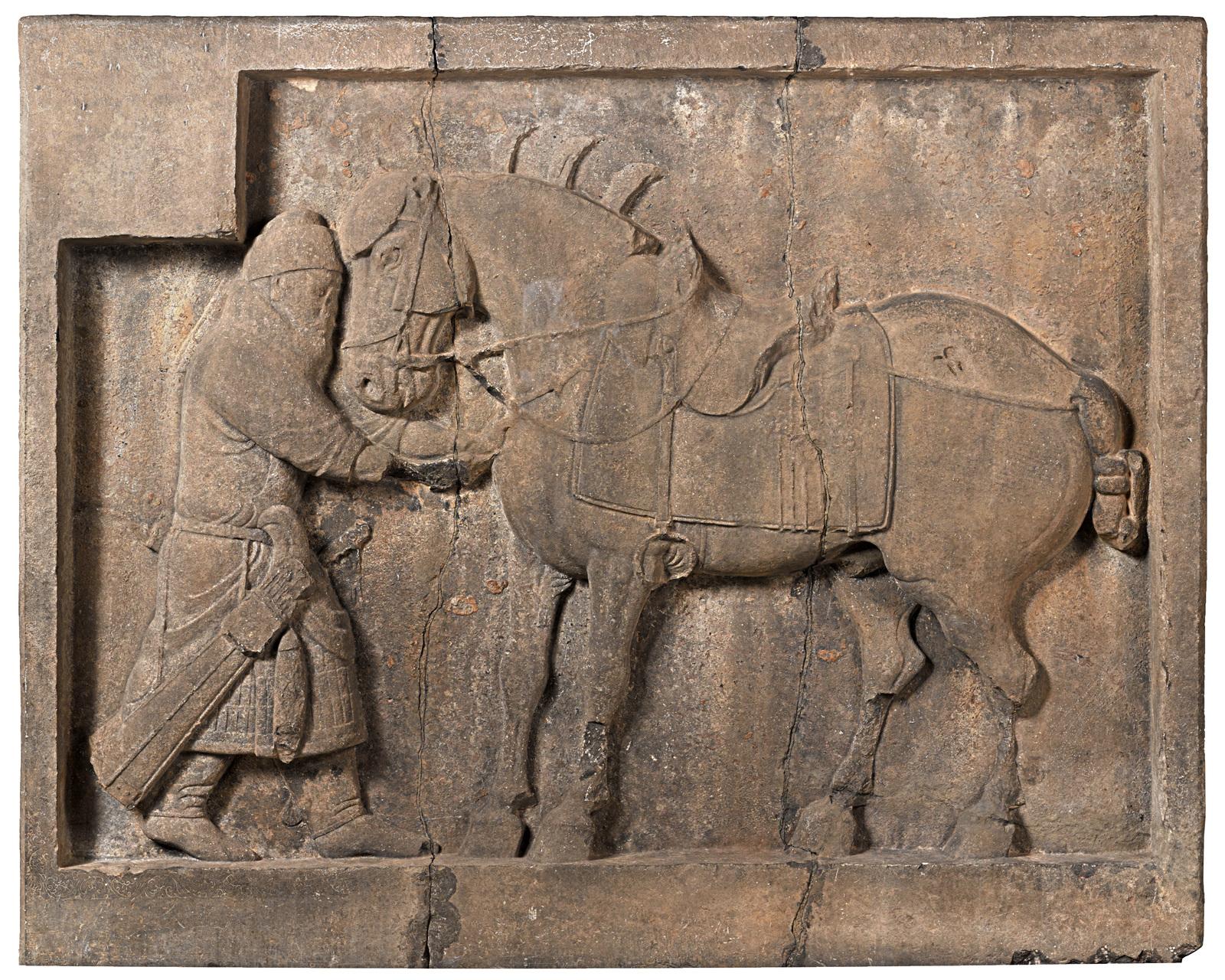
The Two Steeds of Zhao Mausoleum, two stone horse reliefs now in the Asian collection of the Penn Museum, were made during the early Tang dynasty, between 636 and 649.[1] Along with four other horse reliefs, they once accompanied Emperor Taizong of Tang in his mausoleum Zhaoling 昭陵, located at Mount Jiuzong in Shaanxi, China. Taizong himself selected the horses and ordered their images to be carved on stones as part of his burial structure so they could be properly memorialized and accompany him in his afterlife. The six horses, Saluzi (飒露紫 Autumn Dew”), Telebiao (特勒骠 “Turkic Horse”), Quanmaogua (拳毛騧 “Curly”), Qingzhui (青骓 “Horse from Qin”), Baitiwu (白蹄乌 “White-hoofed Crow”), and Shifachi (什伐赤 “Horse from Persia”)[2]were ridden by Taizong in various important battles during the emperor’s lifetime.[3] Each is represented on a separate gray stone slab of approximately 0.17 m high, 0.20 m wide, and 0.40 m thick.[4] Saluzi is shown standing with a man removing an arrow from its chest.[5] Baitiwu, Qingzhui, and Shifachi are depicted in the pose of “flying gallop.”[6] Quanmaogua and Telebiao are depicted as standing.[7] Fissures are visible on each stone slab. While Telebiao, Qingzhui, Baitiwu, and Shifachi are now in Xi’an Beilin Museum, Saluzi and Quanmaogua are in Pennsylvania.
Their “travel” from China to the U.S. took place in the early twentieth century. China was at a politically and socially unstable stage as the Qing government headed towards its end. Artworks flooded into the West in various ways during the late Qing dynasty. Some were directly excavated, removed, and transferred to the West by Western individuals and groups.[8] Westerners’ passion for Chinese art led to its price increase, and therefore many local people acted as middlemen, abetting and aiding the sales and transportations of art.[9] Powerful Chinese figures also managed to acquire high-quality artworks, some of which were obtained by art dealers in the middle of the transitions and shipped abroad to foreign buyers.
Saluzi and Quanmaogua’s story involved both foreign looters and domestic powers. In short, a foreigner tore the six horse reliefs from the walls of Taizong’s tomb in the early 1910s. After this loot, two of them—Saluzi and Quanmaogua, were likely confiscated by Zhang Yunshan, the Division Commander, given to Lu Jianzhang, the provincial military commander, stored in the Commander’s Office in Xi’an for a while, and moved to Beijing per the order of Yuan Shikai, President of the Republic China from 1912 to 1916. Between 1916 and 1917, C.T. Loo shipped them out of Beijing to the U.S.[10] How exactly Loo acquired them, however, is backed by no more than Loo’s own declaration, that “they were sold to us through another man” and that “[i]t was absolutely legal, those horses were sold by the supreme authority of the country.”[11]
Dr. Gordon, director of the Penn Museum from 1910 to 1927 expressed to Loo the museum’s willingness to purchase the two horses in 1918.[12] The horses arrived at the museum on May 8, 1918.[13] The payment was completed in 1921.[14] At the time of the purchase, the museum was not aware of how the horses were removed from the tomb.[15] However, notably, the letter Paul Mallon, a French dealer, wrote to the museum in 1921 did provide some information regarding how the horses were taken away, confiscated, and sold to Loo.[16] Thus, the museum should have become aware of the illegality of the exportation of the horses when the payment was completed.
Chinese laws and principles at the time
Chinese laws at the time regulating the removal, transportation, and exportation of these horses include the Regulation on Methods of Cultural Heritage’s Protection (RMCHP), enacted by the Qing government in 1909 and the Interim Measures for Preservation of Antiquities (IMPA), enacted by the Ministry of Internal Affairs of the Republic of China in 1916. Both the RMCHP and the IMPA listed stone sculptures and reliefs and imperial mausoleums as what the laws intended to preserve.[17]
One critical question is whether the laws were effective when the reliefs left their original site. The reliefs were removed from the mausoleum around 1913, after the Qing government collapsed and before the Republic of China enacted the IMPA. The Republic of China’s government did not overthrow the Qing government’s RMCHP; rather, law enforcers still used the RMCHP as a basis to deter the stealing and selling of antiquities. Local governments also kept investigating, recording, and preserving the local antiquities according to the instructions in RMCHP, despite the unstable status of the central government. Applying the IMPA retrospectively to the horse reliefs’ case may counter the principle of non-retroactivity; however, the Republic of China’s government indeed started investigating cases involving stolen antiquities before the enactment of the IMPA. The IMPA likely functioned not as a “new” law, regulating areas that had not been touched, but as a summary of principles that had long existed in Chinese society and needed to be concreted. Such principles could be applied to the case of the horse reliefs.
President Yuan issued the President’s Executive Order to Restrict the Exportation of Antiquities in 1914, authorizing the Ministry of Internal Affairs and the Tax Department to review the categorization, investigation, regulation, and punishment regarding the selling and exportation of Chinese antiquities as well as the Tax Department to put together measures to restrict the exportation of antiquities.[18] Since Yuan himself enacted both the IMPA and the Presidential Order, Loo’s indication that the transaction involving the horses was entirely legal as they were sold by the supreme authority of China seems highly suspicious—it would be inconsistent for Yuan to have sold two important artworks stolen from Taizong’s imperial mausoleum to the U.S right after he enacted laws prohibiting these exact activities. Loo could have used Yuan as a pretext to cover the illegal sale. However, his choice was in fact arguably “smart,” because such a statement was probably believable at the time. The RMCHP, the IMPA, and the Presidential Order did restrict the selling of antiquities to foreigners, but transporting antiquities to foreign museums was a different story. Especially in the first few years of the Beiyang Regime, before Chinese people realized transporting antiquities overseas would result in permanent loss of cultural heritage, foreign museums basically freely obtained whatever they were interested in, without even paying export duties.[19] It would not seem entirely unreasonable if Yuan authorized the exportation of the horse reliefs to the Penn Museum to “educate the American audience” about the exquisite craftsmanship of the Tang dynasty. However, such transactions were taking advantage of the loopholes in Chinese laws regulating art trades and clearly conflicted with the legislative intent of the IMPA and the Presidential Order.
Loo himself was fully aware of the illegality of his activities—in a letter Loo wrote in 1927 to the Penn Museum’s new director Harrison, he stated that the Republic of China’s government was trying to arrest him because he exported Taizong’s horse reliefs.[20] The government certainly recognized Loo’s activities as actionable under existing laws. The illegality of the exportation of the horse reliefs should be undoubted.
American laws and principles
Following the general principle that the court in the forum country does not have jurisdiction to entertain an action for the enforcement of a penal, revenue, or other public law of a foreign country, the importer of artworks would not be subject to action solely on the ground that the exportation of the artworks was illegal in the exporting country.[21]
The U.S. government’s attitude towards international efforts to control the illicit traffic in cultural property was laissez-faire until 1969, when the U.S. started signing a series of treaties regulating the international trades of art, including the Treaty of Co-operation with Mexico, the Regulations on the import of pre-Columbian artifacts, and the UNESCO Convention on the Means of Prohibiting and Preventing the Illicit Import, Export and Transfer of Ownership of Cultural Property.[22] Due to the federal government’s laid-back approach, the museums in the U.S. also did not adopt policies restricting their collection of illicitly exported artworks.[23] In 1970, the Penn Museum became the first museum in the U.S. to announce policies regarding the acquisition of illicit cultural property, declaring that the museum would no longer purchase artworks unless the specific provenance and the legality of the export are provided.[24] The acquisition of the horses took place long before the museum announced this policy.
Conclusion
Taizong’s horses symbolized the emperor’s unconquerable power. While he carried their sculptures with him to his grave, he probably would not have thought his invincible war horses would one day be stripped off and shipped to a foreign country by his very own descendants. The inefficiency of early twentieth-century Chinese laws regulating antiquities preservations and transactions resulted in the looting and the illegal export of the Two Steeds. The U.S. government’s laid-back attitude in the early twentieth century toward importing illegally obtained artifacts contributed to this result. However, the lack of efficient laws was not the real cause of such crimes, for laws would not cure people’s desire to take advantage of disadvantaged parties. The steeds would not have suffered the hard journeys if they had never been sent to the war fields. What stops the steeds from wandering is to replace human beings’ mindset of occupying, seizing, and conquering with preserving, protecting, and saving.
Suggested Readings
Xiuqin Zhou, Zhaoling-The Mausoleum of Emperor Tang Taizong, Sino-Platonic Papers, Univ. of Penn., Philadelphia, PA, USA, Apr. 2009.
Song Zhang, The development and institutional characteristics of China’s built heritage conservation legislation, Built Heritage, 6 11 (2022). https://built-heritage.springeropen.com/articles/10.1186/s43238-022-00057-x#citeas
Julian E. Barnes, Alleging Theft, U.S. Demands Rare Sculpture Go Back to China, The New York Times, Mar. 30, 2000. https://www.nytimes.com/2000/03/30/nyregion/alleging-theft-us-demands-rare-sculpture-go-back-to-china.html
About the Author
Yihao Ding is a third-year JD candidate at Duke University School of Law. Prior to her legal studies, she obtained her BA degree in History of Art and Architecture from Middlebury College. She is interested in restitution issues of cultural heritage.
Source:
- Xiuqin Zhou, Zhaoling-The Mausoleum of Emperor Tang Taizong, Sino-Platonic Papers, Univ. of Penn., Philadelphia, PA, USA, Apr. 2009.at 141. ↑
- The exact meanings of the names of the horses remain under study. ↑
- Weifang Li, Soft law in Promoting the Return of Zhaoling Two Steeds in Tang Dynasty, Santander Art and Culture Law Review, 2/2020 (6), at 295. ↑
- Zhou, Zhaoling, at 78. ↑
- Fig. 1 ↑
- Fig. 4, 5, 6; Qingzhui is depicted shot by an arrow from its back. ↑
- Fig. 2, 3. ↑
- Xiaodong Li, Historical Review of Cultural Relics Regulations of the Republic of China 民国文物法规史评, Cultural Relics Publishing House, Beijing, 2013, at 6. Song Zhang, The development and institutional characteristics of China’s built heritage conservation legislation, Built Heritage, 6: 11 (2022), at 5. ↑
- Jian Li, The Study on the Legalization of Culture Relics Protection in Modern China, Ph. D dissertation, Culture Industry, Shandong Univ., China, 2015, at 62. ↑
- C.T. Loo was an antiquity dealer in Republic of China, owning his own antiquity dealing companies in Paris, Beijing, Shanghai, and New York. Tian Fu and Pang Lianchang. The Dispersion of Zhaoling Six Horses in Early Republic of China 民国初年昭陵六骏的离散, Popular Archeology, No. 8, 2014, at 65. ↑
- Zhou, Zhaoling, at 94. ↑
- Id. at 92. ↑
- Id. ↑
- Id. at 93. ↑
- Id. ↑
- Id. at 94. Mallon wrote the letter to show his intent to acquire the horses, since he initiated the acquisition in the first place and already advanced money which was lost when the horses were confiscated. ↑
- The Republic of China’s Beiyang government (1912–1928) and Nationalist government (1928–1948) and the People’s Republic of China’s government (1949–present) later enacted more laws regulating the preservation of antiquities. The laws keep using the concepts and principles set out in the RMCHP and the IMPA. It is not clear whether the RMCHP and the IMPA have been officially abolished, but they are likely replaced by the new laws. ↑
- Li, Historical Review, at 43. The original text is: “嗣后关于中国古物之售运/应如何区别种类/严密稽查/规定惩罚之处/着内务部同税务处分别核议/呈候施行/并由税务处拟定限制古物出口章程/通饬海关一体遵照.” ↑
- Li, The Study on the Legalization of Culture Relics Protection, at 63. ↑
- Chen, New Evidence, at 114. ↑
- Paul M. Bator, An Essay on the International Trade in Art, 34 Stan. L. Rev. 275 (1982), at 287. See also Sharon Anne Williams, The International and National Protection of Moveable Cultural Property, Dobbs Ferry, N.Y. : Oceana Publications, 1978, at 106. ↑
- Williams, The International and National Protection of Moveable Cultural Property, at 139. ↑
- Id. ↑
- Id. ↑
Disclaimer: This article is for educational purposes only and is not meant to provide legal advice. Readers should not construe or rely on any comment or statement in this article as legal advice. For legal advice, readers should seek a consultation with an attorney.


You must be logged in to post a comment.