
When Imitation is Not Flattery: Art Fakes, Forgeries, and the Market They Fool
January 28, 2026
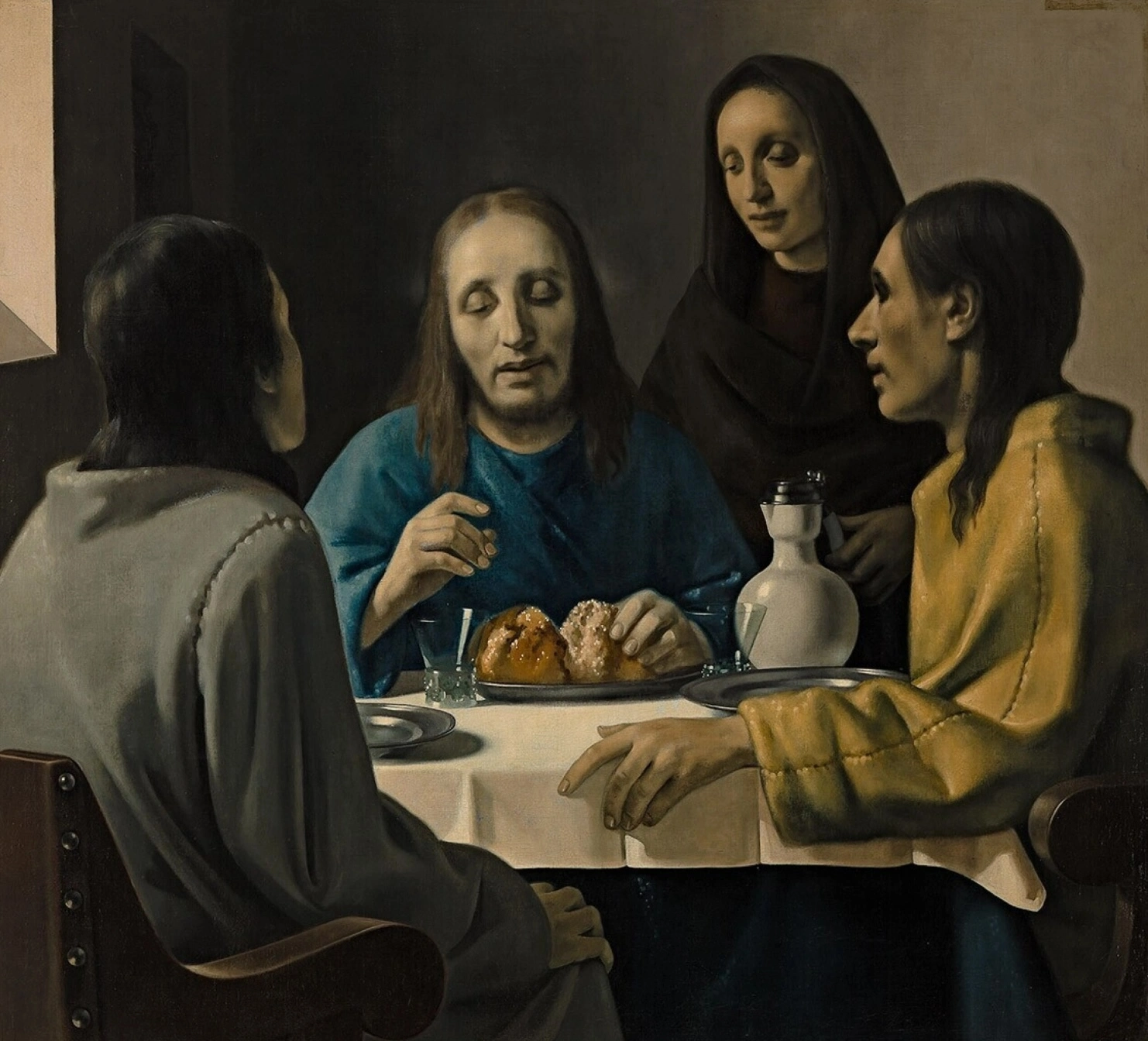
Han van Meegeren, The Supper at Emmaus (1937)
By Lauren Stein
In 2014, the Swiss Fine Art Expert Institute (FAEI) estimated that up to 50% of all artwork circulating the market were either misattributed or forged.[1] While this figure, now more than ten years old, is frequently debated and often criticized as overstated, even a substantially lower percentage raises serious concerns about the reliability and integrity of the art market. The mere possibility that a significant number of works are not what they purport to be undermines confidence among collectors, dealers, and institutions.
The FAEI’s own findings illustrate the scope of the issue. According to Yan Walther, FAEI’s former Director, approximately 70-90% of the artworks examined were ultimately determined not to be by the artist to whom they were attributed.[2] FAEI was “one of the world’s first private and independent laboratories specializing in the scientific study of works of art and cultural objects in the Geneva Free Ports [doing] . . . authentication, dating, condition reports, detection of forgeries, [and] inventory of collections . . . .”[3] To conduct these assessments, the Institute relied on a combination of scientific and technical analysis, including radiocarbon dating, X-rays, and infrared scans, to assess materials and techniques.[4]
Though Walther left the FAEI in 2015, the Institute’s influence continued. In 2016, two scientists formerly affiliated with FAEI co-founded Geneva Fine Art Analysis, Ltd.[5] Geneva Fine Art Analysis offers authentication, preventive conservation, consulting, training, and expert witness services, illustrating the demand for scientific expertise in art-market disputes. Yet even with advanced testing methods, questions of authorship and authenticity often remain contested, highlighting how deeply uncertainty is embedded in the sale of art. Importantly, not every problematic work uncovered through these examinations is the product of intentional deception, a distinction that is frequently lost in public discourse.
Fake vs. Forgery
To meaningfully assess the scope and consequences of inauthentic art, it is essential to distinguish between fakes and forgeries, terms that are often used interchangeably but describe different works. Evlyne Laurin, an appraiser with the International Society of Appraisers,[6] explains that a “fake, by definition, is a copy, a replica, or a misattributed piece of art.”[7] In comparison, a forgery is a work “that was created with misleading (and sometimes criminal) intent. The person behind the forgery is keen to make the viewer of the piece believe that a true master was behind the creation.”[8]
Understanding the distinction shapes how responsibility is assigned, how disputes are litigated, and how losses are absorbed. History offers no shortage of examples where these lines were blurred. Sometimes, these lines were blurred unintentionally and sometimes through elaborate schemes designed to exploit the art market. A closer look at some notorious fakes and forgeries reveals how practices have evolved over time, and why they continue to pose challenges today.
Famous Fakes and Forgeries: A Historical Survey
Examining some of history’s most notorious art forgers reveals that successful deception rarely depends on technical skill alone. Forgeries flourish where there is opportunity for new stories to be made and trustworthy actors in the art marketplace to back them. Few figures illustrate this dynamic more clearly than Han van Meegeren, whose forgeries thrived in the chaotic art market of World War II and continue to offer lessons that resonate in the modern art world.
Han van Meegeren (1889 – 1947)
During the Nazi regime, the art market operated under extraordinary circumstances. High-ranking officials aggressively acquired art. The absence of centralized control and the sheer speed of transactions allowed artworks to surface seemingly overnight and be sold without meaningful investigation.[9] Paintings were quickly moved or hidden, making side-by-side comparisons nearly impossible. In this environment, provenance gaps were not red flags but accepted features of wartime collecting. This was an opening that forgers were well-positioned to exploit.
Johannes Vermeer presented an ideal target for forgery. His teacher is unknown and he is believed to have no pupils.[10] Additionally, “by most [scholarly] counts,” only thirty-four authentic Vermeer paintings survive, leaving ample room for new discoveries to enter the market.[11] van Meegeren understood that scarcity, combined with limited comparative material, made Vermeer particularly vulnerable to manipulation.
Initially, van Meegeren began his career as a painter under his own name. His work, however, was criticized as overly traditional and old-fashioned.[12] He tended towards impressionist and romantic undertones during a time when modern art surged to popularity.[13] Frustrated, he turned to forgery, eventually mastering techniques that convinced even seasoned experts. He mixed his own paints, crafted period-appropriate brushes, baked his paintings to simulate age-related cracking, and painted on canvases sourced from the correct historical
period.[14]
van Meegeren’s success reached its peak during the war, when Hermann Goring, one of the most powerful figures in the Nazi regime, assembled a vast personal art collection of over 1,000 pieces, much of it looted from occupied Europe.[15] After one Vermeer owned by Goring was confiscated by Adolf Hitler, van Meegeren recognized the opportunity to supply replacement “Vermeers,” capitalizing on Goring’s desire to possess works by the Dutch master.[16] However, van Meegeren’s deception unraveled after the war, when he was arrested for selling what authorities believed to be Dutch cultural property to the Nazis.[17] To avoid being charged with treason, van Meegeren confessed the works were forgeries. He was ultimately convicted of fraud and sentenced to one year in prison.[18]
Although van Meegeren’s story belongs to a different era, its implications remain strikingly contemporary. His success underscores how market pressure, unchecked demand, and gaps in oversight can outweigh basic skepticism. As the market evolved in the decades that followed, these same vulnerabilities reemerged in new forms, setting the stage for modern forgery scandals that echoed van Meegeren’s playbook.
John Myatt (1945 – present) and John Drewe (1948 – present)
John Myatt teamed up with John Drewe to orchestrate one of the most notorious art forgery scandals of the late twentieth century. The case demonstrated that while the art market had modernized since van Meegeren’s era, its structural vulnerabilities remained. Beginning in 1986, John Matt discovered he could convincingly “paint like the masters.”[19] Over the next nine years, he produced art in the manner of Braque, Matisse, and Giacometti.[20] Myatt admitted to painting approximately 200 forgeries in the styles of nine masters and delivered them to John Drewe. Though Myatt supplied the paintings, Drewe engineered their entry into the market by successfully placing the works through auction houses Sotheby’s, Christie’s, Phillips, and other reputable dealers in New York, Paris, and London.[21]
Like van Meegeren, Myatt relied on stylistic plausibility rather than direct copying. Unlike van Meegeren, however, Myatt did not attempt to replicate historical materials or techniques. Instead, he used an “unorthodox formula of emulsion and KY-jelly” that allowed the paint to dry quickly, allowing Myatt to paint and produce paintings rapidly.[22] The deception was sustained not by the science of the art, but the paperwork that accompanied it.
The paperwork was Drewe’s true innovation. Where van Meegeren exploited wartime chaos and limited access to comparative works, Drewe weaponized the authority of institutional archives. He systematically infiltrated archives to alter the historical record itself to legitimize Myatt’s paintings.[23] In 1989, Drewe gained access to a library of correspondence between “twentieth-century artists, collectors and curators at the Institute of Contemporary Art in London.”[24] Soon after, ICA letterhead and references to specific correspondence began appearing in forged provenance files.
One of Drewe’s most audacious interventions occurred at the National Art Library, where he dismantled a 1955 exhibition catalogue from the Ohana Gallery.[25] Drewe “reset the title page . . . seeded the catalogue with photographs not only of Myatt’s versions of Giacometti, but also some of his better Chagalls, Dubuffets, de Stals, and Nicholsons. Then he restitched the binding and replaced the forged catalogue in the stacks.”[26]
This scheme illustrates that successful deception evolves alongside the market it targets. Just as van Meegeren capitalized on wartime urgency and Vermeer’s mystique, Myatt and Drewe exploited the art world’s reliance on archives, experts, and auction houses as guarantors of authenticity.
Mark Landis (1955 – present)
Not all forgers are motivated by profit, nor do they all ultimately face legal consequences. Mark Augustus Landis presents a striking counterpoint to figures like van Meegeren or Myatt and Drewe, illustrating that deception in the art world can persist even in the absence of financial gain. Over the course of three decades, Landis successfully infiltrated museum collections across the United States by posing as a Jesuit priest named Father Arthur Scott.[27] Under this guise, he arranged meetings with museum personnel and offered to donate artworks on behalf of other individuals.[28] Landis donated his forgeries because he “wanted to impress [his] mother,” and saw that when he gave away a picture “everybody treated [him] with so much deference and respect and even friendship . . . [a]nd [he] liked it and got used to it.”[29]
Landis’ success rested on strategic restraint. Unlike other forgers who chose big names in hopes of a big payday, Landis deliberately chose artists like Alfred Jacob Miller, Louis Valtat, Charles Courtney Curran, and even Walt Disney.[30] While these artists appear in museum collections, they do not trigger the same level of scrutiny of figures like Picasso or Vermeer. Just as van Meegeren benefited from the scarcity and mystique surrounding Vermeer, and Drewe exploited the authority of archives and institutions, Landis relied on the assumption that donated works by mid-tier artists posed little risk and required minimal verification.
By the time his deception unraveled, Landis had successfully fooled more than fifty museums across twenty states.[31] His deception unraveled in 2008, when Landis encountered the then-curator of Oklahoma City Museum of Art, Matthew Leininger.[32] After Landis offered to donate art to the museum, Leininger was able to “piece together enough documentation to expose Landis’ deception.”[33] Despite the breadth of the deception, Landis was never prosecuted. He never sold his works, received payment, and never claimed the donations as tax deductions.[34]
As the art market entered the twenty-first century, a new generation of scandals in which forged works and fabricated provenances moved through the market.
Operation Cariatide
Despite advances in authentication practices and heightened public awareness, art forgeries remain deeply embedded in the art market. In March 2023, Italian police seized approximately “200 works of contemporary art” from a businessman in Pisa, triggering a deeper investigation.[35] Investigators ultimately uncovered six forgery workshops across Europe that housed over 1,000 works, 450 counterfeit certificates, and 50 fraudulent stamps.[36] Forged artists include Mondrian, Bacon, Kandinsky, Pollock, van Gogh, Banksy, and Chagall.[37]
The investigation implicated thirty-eight individuals and revealed that multiple Italian auction houses had unknowingly sold works falsely attributed to at least nineteen various artists, with the most replicated being Warhol and Banksy.[38] In one striking example, three works attributed to Mondrian, Kandinsky, and Klee were sold at a Pisan auction house for $4,249 each, a shockingly modest price for works that typically go for tens of millions of dollars.[39] Though forgeries can quietly circulate through the secondary market, museums and other cultural institutions are not immune to failures of authentication.
Orlando Museum of Art Scandal
In the summer of 2022, the Orlando Museum of Art mounted Heroes and Monsters, a highly-anticipated exhibition featuring twenty-five previously-unseen works attributed to Jean-Michel Basquiat.[40] The exhibition placed the small museum onto the national stage, allowing a rare glimpse into a new chapter of the artist’s career. Unfortunately, the moment of prominence was short-lived. In June 2022, FBI agents arrived at the museum and seized all twenty-five works, alleging that each was a forgery.[41]
What made the seizure particularly striking was not merely the allegation of inauthenticity, but the fact that serious doubts about the works had circulated for years prior to the exhibition.[42] According to the owners, Basquiat allegedly created the works in 1982 “while living in … Gagosian’s basement and sold them directly to television screenwriter Thad Mumford … without Gagosian’s knowledge.”[43] Mumford locked the paintings away in 2012 and subsequently auctioned them off, where they were bought by William Force and Lee Mangin.[44]
Force and Magnin commissioned multiple experts to assess the paintings, but the resulting opinions were far from conclusive. Jordana Moore Saggese was one such expert, and alleged she never authenticated the Basquiats. She was reportedly paid $60,000 for her work, and stated she “rejected nine of the works outright and said 11 ‘could be’ and seven ‘may be’ legitimate, though she required an in-person examination to be sure, which was never granted.”[45] Despite the ambiguity, the owners continued to promote the works, even as they struggled unsuccessfully to sell them on the open market.[46]
This controversy highlights a recurring theme in modern art fraud: the failure is not always a lack of expertise, but a breakdown in due diligence and risk assessment. However, the appearance of legitimacy can override unresolved doubts, allowing fakes or forgeries to circulate until legal intervention becomes unavoidable.
Legal Consequences and Due Diligence
Frauds and forgeries are not the only issues unsettling the art market. In recent years,
fraud schemes, money laundering, and theft have further exposed the market’s structural vulnerabilities.[47] Complicating matters is the fact that copying an artwork or an artist’s style is not inherently illegal.[48] According to Jason Hernandez, the former US assistant attorney who prosecuted the Knoedler Gallery case, replicating an artist’s signature is not per se unlawful so long as no false representations are made.[49] Even the sale of such a work may fall outside criminal liability if it is not affirmatively represented as an authentic work by a particular artist. This legal reality reinforces the idea that deception does not arise only from the object, but from the narratives surrounding them.
Against this backdrop, due diligence remains one of the most effective tools available to buyers and sellers. Due diligence includes investigating and obtaining “as much information as possible” about the parties, artwork, and transaction itself, to help prevent against “reputational and financial risks.”[50] Collectors who have been drawn into fraud schemes frequently cite misplaced trust rather than technical ignorance as the decisive factor. Michael Ovitz, the cofounder of Creative Artists Agency, learned this lesson after being duped by dealer Perry Rubinstein.[51] Since then, Ovitz now only deals with “‘top, reputable people,’” and is “cautious to employ a proper contract up front when consigning a work for sale.”[52] His experience illustrates that reputation and documentation are essential safeguards in a market that still operates largely on trust.
Certain warning signs recur across forgery and fraud cases. These include a sudden “abundance of previously unknown works by an important artist with murky or hard-to verify provenances,” and the absence of a work from an artist’s catalogue raisonne.[53] While none of these factors alone is dispositive, the presence should prompt heightened scrutiny. As the cases discussed demonstrate, overlooked red flags often resurface only after financial or reputational damage has already occurred.
Even artists themselves are not immune from market incentives that blur ethical boundaries. In 2017, a group of Damen Hirst’s “shark in formaldehyde” works exhibited in Hong Kong was revealed to have been backdated.[54] Although the works were fabricated in 2017, Hirst represented the works as originating in the 1990s, a period that carried greater market value.[55] Hirst’s corporate entity subsequently clarified that, while the works were created later, they had been “conceived” in the 1990s.[56] This demonstrates how value in the art market is frequently tied not just to the artist, but to chronology. These factors can be strategically manipulated without necessarily crossing into illegality.
Conclusion
Ultimately, the distinction between fakes and forgeries is not merely academic. As history makes clear, the art market’s greatest vulnerability is not the existence of imitations, but the willingness to accept unverified stories in their place. Until transparency, documentation, and due diligence are treated as essential rather than optional, the conditions that allow fakes and forgeries to flourish will remain firmly in place. For more information about tools available to assist with authentication, read our recent guidelines on AI and Art Authentication.
About the Author
Lauren Stein is a law student at Wake Forest University School of Law and an intern with the Center for Art Law for the 2025-2026 academic year. She is currently pursuing a career in art law in New York.
Suggested Readings
Anthony Amore, The Art of the Con: The Most Notorious Fakes, Frauds, and Forgeries in the Art World (St. Martin’s Press 2015), https://www.amazon.com/Art-Notorious-Fakes-Frauds-Forgeries/dp/1137279877.
Center for Art Law, On the Responsible Use of AI in Art Authentication (Nov. 2025), https://itsartlaw.org/ai-and-art-authentication-guidelines/.
Edward Dolnick, The Forger’s Spell: A True Story of Vermeer, Nazis, and the Greatest Art Hoax of the Twentieth Century (Harper Perennial 2009), https://www.amazon.com/Forgers-Spell-Vermeer-Greatest-Twentieth/dp/0060825421.
Han van Meegeren, Britannica (last updated Dec. 26, 2025), https://www.britannica.com/biography/Johannes-Vermeer.
Laney Salisbury and Aly Sujo, Provenance: How a Con Man and a Forger Rewrote the History of Modern Art (Penguin Books 2010), https://www.amazon.com/gp/product/0143117408.
Famous Art Forgeries: Mysteries of the Art World, Sotheby’s Institute of Art (Feb. 7, 2024), https://sothebysinstitute.com/articles/how-to-series-art-forgery/.
Richard Whiddington, Italian Police Bust Art Forgery Ring, Seizing More Than $200 Million in Fake Works by Banksy, Picasso, and Others, ArtNet (Nov. 11, 2024), https://news.artnet.com/art-world/banksy-warhol-and-picasso-forgery-network-uncovered-in-italy-2568050.
Select References
- Evlyne Laurin, The Art of Fakes and Forgeries; Documentaries, Books and Incredible Stories, .ART (June 21, 2021),https://art.art/blog/the-art-of-fakes-and-forgeries-documentaries-books-and-incredible-stories ↑
- ArtNews, Over 50 Percent of Art is Fake (Oct. 13, 2014), https://news.artnet.com/market/over-50-percent-of-art-is-fake-130821#:~:text=As%20the%20auction%20and%20fair,extensive%20and%20more%20expensive%20tests. ↑
- Yan Walther, LINKEDIN (last accessed Jan. 25, 2026), https://www.linkedin.com/in/yanwalther/details/experience/. ↑
- ArtNews, Over 50 Percent of Art is Fake (Oct. 13, 2014), https://news.artnet.com/market/over-50-percent-of-art-is-fake-130821#:~:text=As%20the%20auction%20and%20fair,extensive%20and%20more%20expensive%20tests. ↑
- About, GENEVA FINE ARTS ANALYSIS (last accessed Jan. 25, 2026), https://genevafineartanalysis.ch/a-propos-2/a-propos/?lang=en. ↑
- Evlyne Laurin, ISA AM, Fine Art, ISA (last accessed Jan. 15, 2026), https://www.isa-appraisers.org/find-an-appraiser/profile/14808/evlyne-laurin . ↑
- Laurin, supra note 1.. ↑
- Id. ↑
- Edward Dolnick, The Forger’s Spell: A True Story of Vermeer, Nazis, and the Greatest Art Hoax of the Twentieth Century (2008). ↑
- Walter A. Liedtke, Johannes Vermeer (1632-1675), THE METROPOLITAN MUSEUM OF ART (Oct. 1, 2003), https://www.metmuseum.org/essays/johannes-vermeer-1632-1675 . ↑
- Adam Eaker, A New Look at Vermeer, THE METROPOLITAN MUSEUM OF ART (June 5, 2018), https://www.metmuseum.org/perspectives/vermeer-new-look. ↑
- Dolnick, supra note 9. ↑
- Id. ↑
- Jessica Jacob, How Meegeren Forged Paintings So Well It Almost Cost Him His Life, THE COLLECTOR (May 30, 2021), https://www.thecollector.com/han-van-meegeren/. ↑
- The Herman Goring Collection, THE SMITHSONIAN (last accessed Jan. 15, 2026), https://www.si.edu/spotlight/monuments-men/hermangoring. ↑
- G.M. Gilbert, Hermann Goering: Amiable Psychopath, THE JOURNAL OF ABNORMAL PSYCHOLOGY 43, 211 (1948). ↑
- Id. ↑
- Id. ↑
- Peter Landesman, A 20th-Century Master Scam, THE NEW YORK TIMES (July 18, 1999), https://archive.nytimes.com/www.nytimes.com/library/magazine/home/19990718mag-art-forger.html. ↑
- Id. ↑
- Id. ↑
- Id. ↑
- Id. ↑
- Peter Landesman, A 20th-Century Master Scam, THE NEW YORK TIMES (July 18, 1999), https://archive.nytimes.com/www.nytimes.com/library/magazine/home/19990718mag-art-forger.html. ↑
- Id. ↑
- Id. ↑
- Bob Duggan, Outlaw Artist: The Curious Case of Mark Augustus Landis, BIGTHINK IJan. 28, 2011), https://bigthink.com/guest-thinkers/outlaw-artist-the-curious-case-of-mark-augustus-landis/. ↑
- Id. ↑
- Art Forger Mark Landis on How He Became an Unlikely Folk Hero, PHAIDON (last accessed Jan. 12, 2025), https://www.phaidon.com/en-us/blogs/artspace/forger-mark-landis-on-becoming-an-unlikely-folk-hero?srsltid=AfmBOopyYuIRm9xl98mnvu1yG8Sn2HZ2hrwYHC0SGdFRePzuiL_GFL0s. ↑
- Id. ↑
- Id. ↑
- Lici Beveridge, Renowned MS Serial Art Forger Mark Landis Takes New Path With Book About His Art and Life, CLARION LEDGER (June 27, 2024), https://www.clarionledger.com/story/news/2024/06/27/mark-landis-autobiography-who-forged-picasso-art-and-mary-cassatt-art/73957909007/. ↑
- Id. ↑
- Id. ↑
- Richard Whiddington, Italian Police Bust Art Forgery Ring, Seizing More Than $200 Million in Fake Works by Banksy, Picasso, and Others, ARTNET (Nov. 11, 2024), https://news.artnet.com/art-world/banksy-warhol-and-picasso-forgery-network-uncovered-in-italy-2568050#:~:text=Law%20&%20Politics-,Italian%20Police%20Bust%20Art%20Forgery%20Ring%2C%20Seizing%20More%20Than%20$200,Photo:%20courtesy%20Carabinieri%20Art%20Squad.&text=Italian%20police%20have%20dismantled%20a,%2C%20Andy%20Warhol%2C%20and%20Banksy. ↑
- Id. ↑
- Id. ↑
- Id. ↑
- Id. ↑
- Julie Belcove, The Art World Is Booming. And So are the Criminals, Forgers and Frauds in Its Midst, ROBB REPORT (Aug. 28, 2022), https://robbreport.com/shelter/art-collectibles/art-world-shady-secrets-cases-1234739359/. ↑
- Id. ↑
- Id. ↑
- Id. ↑
- Id. ↑
- Id. ↑
- Julie Belcove, The Art World Is Booming. And So are the Criminals, Forgers and Frauds in Its Midst, ROBB REPORT (Aug. 28, 2022), https://robbreport.com/shelter/art-collectibles/art-world-shady-secrets-cases-1234739359/. ↑
- Id. ↑
- Id. ↑
- Id. ↑
- Art Transaction Due Diligence Tool Kit, RESPONSIBLE ART MARKET (last accessed Jan. 25, 2026), https://www.responsibleartmarket.org/guidelines/art-transaction-due-diligence-toolkit/. ↑
- Belcove, supra note 46. ↑
- Id. ↑
- Id. ↑
- Richard Polsky, The Rise of Art Fraud: Exploring Recent Scandals in the Art World, MY ART BROKER (last updated Jan. 9, 2026), https://www.myartbroker.com/investing/articles/rise-art-fraud-exploring-recent-scandals-art-world. ↑
- Id. ↑
- Id. ↑
Disclaimer: This article is for educational purposes only and is not meant to provide legal advice. Readers should not construe or rely on any comment or statement in this article as legal advice. For legal advice, readers should seek a consultation with an attorney.


