
Artist Feature Series: In Conversation with Vincent Inconiglios
March 8, 2024
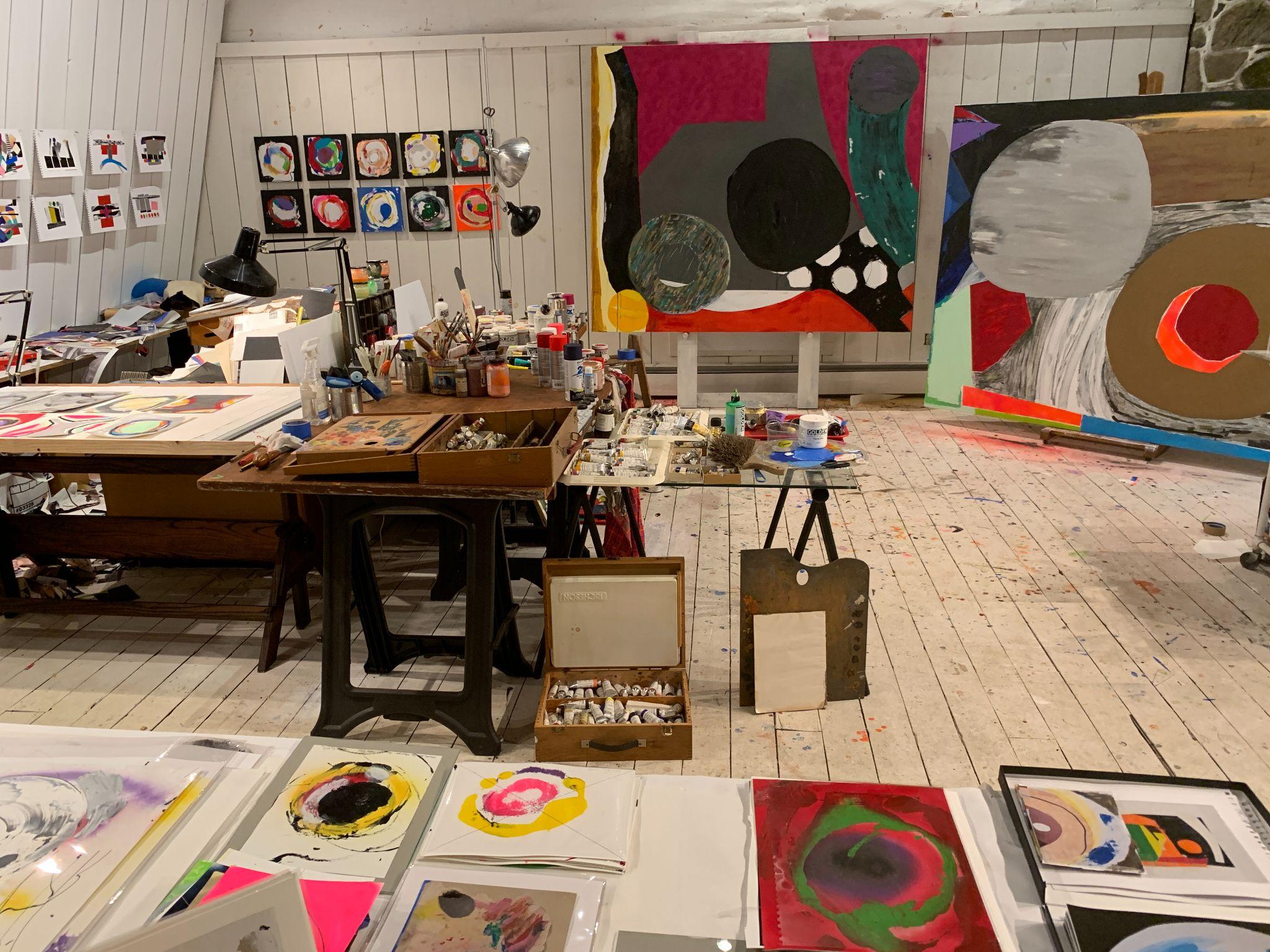
Photo: Vincent Inconiglios Studio
By Atreya Mathur
While creativity and self-expression are at the heart of any artistic practice, navigating the business realities of a career in the arts also requires consideration in legal and financial matters. However, many emerging and even established artists don’t receive formal training in areas like copyright, contracts, taxes or estate planning.
Center for Art Law spoke with artist Vincent Inconiglios who understands this challenge well, having learned many lessons as an artist and a creative consultant in his own prolific career. Inconiglios traces his artistic roots back to his time at Miami University, where he studied Fine Arts and cultivated his passion for the arts. Following his studies, he established an art center in Ohio that catered to individuals of all ages and backgrounds. “It was a stimulating experience working with children as young as three to seniors, all under one roof.” After his tenure at the art center, Inconiglios found himself teaching at Western College for Women, where he not only instructed in painting, drawing, and sculpture but also unexpectedly into the realm of art history. This diverse range of experiences, from teaching to engaging with students in unconventional settings like the Living Arts program in Dayton, Ohio, profoundly shaped his understanding of art’s transformative power.
He returned to New York City to find the loft studio on Gansevoort Street in NYC’s Meatpacking District in 1969. While his artistic pursuits remained constant throughout his career, Inconiglios delved into the world of creative consultancy, applying his design acumen to a myriad of projects for esteemed clients such as Philips Electronics, the Estée Lauder Companies Inc., and JPMorgan. This duality of roles provided him with invaluable insights into the intersection of art and commerce.


In a recent interview, Inconiglios reflected on his artistic career and experiences with attorneys as well as the steps he has taken in planning for his legacy and estate, emphasizing the value of legal education for artists. “Simple things like having a basic contract for exhibitions or commissions can protect both parties and avoid misunderstandings,” he says. He also recommends consulting professionals for major transactions or collaborative projects. Having documentation for transactions and ownership transfers prevents disputes later on. “My advice would be to educate yourself on basic copyright and contractual issues. Even if you’re just starting out, have simple agreements in place for things like exhibitions, commissions or collaborations.” In addition, raising awareness about basic legal topics empowers artists from the beginning. Inconiglios emphasizes that he wants to share the lessons learned so other artists don’t have to go through unnecessary difficulties. “The creative process is complex enough without added risks that proper guidance could prevent.”
By facilitating these types of intergenerational discussions, the art world community at large benefits from open dialogue and the dissemination of practical knowledge to support artistic careers over the long term.
This interview was conducted by Atreya Mathur, Director of Legal Research at the Center for Art Law. Center for Art Law would like to thank Vincent Inconiglios for his time in sitting down with the Center and sharing his experience, inspiration and advice to other artists.
Interview Questions:
Q: How did your journey into the art world begin? Could you tell us a bit about your background, your career in the creative industry and how you began as an artist?
VI: I have always been passionate about art—creating art and teaching art. I studied Fine Arts and have a degree in Fine Arts from Miami University and did graduate work with Richard Anuszkiewicz in the first year of the Blossom Kent Program. Following that, I founded an art center in Ohio, catering to individuals of all ages. Concurrently, I taught at Western College for Women, covering painting, drawing, sculpture, and unexpectedly was asked to teach a course in art history as well. Transitioning to New York City, I navigated an artistic community and continued to create art while engaging in marketing, communications and creative consultancy for a wide range of clients including WWD (Women’s Wear Daily), Philips Electronics, the Estée Lauder Companies Inc. and VNU (the parent company of Nielsen, 50-plus trade shows, magazines and publishing entities). At VNU, for example, my ability to think abstractly and creatively as an artist was appreciated. I approached each project like a collage, carefully assembling solutions that addressed the diverse needs of clients. One notable project involved creating connections between manufacturers, creative designers, and marketing professionals in the apparel industry. This led to many rewarding and insightful relationships.

I have been working as an artist since the 1960s. I began showing my work in the midwest in Universities. In the 1970s, I started creating collage works featuring images of the “Gansevoort Girls” that I would see around my neighborhood, the Meatpacking District in New York. This continuing series was shown in New York in 2011. That gave me more exposure and experience working with galleries. Throughout my career, I’ve taken the approach of letting opportunities come to me through recommendations rather than aggressively pursuing shows or clients myself. I find that relationships and connections have been most important for my work. They’ve led to inclusion in private collections and purchases by AT&T, Norton Simon Collection, and Chase Bank
My journey has been one of constant evolution, where principles of fine art have guided my approach to business. Whether navigating trade shows or pioneering innovative solutions, my artistic vision has remained at the forefront, driving me to explore new horizons and challenge conventional thinking.
Q: A brief overview of any exhibitions or shows, and how you were approached to participate in them?
VI: Some notable exhibitions are my participation in the 1973 Ten Downtown, which led to a 10th-anniversary group exhibition at MoMA PS1 in 1977; the two solo exhibitions at West Broadway Gallery; the 2004 retrospective exhibition at Miami University; my first international solo exhibition in Serbia in 2003; the 2011 solo show in NYC at Jeffrey Leder Gallery that introduced “The Gansevoort Girls,” a series I began in 1976; as well as multiple shows at the Morrison Gallery in Kent, CT.
Many of these exhibition opportunities came to me as invitations rather than active pursuits. I have connected with dealers, museum directors, critics and art consultants through social meetings or visits to my studio, galleries and exhibitions. West Broadway Gallery was one of the first artist-run professional spaces in the early years of SoHo. Ten Downtown was a unique experience, different from the normal gallery show. It was a decade-long, artist-run and organized exhibition series structured like studio visits. Each year, the 10 artists shown in the previous year nominated the next year’s participants. My shows there were reviewed in Artforum and noted by Barbara Rose in New York Magazine.

Q: How do you feel your creative process has evolved through the years?
VI: My creative process has evolved over the decades but is also consistent with the theme of content exploration, both non-objective and figurative. A successful work is like a symphony that I can come back to often, each time hearing it differently and discovering nuances that I may not have seen before. I am the most present when exploring different ways of observing and uniquely seeing. My studio is my utopia. When I’m there I overcome the distractions, anxiety, and fear during the ongoing dystopic social uncertainty that can both motivate and immobilize me. The working process of creating a collage requires my total presence and confidence in the moment. It enables me to let go of control, trust chance, and discover new formal relationships. In times of universal crisis, the collage process helps me to be aware of what is not in my control. Motivated by the exploration and power of chance, the collage process is the grounding medium of my practice, giving me continuous stimulation from unexpected sources. Within each surface, chance and change allow disparate elements to come together and enable me to choose, reject, reinvent, and discover. I follow the impact and direction of the formal elements—the mark, the edge, the shape, the color, the composition—to create a unique visual and emotional experience based on my way of seeing. This process has worked for me for over 50 years.
Q: How has your consulting career influenced the themes in your artwork?
VI: The most rewarding time of my consulting work was when I could approach projects as a “collage.” I worked with leadership at a high level for major companies often with multiple divisions and departments of the organization. I put pieces of solutions together by discovering them in the process, which ties back to making collages…presenting data and content—sometimes similar, sometimes different, and unexpected—to produce a new way of seeing a solution to a challenging problem. Integral to success was working with people who valued and allowed this process of play and discovery to happen. This continued in my development of print products, such as producing magazines and books. Clients encouraged my way of seeing and exploration and we “curated” together for very successful outcomes.

Q. Could you tell me more about some of your work, you mention the Donut Series– what inspired this body of work?
VI: The Donut Series began as an exploration of circular forms and negative space. In the late 70s, I was doing a lot of collage work incorporating images I found around my neighborhood. I started noticing the circular shapes that were everywhere—things like the meat hooks, manhole covers, hubcaps, and of course donuts in shop windows. There was something compelling to me about the simplicity of the circle yet the complexity it could take on in different contexts. The donut paintings allowed me to focus purely on exploring variations within that one basic form. Even now, I find the circle endlessly fascinating as a formal element in my work. The “donut” notation added a touch of humor—often interpreted by the viewer as much more than a “donut.”
Q: You also talked about showing some of those donut paintings again in 2016. What prompted revisiting that older series?
VI: A friend and curator named Dr. Lee Hallman approached me about doing an essay on the donut works for a publication. As she researched the background and meaning behind the series, it got me looking back at those pieces with new eyes. I realized how much the “donut” motif had evolved over the decades I spent working with it. When a local gallery owner heard I was re-engaging with that body of work, he invited me to show some of the paintings from across the donut series’ timeline. Revisiting those older circular compositions allowed me to appreciate the progression of my exploration into form and negative space over a long career and resulted in many of the large works done between 2015 and 2022.
Q: It sounds like you’ve had a long and interesting career so far. How has your focus changed in more recent years?
VI: In the last 8–9 years, I’ve been focusing on studio work rather than taking on commercial projects. However, as I’ve gotten older, I’ve started thinking more about legacy planning and making sure my artwork is organized and protected after I’m gone. Part of what’s motivating that is wanting important pieces, including some of my photographs of renowned Haitian artists I was fortunate enough to meet in the early-1980s, to end up in museum collections so the full story of my work can be told.
Q: How has your perspective on the business and legal side of art evolved over your career?
VI: Early on, I was more focused on the creative process alone. But experiences have taught me—often the hard way—that the commercial and legal aspects are also important to protect your legacy. I wish I had paid more attention to contracts, rights, valuation—it’s not just about the art. Seeing how the industry works now, I understand the value of professional guidance.
Q: What motivates you to help other artists now with legal and business matters?
VI: I want to share the lessons I’ve learned so other artists don’t have to go through unnecessary difficulties. The creative process is complex enough without added risks that proper guidance could prevent. If I can help the next generation avoid pitfalls and understand their rights, it feels meaningful to give back to the community.
Q: How do you navigate creating relationships with professionals in the art world or gallerists/dealers?
VI: While I have continually engaged in the art scene by actively going to openings and exhibitions, I have had a more passive relationship with dealers and galleries. It has always been easier for me to go to my studio and make more art. I have many series that have not been seen publicly. Now my awareness of time is changing my approach to navigating art world relationships and I’m not afraid to ask for help.
Q: What are your thoughts on the process of valuing artwork? Any challenges faced when valuing your work? What are some of the factors you consider when assessing the value of a piece?
VI: For me, creative and artistic merit have always been more important than monetary worth. However, I realize the art market doesn’t always see it that way. When thinking about valuation, I look at things like the significance and uniqueness of the work within my oeuvre, critical recognition it has received, and its completeness. Provenance and exhibition history provide important context as well. The materials and size also affect conservation costs. Ultimately though, I know my work is worth what someone is willing to pay. Bringing more attention to my pieces through shows, publications, and museum acquisitions will hopefully help establish a more informed value over time. I am not a proponent of “art by the square inch” which is a common evaluation method in the art market.
Q: You’ve also been taking steps to better protect your artwork legally. What are some of the specific protections you’re putting in place?
VI: I am in the process of cataloging my entire body of work with high-quality digital images and detailed records. This will create an authoritative inventory for my heirs. I’m also consulting with an attorney to draft contracts governing future use and transfer of the works. An area of focus is copyright— clearly defining reproduction and resale rights. Down the line, I may form an LLC to own new creations. Proper documentation and legal structures can help ensure my vision lives on responsibly after I’m gone.

Q: What have been some of the challenges in that process and how are you working to address them?
VI: It’s been overwhelming trying to tackle such a huge volume of work by myself. I realize I need help from someone with art experience who can assist long-term. Over the past year I have been fortunate to find excellent assistants in this area. I’m also looking to build relationships with lawyers who understand and appreciate my artwork so they can help develop a multi-year legal strategy. Figuring out how to properly value all the pieces is difficult since monetary worth isn’t always the best measure. I hope bringing more of my work to museums and unique exhibition venues can help address that challenge over time.
Q: What made you start taking steps towards estate planning and organizing your work?
VI: A few factors contributed to that. As I approached my ’70s, I started feeling less physically strong and had a fall off a ladder recently that really drove the point home about aging. On top of that, I have a lot of artwork and materials stored in different places and realized that no one else would be able to make sense of it all if I wasn’t around to explain it. I love flat files. So about four or five years ago, I began the process of organizing everything. More recently, an art dealer I work with helped me get in touch with someone who could assist with cataloging work and organizing all my art more efficiently to begin the process of legacy and estate planning but also to hopefully have my artwork viewed in exhibitions and to sell some of the work as well.
Q: What are your goals for the future in terms of estate planning and legacy?
VI: Ultimately, I want to feel confident that my work and story will be protected and carried on after I’m gone. Finding the right partner entity is important, whether that’s a gallery, nonprofit, or lawyer. I also want to see key pieces placed permanently in museum collections. In the next 5–10 years, my goal is to have a solid plan and partnerships in place so I’m not worrying as much about the future of my artwork. I’m trying to be proactive now rather than leave it all to chance while at the same time creating new works.
Q: You mentioned wanting to work with lawyers who appreciate and understand your artwork. What qualities would you look for in legal counsel to best represent your interests and legacy?
VI: For me it’s crucial that any attorneys I engage with have a genuine interest in and appreciation for the visual arts. They need to take the time to understand my creative process and vision in order to properly advise me. Experience advising other artists would be valuable. It’s also important they see my work not just as legal assets but as pieces of cultural and historical significance worthy of preservation. They should be willing to think creatively about non-traditional compensation like bartering services for a piece. And they must prioritize building trust so I’m confident my wishes will be honored after I’m gone. Communication and collaboration are key.
Q: What concerns do you have about more traditional approaches to estate planning as an artist?
VI: Many lawyers tend to view these issues too linearly and practically without regard for the emotional or cultural aspects. There’s a risk they could see my work as just another collection of property to be divided up or liquidated. I worry more cookie-cutter solutions may not fully respect the integrity and vision behind each piece. My hope is to find counsel willing to take a holistic view of my entire body of work and legacy and help develop a nuanced strategy accordingly. The law also moves slowly—I want advisors who will be proactive and innovative in protecting my interests now and future.
Q: You mentioned some experiences earlier in your career where you didn’t have proper contracts or agreements in place. What would you have done differently?
VI: I wish I had been more aware about getting advice—to get things in writing, even simple agreements or contracts. It would have protected me and avoided some issues down the line. Things were more informal in the past, but a basic paper trail for transactions and ownership is important.
Q: Have you explored any legal structures, like trusts or foundations, to safeguard and promote your work or spoken to someone about this?
VI: My biggest priority is to learn how my continuing collection of art works from 50-plus years should be approached at this time. This question has led me to the Center for Art Law, and I hope to learn more through collaboration with the organization.

Q: What advice would you give to young or emerging artists about protecting their work legally?
VI: My advice would be to educate yourself on basic copyright and contractual issues. Even if you’re just starting out, have simple agreements in place for things like exhibitions, commissions or collaborations. And don’t be afraid to consult professionals for major projects or transactions. It’s better to take precautions up front.
Some of the key advice I offer to emerging artists starting their careers: recommend prioritizing computer literacy, as today’s artists need to be comfortable operating digitally. The industry has changed significantly, and emerging artists need to stay informed to be competitive. I also suggest taking a broad approach to research beyond just art history. Exploring different areas of interest will help artists become more well-rounded. There’s always more to discover, even when revisiting familiar works. Additionally, I point emerging artists towards webinars and discussions about legal literacy and some of the excellent non-profits are doing. It’s important for them to understand aspects of the industry they may not be aware of yet. Listening to available resources can help identify gaps in knowledge. Finally, I advise not being afraid to partner with others, ask questions, and remain curious. There are no shortcuts. Understanding the process with an open and inquisitive mindset will serve artists well throughout their career. Trying new things and continuing to learn is so valuable.

Current Exhibition:
Vincent Inconiglios has a solo exhibition in New York running from February 25 to April 15, 2024 at Cinema Supply. The exhibition, the first of the “Made-In-New York“ project showcases a select painting from 1967 and focuses on more recent works. “Made-In-New York“ is a rediscovery curatorial series of artists that embody the cultural legacy of New York City. By reinserting the uncanonized voices of New York-based artists into the art historical narrative, the “Made-in-New York” project sets out to achieve a truer and more meaningful art historical account of New York. The exhibit can be seen by appointment at Cinema Supply on 21st Street in Chelsea.
A thank you to Vincent Inconiglios, Donna Raftery and Barbie Kim for this interview and for the Center’s studio visit.
About the Author
Atreya Mathur is the Director of Legal Research at the Center for Art Law. She served as the inaugural Judith Bresler Fellow at the Center (2021–22) and earned her Master of Laws from New York University’s School of Law where she specialized in Competition, Innovation, and Information Laws, with a focus on copyright, intellectual property, and art law.
Disclaimer: This article is for educational purposes only and is not meant to provide legal advice. Readers should not construe or rely on any comment or statement in this article as legal advice. For legal advice, readers should seek a consultation with an attorney.


You must be logged in to post a comment.