• About
    • Mission
    • Team
    • Boards
    • Mentions & Testimonials
    • Institutional Recognition
    • Annual Reports
    • Current & Past Sponsors
    • Contact Us
  • Resources
    • Article Collection
    • Podcast: Art in Brief
    • AML and the Art Market
    • AI and Art Authentication
    • Newsletter
      • Subscribe
      • Archives
      • In Brief
    • Art Law Library
    • Movies
    • Nazi-looted Art Restitution Database
    • Global Network
      • Courses and Programs
      • Artists’ Assistance
      • Bar Associations
      • Legal Sources
      • Law Firms
      • Student Societies
      • Research Institutions
    • Additional resources
      • The “Interview” Project
  • Events
    • Worldwide Calendar
    • Our Events
      • All Events
      • Annual Conferences
        • 2026 Art Law Conference
        • 2025 Art Law Conference
        • 2024 Art Law Conference
        • 2023 Art Law Conference
        • 2022 Art Law Conference
        • 2015 Art Law Conference
  • Programs
    • Visual Artists’ Legal Clinics
      • Art & Copyright Law Clinic
      • Artist-Dealer Relationships Clinic
      • Artist Legacy and Estate Planning Clinic
      • Visual Artists’ Immigration Clinic
    • Summer School
      • 2026
      • 2025
    • Internship and Fellowship
    • Judith Bresler Fellowship
  • Case Law Database
  • Log in
  • Become a Member
  • Donate
  • Log in
  • Become a Member
  • Donate
Center for Art Law
  • About
    About
    • Mission
    • Team
    • Boards
    • Mentions & Testimonials
    • Institutional Recognition
    • Annual Reports
    • Current & Past Sponsors
    • Contact Us
  • Resources
    Resources
    • Article Collection
    • Podcast: Art in Brief
    • AML and the Art Market
    • AI and Art Authentication
    • Newsletter
      Newsletter
      • Subscribe
      • Archives
      • In Brief
    • Art Law Library
    • Movies
    • Nazi-looted Art Restitution Database
    • Global Network
      Global Network
      • Courses and Programs
      • Artists’ Assistance
      • Bar Associations
      • Legal Sources
      • Law Firms
      • Student Societies
      • Research Institutions
    • Additional resources
      Additional resources
      • The “Interview” Project
  • Events
    Events
    • Worldwide Calendar
    • Our Events
      Our Events
      • All Events
      • Annual Conferences
        Annual Conferences
        • 2026 Art Law Conference
        • 2025 Art Law Conference
        • 2024 Art Law Conference
        • 2023 Art Law Conference
        • 2022 Art Law Conference
        • 2015 Art Law Conference
  • Programs
    Programs
    • Visual Artists’ Legal Clinics
      Visual Artists’ Legal Clinics
      • Art & Copyright Law Clinic
      • Artist-Dealer Relationships Clinic
      • Artist Legacy and Estate Planning Clinic
      • Visual Artists’ Immigration Clinic
    • Summer School
      Summer School
      • 2026
      • 2025
    • Internship and Fellowship
    • Judith Bresler Fellowship
  • Case Law Database
Home image/svg+xml 2021 Timothée Giet Cultural Heritage image/svg+xml 2021 Timothée Giet WYWH: Tricking the Art Market – On Forgery, Beltracchi, and Scientific Technology
Back

WYWH: Tricking the Art Market – On Forgery, Beltracchi, and Scientific Technology

December 18, 2018

By Musetta Durkee

Forgeries [i] have tricked the art world for decades. Sometimes a work appears that fills a gap in an artist’s catalogue or provides added inventory of a much desired artist. Other times a buyer has an emotional connection to a work. Or a work may have already been in the art market for decades and its authenticity is presumed. Oftentimes, rigorous due-diligence is not undertaken or fails and a forgery enters the art market, sometimes purchased for millions of dollars and remaining undetected for decades. 

On November 14, 2018, Center for Art Law and Brooklyn Law School hosted a film screening of “Beltracchi: The Art of Forgery” (2014, dir. Arne Birkenstock), a documentary looking at the work of famous German forger Wolfgang Beltracchi, accompanied with a presentation by Professor Jennifer Mass, President of Scientific Analysis of Fine Art, LLC and Professor of Cultural Heritage Sciences at Bard Graduate Center.

Whenever forgeries are exposed, shock pulsates through the entire art market. Experts are increasingly essential to perform necessary diligence, and are using scientific solutions to expose forgeries that have already entered the art market, as well as to prevent the selling and acquiring forgeries. Professor Mass is one of those experts. In a discussion prompted by “Beltracchi: The Art of Forgery,” Professor Mass explored the many scientific strategies deployed by experts in detecting forgeries. 
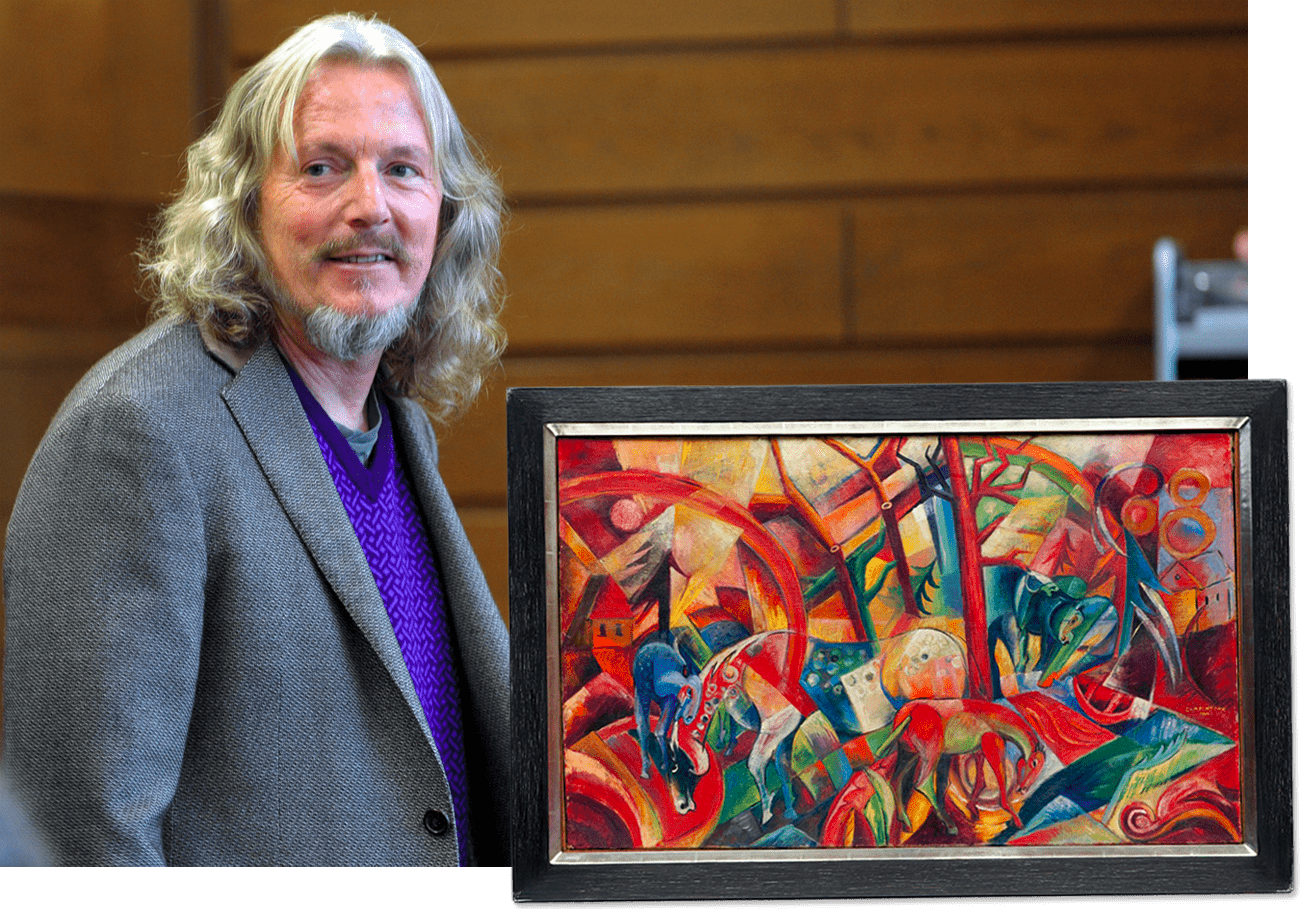
Beltracchi with his forged Campendonk “Rotes Bild mit Pferden.” By Federico Gambarini/EPA/Landov; by Simon Vogel/picture alliance /dpa (painting).

Forgeries have captured the imaginations of art world insiders and laypersons alike.  For example, the Musée Jacquemart-André in Paris is exhibiting two versions of Caravaggio’s “Mary Magdalene in Ecstasy” side-by-side raising the question of which painting is authentic. However, a learned eye alone is not enough to spot a forgery. Professor Mass emphasized that determining the authenticity of an art object requires collaboration between curators, authenticators, and scientists. Experts must evaluate the state of preservation, attribution, genesis, provenance, and title of the work. There must be close looking at the aesthetic qualities of the work, evaluation of the history of the work and related documentation, and chemical analysis of the work. Furthermore, no expert can determine the authenticity of an object by looking at a photo of the work – it is much better to be able to hold the work to see its actual qualities, such as the true colors, the brushstrokes, and the materials.  
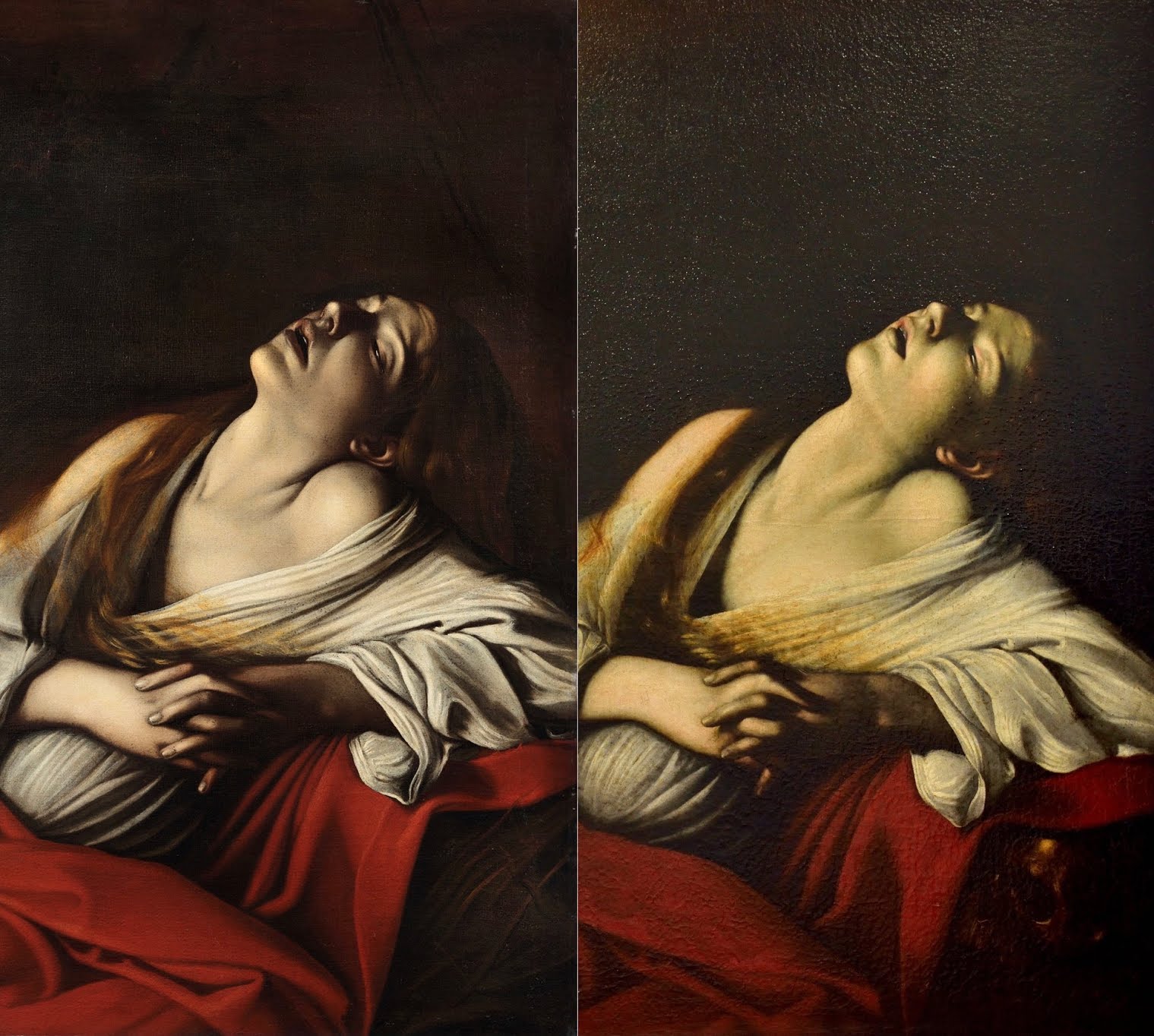
Two versions of Caravaggio’s “Mary Magdalene in Ecstasy” on view at the Musée Jacquemart-André in Paris.
On left, “Mary Magdalene in Ecstasy, Klein Magdalena” (ca. 1606).
On right, “Mary Magdalene in Ecstasy” (1606).

Forgers go to great lengths to fool experts, Professor Mass explains: forgeries must have the right labels, dates, signature, provenance, restoration history, and materials (paint, canvas) that are time appropriate. For example, if you see a work that is supposedly hundreds of years old, with no restoration history, that would be a red flag. Similarly, putting a painting under ultraviolet light may show a blue fluorescence that was invented after WWII; if the painting was supposed to be 1916, that would point to a forgery. Or, if there was an original signature, but over sixty percent of the painting was overpainted, that would also warrant consideration (normally, conservation should be limited to twenty to thirty percent of work).  
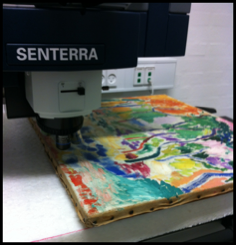
“Technical art history,” as Professor Mass describes the scientific aspects of forgery detection, uses scientific tools and methods to determine the authenticity of an art object. By using tools along the electromagnetic radiation spectrum, from ultraviolet light to x-rays to infrared sensors, experts can obtain information regarding paint properties, layers of paint including overpainting and brushstrokes, quality of canvas including tears or repairs and binding, and information on light, humidity, and other conditions such as water stains. Each viewing technique reveals different information in the work. For example, ultraviolet light can show how cadmium yellow fades to white, thereby providing information about the degradation of the painting. Furthermore, with the development of new technologies – such as hyperspectral visuality, mass spectrometry research, new x-ray technologies, and even particle accelerators – scientists can conduct more sophisticated chemical and DNA analyses, and even evaluate works completely nondestructively, that is, without using even a micro-sample of paint from the work. Indeed, the American Institute of Conservation requires that analysis of works be conducted as non-destructively as possible, which has led to the development of these new technologies. 

Wolfgang Beltracchi is one of the most prolific and financially successful art forgers in history.  He claims to have forged around 300 works, including works in museums and private collections, by artists including Max Ernst, Fernand Léger, Heinrich Campendonk, and André Derain. With the help of his wife Helen, Beltracchi sold his forgeries by creating fake provenance, complete with staged black and white photographs, and fake collectors.

Fake provenance photo staged by Beltracchi and featuring his wife alongside his forgeries. From Polizei/dapd/ddp images/AP.

In 2011, a German court found him and his wife guilty of forgery relating to 14 works he had sold for a total of $45 million, as he had the intent to deceive in making and selling his forgeries. After serving his sentence, he was released in January 2015 and is currently painting under his own name, with some of his own works selling for over $80,000. In an interview with The Art Newspaper, he describes a “good forger” as someone who is “an art historian[,] who is a restorer, who is a painter and who has scientific knowledge.” However, Beltracchi made several mistakes in his forgeries that ultimately led to his arrest and conviction.  
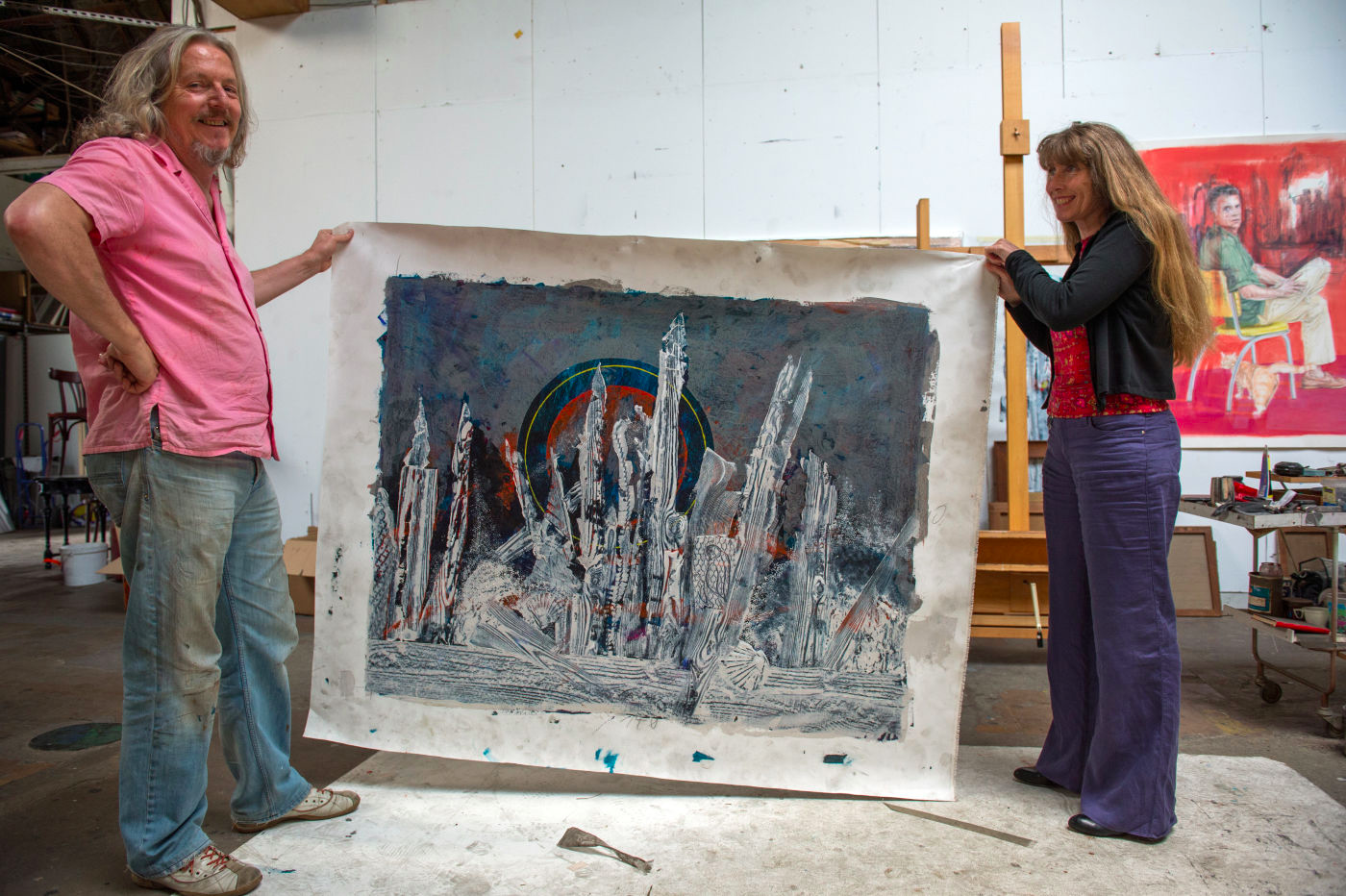
From “Beltracchi: Art of the Forgery,” showing Wolfgang and Helen Beltracchi with a forged Max Ernst.

In Beltracchi’s case, Professor Mass identified at least seven ways in which Beltracchi’s forgery of Heinrich Campendonk’s “Rotes Bild mit Pferden” was exposed and led to his arrest. First, as also described in Beltracchi, Beltracchi used a white paint that had titanium white in it, a pigment that was not available in 1914, the year attributed to the forgery. Second, the painting construction was incorrect – Campendonk’s paintings went all the way around the edges of the frame, while Beltracchi’s only went to the edge of the canvas. Third, Beltracchi intended to fake wormholes in the frame to imitate age, but he merely poked holes straight through with a nail, and wormholes are not straight. Fourth, Beltracchi was overly aggressive in sanding down the canvas, creating a thin painting layer. Fifth, in trying to show age, he made the canvas too dirty. Sixth, using x-ray, an early composition on the canvas could be seen. Seventh, Beltracchi’s drying technique created a different distribution of fatty acids than with normal drying. All of these mistakes together led to the conclusion that the painting was a forgery.

But how did Beltracchi fool the art market in the first instance? Professor Mass notes that like many successful art forgers, he did not head for the high end of the market, where expensive scientific analysis may be more likely to be pursued. And rather than copying an artist’s style, he made pastiches of styles, thereby filling a gap in the artist’s catalogue and setting up an art historian for a discovery to be made. He also concocted elaborate fake provenances and created fake collectors for his works, thereby creating a plausible history and context to his forgeries. As such, Professor Mass emphasizes that not only scientists, but also collectors and historians need to be diligente and be on the lookout for suspicious acts. For example, if one notices a bottomless trove of one particular artist or works that are filling gaps in an artist’s collection they should be on the alert.
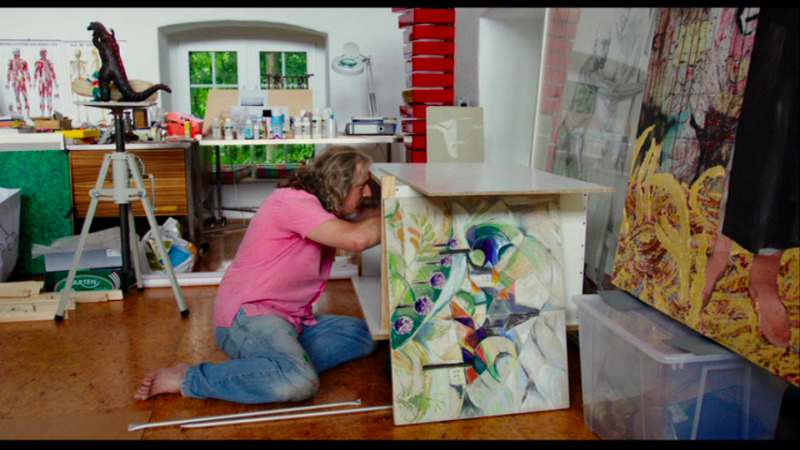
From “Beltracchi:The Art of the Forgery” showing Beltracchi preparing on oven to bake and therefore age one of his forgeries.

However, even armed with scientific tools and methods and as more collectors and auction houses become aware of the potential for forgeries, Professor Mass often finds herself in the position of the naysayer. “The market is pushing towards a ‘yes,’” she explains, and opinions labelling a work as a forgery can be unpopular, especially if someone has already purchased the work. According to Professor Mass, even though auction houses give the appearance of trying to protect against forgeries entering the market, auction houses are primarily interested in selling. Indeed, Professor Mass noted that between forty and seventy percent of works in the art market could be forgeries. Works by Modigliani, folk and vernacular art, and Chinese imperial porcelain are all known to be susceptible to forgeries.

There are certain ethical questions that arise through Professor Mass’s work. For example, in working with Professor Mass’s Scientific Analysis of Fine Art risk management company, she has examined many art works, some of which are forgeries. Though she notes that her expert opinion regarding the authenticity of a work belongs to the client alone, Professor Mass does make an exception if she finds evidence of systematic collection of art that was moved during WWII. Also, Professor Mass notes that there can undoubtedly be disagreements between experts in determining the authenticity of an art object. However, she is encouraged by a new initiative to develop a Court of Arbitration of Art where there would be neutral experts, instead of competing experts for hire.

Professor Mass rejects the idea that “a connoisseur’s eye will tell us everything we need to know.” Instead, in her presentation, she stresses that experts must look at the materiality of an object as well as the connoisseurship before including in an artist’s catalogue raisonné. Artist foundations, such as Joan Mitchell’s foundation, are increasingly concerned about forgeries entering the market. A bill pending in New York State Assembly since 2016 was designed to provide protection to art historians/experts when authenticating artworks and protect them from litigation in the instances when the opinions based on their reviews were disfavorable to the artwork and economically detrimental to the collector/holder of the art piece determined to be inauthentic.  In the modern world where even living artists, such as Jeff Koons, have found themselves protesting forgeries that have entered the market- Scientists and connoisseurs must collaborate to protect against forgeries of artists’ works.


[i] “Forgeries” and “fakes” are often used interchangeably and/or imprecisely in discussions such as these.  According to Professor Jennifer Mass, a fake has no signature, and a forgery has a signature. For purposes of this article, I will be using “forgery” throughout, even though the discussion applies equally to fakes (for example, a signature is not needed to show intent to deceive).  

Suggested Readings

  • Anthony M. Amore, The Art of the Con: The Most Notorious Fakes, Frauds, and Forgeries in the Art World (St. Martin’s Press, July 14, 2015), available for purchase here.
  • Noah Charney, The Art of Forgery: The Minds, Motives and Methods of the Master Forgers (Phaidon Press, May 12, 2015), available for purchase here.
  • Jennifer Mass, “How the Scientific Study of Painting has Become Accessible to Everyone,” Apollo (June 25, 2018), available here.
  • Jennifer Mass, selected recent publications in Heritage Science, Smithsonian Institute Press, Archetype Press, Journal of Analytical Atomic Spectrometry, and Keramos.
  • Ken Perenyi, Caveat Emptor: The Secret Life of an American Art Forger (Pegasus Books, Aug. 15, 2012), available for purchase here.

About the Author: Musetta Durkee is a lawyer and freelance writer focusing on the arts. Formerly an associate with WilmerHale, she received her J.D. from University of California, Berkeley, School of Law and her M.A. in Performance Studies from New York University.

Disclaimer: This article is for educational purposes only and is not meant to provide legal advice. Readers should not construe or rely on any comment or statement in this article as legal advice. For legal advice, readers should seek a consultation with an attorney.

Post navigation

Previous Twice Looted, Twice Returned?
Next Art in the Courtroom: Dealing with New Deal-Era Murals – Part II

Related Art Law Articles

Center for Art Law WYWH Jan 2026 Weller
Wish You Were Here

Wish You Were Here: Professor Weller’s Introduction of the New Court of Arbitration for Nazi-Looted Cultural Property

April 7, 2026
Clinic Instagram
Art lawWish You Were Herebootcampevent review

WYWH: “Art Lawyering Bootcamp: Copyright Law”

March 6, 2026
word image 75296 1
Art lawCultural Heritage

Beyond “Due Diligence”: Closing Loopholes in the Global Antiquities Trade

October 9, 2025
Center for Art Law
What the Heck is Copyright (2)

What is Copy, Right?

2026 Annual Conference

Let’s explore Visual Art, AI, and the Law in the 21st Century together.


Reserve Your Ticket TODAY
Guidelines AI and Art Authentication

AI and Art Authentication

Explore the Guidelines for AI and Art Authentication for the responsible, ethical, and transparent use of artificial intelligence.

Download here
Center for Art Law

Follow us on Instagram for the latest in Art Law!

In this episode, we speak with art market expert D In this episode, we speak with art market expert Doug Woodham to unpack how Jean-Michel Basquiat became one of the most enduring cultural icons of our time.

Moving beyond his rise in 1980s New York, this episode focuses on what happened after his death. We explore how his estate, led by his father, shaped his legacy through control of supply, copyright, and narrative; how early collectors and market forces drove the value of his work; and how museums and media cemented his place in art history.

Together, we explore the bigger question: is creating great art enough, or does becoming an icon require an entire ecosystem working behind the scenes?

🎙️ Check out the podcast anywhere you get your podcasts using the link in our bio!

Also, please join us on May 27  for the highly anticipated Art Law Conference 2026, held at Brooklyn Law School and Online (Hybrid). Entitled “What is Copy, Right? Visual Art, AI, and the Law in the 21st Century,” this year’s conference explores the evolving relationship between visual art, copyright law, and artificial intelligence!

#centerforartlaw #artlaw #artlawyer #podcast #legal #research #legalresearch #newepisode #artmarket #basquiat
Amy Sherald cancelled her mid-career retrospective Amy Sherald cancelled her mid-career retrospective, scheduled at the National Portrait Gallery (NPG) in D.C., after a curatorial controversy over the potential removal of her recent work, "Trans Forming Liberty" (2024). Sherald denounced the attempt to remove this work as a blatant and intentional erasure of trans lives. 

This is one of the best examples and the most illustrative examples of the current administration's growing efforts to control the Smithsonian Institution's programming. In this climate of political tension, how do cultural institutions defend themselves against censorship and keep their curatorial independence?

📚 Click the link in our bio to read more!

#centerforartlaw #artlaw #legal #artlawyer #legalreserach #artcuration #curatorialindependance #censorship
Grab 15% off tickets the upcoming bootcamp on Arti Grab 15% off tickets the upcoming bootcamp on Artist-Dealer Relations, now available online!! 

Center for Art Law’s Art Lawyering Bootcamp: Artist-Dealer Relationships is an in-person, full-day training aimed at preparing lawyers for working with visual artists and dealers, in the unique aspects of their relationship. The bootcamp will be led by veteran attorneys specializing in art law.

This Bootcamp provides participants -- attorneys, law students, law graduates and legal professionals -- with foundational legal knowledge related to the main contracts and regulations governing dealers' and artists' businesses. Through a combination of instructional presentations and mock consultations, participants will gain a solid foundation in the specificities of the law as applied to the visual arts.

Bootcamp participants will be provided with training materials, including presentation slides and an Art Lawyering Bootcamp handbook with additional reading resources.

Art Lawyering Bootcamp participants with CLE tickets will receive New York CLE credits upon successful completion of the training modules. CLE credits pending board approval.

🎟️ Grab tickets using the link in our bio!

Get 15% off using the code: Final15 

#centerforartlaw #artlaw #legal #research #lawyer #artlawyer #bootcamp #artistdealer #CLE #trainingprogram
On the night of April 15–16, 2026 alone, Russia se On the night of April 15–16, 2026 alone, Russia sent hundreds of drones and missiles on sleeping cities across Ukraine, killing and injuring dozens of civilians. War is funded in part by individuals who have important artworks in their personal collections. This full-scale invasion of Ukraine, now in its fifth year, daily exacts a grave toll on Ukrainian lives and cultural heritage, while fundamentally disrupting European commerce. In response, art market participants have adapted their practices, most have accepted, if not always embraced, the need to scrutinize the source of funds and the ultimate beneficiaries of their transactions. Yet there is a growing sense that parts of the trade are holding their breath, waiting to see when they might safely return to dealing with the oligarchs who continue to fund the Russian war machine.

For art market participants operating in the UK, compliance is no longer a peripheral concern, it is a legal imperative. Regulators are watching, the consequences of non-compliance increasingly extend beyond administrative penalties into criminal liability, and private-public partnerships offer the most credible path toward a more resilient and trustworthy market. 

Join us on April 24th for a panel discussion in London on the current state of AML enforcement and sanctions.

🎟️ Grab your tickets using the link in our bio!

#centerforartlaw #artlaw #artlawyer #lawyer #artcrime #london #artissues #museumissues
Sotheby's sold Modigliani’s Portrait de Leopold Zb Sotheby's sold Modigliani’s Portrait de Leopold Zborowski to Cahn in 2003 for the low price of about $1.55 million. In 2016, Cahn claimed he was verbally informed about authenticity issues with the painting by Sotheby's. The parties did make an agreement regarding Cahn reselling with Sotheby's for a guaranteed price in exchange for releasing the auction house from all claims related to the painting. Cahn claims that he attempted to set this process in motion in June 2025, but he received no response. Cahn now seeks damages totaling $2.67 million, plus interest and attorneys’ fees, for breach of contract. 

Through this dispute, Vivianne Diaz's article highlights a bigger issue in the art market by explaining how forgeries negatively affect both collectors and auction houses, and how auction houses need to be more careful, but most importantly, proactive in their authentication determinations.

📚 Click the link in our bio to read more!

#centerforartlaw #artlaw #artlawyer #legalresearch #art #Modigliani #LeopoldZborowski #sothebys
Don't miss our upcoming April 20th bootcamp on Art Don't miss our upcoming April 20th bootcamp on Artist-Dealer Relations, now available online!!

Center for Art Law’s Art Lawyering Bootcamp: Artist-Dealer Relationships is an in-person, full-day training aimed at preparing lawyers for working with visual artists and dealers, in the unique aspects of their relationship. The bootcamp will be led by veteran attorneys specializing in art law.

This Bootcamp provides participants -- attorneys, law students, law graduates and legal professionals -- with foundational legal knowledge related to the main contracts and regulations governing dealers' and artists' businesses. Through a combination of instructional presentations and mock consultations, participants will gain a solid foundation in the specificities of the law as applied to the visual arts.

Bootcamp participants will be provided with training materials, including presentation slides and an Art Lawyering Bootcamp handbook with additional reading resources.

Art Lawyering Bootcamp participants with CLE tickets will receive New York CLE credits upon successful completion of the training modules. CLE credits pending board approval.

🎟️ Grab tickets using the link in our bio!

#centerforartlaw #artlaw #legal #research #lawyer #artlawyer #bootcamp #artistdealer #CLE #trainingprogram
The historic Bayeux Tapestry, conserved in Normand The historic Bayeux Tapestry, conserved in Normandy, France, is scheduled to be loaned from the Bayeux Museum to the British Museum for ten months beginning in the fall of 2026. This is the first time the tapestry will have returned to the UK in over 900 years. 

This loan, authorized by France, has raised multiple controversies, particularly over conservation concerns. Nevertheless, it has been made possible through a combination of factors, including improved conservation techniques, enhanced transport precautions, comprehensive loan agreements, insurance, and the application of relevant protective laws. 

Check out our recent article by Josie Goettel to read more about this historic loan regarding not only in its symbolic significance, but also in its technical complexity.

📚 Click the link in our bio to read more!

#centerforartlaw #artlaw #artlawyer #lawyer #legalresearch #legal #museumissues #bayeuxtapisserie #bayeuxtapestry #britishmuseum #bayeuxmuseum
Due to decreasing government funding and increasin Due to decreasing government funding and increasing operational costs, philanthropic giving is more essential than ever. Since the current administration took office, one-third of museums nationwide have lost government grants and contracts. These losses have set off a domino effect of difficult decisions, including laying off staff, cancelling public programming, and delaying maintenance and repairs. 

Many art museums are also still recovering from financial losses incurred during the Covid-19 Pandemic. This recent article by Kamée Payton explores how noncash charitable donation alternatives are used by cultural institutions as financing, and how noncash charitable donations can prove mutually beneficial for both donors and recipients—particularly in terms of tax treatment.

📚 Click the link in our bio to read more! 

#centerforartlaw #artlaw #artlawyer #lawyer #legalresearch #museumissues #taxes #donations #taxtreatment
Brief newsletter instead of a list of abbreviation Brief newsletter instead of a list of abbreviations and dates (here is looking at you, AML and KYC, London, NY, Rome). A laconic message that as days are getting longer and we are charmed by sunshine, blooms, and prospects of holidays, the man-made world does not fail to disappoint (don’t believe me? put aside art law and read world news), and all that during the springtime.

On a high note, we are grateful to our Spring Interns who are finishing up their stint with the Center in a couple of weeks, well done! Together we invite you to the upcoming events in person and online. Come FY2027 (a.k.a. June), we will introduce you to the Summer Class and new Advisors. Hang in there through April and May, take notes, don’t forget – we are living in the best of times and the worst of times. Again. 

🔗 Check out our April newsletter, using the link in our bio, to get a curated collection of art law news, our most recent published articles, upcoming events, and much more!!

#centerforartlaw #artlaw #artlawyer #lawyer #artissues #newsletter #april #legalresearch
When we take a holiday from talking about art law When we take a holiday from talking about art law in New York City, we talk about art law in other places. Recently our Judith Bresler Fellow, Kamée Payton attended the London Art Fair. Below is a snippet of her experience:

"I had the wonderful opportunity to attend the London Art Fair this past weekend where I met many incredible artists and art market participants. I was proud to represent the Center for Art Law in conversations with other attendees. It was an absolute delight to see what contemporary artists are contributing to the art world."

#centerforartlaw #artlaw #london #artfair #londonartfair #uk #nyc #artlawyer #legalresearch
Check out our recent article by Lauren Stein revie Check out our recent article by Lauren Stein reviewing Amy Werbel’s "Lust on Trial: Censorship and the Rise of American Obscenity in the Age of Anthony Comstock." Werbel's book showcases a portrait of Anthony Comstock, America’s first professional censor, a man obsessed with purity and self-control who regarded masturbation as a sign of moral corruption. 

Read more about this public figure and Werbel's telling of his life including the impact he had on the US's early attempts to curtail desire in the decades before World War I, in Lauren's review. 

 📚 Click the link in our bio to read more! 

#centerforartlaw #artlaw #artlawyer #lawyer #legalresearch #bookreview #censorship #artistissues
One of our interns, Jacqueline, stopped by the Mor One of our interns, Jacqueline, stopped by the Morgan after the blizzard to catch their exhibition, “Caravaggio’s Boy with a Basket of Fruit in Focus." In partnership with the Foundation for Italian Art and Culture (FIAC) and on loan from the Galleria Borghese in Rome, this is the first time in decades that Caravaggio's early masterpiece has come to the United States. 

"The Morgan is just two blocks away from my university, the Graduate Center. The library and museum have been a rich resource for me, representing an institution that honors the rich legacy of its collector, while also maintaining exciting rotating exhibitions," Jacqueline said. 

The painting is in conversation with other works by those who influenced Caravaggio and those he subsequently inspired. The exhibition's sparkling 3-month run comes to a close April 19.

📚 Check out more information on the exhibition using the link in our bio!

#centerforartlaw #artlaw #artmuseum #caravaggio #themorgan #nyc #artlawyer #legalresearch
  • About the Center
  • Contact Us
  • Newsletter
  • Upcoming Events
  • Internship
  • Case Law Database
  • Log in
  • Become a Member
  • Donate
DISCLAIMER

Center for Art Law is a New York State non-profit fully qualified under provision 501(c)(3)
of the Internal Revenue Code.

The Center does not provide legal representation. Information available on this website is
purely for educational purposes only and should not be construed as legal advice.

TERMS OF USE AND PRIVACY POLICY

Your use of the Site (as defined below) constitutes your consent to this Agreement. Please
read our Terms of Use and Privacy Policy carefully.

© 2026 Center for Art Law
 

Loading Comments...
 

You must be logged in to post a comment.