
Catalogue Raisonné Research: Purpose, Process, Pitfalls & Publication
March 14, 2024
About this Event
The catalogue raisonné has become increasingly important in establishing the scope and significance of an artist’s work,–that is, art historically–but also through documentation, provenance, and connoisseurship in establishing authenticity and monetary value in a litigious environment.
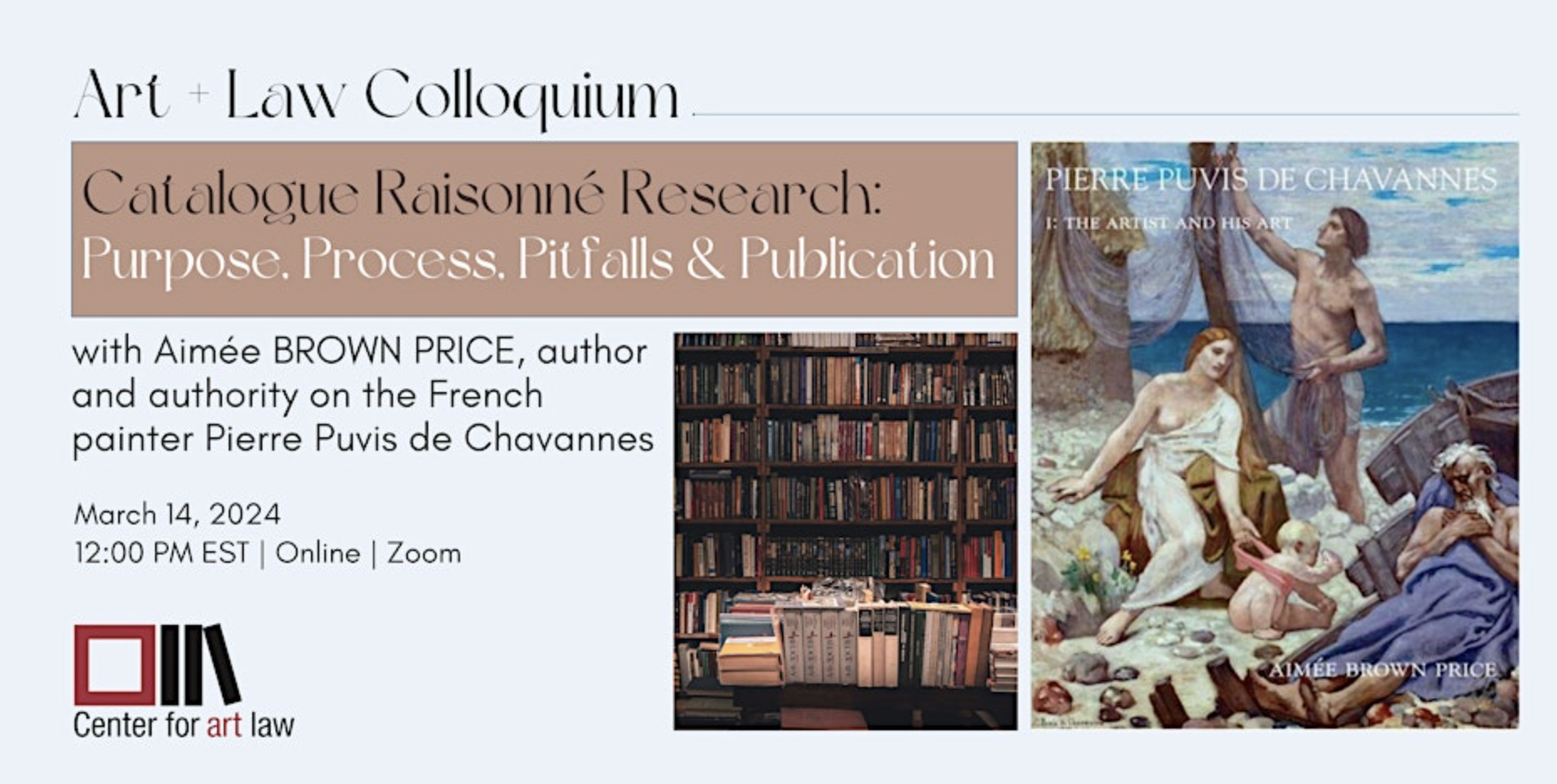
An authority on the French painter Pierre Puvis de Chavannes and author of Pierre Puvis de Chavannes, volume II of which is A Catalogue Raisonné of the Painted Work, in this session Aimée Brown Price discussed the aims and outlined the process of research, and kinds of information, necessitated by the preparation of such a publication. Methods of sleuthing and navigating the labyrinth of locating work; her experiences with the “châteaux people,” collectors, curators, other art historians, and dealers; and strategies used for identifying, accessing, and attributing works are further topics. Her talk was bolstered with frequent digressions into what are said to be her invaluable insights, sage advice, and practical tips for aspiring catalogue raisonné authors and enthusiasts.
About the Speaker:
Aimée Brown Price
Aimée Brown Price, who received her Ph.D. from Yale University, has taught at the California Institute of Technology, Princeton University, the CUNY Graduate Center, the New York Studio School; and lectured at Oxford and Cambridge Universities; the National Galleries in London and Washington, D. C.; the Institut d’Art et d’Archéologie, Paris; the Musée de Picardie, Amiens; the Pushkin Museum, Moscow; the Chicago Art Institute; Smith College; and the Norton Simon Museum, Pasadena, among other institutions. Her articles have appeared in Art in America, The Art Bulletin, The Burlington Magazine and the Gazette des Beaux-Arts, and she has contributed essays to numerous exhibition catalogues in this country and abroad.
Her scholarly specialty is nineteenth-century art, with interests ranging from mural painting and modernized allegorical figures to caricature, public and private art, and the invention of modernism. Portraiture is another pursuit: smiles in portraiture; double portraits of couples; artists’ depictions of their dealers; and abstract-symbolic representations.
Handouts and Reading Material
Read the handouts HERE.


