
Museums, Heritage, and Digital Art: An Interview with Franco Losi of Cinello
December 28, 2023
By Alisa Grisin
In the Spring of 2022, intern Alisa Grishin interviewed Franco Losi from the company Cinello. At the time, Cinello received attention for creating digital copies of paintings in four major Italian museums. These digital copies, called DAWs, were made to be bought by private audiences with Cinello and each individual museum splitting the net profit. As museums were recovering from pandemic loss, these DAWs were seen as a new and exciting revenue-generator.
After the contracts had been written and the digital copies made, Cinello was in the news once again. What had been a promising move for museums was very quickly turning into a disappointing investment as museums, namely the Uffizi Gallery, because they were not receiving the profits they had expected. The Italian government then became involved after raising concern that by distributing these works of art, such as those by Michelangelo, establishing “ownership” becomes hazy and museums “risk losing control of [Italian] heritage.”
Covering the topics of digital art, museums, and cultural heritage, Losi described the process behind the creation of Cinello’s DAWs Initially focused on the relationship between the developing digital art sector and cultural heritage preservation, this interview provided some insight into the business’s private operations as well as their then-current relationship with museums. As the controversy followed, however, this interview adds an additional background to the position of Cinello and the company’s understanding of cultural heritage protection.
In the past couple of years, many museums have begun to embrace digital art. While the story of Cinello might not hold up as a cautionary tale for the future of museums and the digital sector, it does pose important considerations. As law is still catching up to these developments, this is uncharted territory for museums and they must advance accordingly.
The following interview is presented verbatim as Franco Losi delivered it.
Tell us about yourself. What is your background and how did it get you to Cinello?
I am the son of a painter. I have breathed art from an early age, and as soon as I had the opportunity to found a company that could merge my skills as an engineer and the love I have always had for the art world, I did.
Cinello is a startup born in 2015 from me and John Blem. We both come from IT and we are engineers. I’ve got thirty-year[s of] experience in the field of new technologies and start-ups, start[ing] in Mountain View, CA in the early ‘90s, where we established the first company of artificial intelligence. We have combined the skills developed in the digital and the passion for art and the Italian historical and artistic heritage, an identity element of our country and an asset to be valued.
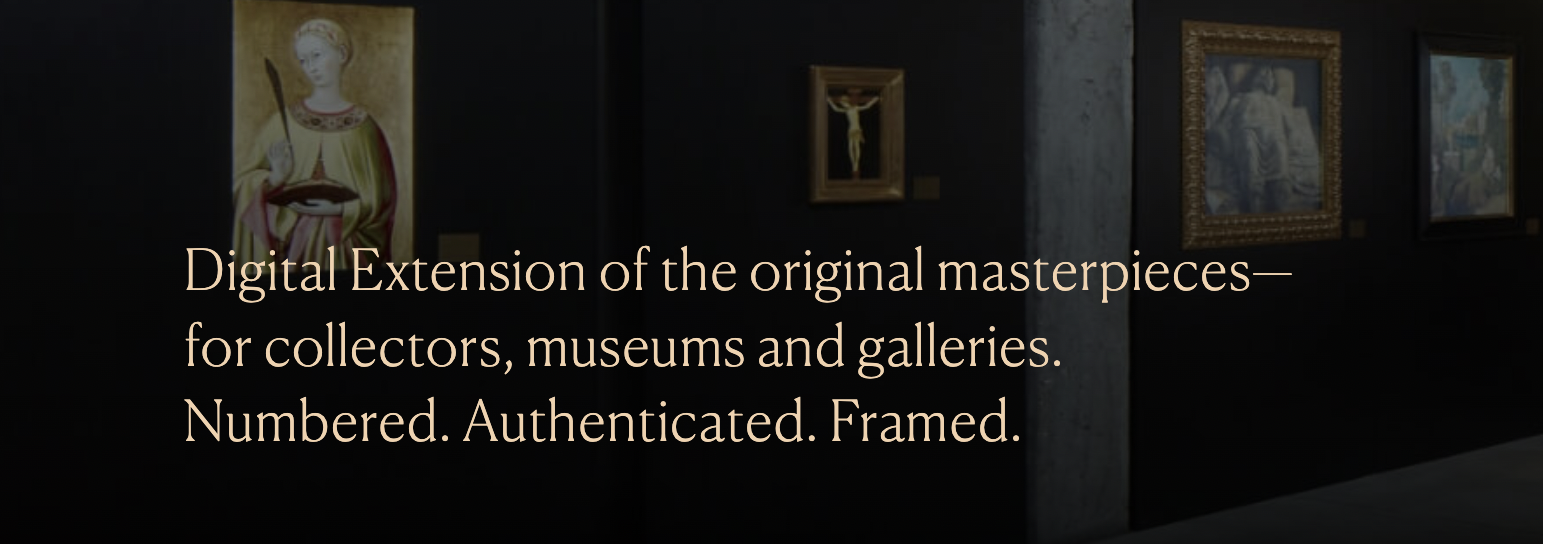
Starting from the most important masterpieces of art history, Cinello creates DAW® – Digital Art Work: digital multiples in 1:1 scale, in a limited series, certified and not duplicable thanks to a patented technology that guarantees its management. Each DAW® is unique, numbered, authenticated and not reproducible, and respects all the constraints and requirements of the work of art, starting with its uniqueness. With the approval of MiBACT (Italian Minister of Culture), Cinello has entered into agreements with the most important Italian museums public and private – Monumental Complex of the Pilotta in Parma, Accademia Galleries of Venice, Museum and Real Bosco di Capodimonte, Uffizi Galleries, Brera Art Gallery, Veneranda Biblioteca Ambrosiana, Palazzo Pretorio di Prato Museum, Monte Foundation dei Paschi di Siena – who have authorized the reproduction of a wide selection of their most famous masterpieces.
What is the mission of Cinello? Does it fill a gap that you recognized in the museum field?
Our mission is to share education and knowledge of artistic heritage and historical masterpieces by using new technologies. We organize art shows, special events, meetings, seminars, exhibitions, with the purpose to expand and share the artistic heritage.
We develop educational activities in the art world, research and partnership agreements with the most prestigious Italian and international institutions.
Our concrete support to the museums takes form through DAWs on Cinello’s platform.
In your opinion, how can digital art help preserve cultural and artistic heritage? Are there limits to this potential?
Basically we live in a completely globalized world, with a constantly growing population and a progressive shortage of resources. I am convinced that digital can meet the primary needs of human beings in the years to come, obviously also in the art sector. Think of our cities, like Venice or Florence, they were designed to be lived in by thousands of people, not millions. In fact, in recent decades they have often been put under strain by the daily amount of tourists. Digital, in this case, allows us to export the most important masterpieces of our museums, which cannot be moved for reasons of value, and exhibit them anywhere in the world with zero impact, without emitting Co2.
In your experience, what has been the attitude of most museums in regard to digital art?
Museums are very careful to preserve the value of their works, and not to waste it. Our patent meets that need for safety and protection. Through DAWs we are able to provide a steady new source of revenue, which allows museums to survive and preserve masterpieces. As you well know, you do not live on ticketing alone. It was necessary to find a way to create new revenues, and digital meets this need.
How do DAWs work? What was the patenting process like?
Cinello allows you to become the owner and to display an original digital artwork serigraphy called DAW® (Digital ArtWork) on a high-end monitor device at the best resolution available at the time.
It uses a proprietary and patented unbreachable multi-security level encryption that provides the best level of digital protection, which prevents any attempt of unauthorized duplication and dissemination. In seeking uniqueness, the digital artwork content is authorized and certified by the artists or by the museum owning the artwork and/or its copyright. DAWs® are only produced in limited edition numbers that are under the full control of the artist or the copyright holder and managed by Cinello. By having this limited number of certified digital multiples on the market, the DAW® artworks will naturally increase in value, attracting collectors looking for scarcity in collecting digital assets.
Cinello’s objective with the DAW® project is to define the design, the engineering and deployment process of the patented digital management system which provides an encrypted and easy to display certified edition of original digital artworks in a very high image resolution in the original size.
The entire system functionalities can be summarized as follows: through a catalog, a customer can browse all the available artworks and choose to buy a signed and numbered digital serigraphy. They will receive a bundle made of a monitor display as wide as necessary to display the artwork image in its real dimensions, a hand-made frame made to perfectly fit the monitor shape, a paper version of DAW® certificate of authenticity and the exclusive access to the MyGal app, which stands at the core of the image displaying process.
The user will only have to connect their personal device (mobile, tablet etc.) to the monitor and turn it on to enjoy the view of their DAW®.
DAW® – is a new technology protected by an international patent. It is managed by a platform that uses ultra-modern technology, with high standards of protection (from forgery or theft), respecting all the obligations, requirements and the very uniqueness of the works of art themselves, thanks to the most modern encryption systems. Each DAW® is a digital multiple of a masterpiece of art history, produced in original size in a limited series. The works are certified and protected with a patented digital encryption system.
The extraordinarily high technological content makes the DAW® absolutely impossible to copy and guarantees its uniqueness. For each DAW® an NFT token is created on the Blockchain, this certifies the ownership of the work.
Each DAW® is created with the consent of the museum which houses the original work and is accompanied by a certificate of authenticity signed by Cinello and by the museum itself.
For each work of art DAW® creates a numbered series. This is intended for museums, private collectors, and public and private entities around the world who are interested in organizing exhibitions [and] utilizing these rare masterpieces for educational purposes.
Cinello was founded to support the holders of this precious heritage: primarily for museums and institutions.
All revenues from DAW® and from exhibitions are shared equally with our partners to ensure a new revenue stream without introducing any restrictions on ownership or current rights.
Are there/have there ever been any copyright concerns? Any other legal concerns you can share with us?
Cinello has patented a new technology for the creation of DAW®, Digital Artwork: produced as a digital version of the original masterpiece in the original size.
The patent is related to a model that binds the digital file to the device used to display the file, this binding is realized through a digital encryption system, where the encryption key is created starting from the unique identifier of the display system. This is a unique identifier number assigned to every existing device.
Thanks to this patented digital encryption system, each DAW® is an upgradable limited edition that will be numbered, certified, and protected from sharing or copy.
DAWs® are managed by a platform that uses cutting-edge technologies to ensure all the constraints and requisites of the work of art are respected and protected, with the primary goal of maintaining the uniqueness of the art work itself.
A DAW® is a digital object, currently proposed as equal as exposed in museums, protected by an international patent. It is a bundle that includes:
- a limited edition digital file, in high definition, encrypted according to the Cinello’s patent and reproduced at the highest resolution available at that time.
- a MyGal device which includes a software to decrypt the digital file and to display it in the monitor; it stands at the core of the image displaying process.
- a paper certificate of authenticity, signed and numbered by Cinello and the artist and/or IP owner of the artwork (Museums Directors).
When a customer buys a DAW® they become the owner of all the above items as a bundle. To complete, a monitor on which to view the DAW® (provided by Cinello or by the client itself) and a hand-frame to make the DAW® look like the original painting.
At the end of the purchase process, Cinello creates an NFT token starting from the DAW, using as metadata a set of information that identifies the DAW® (artist, artwork, number of the limited edition, fingerprint of the digital file) and the token is loaded on the owner’s wallet. In this way Cinello certifies the ownership of the DAW on a public register such as the blockchain.
Where do you see the future of museums and digital art heading?
Not only private homes but also our museums in the future will have a fundamental digital counterpart in their existence. I don’t think you need to predict the future to imagine a digital life in the years to come. I am convinced that museums will also be able to enjoy immense benefits from what is happening.
While digitization has become largely mainstream, many museums are still wary of digitization for profit. What would you tell a museum interested in getting started?
First of all, I would tell them that digital has already completely become part of our lives, it is not something we can choose or not. The point is not to wait too long so as not to risk being late. My advice is to pay close attention to your partners, to rely on someone who is able to protect and not waste the value of the assets. Digital is an extraordinary resource only if it is well governed. Alternatively, what we have seen with music or publishing risks happening, where entire industries have been knocked out.
Disclaimer: This interview was conducted for educational purposes only. The Center for Art Law does not endorse or promote any companies we write about.
About the Author:
Alisa Grishin currently serves as the Social Media Coordinator at the Center for Art Law. Previous positions at the Center include being a Spring 2022 Intern and Summer 2022 Development Assistant. She recently received her MA in Cultural Studies from KU Leuven in Belgium and previously received a B.A. in History with a concentration in Public History and minors in Political Science and Legal Studies from Salem State University. She is originally from Salem, Massachusetts, a place that has influenced a specific interest in cultural policy and heritage preservation.
Suggested Readings:
Cinello. Accessed November 15, 2023. https://www.cinello.com.
Cinello. “Bottega.” Accessed November 15, 2023. https://www.cinello.com/insights/article/1/bottega.
“From VR to NFTs: In the Year of AI, How Should We Define Digital Art?” The Art Newspaper, October 17, 2023. Accessed November 15, 2023. https://www.theartnewspaper.com/2023/10/17/from-vr-to-nfts-in-the-year-of-ai-how-should-we-define-digital-art.
“NFTs of Old Masters: Good or Bad?” The Art Newspaper, March 3, 2022. Accessed November 15, 2023. https://www.theartnewspaper.com/2022/03/03/nfts-of-old-mastersgood-or-bad.
“Eternal Return: Italian Museums to Sell Digital Copies of Masterpieces.” The Art Newspaper, February 11, 2022. Accessed November 15, 2023. https://www.theartnewspaper.com/2022/02/11/eternal-return-italian-museums-to-sell-digital-copies-of-masterpieces.
“Italian Government Weighs In on Digital Copies Fracas.” The Art Newspaper, July 8, 2022. Accessed November 15, 2023. https://www.theartnewspaper.com/2022/07/08/italian-government-weighs-in-on-digital-copies-fracas.
Disclaimer: This article is for educational purposes only and is not meant to provide legal advice. Readers should not construe or rely on any comment or statement in this article as legal advice. For legal advice, readers should seek a consultation with an attorney.


