• About
    • Mission
    • Team
    • Boards
    • Mentions & Testimonials
    • Institutional Recognition
    • Annual Reports
    • Current & Past Sponsors
    • Contact Us
  • Resources
    • Article Collection
    • Podcast: Art in Brief
    • AML and the Art Market
    • AI and Art Authentication
    • Newsletter
      • Subscribe
      • Archives
      • In Brief
    • Art Law Library
    • Movies
    • Nazi-looted Art Restitution Database
    • Global Network
      • Courses and Programs
      • Artists’ Assistance
      • Bar Associations
      • Legal Sources
      • Law Firms
      • Student Societies
      • Research Institutions
    • Additional resources
      • The “Interview” Project
  • Events
    • Worldwide Calendar
    • Our Events
      • All Events
      • Annual Conferences
        • 2025 Art Law Conference
        • 2024 Art Law Conference
        • 2023 Art Law Conference
        • 2022 Art Law Conference
        • 2015 Art Law Conference
  • Programs
    • Visual Artists’ Legal Clinics
      • Art & Copyright Law Clinic
      • Artist-Dealer Relationships Clinic
      • Artist Legacy and Estate Planning Clinic
      • Visual Artists’ Immigration Clinic
    • Summer School
      • 2025
    • Internship and Fellowship
    • Judith Bresler Fellowship
  • Case Law Database
  • 2025 Year-End Appeal
  • Log in
  • Become a Member
  • Donate
  • 2025 Year-End Appeal
  • Log in
  • Become a Member
  • Donate
Center for Art Law
  • About
    About
    • Mission
    • Team
    • Boards
    • Mentions & Testimonials
    • Institutional Recognition
    • Annual Reports
    • Current & Past Sponsors
    • Contact Us
  • Resources
    Resources
    • Article Collection
    • Podcast: Art in Brief
    • AML and the Art Market
    • AI and Art Authentication
    • Newsletter
      Newsletter
      • Subscribe
      • Archives
      • In Brief
    • Art Law Library
    • Movies
    • Nazi-looted Art Restitution Database
    • Global Network
      Global Network
      • Courses and Programs
      • Artists’ Assistance
      • Bar Associations
      • Legal Sources
      • Law Firms
      • Student Societies
      • Research Institutions
    • Additional resources
      Additional resources
      • The “Interview” Project
  • Events
    Events
    • Worldwide Calendar
    • Our Events
      Our Events
      • All Events
      • Annual Conferences
        Annual Conferences
        • 2025 Art Law Conference
        • 2024 Art Law Conference
        • 2023 Art Law Conference
        • 2022 Art Law Conference
        • 2015 Art Law Conference
  • Programs
    Programs
    • Visual Artists’ Legal Clinics
      Visual Artists’ Legal Clinics
      • Art & Copyright Law Clinic
      • Artist-Dealer Relationships Clinic
      • Artist Legacy and Estate Planning Clinic
      • Visual Artists’ Immigration Clinic
    • Summer School
      Summer School
      • 2025
    • Internship and Fellowship
    • Judith Bresler Fellowship
  • Case Law Database
Home image/svg+xml 2021 Timothée Giet Art law image/svg+xml 2021 Timothée Giet Confessions of an Artist and a Lawyer: Practicing Art Law, One Trial and Painting at a Time
Back

Confessions of an Artist and a Lawyer: Practicing Art Law, One Trial and Painting at a Time

June 19, 2018
By Stephanie Drawdy 

When I chose the legal profession as a career, it was so that I could feed a burning intellectual interest in the law. An introductory political science course in high school piqued my interest in the process of government and politics. From that time, I felt a strong pull towards being a law school graduate; I believed (rightly or not) that I would then have earned a “legitimate” voice in our society by virtue of being, not just a creative thinker, but also a critical thinker.

I also became a lawyer so that I could afford to be a self-sufficient painter. My “Grand Plan”: practice law to pay the bills, practice painting to feed my soul. To my mind, I had stumbled upon a treasure trove when I learned during my time at New York Law School that an art law course was offered, taught by Judith Bressler; it was one of the best courses in my law school experience. Up to that point, my adoration of art and my interest in law were segregated; now, I saw the potential for both interests to live in harmony.

IMG_1027

The ecosystem of art law has many facets. It includes some topics that can be rather dry, contracts for example; others drip with intrigue, Nazi-looted art being the most obvious. During my studies at London’s Institute of Art and Law (IAL), I was introduced to a fuller breadth of the topics residing under the umbrella of art law: restitution and repatriation, de-accessioning of art, protection, and censorship of street art, and the list goes on.  

I am often impressed by the multitude and magnitude of art law topics that present themselves if you are looking for them. At an IAL Study Form in March, IAL Assistant Director, Alexander Herman, discussed a recent news item about an 18th-Century Panini painting that went missing from London’s Orleans House Gallery fifty years ago. The Gallery hired a painter, Fred Fordham, to re-create the painting from a black-and-white photograph and existing versions of the painting.  The issue raised was whether Fordham would have a right to copyright in this derivative work under UK law. To be eligible, Fordham would need to show his painting was an “original work of skill, labour and judgement; minor alterations that do not substantially alter the original would not qualify.” Since the composition of both paintings is the same, did Fordham merely re-create the Panini with “minor alterations”? Or did Fordham make choices that “substantially” altered from the original? Would his choice of palette be deemed a substantial alteration? Or would Fordham’s reference to existing versions make his pigment choices a “minor” alteration?

The questions raised regarding the Panini reproduction are examples of the many issues that emerge in art law that cause me to ask, would I have the same passion to answer these questions if I was not both a painter and an attorney? Since I started down this dual road of artist/attorney, I have met more than once with self-imposed doubt over my choice to practice law and not give myself fully to painting. As the adage goes, “creativity takes courage.” Thank you, Mr. Matisse. I have known many courageous, full-time artists who do well, and their success has always triggered me to question whether I am authentically a painter since I wear the proverbial hat of a lawyer as well.

My legal work thus far has covered a broad range of areas, few of which have dealt with art: reinsurance, director/officer liability, and construction defects are some examples. As a litigator, my week-to-week includes researching and writing memoranda, deposing witnesses for hours until they admit to their wrongdoing, disagreeing with opposing counsel over most things, preparing for mediation, preparing for trial, preparing for appeals, and then explaining to clients why their case is taking so much longer to resolve than they prefer. Like many other law school graduates I know, our work affords a financial benefit, but sometimes the legal climate leaves our souls panting.  My nighttime/weekend work as a painter is what waters my desert, rehabilitating me as I sketch and paint.

At brunch recently, a law school friend and I discussed our careers as attorneys, and the artistic pull we had each felt since childhood. We were continuing a long-running discussion of Elle Luna’s book, The Crossroads of Should and Must, which encourages self-awareness about your career and your calling. Ms. Luna, whose father was an attorney, was rejected from every law school she applied to; she credits these rejections as the impetus for her to realize both her calling and career as an artist. My friend, whose calling is to write, left his corporate job for a season to pursue writing exclusively; after about a year of wrestling with the day-to-day of sitting with his words, he has now re-entered corporate life in a position that he believes will provide an opportunity to incorporate his calling into his career. When the topic turned to my ability to sit with and push my paintings to the next level, he pointedly asked: are you perhaps practicing law and embracing art law to avoid a true call to paint full-time? The grit of his question resonated with me.

IMG_0839

I have finally arrived at the answer… no. I have grown to appreciate that my choices have not been missteps. Like T.S. Eliot whose career as a banker gave him the freedom to write and Philip Glass whose work as a plumber facilitated his work as a composer, so I have the freedom to paint because I practice law, whether that includes cases about art or not. My voice as an artist is also arguably amplified by my position as a lawyer; while it is easy to discount an artist’s contribution to, say a museum board, because artists “by nature are rule breakers” who may jeopardize the institution they should be serving, those in authority are less likely to dismiss an attorney who also happens to be an artist from a position in such an institution.

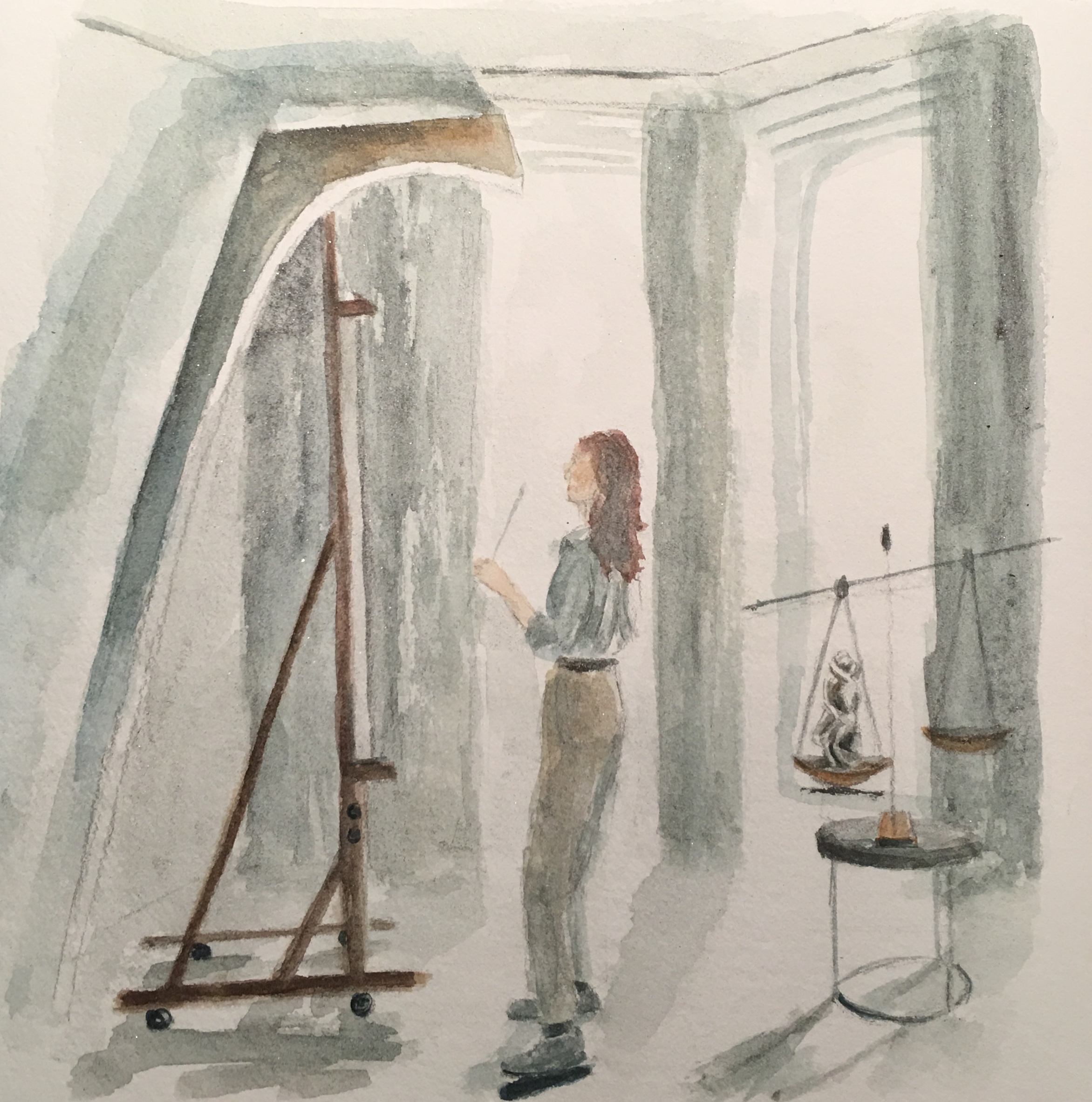
What’s more, my career (the law) and my calling (the painting) actually serve to complement one another. My analysis of the legal query surrounding the Panini reproduction is better because I am a painter; conversely, my paintings are better for having analyzed legal issues as that stimulates me on another level that painting does not reach. Because I travel this dual road, my mental eye is more keenly attuned and unified for each task ahead, be it a legal brief or a watercolor.

About the Author:  Stephanie Drawdy is licensed to practice law in New York and South Carolina. She holds a B.A. in Studio Art and Political Science from the College of Charleston, a J.D. from New York Law School, and a Diploma in Arts Profession Law and Ethics from London’s Institute of Art and Law.  She has studied painting under classical figurative artists from the New York Academy of Art, Studio Incamminati, Academy of Art College, McCormack Studios, and the New York Art Students League. Her paintings are largely representational and include landscapes, still life, and the figure. She can be found on Instagram under stephaniedrawdyart and can be contacted at stephaniedrawdyart@gmail.com.

Disclaimer: This article is for educational purposes only and is not meant to provide legal advice. Readers should not construe or rely on any comment or statement in this article as legal advice. For legal advice, readers should seek a consultation with an attorney.

Post navigation

Previous Leaving a Mark: Artistic Expression, New Media in Protest and Law
Next Art Hygiene Law: Artists Who Use Unusual Materials and Viewers Who “Take In” The Art

Related Posts

Case Review: United States v. Twenty-Nine Pre-Columbian and Colonial Artifacts, From Peru

October 6, 2014

Protecting Chaco Culture National Historical Park: When Culture and Congress Clash

November 3, 2022

That’s cool: ICE returns archival materials to the Russian Federation

December 23, 2010
Center for Art Law
A Gift for You

A Gift for You

this Holiday Season

Celebrate the holidays with 20% off your annual subscription — claim your gift now!


Get your Subscription Today!
Guidelines AI and Art Authentication

AI and Art Authentication

Explore the new Guidelines for AI and Art Authentication for the responsible, ethical, and transparent use of artificial intelligence.

Download here
Center for Art Law

Follow us on Instagram for the latest in Art Law!

It's the season! It's the season!
In 2022, former art dealer Inigo Philbrick was sen In 2022, former art dealer Inigo Philbrick was sentenced to seven years in prison for committing what is considered one of the United States' most significant cases of art fraud. With access to Philbrick's personal correspondence, Orlando Whitfield chronicled his friendship with the disgraced dealer in a 2024 memoir, All that Glitters: A Story of Friendship, Fraud, and Fine Art. 

For more insights into the fascinating story of Inigo Philbrick, and those he defrauded, read our recent book review. 

🔗 Click the link in our bio to read more!

#centerforartlaw #legalresearch #artlaw #artlawyer #lawer #inigophilbrick #bookreview #artfraud
The highly publicized Louvre heist has shocked the The highly publicized Louvre heist has shocked the globe due to its brazen nature. However, beyond its sheer audacity, the heist has exposed systemic security weaknesses throughout the international art world. Since the theft took place on October 19th, the French police have identified the perpetrators, describing them as local Paris residents with records of petty theft. 

In our new article, Sarah Boxer explores parallels between the techniques used by the Louvre heists’ perpetrators and past major art heists, identifying how the theft reveals widespread institutional vulnerability to art crime. 

🔗 Click the link in our bio to read more!

#centerforartlaw #artlaw #legalresearch #artcrime #theft #louvre #france #arttheft #stolenart
In September 2025, 77-year old Pennsylvania reside In September 2025, 77-year old Pennsylvania resident Carter Reese made headlines not only for being Taylor Swift's former neighbor, but also for pleading guilty to selling forgeries of Picasso, Basquiat, Warhol, and others. This and other recent high profile forgery cases are evidence of the art market's ongoing vulnerability to fraudulent activity. Yet, new innovations in DNA and artificial intelligence (AI) may help defend against forgery. 

To learn more about how the art market's response to fraud and forgery is evolving, read our new article by Shaila Gray. 

🔗 Click the link in our bio to read more!

#centerforartlaw #artlaw #legalresearch #artlawyer #lawyer #AI #forgery #artforgery #artfakes #authenticity
Did you know that Charles Dickens visited America Did you know that Charles Dickens visited America twice, in 1842 and in 1867? In between, he wrote his famous “A Tale of Two Cities,” foreshadowing upheavals and revolutions and suggesting that individual acts of compassion, love, and sacrifice can break cycles of injustice. With competing demands and obligations, finding time to read books in the second quarter of the 21st century might get increasingly harder. As we live in the best and worst of times again, try to enjoy the season of light and a good book (or a good newsletter).

From all of us at the Center for Art Law, we wish you peace, love, and understanding this holiday season. 

🔗 Read more by clicking the link in our bio!

#centerforartlaw #artlaw #legalresearch #artlawyer #december #newsletter #lawyer
Is it, or isn’t it, Vermeer? Trouble spotting fake Is it, or isn’t it, Vermeer? Trouble spotting fakes? You are not alone. Donate to the Center for Art Law, we are the real deal. 

🔗 Click the link in our bio to donate today!

#centerforartlaw #artlaw #legalresearch #endofyear #givingtuesday #donate #notacrime #framingartlaw
Whether legal systems are ready or not, artificial Whether legal systems are ready or not, artificial intelligence is making its way into the courtroom. AI-generated evidence is becoming increasingly common, but many legal professionals are concerned that existing legal frameworks aren't sufficient to account for ethical dilemmas arising from the technology. 

To learn more about the ethical arguments surrounding AI-generated evidence, and what measures the US judiciary is taking to respond, read our new article by Rebecca Bennett. 

🔗 Click the link in our bio to read more!

#centerforartlaw #artlaw #legalresearch #artlawyer #lawyer #aiart #courtissues #courts #generativeai #aievidence
Interested in the world of art restitution? Hear f Interested in the world of art restitution? Hear from our Lead Researcher of the Nazi-Era Looted Art Database, Amanda Buonaiuto, about the many accomplishments this year and our continuing goals in this space. We would love the chance to do even more amazing work, your donations can give us this opportunity! 

Please check out the database and the many recordings of online events we have regarding the showcase on our website.

Help us reach our end of year fundraising goal of $35K.

🔗 Click the link in our bio to donate ❤️🖤
Make sure to grab your tickets for our discussion Make sure to grab your tickets for our discussion on the legal challenges and considerations facing General Counsels at leading museums, auction houses, and galleries on December 17. Tune in to get insight into how legal departments navigate the complex and evolving art world.

The panel, featuring Cindy Caplan, General Counsel, The Jewish Museum, Jason Pollack, Senior Vice President, General Counsel, Americas, Christie’s and Halie Klein, General Counsel, Pace Gallery, will address a range of pressing issues, from the balancing of legal risk management with institutional missions, combined with the need to supervise a variety of legal issues, from employment law to real estate law. The conversation will also explore the unique role General Counsels play in shaping institutional policy.

This is a CLE Event. 1 Credit for Professional Practice Pending Approval.

🎟️ Make sure to grab your tickets using the link in our bio! 

#centerforartlaw #artlaw #legalresearch #generalcounsel #museumissues #artauctions #artgallery #artlawyer #CLE
While arts funding is perpetually scarce, cultural While arts funding is perpetually scarce, cultural heritage institutions particularly struggle during and after armed conflict. In such circumstances, funds from a variety of sources including NGOs, international organizations, national and regional institutions, and private funds all play a crucial role in protecting cultural heritage. 

Read our new article by Andrew Dearman to learn more about the organizations funding emergency cultural heritage protection in the face of armed conflict, as well as the factors hindering effective responses. 

🔗 Click the link in our bio to read more! 

#centerforartlaw #artlaw #legalresearch #lawyer #artlawyer #culturalheritage #armedconflict #UNESCO
Join the Center for Art Law in welcoming Attorney Join the Center for Art Law in welcoming Attorney and Art Business Consultant Richard Lehun as our keynote speaker for our upcoming Artist Dealer Relationships Clinic. 

The Artist-Dealer Relationships Clinic helps artists and gallerists negotiate effective and mutually-beneficial contracts. By connecting artists and dealers to attorneys, this Clinic looks to forge meaningful relations and to provide a platform for artists and dealers to learn about the laws that govern their relationship, as well as have their questions addressed by experts in the field.

After a short lecture, attendees with consultation tickets will be paired with a volunteer attorney for a confidential 20-minute consultation. Limited slots are available for the consultation sessions.
Today we held our last advisory meeting of the yea Today we held our last advisory meeting of the year, a hybrid, and a good wrap to a busy season. What do you think we discussed?
  • About the Center
  • Contact Us
  • Newsletter
  • Upcoming Events
  • Internship
  • Case Law Database
  • Log in
  • Become a Member
  • Donate
DISCLAIMER

Center for Art Law is a New York State non-profit fully qualified under provision 501(c)(3)
of the Internal Revenue Code.

The Center does not provide legal representation. Information available on this website is
purely for educational purposes only and should not be construed as legal advice.

TERMS OF USE AND PRIVACY POLICY

Your use of the Site (as defined below) constitutes your consent to this Agreement. Please
read our Terms of Use and Privacy Policy carefully.

© 2025 Center for Art Law
 

Loading Comments...
 

You must be logged in to post a comment.