
Case Review: Warhol v. Goldsmith
December 5, 2018
By Clara Cassan.
Since the opening of his retrospective at The Whitney Museum of AmericanArt, From A to B and Back Again,[i] Andy Warhol is the talk of the town… again. One of the Museum’s facades is now covered with poppy flowers, and its fifth floor is dominated by a rainbow Mao Tse-Tung. Though the visual imprints Warhol has left on the art world and popular culture are inescapable, the legal heritage he delegated to his Foundation after his death in 1987 are less acclaimed. The entity has been confronted with many litigations addressing copyright and authenticity issues related to the artist’s works and most often to his screenprints.
One of the most recent cases, The Andy Warhol Foundation For The Visual Arts, Inc. v. Goldsmith et al[ii] (“the Goldsmith case”) lays an unusual scenario in that regard; one where the Foundation raced its way to court before its adversaries, photographer Lynn Goldsmith and her company Lynn Goldsmith Ltd. (“LGL”).
The case involves Goldsmith’s 1981 photo of late singer Prince and Warhol’s Prince Series, of which Goldsmith’s photo is the basis. Her and her company had threatened to file a litigation against the Foundation for copyright infringement if they did not receive compensatory damages.
On April 7th, 2017, the Foundation (“the Plaintiff”) filed a complaint against Lynn Goldsmith and Lynn Goldsmith Ltd. (“the Defendants”) on four causes of action. The Plaintiff’s complaint offers an insight on Copyright Law, the essence of Pop Art, and Warhol’s emblematic silkscreened vision.
Facts

Lynn Goldsmith emerged as one of the first American female photographers in the“Sex, Drugs & Rock n Roll” era. Her work is featured is major national collections, such as The Museum of Modern Art or The Smithsonian NationalPortrait Gallery, and her coffee table book New Kids on the Block[iii], was featured on The New York Times BestSeller list.[iv] She was one of the first artists to portray late singer Prince, as his career was just beginning to sprout. In 1981, Newsweek hired Goldsmith for their article dedicated to the rising pop star. In one of the pictures from that photoshoot, he wears a serious gaze, high-waisted dress pants and silver suspenders, a white buttoned up shirt and an untied bow around his neck. His hands are nonchalantly tucked in his side pockets. When Goldsmith was asked to describe how her subject spoke to her in that moment, she said she saw “someone who could be so expressive and really was willing to bust through what must be their immense fears to make the work that they wanted to do, which kind of required a different part of themselves, but at the heart of it all, they’re frightened.”[v] She further explained that all her photos aimed at conveying people’s uniqueness and identity. This artistic quest surfaces when her work is studied as a whole; rather than an overall harmony, her oeuvre is a patchwork of intimate shots.
Upon the release of his Grammy Award winning album Purple Rain, glossy magazine Vanity Fair spread his portrait across its November 1984 issue. The magazine’s photo department asked for a written license to use Goldsmith’s 1981 picture to illustrate the article, which the artist and her company delivered. As one of the backbones of an art movement that targets popular culture, fame and the media, Andy Warhol was asked to create a more colorful version of the photograph to be featured on a full page across from the article. Warhol’s screenprint featured a purple Prince on a dark orange background. The mention ©1984 by Lynn Goldsmith/LGL was featured below it.

[Above: Reproduction of pages 66-67 of the November 1984 issue of Vanity Fair, featuring one of Warhol’s screenprint depicting pop artist Prince.
Exhibit taken from the Complaint.]
Prince died on April 21, 2016. About three months later, Defendants formed their first allegations against the Plaintiff, threatening to file a lawsuit if they did not receive compensation for what they consider to be copyright infringement.
Arguments
The Plaintiff requested a declaratory judgement in anticipation of the Defendants’ “baseless claims.” The Foundation now hopes the Second District Court will consider Warhol’s Prince Series in light of its previous Prince case – Richard Prince, that is – in which the judge had found the Defendant’s work to be transformative and protected by fair use, back in 2013.[vi]

Right: Andy Warhol, Prince Series, 1984, Vanity Fair.
Exhibit taken from the complaint.
Additionally, the Plaintiff believes the Defendants’ claims are barred by the statute of limitations and the equitable doctrine of laches.
The Complaint supports these arguments with extensive factual background and explanations on Warhol’s artistic signatures. In order to demonstrate that his art is incomparable to Goldsmith’s, the Plaintiff relies on Warhol’s unique production process and silkscreens, as well as on the message he conveys through his work. In the same way it may feel unnatural to think of a person differently than as both a body and a mind, an artwork’s aesthetics is inseparable from its latent message, when it has one. This is especially true for a Warhol silkscreen in which, as analyzed in one of The Whitney’s walltexts, “the photograph (…) became both the subject of the painting and the means by which Warhol made it.”
Thus, the Defendants’ arguments travel from visual to symbolic language to persuade the Court of the work’s originality, while exploring the newly pushed boundaries of fair use and the more traditional equitable doctrine of laches.
Silkscreen technique and meaning
Warhol began exploring the silkscreen technique in 1962. The process entailed screenprinting a photograph onto a canvas and reproducing that same image again indifferent colors. This discovery was Warhol’s artistic genius.
The Defendants argue that Warhol’s works transcend their subjects’ personality. While Goldsmith uses her camera to create confidential portraits, Warhol used public figures to comment upon social issues. His muses served as human billboards for the topics he denounced, and he chose them for what he believed society associated them with, rather than for who they were as individuals. Warhol’s messages were effective because he worked off images most Americans were familiar with; images that had been ingrained in the common imagination. As an example, the Complaint alludes to the artist’s 1962 silkscreen representations of Marilyn Monroe, which transformed her publicity photo for the movie Niagara (1953). Dr. Tina Rivers Ryan stated that the use of two-dimensional silkscreens in this work creates an “emotional ‘flatness’ and [turns] the actress into a kind of automaton.” Warhol hoped his use of universal photographs would lead his audience into questioning and comparing them to his alterations. His portraits would have been deprived of their essence without a clear reference to popular culture.
-

Andy Warhol, “Liz” (1963), silkscreen on linen, 40×40” © 2018 Andy Warhol Foundation for the VisualArts/Artists Rights Society (ARS), New York -

Andy Warhol, “Untitled” from Marilyn Monroe Series (1967), Screenprint, 36×36” © 2018 Andy Warhol Foundation for the VisualArts/Artists Rights Society (ARS), New York
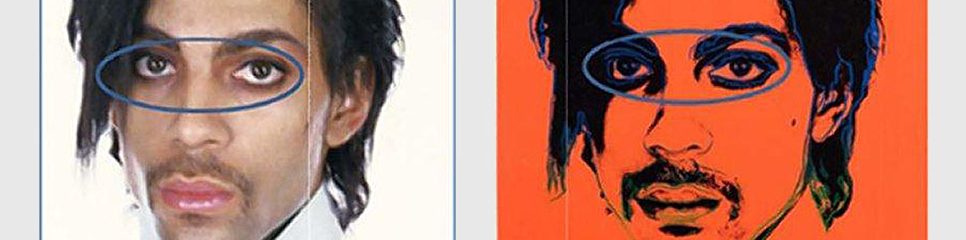
In his expert opinion for the Foundation[vii], Dr. Thomas Crow explains how Warhol applied that very technique to transform Goldsmith’s photograph. According to Dr. Crow, “the heightened contrast that Warhol preferred has the effect of isolating and exaggerating only the darkest details: the hair, moustache, eyes, and brows. One conspicuous effect of these changes was to make the subject appear to face fully towards the front as a detachable mask, negating the more natural, angled position of the figure in the source photograph.”
Warhol’s litigious work merely shows the singer’s face and hair. Prince’s outfit and body language were an essential part of Goldsmith’s photo. Interestingly, Warhol was able to separate the physical body from the person’s head for most of his prints. This gives his viewers the impression that the model depicted is only half real. Though Prince is still recognizable, Warhol’s portrait cuts off parts of his personality that were focused on in Goldsmith’s work. Clearly, the two visual artists had different intentions behind their portrayals.
Glamour was arguably Warhol’s favorite muse. Many of the models he chose were known for their beauty, regardless of their gender. The heavy colorings in his silkscreen portraits often aimed at reflecting this glamour. Once Prince’s head was disembodied from Goldsmith’s photo, Warhol darkened some of the singer’s facial features and eye makeup, underlying his androgynous character, which Prince integrated in his art in times of historical sexual liberation. The silkscreens convey their subject’s ambiguity by making his eyeliner, his moustache and his brows more prominent. As a result, these elements are at the center of the viewer’s attention. Warhol also matted the lighting from Goldsmith’s photograph, a lighting that originally unmasked Prince’s tired eyes and hollow cheeks that made the popstar look imperfect and approachable. In the Prince Series, he is expressionless and flat like Marilyn was in hers, but also relieved of what social standards tend to categorize as flaws.
Thus, while Goldsmith focused on revealing Prince’s humanity, Warhol used him to criticized fame’s robotic industry. This satirical aspect of his work is precisely what the Defendant relied on to explain that his portrait has been protected by fair use for years.
Fair Use Defense
An artwork can qualify as fair use in several situations defined in the Copyright Act.[viii] For example, an artist does not need the copyright owner’s authorization to use his work to create a parody or some other form of satire of the original work.

Right: Richard Prince, Canal Zone Series, 2008, powerHouse Books, Gagosian Gallery.
In Cariou v. Prince[ix], the facts were similar to the casein question here, and practically launched the Goldsmith lawsuit. The Court of Appeals for the Second Circuit faced an issue related to artist’s Richard Prince’s use of Patrick Cariou’s photograph of Rastafarians. In order to declare that (Richard) Prince’s works were protected by the doctrine of fair use, the Court interestingly stated that “Much of Andy Warhol’s work, including work incorporating appropriated images of Campbell’s soup cans or of Marilyn Monroe, comments on consumer culture and explores the relationship between celebrity culture and advertising.”[x] When the case settled, Goldsmith expressed her disagreement with the justice system on social media, acting as a spokeswoman for contemporary artists. She then decided to threaten the AndyWarhol Foundation to defend her own work against satire was predictable, yet overdue.
Surely, in 2016, Goldsmith was still motivated be the anger she had shared in her Facebook post about copyright laws not changing in artists’ favor three years earlier. Perhaps she still has hope today that the power of Warhol’s prints will fade with time once, and if, the Goldsmith case reaches the Court of Appeals. However, copyright cases involving the Foundation seem to tilt more in its favor everytime. In 1997, the Court of Appeals for the Second Circuit affirmed the lower judges’ dismissal of a licensing agency’s claim that the Foundation had violated the Racketeer Influenced and Corrupt Organizations Act[xi]; in 2012, the Second District Court dismissed the Velvet Underground’s claim for a declaratory judgment that the Foundation had no rights in the design of their album cover.[xii] The Court’s decision was partly based on the idea that the band’s potential economic prejudice would not be sufficiently related to the pop artist’s copyrights. These cases, now embellished by Cariou v. Prince, likely weaken Goldsmith’s claims.
Statute of Limitations
The Copyright Act enforces a three-year statute of limitations[xiii] which starts to run when the plaintiff becomes aware of the litigious work’s existence, or when reasonable diligence should have brought it to the Plaintiff’s attention.
Here, the Plaintiff argues that the Defendant should have known of the Prince Series starting when it was featured in Vanity Fair published its article, in 1984. Vanity Fair was and is still one of the world’s most successful fashion magazine. As a fashion photographer, it is hard to believe Lynn Goldsmith was unaware the 1984 November issue was dedicated to Prince, after she had been assigned to take the singer’s picture several times and followed his work. In fact, the Defendants granted a license to the magazine on that year on that very photograph, “for use as artist reference for an illustration to be published in Vanity Fair November 1984 issue.” The Plaintiff further draws an extensive list of sales and exhibitions that featured works from the Prince Series between 1984 and 2015. Still, the Defendants’ counterclaim reassesses they only took notice of Warhol’s screen print after Prince’s death in 2016, when Conde Nast published a magazine to honor his career.
Goldsmith Fights Back
In their counterclaim[xiv], Lynn Goldsmith and LGL argued the Plaintiff used the black and white photo “outside the permitted scope of the License,” which stated that no other usage of the artwork was granted outside the Vanity Fair November issue. The response also explain the fashion magazine did “not inform the photographer of [Andy Warhol]’s identity.” The Defendants will try and prove why they could not have reasonably known Warhol had created the image. However, by 1984 most of New York’s art scene was likely to recognize the author.
Rather than the Vanity Fair illustration, the “Infringing Image” the Defendants refer to is the one cover image of The Genius of Prince (2016) publication, as a derivative work. As shown in their documents, The Foundation agreed to the image’s use in exchange of a $10,000 licensing fee by Conde Nast.[xv] Warhol’s screenprint of Prince was modified, blending the singer’s face into the background. According to the Defendants, this cover deprived “Goldsmith of actual and potential economic benefits she would have earned and could earn from licensing rights to the […] photo”[xvi]
In response to The Foundation’s expansive list of public showings of the Prince Series, the Defendants enumerate several copyright cases in which Warhol’s institution was sued for copyright infringement. As per those legal battles, the Plaintiff was certainly aware of the importance of obtaining the photographer’s prior consent.
UPDATE: on July 1, 2019, the Southern District of New York ruled in a summary judgment that, although Goldsmith’s photograph is protected by copyright, the Foundation properly pleaded the Fair Use defense. Despite the works being commercial in nature, the Andy Warhol Foundation is a nonprofit, and gave works to be exhibited in museums – the works therefore “add value to the broader public interest.” The court also ruled that Warhol’s Prince are transformative, purveying a different message than Goldsmith’s photographs.
UPDATE: on March 26, 2021, the Court of Appeals for the Second Circuit ruled on appeal from Goldsmith that “The Prince Series works are substantially similar to the Goldsmith Photograph as a matter of law” and that Warhol’s use did not constitute fair use and was not transformative enough.
[i] From A to B and Back Again through Mar. 31, 2019 at the Whitney Museum of American Art.
[ii] The Andy Warhol Foundation For The Visual Arts, Inc. v. Goldsmith et al, No.1:17-cv-02532 (S.D.N.Y. filed Ap. 7, 2017).
[iii] Goldsmith, L. New Kids On The Block, Oct.1990, Paperback.
[iv] Amended Answer of Defendants, Amended Counterclaim of Lynn Goldsmith for Copyright Infringement and Jury Demand, No. 17-cv-02532-JGK (S.D.N.Y. filed July 7, 2017). Available upon request.
[v] Lynn Goldsmith Deposition Transcript 105:8–106:15.
[vi] Cariou v. Prince, 714 F. 3d 694 (2d Cir. 2013).
[vii] Expert Report of Dr. Thomas Crow in Support of the Plaintiff, The Andy Warhol Foundation For The Visual Arts, Inc. v. Goldsmith et al, No.1:17-cv-02532-JGK.
[viii] 17 U.S.C. § 107.
[ix] Id.
[x] Id., at 706.
[xi] Schlaifer Nance & Company. v. The Estate of Andy Warhol and al., 119 F.3d 91 (2d. Cir. 1997).
[xii] The Velvet Underground and al v. The Andy Warhol Foundation for the Visual Arts, Inc., 890 F. Supp.2d 398 (2014).
[xiii] 17 U.S.C. § 507(b).
[xiv] Id.
[xv] Id. at 30.
[xvi] Id. at 8.
Additional readings:
- B. Boucher, “Richard Prince Wins Major Victory in Landmark Copyright Suit”, Art in America, April 25, 2013. Available here.
- H. Cotter, “Meet Warhol, Again, in This Brilliant Whitney Show”, The New York Times, Art & Design Section, November 8, 2018. Available here.
- D. Fortune, “Lynn Goldsmith Takes Amazing Photos of Rock Stars—And No Shit From Any of Them”, LA Weekly, February 8, 2016. Available here.
- L. Gilbert, “Fair use or foul? An appropriation case involving Warhol raises an artistic debate in New York court”, The Art Newspaper, October 15, 2018. Available here.
- E. Kinsella, “Warhol Foundation Fires First Shot in Legal Battle Over Prince-Themed Artworks”, artnet news, April 11, 2017. Available here.
- T. R. Rivers, “Warhol, Marilyn, Diptych”, no date, online article Khan Academy. Available here.
- Artist Lynn Goldsmith, https://lynngoldsmith.com/wordpress/
- The Whitney Museum of American Art, https://whitney.org/
About the Author: Clara Cassan is French-American. She holds as graduate degree in European Intellectual PropertyLaw and Art History from Paris I, Sorbonne University. She will begin her LL.M degree at Fordham University in Intellectual Property and Information Technology Law in January 2019. Clara currently works as an intern with Cahill, Cossu, Noh & Robinson, LLP.
Disclaimer: This article is for educational purposes only and is not meant to provide legal advice. Readers should not construe or rely on any comment or statement in this article as legal advice. For legal advice, readers should seek a consultation with an attorney.


You must be logged in to post a comment.