• About
    • Mission
    • Team
    • Boards
    • Mentions & Testimonials
    • Institutional Recognition
    • Annual Reports
    • Current & Past Sponsors
    • Contact Us
  • Resources
    • Article Collection
    • Podcast: Art in Brief
    • AML and the Art Market
    • AI and Art Authentication
    • Newsletter
      • Subscribe
      • Archives
      • In Brief
    • Art Law Library
    • Movies
    • Nazi-looted Art Restitution Database
    • Global Network
      • Courses and Programs
      • Artists’ Assistance
      • Bar Associations
      • Legal Sources
      • Law Firms
      • Student Societies
      • Research Institutions
    • Additional resources
      • The “Interview” Project
  • Events
    • Worldwide Calendar
    • Our Events
      • All Events
      • Annual Conferences
        • 2025 Art Law Conference
        • 2024 Art Law Conference
        • 2023 Art Law Conference
        • 2022 Art Law Conference
        • 2015 Art Law Conference
  • Programs
    • Visual Artists’ Legal Clinics
      • Art & Copyright Law Clinic
      • Artist-Dealer Relationships Clinic
      • Artist Legacy and Estate Planning Clinic
      • Visual Artists’ Immigration Clinic
    • Summer School
      • 2026
      • 2025
    • Internship and Fellowship
    • Judith Bresler Fellowship
  • Case Law Database
  • Log in
  • Become a Member
  • Donate
  • Log in
  • Become a Member
  • Donate
Center for Art Law
  • About
    About
    • Mission
    • Team
    • Boards
    • Mentions & Testimonials
    • Institutional Recognition
    • Annual Reports
    • Current & Past Sponsors
    • Contact Us
  • Resources
    Resources
    • Article Collection
    • Podcast: Art in Brief
    • AML and the Art Market
    • AI and Art Authentication
    • Newsletter
      Newsletter
      • Subscribe
      • Archives
      • In Brief
    • Art Law Library
    • Movies
    • Nazi-looted Art Restitution Database
    • Global Network
      Global Network
      • Courses and Programs
      • Artists’ Assistance
      • Bar Associations
      • Legal Sources
      • Law Firms
      • Student Societies
      • Research Institutions
    • Additional resources
      Additional resources
      • The “Interview” Project
  • Events
    Events
    • Worldwide Calendar
    • Our Events
      Our Events
      • All Events
      • Annual Conferences
        Annual Conferences
        • 2025 Art Law Conference
        • 2024 Art Law Conference
        • 2023 Art Law Conference
        • 2022 Art Law Conference
        • 2015 Art Law Conference
  • Programs
    Programs
    • Visual Artists’ Legal Clinics
      Visual Artists’ Legal Clinics
      • Art & Copyright Law Clinic
      • Artist-Dealer Relationships Clinic
      • Artist Legacy and Estate Planning Clinic
      • Visual Artists’ Immigration Clinic
    • Summer School
      Summer School
      • 2026
      • 2025
    • Internship and Fellowship
    • Judith Bresler Fellowship
  • Case Law Database
Home image/svg+xml 2021 Timothée Giet Art law image/svg+xml 2021 Timothée Giet A Rose Enigma: Pending (Right) Protection
Back

A Rose Enigma: Pending (Right) Protection

December 8, 2023
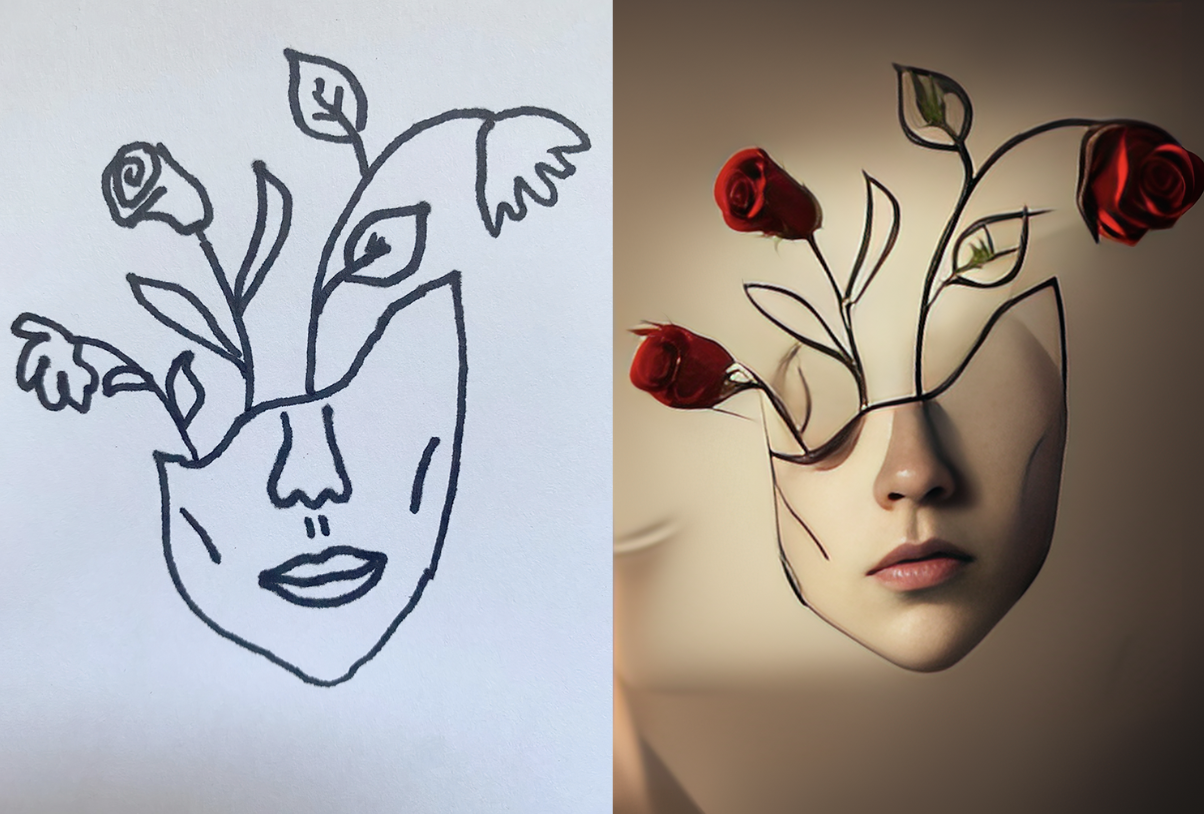
A Rose Enigma: Pending Protection

By Atreya Mathur

Introduction: From Zarya of the Dawn to Rose Enigma

The US Copyright Office (USCO) issued a pivotal decision regarding the copyright registration of “Zarya of the Dawn,” a graphic novel that incorporates artificial intelligence (AI) in the image creation process. Authored by Kris Kashtanova, the graphic novel utilized the Midjourney AI platform to generate some of its illustrations, sparking a debate about the intersection of AI-assisted art and creativity and copyright protection.

Rose Enigma, Kris Kashtanova
From the Copyright Registration Letter (February 2023)

Kashtanova successfully obtained a copyright registration for the entire graphic novel in September 2022. However, a subsequent review by the USCO, initiated in October 2022, led to a reevaluation of the registration. The USCO’s final decision, issued on February 21, 2023,[1] resulted in a limited registration that covered the text, selection, and arrangement of the images, but notably excluded copyright protection for the individual AI-generated images themselves.[2]

The Issue with Zarya of the Dawn

The crux of the matter lies in the USCO’s stance that copyright protection should be exclusive to human authors. The decision hinged on the perceived lack of substantial creative control exerted by Kashtanova over Midjourney’s output, emphasizing the “distance” between user input and AI-generated output.[3] Drawing parallels to commissioning a visual artist, the USCO distinguished Midjourney from traditional tools like cameras or software, asserting that the AI platform produces less predictable and controllable results.[4]

Regarding the images independently, the Office concluded that images generated by Midjourney lacked originality and protection.[5] The USCO relied on the principle that works produced by a machine without human creative input are ineligible for copyright. While Kashtanova claimed to guide the creative process, it was clarified that Midjourney, not Kashtanova, originated the “traditional elements of authorship” in the images.[6] Kashtanova’s involvement was described as selecting, tweaking prompts, and engaging in trial-and-error, but she does not claim to create visual material herself. The final images are to be attributed to Midjourney’s autonomous generation.[7] So while the selection and arrangement is protected, the images in itself are not protected by copyright.

Legal experts, artists, and AI developers have been polarized in their reactions to the decision. Some see it as a partial victory, acknowledging Kashtanova and Midjourney’s role in the creative process while retaining certain rights. Others, however, view it as a setback for AI-assisted creativity, arguing that it neglects protection for potentially original and expressive AI-generated images. The decision’s perceived narrowness has ignited discussions on its adaptability to the diverse landscape of AI platforms and their intricate interactions with human users.

The Decision

While recognizing Kris Kashtanova’s authorship of the text and the overall structure of “Zarya of the Dawn,” the USCO’s decision underscores the non-human authorship of the AI-generated images. The decision prompts broader questions about the future legal landscape of AI-generated works. As AI continues to permeate various creative domains, challenges arise regarding music, poetry, code, and other forms of expression. Determining the level and nature of human involvement and authorship in these works, and striking a balance between the interests of human creators, AI developers, and the public, presents a challenge. Moreover, the decision raises concerns about how legal frameworks will keep pace with the evolution and innovation of AI technology.

What’s the Enigma?

Following the USCO’s partial cancellation of Kashtanova’s registration for Zarya of the Dawn, the artist remained undeterred and submitted a new application for a distinct artwork titled “Rose Enigma.” This piece, produced using AI tool Stable Diffusion, incorporates Kashtanova’s hand-drawn art and other input, emphasizing the artist’s creative control. Kashtanova’s lawyers emphasized Kashtanova’s contributions, including a pen drawing, specific text prompts, and the use of a separate tool to control the viewer’s perspective, as evidence of the artist’s substantial creative input.[8]

Kashtanova’s attorneys argued that “Rose Enigma” was not a random creation but a result of intentional choices and creative control, positioning Kashtanova as the author. The application asserts that the artist’s exercises of control and creative decisions brought visible form to the work, aligning with copyright eligibility criteria.[9]

Kashtanova selected a cyborg as the subject for “Rose Enigma” and took active steps to guide Stable Diffusion in realizing this choice.[10] Through textual prompts, Kashtanova included specific details like “cyborg,” ensuring the accurate rendition of their envisioned subject. Kashtanova had a distinct conception of how the cyborg should appear—a young, human-looking woman with flowers emerging from her head. To convey these details, Kashtanova added descriptors such as “young,” “woman,” and “flowers coming out of her head” to the textual prompt. Not content with generic flowers, the artist also specified roses for the depiction. Using parentheses around “roses” in the prompt, with a multiplier effect, Kashtanova ensured Stable Diffusion focused on this particular floral element, adding nuance to the artistic expression. To capture the desired style, a blend of photorealism and hyperrealism, Kashtanova instructed Stable Diffusion with terms like “photorealism,” “hyper realism,” “8k,” and “hyper-detailed” in the prompt. This conveyed Kashtanova’s intention for the work to resemble a highly realistic painting while incorporating the emotive quality found in hyperrealist pieces. Kashtanova’s vision extended to dramatic lighting, characterized by harsh shadows—a preference rooted in their experience as a professional photographer. By including “cinematic lighting” in the textual prompt, Kashtanova aimed to exert control over Stable Diffusion, ensuring the realization of their envisioned lighting effects.[11]

Heather Whitney, an attorney for Kashtanova, stated that they believe “Rose Enigma” is eligible for registration under the new guidance provided by the Copyright Office. The guidance emphasizes the disclosure of AI use while maintaining the copyright eligibility of the artist’s contributions.

In addition, the artist states that the “goal” of “Rose Enigma” is to provide education to the US Copyright Office on the diverse applications of A.I. technology.

Conclusion

Considering the detailed artistic direction provided by Kashtanova for the creation of “Rose Enigma” using Stable Diffusion, the potential for copyright registration becomes even more nuanced. While Kashtanova actively guided the AI through specific prompts, shaping the subject, floral elements, style, and lighting, the question of copyright eligibility hinges on the extent of human input and creative control. Kashtanova’s meticulous choices, from the cyborg’s appearance to the nuanced details of roses and stylistic preferences, demonstrate a deliberate and thoughtful artistic direction. However, the AI’s role in generating the images and the extent to which it “autonomously contributes” to the creative process raise complexities in the copyrightability analysis.

In the context of copyright law, the ability to claim authorship and secure copyright protection typically rests on human creativity and originality. While Kashtanova’s influence is evident in the detailed prompts and artistic preferences, the underlying generation process by Stable Diffusion introduces an element of “machine autonomy.”[12]

The Copyright Office’s approach to AI-generated works involves assessing the level of human input and intervention. Kashtanova’s active role in directing Stable Diffusion provides a compelling argument for copyright eligibility, especially considering the specificity of the prompts and the unique artistic vision conveyed. However, the inherent unpredictability of AI-generated outcomes and the absence of precise control over each detail may present challenges to a straightforward copyright claim.

Kashtanova’s persistence in seeking copyright protection for AI-generated art raises questions about the evolving landscape of copyright law in the realm of AI-assisted creativity. As legal discussions continue, artists like Kashtanova navigate the balance between AI assistance and maintaining authorship rights over their creative expressions.

About the Author

Atreya Mathur is the Director of Legal Research at the Center for Art Law. She was the inaugural Judith Bresler Fellow at the Center (2021-22) and earned her Master of Laws from New York University’s School of Law where she specialized in Competition, Innovation, and Information Laws, with a focus on copyright, intellectual property, and art law.

Sources

  1. United States Copyright Office, Registration # VAu001480196, available at https://www.copyright.gov/docs/zarya-of-the-dawn.pdf ↑
  2. Id. ↑
  3. Id. ↑
  4. Id. ↑
  5. Id. ↑
  6. Id. ↑
  7. Id. ↑
  8. Registration Cover Letter for Rose Enigma, available at https://drive.google.com/drive/u/0/folders/1MOZe5wLRJF3hR6I-x77GXeuTG-QAUv37 ↑
  9. Also see Copyright Registration Guidance: Works Containing Material Generated by Artificial Intelligence, 88 Fed. Reg. 16,190 (Mar. 16, 2023) (to be codified at 37 C.F.R. § 202) ↑
  10. Registration Cover Letter for Rose Enigma, available at https://drive.google.com/drive/u/0/folders/1MOZe5wLRJF3hR6I-x77GXeuTG-QAUv37 ↑
  11. Id. ↑
  12. Id. ↑


Disclaimer: This article is for educational purposes only and is not meant to provide legal advice. Readers should not construe or rely on any comment or statement in this article as legal advice. For legal advice, readers should seek a consultation with an attorney.

Post navigation

Previous Deciphering the Foreign Sovereign Immunities Act and Its Effects on Reclaiming Looted Art
Next The Commodity of Colored Bricks: The Limitations of Art in the Real Estate Market

Related Art Law Articles

Center for Art Law AI Artibtrator Article
Art lawadr

No Industry Seems Untouched by the AI Avalanche – Where Does AI Stand With ADR? Or Better Asked, Where Does ADR Stand With AI?

February 25, 2026
Center for Art Law AML Laundry Machines Ad
Art law

Regulation Without Legislation: Combatting Money Laundering in the U.S. Art Market

February 21, 2026
Center for Art Law Susan (Central Park) Legacy Over Licensing Josie Goettel
Art lawcopyrightlicensing

Legacy Over Licensing: How Artist Estates and Museums Are Redefining Control in the Digital Age

February 19, 2026
Center for Art Law
Summer School Promo

2026 Art Law Summer School

Applications Now Open

Want to learn MORE about art law? Join us for an unforgettable week of art law in NYC!


Apply Now
Center for Art Law

Follow us on Instagram for the latest in Art Law!

Have you seen the 2024 documentary "The Spoils"? O Have you seen the 2024 documentary "The Spoils"? Our latest review covers Jamie Kastner's film that follows the Max Stern Foundation's restitution efforts and asks hard questions about who holds power in the art world. Savannah Weiler reviews it and we want to hear your take. Read it via the link in bio and drop your thoughts in the comments! 👇 

#centerforartlaw #FILMREVIEW #nazieralootedart #maxsternfoundation
Smile — you're at the Center for Art Law! 🌷 Meet o Smile — you're at the Center for Art Law! 🌷 Meet our Spring 2026 intern team, joining us from schools and graduate programs across the country! 🎓 

Our Spring 2026 Interns have been learning and working hard starting January! We are pleased to introduce to you Donyea James (Legal Intern, Fordham Law, 3L), Alexandra Kharchenko (Legal Intern, French LLM Grad of Northwestern Pritzker School of Law), Jacqueline Koutrodimos-Lewis (Graduate Intern, with MA in Classics and BA in Art History), Prisha Mehta (Undergraduate Intern, University of Texas at Austin, Class of 2026), Halle O’Hern (Legal Intern, Brooklyn Law, 2L), Marina Rastorfer (Legal Intern, Cardozo Law, LLM), and Savannah Weiler (Graduate Intern, MA in History of Art). 

From legal research to event planning, our interns are doing it all — under careful supervision!

Interested in joining our team? Fall 2026 internships begin the 2nd week of September — visit the link in our bio to learn more!
📌 We are looking for interns who can commit to working with us the entire academic year. 

#ArtLaw #LegalInterns #SpringInterns #InternSpotlight #ArtAndLaw #LawSchool #Internship BrooklynLawSchool #FordhamLaw #CardozoLaw #Northwestern #UTAustin #ClassicsAndArt #ArtHistory #NextGenLawyers
🏒 🎨⚖️ Thank you to all the applicants interested 🏒 🎨⚖️

Thank you to all the applicants interested in our 2026 summer internship program. We are humbled by the talent and volume of applications received. We only wish we could offer placement to all of you. If we cannot accommodate your interest this summer, please consider joining us as guest writers, volunteers and students at the upcoming summer school.
Grab an Early Bird Discount for our new CLE progra Grab an Early Bird Discount for our new CLE program to train lawyers to assist visual artists and dealers in the unique aspects of their relationship.

Center for Art Law’s Art Lawyering Bootcamp: Artist-Dealer Relationships is an in-person, full-day training aimed at preparing lawyers for working with visual artists and dealers, in the unique aspects of their relationship. The bootcamp will be led by veteran attorneys specializing in art law.

This Bootcamp provides participants -- attorneys, law students, law graduates and legal professionals -- with foundational legal knowledge related to the main contracts and regulations governing dealers' and artists' businesses. Through a combination of instructional presentations and mock consultations, participants will gain a solid foundation in the specificities of the law as applied to the visual arts.

Bootcamp participants will be provided with training materials, including presentation slides and an Art Lawyering Bootcamp handbook with additional reading resources.

The event will take place at DLA Piper, 1251 6th Avenue, New York, NY. 9am -5pm.

Art Lawyering Bootcamp participants with CLE tickets will receive New York CLE credits upon successful completion of the training modules. CLE credits pending board approval. 

🎟️ Grab tickets using the link in our bio! 

#centerforartlaw #artlaw #legal #research #lawyer #artlawyer #bootcamp #artistdealer #CLE #trainingprogram
A recent report by the World Jewish Restitution Or A recent report by the World Jewish Restitution Organization (WRJO) states that most American museums provide inadequate provenance information for potentially Nazi-looted objects held in their collections. This is an ongoing problem, as emphasized by the closure of the Nazi-Era Provenance Internet Portal last year. Established in 2003, the portal was intended to act as a public registry of potentially looted art held in museum collections across the United States. However, over its 21-year lifespan, the portal's practitioners struggled to secure ongoing funding and it ultimately became outdated. 

The WJRO report highlights this failure, noting that museums themselves have done little to make provenance information easily accessible. This lack of transparency is a serious blow to the efforts of Holocaust survivors and their descendants to secure the repatriation of seized artworks. WJRO President Gideon Taylor urged American museums to make more tangible efforts to cooperate with Holocaust survivors and their families in their pursuit of justice.

🔗 Click the link in our bio to read more.

#centerforartlaw #artlaw #museumissues #nazilootedart #wwii #artlawyer #legalresearch
Join us for the Second Edition of Center for Art L Join us for the Second Edition of Center for Art Law Summer School! An immersive five-day educational program designed for individuals interested in the dynamic and ever-evolving field of art law. 

Taking place in the vibrant art hub of New York City, the program will provide participants with a foundational understanding of art law, opportunities to explore key issues in the field, and access to a network of professionals and peers with shared interests. Participants will also have the opportunity to see how things work from a hands-on and practical perspective by visiting galleries, artist studios, auction houses and law firms, and speak with professionals dedicated to and passionate about the field. 

Applications are open now through March 1st!

🎟️ APPLY NOW using the link in our bio! 

#centerforartlaw #artlawsummerschool #newyork #artlaw #artlawyer #legal #lawyer #art
Join us for an informative presentation and pro bo Join us for an informative presentation and pro bono consultations to better understand the current art and copyright law landscape. Copyright law is a body of federal law that grants authors exclusive rights over their original works — from paintings and photographs to sculptures, as well as other fixed and tangible creative forms. Once protection attaches, copyright owners have exclusive economic rights that allow them to control how their work is reproduced, modified and distributed, among other uses.

Albeit theoretically simple, in practice copyright law is complex and nuanced: what works acquire such protection? How can creatives better protect their assets or, if they wish, exploit them for their monetary benefit? 

🎟️ Grab tickets using the link in our bio! 

#centerforartlaw #artlaw #legal #research #lawyer #artlawyer #bootcamp #copyright #CLE #trainingprogram
In October, the Hispanic Society Museum and Librar In October, the Hispanic Society Museum and Library deaccessioned forty five paintings from its collection through an auction at Christie's. The sale included primarily Old-Master paintings of religious and aristocratic subjects. Notable works in the sale included a painting from the workshop of El Greco, a copy of a work by Titian, as well as a portrait of Isabella of Portugal, and Clemente Del Camino y Parladé’s “El Columpio (The Swing). 

The purpose of the sale was to raise funds to further diversify the museum's collection. In a statement, the institution stated that the works selected for sale are not in line with their core mission as they seek to expand and diversify their collection.

🔗 Click the link in our bio to read more.

#centerforartlaw #artlawnews #artlawresearch #legalresearch #artlawyer #art #lawyer
Check out our new episode where Paris and Andrea s Check out our new episode where Paris and Andrea speak with Ali Nour, who recounts his journey from Khartoum to Cairo amid the ongoing civil war, and describes how he became involved with the Emergency Response Committee - a group of Sudanese heritage officials working to safeguard Sudan’s cultural heritage. 

🎙️ Click the link in our bio to listen anywhere you get your podcasts! 

#centerforartlaw #artlaw #artlawyer #legal #research #podcast #february #legalresearch #newepisode #culturalheritage #sudaneseheritage
When you see ‘February’ what comes to mind? Birthd When you see ‘February’ what comes to mind? Birthdays of friends? Olympic games? Anniversary of war? Democracy dying in darkness? Days getting longer? We could have chosen a better image for the February cover but somehow the 1913 work of Umberto Boccioni (an artist who died during World War 1) “Dynamism of a Soccer Player” seemed to hit the right note. Let’s keep going, individuals and team players.

Center for Art Law is pressing on with events and research. We have over 200 applications to review for the Summer Internship Program, meetings, obligations. Reach out if you have questions or suggestions. We cannot wait to introduce to you our Spring Interns and we encourage you to share and keep channels of communication open. 

📚 Read more using the link in our bio! Make sure to subscribe so you don't miss any upcoming newsletters!

#centerforartlaw #artlaw #artlawyer #legal #research #newsletter #february #legalresearch
Join the Center for Art Law for conversation with Join the Center for Art Law for conversation with Frank Born and Caryn Keppler on legacy and estate planning!

When planning for the preservation of their professional legacies and the future custodianship of their oeuvres’, artists are faced with unique concerns and challenges. Frank Born, artist and art dealer, and Caryn Keppler, tax and estate attorney, will share their perspectives on legacy and estate planning. Discussion will focus on which documents to gather, and which professionals to get in touch with throughout the process of legacy planning.

This event is affiliated with the Artist Legacy and Estate Planning Clinic which seeks to connect artists, estate administrators, attorneys, tax advisors, and other experts to create meaningful and lasting solutions for expanding the art canon and art legacy planning. 

🎟️ Grab tickets using the link in our bio! 

#centerforartlaw #artlaw #clinic #artlawyer #estateplanning #artistlegacy #legal #research #lawclinic
Authentication is an inherently uncertain practice Authentication is an inherently uncertain practice, one that the art market must depend upon. Although, auction houses don't have to guarantee  authenticity, they have legal duties related to contract law, tort law, and industry customs. The impact of the Old Master cases, sparked change in the industry including Sotheby's acquisition of Orion Analytical. 

📚 To read more about the liabilities of auction houses and the change in forensic tools, read Vivianne Diaz's published article using the link in our bio!
  • About the Center
  • Contact Us
  • Newsletter
  • Upcoming Events
  • Internship
  • Case Law Database
  • Log in
  • Become a Member
  • Donate
DISCLAIMER

Center for Art Law is a New York State non-profit fully qualified under provision 501(c)(3)
of the Internal Revenue Code.

The Center does not provide legal representation. Information available on this website is
purely for educational purposes only and should not be construed as legal advice.

TERMS OF USE AND PRIVACY POLICY

Your use of the Site (as defined below) constitutes your consent to this Agreement. Please
read our Terms of Use and Privacy Policy carefully.

© 2026 Center for Art Law
 

Loading Comments...
 

You must be logged in to post a comment.