
Appropriation Art on Trial: Oral Arguments before the Supreme Court in Warhol v. Goldsmith
October 22, 2022
By Jana S. Farmer, Leia Leitner and Meenka Maharaj
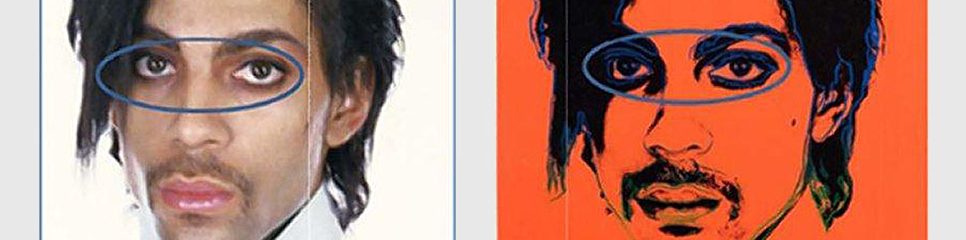
On October 13, 2022, the U.S. Supreme Court heard arguments in the matter of Andy Warhol Foundation for the Visual Arts, Inc. v. Goldsmith, et al. on the issue of whether Warhol’s silkscreen prints of iconic musician Prince based on an underlying photograph taken by Lynn Goldsmith in 1981, constituted “fair use” because the prints imbued the original artwork with a new meaning and message.
The fair use doctrine allows the use of a copyrighted work without permission from the copyright holder in limited circumstances. The four factors of the “fair use” test are set forth in section 107 of the Copyright Act:
- The purpose and character of the use, including whether such use is of a commercial nature or is for nonprofit educational purposes;
- The nature of the copyrighted work;
- The amount and substantiality of the portion used in relation to the copyrighted work as a whole;
- The effect of the use on the potential market for or value of the copyrighted work.
See 17 U.S.C. § 107.
The Second Circuit found that even where there was a distinct meaning or message of the follow-on artwork created by Warhol, the work was not “transformative” when it recognizably derived from its source material. Based on the existing precedent, including Campbell v. Acuff-Rose Music Inc. and Google LLC v. Oracle Am., Inc., the courts have considered whether a follow-on work is transformative as part of the first prong of the fair use analysis. Certiorari was granted by the U.S. Supreme Court on March 28, 2022. The Court is now tasked with revisiting the scope and importance of “transformative use” within the first prong. The participating attorneys faced a hot bench from the start–opening remarks lasting no longer than three minutes before the Justices posed their questions.
Oral Argument on behalf of Petitioner, The Andy Warhol Foundation
Roman Martinez, representing the Warhol Foundation in this matter, contended that the Second Circuit decision below did not follow precedent and was contrary to the intent of the first factor of fair use, which must consider the transformative nature of an artwork in determining whether a copyright violation occurred. Martinez argued that Warhol’s follow-on works were transformative in both purpose and character, in that they change the meaning of Goldsmith’s portrait of Prince as a person to the depiction of Prince as a depersonalized icon under the effects of modern culture and celebrity status.
According to Martinez, a “new meaning and message” must be considered as part of any fair use and analysis (even where, as here, the contours of the follow-on artworks recognizably derive from the original work) and that such an examination maintains a balance between protecting artists’ right to monetize their works while still encouraging follow-on expression. Martinez also emphasized the risk that a ruling in favor of Goldsmith could have potential legal consequences for other follow-on and/or derivative works of art, stripping protections that currently exist. Martinez mentioned, but did not discuss at length, the First Amendment implications of the decision.
A series of questions and hypotheticals from the bench followed, highlighting the justices’ concern with the expanding scope of “transformative use” and the scope of the test proposed by Martinez. Specifically, as Justice Barrett put it, “there may be nothing left to the original author for derivative works” if “transformative use” is at the center of any fair use analysis. The bench appeared overall to be skeptical of Martinez’s approach, for whom “new meaning and message” seemingly influences every aspect of the fair use analysis.
Justices Jackson and Sotomayor explored the concepts of “purpose” and “character” from factor one (the purpose and character of the use, including whether such use is of a commercial nature or is for nonprofit educational purposes), at one time noting that Martinez seemed to be conflating these concepts with his “new meaning and message” test and looking for him to admit that Warhol’s use was commercial. Specifically at issue before the Court is the 2016 commercial license of Orange Prince that the Warhol Foundation granted to Vanity Fair magazine. Commercial licensing is a factor often weighed against a finding of fair use.
Looking at the 2016 license of Orange Prince, Justice Sotomayor compared the uses for the Orange Prince print and Goldsmith’s photographs, asserting that both were used by magazines for seemingly commercial purposes. Martinez tried to sidestep the issue, arguing that “new meaning and message” must be considered as both part of the purpose and part of the character, and that Warhol’s creative process itself is on trial, not just the 2016 license. Martinez suggested that Warhol’s purpose was to communicate to his audience through visual art, and that an adverse finding will dampen the expression of artists like Warhol. Martinez supported his approach by noting that the magazine specifically paired the Orange Prince image, which is understood to be commentary on the “dehumanizing effects of celebrity culture,” with an article discussing Prince’s celebrity status.
From the outset of his argument, Martinez provided that movie adaptations of books would serve as a classic example of non-transformative work. Justice Kagan questioned why movies would lack the qualities to be considered transformative when new settings, characters and themes often are included or altered in such works. Martinez relied primarily on the first and last prongs of the fair use analysis – as he had throughout his oral argument – and offered that under the first prong, the nature of the changes would not transform the message in comparison to the book; and under the fourth prong, creation of a movie by someone other than the author would be competing in the same market as the original artist. He also noted that under the third prong, a substantial portion of the original book would need to be used, all factors together weighing against a finding in favor of fair use.
Justice Barrett brought up the Lord of the Rings book to movie adaptation, expressing incredulity that the movies would not be considered transformative under Martinez’s proposed test. Martinez backed down, stating that he needed to learn more about the books and the movies.
Justice Alito questioned whether song covers from different artists who may alter the song and believe that they are conveying a different meaning would be able to argue fair use given his stance; Martinez once again denied that infringement would not exist based on an analysis considering four balancing factors. Specifically, Martinez indicated that not only would the songs be competing in the same market, but the cover would use a substantial part if not all of the original (melody and words).
In attempting to define the extent of the transformation required for a follow-on work to receive fair use protection, Chief Justice Roberts “cheekily” inquired as to whether the addition of a smiley face drawn on the Goldsmith photograph of Prince would have imbued a sufficient “new message.” Justice Thomas proposed a hypothetical where he, as a Syracuse fan, created a poster of the Orange Prince print and included the words “Go Orange” underneath. The justices’ hypotheticals set a clear trap for. Martinez, forcing him to admit that different degrees in transformation might exist to influence the analysis, including suggesting that the addition of the words “Go Orange” would not be significantly transformative as to meet the criteria of fair use.
This questioning by the bench signifies that while the Court is perhaps not likely to do away with the “transformative use” altogether, the justices are wary of the expanding application of transformative use to the extent that any work in a new medium possibly may be considered transformative, particularly when both the original and the follow-on work are exploited commercially. It is telling that. Martinez struggled with the Court’s hypotheticals, many of which are easily analogous to the facts of the case at issue.
In many of his responses to the justices’ questioning as to the distinctions between derivative and transformative works, Martinez referenced the respective artists’ markets, which are normally considered as part of the fourth prong of the fair use analysis. Importantly, he also argued that only the first prong of the fair use analysis was briefed before the court.
Justice Kavanaugh immediately followed up on these responses, requesting clarity on the weight of competition in the same market for the two works. Martinez responded that when considering whether a new work may serve as a substitute for the original work in the market, price and aesthetics would be the deciding factors. Warhol’s art is priced significantly higher than Goldsmith’s work, for both original artworks and for licensed images. Martinez also stressed that the different aesthetics in the two portraits of Prince and the different messages that they connote allow these works to coexist without competing in the market.
The justices questioned Martinez’s need to rely on the other factors of the fair use analysis when addressing the Court’s hypotheticals. He argued that while reliance on the fourth factor may be necessary in responding to the other hypotheticals, in the present case, Warhol’s additions to Goldsmith’s photograph were so significant and transformative that it left no question as to whether new meaning was created.
The justices also questioned what evidence the courts should consider on the issue of whether a derivative work was sufficiently transformative as to create new meaning, to which Martinez responded that the courts are well equipped to consider expert evidence. Chief Justice Roberts posed a hypothetical of an artwork that consists of a single color within a frame, asking Martinez to determine whether changing the color would be considered a significant transformation under his “new meaning” test. Martinez responded that new meaning is not necessarily added in a fundamental way just “because the work is in a different form or because it has different colors.” Chief Justice Roberts countered that perhaps art critics would find otherwise, raising the question as to the role of courts and of art experts in fair use litigation. Martinez’s stance was that the courts are well equipped in considering the persuasiveness of proffered expert testimony. However, if the courts are to weigh the degree of transformativeness, this question is not so simple. Martinez noted that Campbell requires a court to determine only that there is a distinctive message or meaning, and not what such message or meaning may be.
By the end of his argument, Martinez conceded that as some questions had been raised about the other fair use factors, it would be reasonable to remand that determination to the district court; however, as he had been throughout the oral argument, he remained single-mindedly focused that the Second Circuit had erred in its decision with respect to the importance of considering new meaning as part of the first factor of the fair use doctrine.
Oral Argument on Behalf of Lynn Goldsmith and Lynn Goldsmith, Ltd.
Lisa Blatt, representing respondent Lynn Goldsmith, underscored that the multi-factor fair use test is an affirmative defense that requires a copyright defendant to provide justification for copying the underlying work and not simply address the “meaning and message” behind the follow-on work. In doing so, Ms. Blatt largely focused on the term “purpose” under the first prong, which she interprets as the “reason or justification to take another’s copyright.” She points out that a justifiable purpose in this context should not be to avoid “paying the customer price” or the “drudgery of coming up with something fresh.”
Ms. Blatt argued that the Warhol Foundation failed to address the reasons sufficient to justify the use of Goldsmith’s photograph and the overall purpose of Warhol’s use of the original work to satisfy the first prong of the fair use test. As such, she appeared essentially to be asking the High Court to adopt a more narrow approach to the first fair use test prong for all media, including works of visual art, in copyright infringement claims. Specifically, Ms. Blatt argued that the court should analyze the first prong as: “[whether] the defendant has an asserted purpose for copying someone else’s work … [to determine whether] copying of the original needed to best achieve the defendant’s … purpose [to create the copied work].” Notably, Goldsmith’s and the U.S. Government’s briefs mentioned different standards that may justify copying, including “essential,” “necessary,” or even “at least useful.” During the argument, Ms. Blatt conceded that Goldsmith was not opposed to any standard of necessity or usefulness, so long as justification was provided and the “new meaning or message” test was rejected.
Justice Jackson explored the “necessary” element when it applied to criticism or commentary with respect to a specific work, using the examples of Warhol’s Campbell’s Soup Cans and whether a different brand could have been used instead to achieve his purpose of commenting on consumerism and brand loyalty. Ms. Blatt’s response was rather vague as she stated that it was “absolutely necessary” for Warhol to use the trademarked soup product as opposed to a generic soup can, distinguishing the case at issue by stating that Warhol was not trying to sell soup (therefore, like Martinez, leaning on the fourth prong on the analysis in support of her first-prong arguments).
Ms. Blatt also argued that Martinez’s “new meaning and message” test to determine “purpose” under the first prong was not sufficient to support “copy[ing] for free” and that this test is “too easy to manipulate.” She noted that in Campbell, the discussion of “new meaning and message” was completely missing in the part of the analysis to determine the “purpose” of a copied work under the first prong. Instead, Ms. Blatt stated that the Campbell court focused exclusively on the parodic purpose of the work and not the “new meaning and message.” Ms. Blatt asserted that the petitioner’s proposed test would drive a “giant hole” through the statute’s definition of derivative work. Ms. Blatt’s proposed example of fair use would be collages, such as if Warhol created a giant butterfly out of Goldsmith’s Prince portrait.
Justice Thomas and Justice Kagan asked Ms. Blatt a series of follow-up questions as to how the “purpose and character” need to be considered as part of the first prong of the analysis and whether the “meaning or message” of the work comes into play at all. Interestingly enough, Ms. Blatt backpedaled from her briefs, stating that “meaning and message” is relevant to determining the “purpose” under the first prong and it may be considered, triggering Justice Kagan to comment that the Second Circuit stated that the “meaning and message” is irrelevant to the first factor of the fair use analysis.
Ms. Blatt, however, did not fully articulate how “message and meaning” is to be considered, merely commenting that “what the [Second Circuit is] yakking about … is that [the follow-on work] has to be reasonably perceived as having a distinctive artistic purpose.” She then reiterated her point that “you cannot have a bare purpose to add new meaning to someone else’s art for profit.” With this response, Ms. Blatt is seemingly conceding a distinction between artistic use and use for commercial purposes (in which case, a question arises as to what use by a follow-on artist will be considered no longer artistic but solely commercial).
The justices again posed a series of hypotheticals to explore transformative versus derivative works, including sequels and adaptations, which Ms. Blatt tried to sidestep by discussing “spinoffs” of television shows. Chief Justice Roberts pointed out that counsel’s examples were not the same as they did not address the creation of “transformative” visual arts, which he noted were very different. The justices also asked a series of questions as to whether Warhol’s work should be considered in the context of his status as a celebrated transformative artist. Ms. Blatt stated that Warhol’s artworks should not be given more credence merely because he is famous, as such consideration would give petitioner an unfair upper hand.
In sum, Ms. Blatt asked the High Court to reject the petitioner’s “new meaning or message” test where it was not tied to any purpose other than “I want to make money off some art and I had some really cool idea here.” Rather, Ms. Blatt argued that the test should involve how the original work was necessary for use by the creator to develop a distinctive purpose for a copied work under the first factor of the fair use analysis.
Oral Argument on Behalf of the Government of the United States
In addition to hearing the arguments for the attorneys for the Warhol Foundation and for Goldsmith, the Supreme Court granted leave to the U.S. Government to present their oral argument. Ms. Yaira Dubin, arguing on behalf of the U.S. Government, stated that two factors drive the first factor of the fair use analysis: “does the use serve a distinct purpose or instead supersede the original, and what is the justification for copying?” She argued that the Warhol Foundation never tried to show that copying was essential to accomplish a distinct purpose. In comparing the two works, Ms. Dubin equated the “purpose” of Goldsmith’s photograph and of Warhol’s use as being to depict Prince’s appearance, rather than to transmit the message of “dehumanizing effects of celebrity culture in America” behind Warhol’s Prince Series.
Ms. Dubin urged the High Court to reject the petitioner’s request to look at the meaning behind Warhol’s Prince Series and determine why the copying was justified in the first place. Ms. Dubin claimed that the “new meaning and message” test impermissibly requires the courts to inquire into the meaning of art and that it would “destabilize long standing industry licensing practices that promote the creation of original works[;] sequels, spinoffs, adaptations all become fair game if conveying a different meaning confers a license to copy.”
Essentially, Ms. Dubin argued that when a person copies another’s work, the question should be “Why are you using my thing to do your work?” under the first factor of the fair use defense. She agreed with Justice Jackson’s restatement of her argument that there should be some other purpose for the creation of a follow-on work besides adding a new meaning. In addition, Ms. Dubin stressed the danger of an approach of adding a new “meaning or message” to the analysis, given the frequency of creators easily finding a new “meaning or message” for these works, and claiming the work is “transformative use” under the fair-use analysis.
Ms. Dubin reiterated the respondent’s position that the “meaning or message” analysis is too broad to include in factor one of the fair use test. She clarified that the difference between Goldsmith’s and the U.S. Government’s positions is the interpretation of the “necessary” element under factor one. And, in a confusing manner, Ms. Dubin explained that the formulation for the U.S. Government’s test is that the original is “necessary,” or “at least useful,” to determine whether the copied work achieved a distinct purpose.
Analysis
The Warhol Foundation’s attorneys turned to precedent and legislative history in their argument to read the “new meaning and message” analysis into the first prong of the fair use defense. Although the Campbell and Google holdings support consideration of a distinct meaning and message, this Court is no stranger to revising precedent and history to decide current issues by discussing textual interpretation. Even if this Supreme Court looks to precedent in making their determination, the questions posed by the bench indicate a concern for the expanding transformative use standard, and an interest in limiting its scope.
Notably, Chief Justice Roberts, Justice Sotomayor, Justice Kagan and Justice Jackson appear to question Goldsmith’s and the U.S. Government’s interpretation of “purpose” by itself without analyzing “purpose and character” together under factor one of the fair use defense or without considering “meaning and message.” This suggests that these justices may be considering reversing the Second Circuit’s decision and remanding the case back to the district court with clarification as to how the High Court believes the purpose and character of the use should be considered procedurally.
On the other hand, the justices’ questioning of Martinez as to the purpose of licensing the Orange Prince to a magazine being commercial, and of Ms. Blatt as to whether she would have an issue with use of Warhol’s Prince Series in a museum, hints at the High Court’s inclination to limit transformative use along commercial/non-commercial use lines. Judge Thomas’s hypothetical about adding “Go Orange” at the bottom of the Orange Prince to waive at Syracuse football games illustrates the ease with which one can satisfy the petitioner’s “new meaning and message” test under factor one of the fair use defense, to which the bench in general seemed to have expressed dissatisfaction.
Either way, the Supreme Court’s decision in Warhol will likely have significant consequences on creators and those whose work is copied or used as a foundation for a derivative work. If the Court takes up Goldsmith’s narrow approach in defining the “purpose and use” under factor one, the decision may have chilling effects on potentially limiting creators’ freedom of expression under the First Amendment for commentary on preexisting art. This point, again, was barely touched on during the oral arguments.
On the other hand, if the Supreme Court agrees with the Warhol Foundation, the courts may find themselves in the role of art critics to determine what qualifies as “transformative art” and what level of transformativeness is sufficient. To the extent the High Court allows for the opportunity to address the “purpose” for the follow-on work through the “new meaning and message,” appropriation artists (together with their experts) will need to be prepared to provide an explanation of the meaning behind the follow-on work, which is something that artists (including, historically, Warhol) may not always want to do.
From the Center: For more coverage of the case, see Case Review and other articles from the Center.
About the authors:
Jana Farmer is the Chair of the Art Law Practice at Wilson Elser law firm and the Editor in Chief of the Art Law Perspectives blog. She also serves as a member of the Board of Advisers to the Center for Art Law. Leia Leitner and Meenka Maharaj are members of Wilson Elser’s Art Law Practice and regular contributors to the Art Law Perspectives blog.
Disclaimer: This article is for educational purposes only and is not meant to provide legal advice. Readers should not construe or rely on any comment or statement in this article as legal advice. For legal advice, readers should seek a consultation with an attorney.


