
Art-istic or Art-ificial? Ownership and copyright concerns in AI-generated artwork
November 21, 2022
By Atreya Mathur
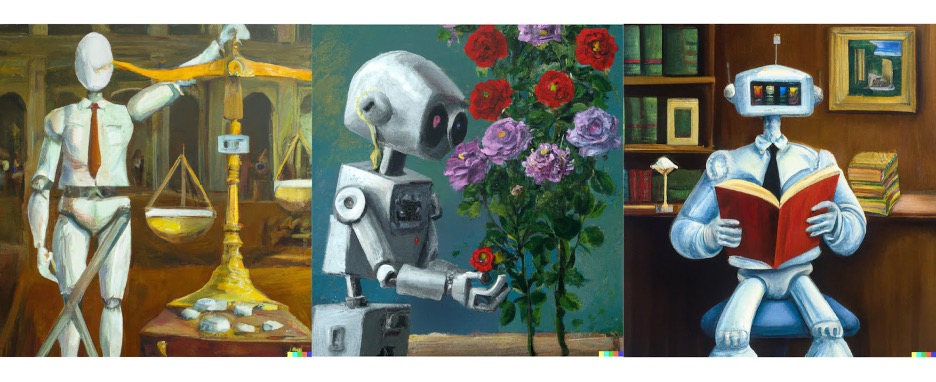
Credit: DALL·E 2; text prompts (left to right): painting of a robot holding justice scales; painting of a robot-artist painting flowers; painting of a robot reading a law book
What does it take to be an artist in the 21st century? Can one create art with paint brushes, watercolors, or oil pastels? Or can one simply think art into existence? ‘AI’ artwork generators like DALL·E and Stable Diffusion, offer users the ability to quickly create detailed images based on prompts, which can be anything you think of— An astronaut surfing in Times Square? A lawyer relaxing on the beach? (one could dream!) or a robot learning the law… in the artistic style of Da Vinci? You got it. However, when the idea is realized and the masterpiece has been generated– who owns it? who is the maker? the ‘AI’ or a copyright holder that the artwork is based on? Who has a perfected (or any) claim of co-authorship? Who can commercialize these images? Can someone be sued for infringement if they use the image without permission?
Introducing DALL·E 2
Artists build autonomous robots to collaborate with– they feed algorithms with data, and train machines to generate different kinds of visual works.[1] Creators, such as Google Arts & Culture Lab, work with computer programs that mimic the human mind to generate a never-ending stream of unique artworks. Artificial intelligence has therefore emerged as a desirable collaborator in artistic creation.[2] While AI-produced art has been around for some time, software released this year including, DALL·E 2, Midjourney AI, and Stable Diffusion, has allowed even the most inexperienced artists to produce intricate, abstract, or photorealistic compositions by merely typing a few words into a text box.[3] DALL-E 2 is learned by an OpenAI model called CLIP (Contrastive Language-Image Pre-training) which functions as the main bridge between text and images. Through machine learning, AI is trained in data and is now able to create images and generate art by itself. The training data in this case is an aggregate of large datasets of images and tagged images labeled into a set of categories, across the internet,[4] out of which most images are likely protected by copyright. The output images that these tools can generate are figurative-looking — in that it is believable that the artwork could have been created by a real person or artist.[5]
OpenAI, an artificial intelligence research laboratory, was founded in San Francisco in late 2015 by Carlos Virella, Elon Musk, Greg Brockman, Ilya Sutskever, Sam Altman and Wojciech Zaremba, who collectively pledged one billion U.S dollars.[6] OpenAI released its text-to-image generation model based on transformers architecture called DALL·E. The name of this model is inspired by surrealist painter Salvador Dali and the robot from Wall-E.[7] OpenAI initially developed the GPT (Generative Pre-trained Transformer) model that its DALL·E software used in 2018, and just four years later the software is capable of generating imagery in myriad styles, manipulating and rearranging objects within its images and accurately designing novel compositions without explicit instruction.[8] It has even proven to be capable of solving Raven’s Matrices – visual tests used to measure human intelligence – showing that DALL·E can express both geographical and temporal knowledge, where it has an understanding of places, concepts and how they change over time.[9]

DALL·E 2 (2022) is the new version of DALL·E (first released in January 2021)and can make realistic and context-aware edits, including inserting, removing, or retouching specific sections of an image from a natural language description. It can also take an image and make novel and creative variations of it inspired by the original. DALL·E was trained by learning the relationship between images and the text used to describe them. It uses a process called “diffusion”, which starts with a pattern of random dots and gradually alters that pattern towards a final output.[10] DALL·E “trained” on approximately 650 million image-text pairs scraped from the internet, learning from that dataset the relationships between images and the words used to describe them.[11] But while OpenAI filtered out images for specific content, such as images that violate their content code including pornography and duplicates, and implemented additional filters at the API (application programming interface) level, for example for prominent public figures and likeness of individuals, the company admitted that the system can sometimes create works that include trademarked logos or characters.[12] In their Press release dated April 6, 2022, the company stated that “the model can generate known entities including trademarked logos and copyrighted characters. OpenAI will evaluate different approaches to handle potential copyright and trademark issues, which may include allowing such generations as part of “fair use” or similar concepts, filtering specific types of content, and working directly with copyright/trademark owners on these issues.”[13]
Copyright, Contracts and Commercialization
It is safe to state that artificial intelligence generated art is here to stay. The success of the model has been such that OpenAI also announced that it will be commercializing DALL.E 2 and its image generation platform.[14] Credits can be purchased to make prompts to generate art. So once an AI-generated masterpiece is created, what’s stopping someone from claiming it as their own and using it commercially or preventing others from using it? Who owns these DALL·E outputs? Is it OpenAI? The person who writes the prompts? Or is it nobody’s at all?
On top of existentially threatening the very concept of artists and creatives, AI-generated content raises several new legal issues.[15] Copyrights are a form of intellectual property protected by federal law.[16] Owning a copyright gives the owner the exclusive right to reproduce, publish, or sell an original work of authorship, such as a book, a painting, or a song.[17] Under current copyright law, artists using traditional mediums, such as paint, pen, or paper, are considered the authors of the work and generally hold copyright over their work by default. The fundamental question before addressing AI-created art is whether copyright can belong to anyone other than a human being. The Naruto Case throws some light in understanding the matter and answers this question.
David Slater, a British (and very much human) wildlife photographer, set a camera up on the island of Sulawesi and had left the camera unattended. A handsome and rather curious young gentleman (a monkey) named Naruto clicked the button while looking at the camera, capturing selfies showing off his photogenic side. Following this, Slater published a book featuring the selfie and other pictures that had been taken by Naruto. In response, the People for the Ethical Treatment of Animals (PETA) filed a complaint against him and the publisher, representing Naruto, and argued that he had “the right to own and benefit from the copyright in the Monkey Selfies in the same manner and to the same extent as any other author.”[18] Further, it was argued that while the claim of authorship by species other than homo sapiens may be novel, “authorship” under the Copyright Act, 17 U.S.C § 101 et seq., is sufficiently broad so as to permit the protection of the law to extend to any original work, including those created by Naruto. However, the US. Copyright Office stated that they “will refuse to register a claim if it determines that a human being did not create the work.”[19] The office also said that it would exclude works “produced by machine or mere mechanical process that operates randomly or automatically without any creative input or intervention from a human author.”[20]
Although copyright law doesn’t specifically address artificial intelligence, or even human authorship of original art, protection under the Copyright Act must meet the following requirements:[21]
- an original work of authorship;
- fixed in a tangible medium;
- that has a minimal amount of creativity.
If a work of art doesn’t meet all three of these requirements, then it does not qualify for copyright protection. Copyright cannot belong to the AI itself. Section 306 of The Copyright Act protects “original works of authorship,” which implies a human hand in the process.[22] The Act makes the human requirement clear: “The U.S. Copyright Office will register an original work of authorship, provided that the work was created by a human being.“[23] This means that, under the current rules, AI-generated art has no owner.
Copyright protection in art is given as soon as the work is created, so the creator has exclusive right to decide the future use of the work. But since machine-created may not need the criteria for copyright protection, ownership may not be clearly distinguished.
Apart from ownership rights of the AI-generated artwork, there are additional copyright concerns that may arise. There may be infringement claims on the final image based on copyrighted artworks inputted into the AI at the time of machine learning which may infringe the rights of copyright holders.
Under the current U.S law, owners of the AI technology itself may be the ones with cause for concern – potentially being at risk of copyright infringement lawsuits.[24] AI usually reviews or even contains reproductions of other people’s artwork that it uses to create new artwork, that new artwork could be an unauthorized derivative, which is an infringement– if the AI also stores a reproduction of that artwork, that too is an infringement.[25] This concerns the owner of the AI who may ultimately be liable for infringement. But since copyright law does not protect AI-generated artwork, it is likely neither the AI nor the AI company has any rights in the image.
Analysis of terms of use
So, what does this mean for images generated by DALL·E 2? The first place to go to answer these questions is DALL·E’s own terms of use. It is important to note that when using the tool, creators have two options, to either upload an image to have it modified by the AI or inputting a prompt to generate an image. The terms of use state the following:
“Your Content. You may provide input to the Services (“Input”), and receive output generated and returned by the Services based on the Input (“Output”). Input and Output are collectively “Content.” As between the parties and to the extent permitted by applicable law, you own all Input, and subject to your compliance with these Terms, OpenAI hereby assigns to you all its right, title, and interest in and to Output…”
“Similarity of Content. Due to the nature of machine learning, Output may not be unique across users and the Services may generate the same or similar output for OpenAI or a third party…Responses that are requested by and generated for other users are not considered your Content.”
According to the terms of use of DALL·E 2, OpenAI assigns the right, title, and interest in and to the final image to the creator, provided the terms have been complied with. Copyright assignment permits a third party to take ownership of the copyright from the owner, or assignor. This means that the creator, the person who inputs the text prompt, is the owner of the image and has the rights to the final image. The creator becomes the owner of the images, regardless of whether those images have copyright or not.
The second paragraph recognizes the possibility of other creators coming up with similar generated images based on similar prompts and attempts to bypass copyright concerns stating that any prompt generated by another user, which may be similar or the same due to the nature of the machine learning. But the terms simply state that the content would not belong to the creator if it has been generated by another user but provides no guidelines as to who the content then actually belongs to.
The sharing and publication policy[26] also states:
“Creators who wish to publish their first-party written content (e.g., a book, compendium of short stories) created in part with the OpenAI API are permitted to do so under the following conditions….The role of AI in formulating the content is clearly disclosed in a way that no reader could possibly miss, and that a typical reader would find sufficiently easy to understand… People should not represent API-generated content as being wholly generated by a human or wholly generated by an AI, and it is a human who must take ultimate responsibility for the content being published.”[27]
So, is there any possibility of copyright infringement while generating or using artwork generated by DALL·E 2? OpenAI precociously bypasses most copyright questions through contract and their carefully and cleverly worded terms of use, making rather evasive references to intellectual property ownership.[28] Additionally, OpenAI is taking measures to reduce potential infringement issues including:[29] Rejecting image uploads that include recognizable faces; Rejecting generation prompts that attempt to recreate the likeness of public figures including celebrities and politicians, or realistic photos of real individuals; Improving their filters to block users from creating harmful or restricted content, which includes violent, adult, or political content, and also removing corresponding data from the software’s training itself; Implementing a new technique that is said to improve 12x the generation of diverse images of people, to help reduce bias; Using both automated and human monitors to supervise the platform and avoid misuse.[30] These measures in totality may help filter copyrighted photos, or trademarks and logos or avoid right to publicity claims that are likely to cause intellectual property concerns among owners of the rights.
Below, find an image generated on a text prompt including the name brand “Gucci.” The software has likely been inputted with alternate images that circumvent any identifying trademark or brand name or logo, but still make for interesting and even amusing artworks when certain terms are inputted. In this case, with subtle inferences to luxe looking hand bags and spoiled pooches. Art in its own sense, perhaps?


OpenAI also gives users full usage rights to commercialize the images they create with DALL·E, including the “right to reprint, sell, and merchandise.”[31] To be clear, this doesn’t mean OpenAI is relinquishing its own right to commercialize images users create using DALL·E. Deeper into the terms of service, you will find that “OpenAI will not assert copyright over Content generated by the API for you or your end users.”[32] OpenAI is signaling to users that they are free to commercialize their DALL·E images without fear of receiving a cease-and-desist letter from a company that could sue them from profiting from the images created. This does not restrict a third party from suing the user of a DALL·E image or the sale of an AI-generated artwork. [33] However, the terms of service also put users on notice that OpenAI “may change these Terms or suspend or terminate your use of the Services at any time.”[34] Which means that the legal concerns can become more pressing in time. With the inherent lack of paternity or authorship of the work by the AI itself and potentially infringing datasets that AI has learned, the creators may ultimately be liable for infringement of copyright when the images are used.
Conclusion
Ultimately humans are the ones that make the final decision to use art generated by a machine (to illustrate their articles for example); therefore, AI clearly cannot grant permission for use of the work or hold a copyright for the same.[35] The Naruto case was decided as it was for this reason. If there was substantial contribution from a team or a person who provided substantive inputs deemed creative enough for the ultimate output of the work, then they could potentially own copyright in the work. If the design, however, was significantly attributed mainly to the AI or the program, then the work would likely not be copyrighted and would possibly belong in the public domain. The future in terms of legal protection of these works is still questionable, as it is difficult to assess the full extent to which AI will be used in creative works.[36] For now, it seems likely that creators can continue to use DALL·E 2 and generate images that can be used commercially with no fear of being sued from OpenAI or DALL·E 2, provided all the terms and content policy of the software are complied with. However, it would be wise to proceed with caution, especially if commercializing the images, keeping in mind that the final images produced may still infringe on another’s copyright or the likeness of a subject in the AI-generated images.
In the meantime, any disputes arising from computer generated works by AI will need to be assessed on a case-by-case basis and will likely depend on the level of contribution of each of the parties in the creation of the work.[37] Stable Diffusion’s software allows for quite a range of user inputs and its creators have explained its functioning in detail.[38] While joint authorship or co-authorship claims due to a collaborative role may be an interesting claim, a court will rule in favor of ascribing ownership to a human creator (which can be the developer of the software so long as they say they are the authors), rather than to a software which is not a legal entity yet. It is interesting to note the carefully worded terms of use in the case of DALL·E 2, where the rights have been explicitly transferred to the creator through a contract. The terms allow the creator access to the code and the creator has the power to input text prompts and put ideas together to generate the work. However, ideas are not protected under copyright law and the sharing and publication policy provides for similarity in content generation, stating that the creator will have no right in an image that has been generated by another person. So while one can own an AI-generated image due to the contractual transfer of rights from DALL·E 2, the copyrights surrounding it and confusion in ownership of images generated using similar text prompts still leave things unclear.
In other intellectual property realms, the patent world is discussing whether an AI can be listed as an “inventor” on a patent application.[39] While not directly comparable, since the standards for “authorship” and “inventorship” are different, it is a notable step for understanding AI ownership rights, and as laws evolve with society, it isn’t beyond imagination that Artificial General Intelligence may find its way as a “legal person” or may have laws specifically drafted for its regulation and ownership in the near future.

The risks associated with using models like DALL·E to generate art are still largely unknown as they have not been contested or substantially tested in any courts. The usage of any of these software or programs do come with their own contracts, terms of service, license agreements and limitations. Such terms can impose restrictions on who owns the final output, what can be done with the generated art, the content permitted to be generated, commercialization of artwork and risk and liability of using the artwork. Being aware of what is expressly permitted and prohibited when using such tools becomes critical as one’s ability to use it may be rescinded or considered infringing if the terms are violated. It may be wise to consider not using any artist’s name or work in the generation of artwork, and explicitly mentioned the artwork was created by AI — especially in cases where the styles or similarities to artists is still under copyright protection.[40] It may be argued that regardless of initial images inputted in, the artwork is transformative enough to be fair use of the artwork, but this is a defense against infringement and may be challenging to prove depending on the case. Without knowing the specifics of the AI and the prompts used, it will be difficult to give a definitive answer on when the work would be infringing and who has ownership of the artwork when similar artworks based on similar, or the same prompts can be generated[41].
Suggested Readings and Videos:
- Aditya Ramesh et al., Zero-Shot Text-to-Image Generation (2021).
- Boris Dayma and Pedro Cuenca, DALL·E mini — Generate Images from Any Text Prompt (2021).
- Lauria Clarke, When AI can make art – what does it mean for creativity, The Guardian (2022).
- Pamela Mishkin and Lama Ahmad, DALL·E 2 Preview — Risks and Limitations (2022).
- R.A. Gonsalves, Exploring DALL-E for Digital Art Creation, Towards Data Science.
- The AI that creates any picture you want, explained, Vox.
About the Author:
Atreya Mathur is the Director of Legal Research at the Center for Art Law. She was the inaugural Judith Bresler Fellow at the Center (2021-22) and earned her Master of Laws Graduate from New York University School of Law where she specialized in Competition, Innovation, and Information Laws, with a focus on copyright, intellectual property, and art law.
Sources:
- Adam Hencz, Agents Of Change: Artificial Intelligence – AI Art and How Machines Have Expanded Human Creativity, Artland Magazine, available at https://magazine.artland.com/ai-art/ ↑
- Id. ↑
- Eray Eliacik, AI Art Generator Wars: Newcomer Stable Diffusion is the Free Alternative to Dall-E and Midjourney, Dataconomy (2022), available at https://dataconomy.com/2022/09/stable-diffusion-ai-art-generator/ ↑
- Learn about how CLIP works here https://medium.com/augmented-startups/how-does-dall-e-2-work-e6d492a2667f ↑
- Arthur Roberts, et.al., Who owns the copyright in AI-generated art?, Murgitroyd Blog (2022), available at https://www.murgitroyd.com/en-us/blog/who-owns-the-copyright-in-ai-generated-art/ ↑
- See OpenAI, Crunchbase, available at https://www.crunchbase.com/organization/openai ↑
- Aishwarya Verma, Comprehensive Guide to DALL-E By OpenAI: Creating Images from Text, Analytics India Magazine (2021), available at https://analyticsindiamag.com/comprehensive-guide-to-dall-e-by-openai-creating-images-from-text/ ↑
- Who Owns AI-Generated Art?, LBB (2022), available at https://www.lbbonline.com/news/who-owns-ai-generated-art ↑
- Id. ↑
- See DALL·E 2, available at https://openai.com/dall-e-2/ ↑
- Kyle Wiggers, Commercial image-generating AI raises all sorts of thorny legal issues, TechCrunch (2022), available at https://techcrunch.com/2022/07/22/commercial-image-generating-ai-raises-all-sorts-of-thorny-legal-issues/ ↑
- Id. ↑
- P. Mishkin, et al., DALL·E 2 Preview — Risks and Limitations (2022), available at https://github.com/openai/dalle-2-preview/blob/main/system-card.md#copyright-and-trademarks ↑
- Andres Guadamuz, DALL·E goes commercial, but what about copyright?, TechnoLlama (2022), available at https://www.technollama.co.uk/dall%C2%B7e-goes-commercial-but-what-about-copyright ↑
- Who Owns AI-Generated Art?, LBB (2022), available at https://www.lbbonline.com/news/who-owns-ai-generated-art ↑
- What is Copyright, U.S Copyright Office, available at https://www.copyright.gov/what-is-copyright/ ↑
- Id. ↑
- Naruto v. Slater, No. 16-15469 (9th Cir. 2018). ↑
- Id. ↑
- Id. ↑
- The Compendium of the U.S. Copyright Office Practices (3d.), available at https://www.copyright.gov/comp3/chap300/ch300-copyrightable-authorship.pdf ↑
- 17 U.S.C. § 102(a); See also Burrow-Giles Lithographic Co. v. Sarony, 111 U.S. 53, 58 (1884) and The Compendium of the U.S. Copyright Office Practices (3d.), available at https://www.copyright.gov/comp3/chap300/ch300-copyrightable-authorship.pdf ↑
- The Compendium of the U.S. Copyright Office Practices (3d.), available at https://www.copyright.gov/comp3/chap300/ch300-copyrightable-authorship.pdf ↑
- Who Owns AI-Generated Art?, LBB (2022), available at https://www.lbbonline.com/news/who-owns-ai-generated-art ↑
- Id. ↑
- See DALL·E 2, Sharing & Publication Policy, available at https://openai.com/api/policies/sharing-publication/ ↑
- Stock language suggested in the terms to describe the creative process, provided it is accurate:“The author generated this text in part with GPT-3, OpenAI’s large-scale language-generation model. Upon generating draft language, the author reviewed, edited, and revised the language to their own liking and takes ultimate responsibility for the content of this publication.” ↑
- For more insights on AI, copyright, and their impact on the art world, explore additional resources
- Andres Guadamuz, DALL·E goes commercial, but what about copyright?, TechnoLlama (2022), available at https://www.technollama.co.uk/dall%C2%B7e-goes-commercial-but-what-about-copyright ↑
- Id. ↑
- Ivanna Attie, DALL-E Opens with Commercial Use- What Does This Mean for Stock Photos, Stock Photos Secrets (2022), available at https://www.stockphotosecrets.com/news/dall-e-ai-free-for-commercial-use.html ↑
- See DALL·E 2, Terms of Use, available at https://openai.com/api/policies/terms/ ↑
- Id. ↑
- Jessica Rizzo, Who Will Own the Art of the Future?, Wired (2022), available at https://www.wired.com/story/openai-dalle-copyright-intellectual-property-art/ ↑
- See DALL·E 2, Terms of Use, available at https://openai.com/api/policies/terms/ ↑
- Who owns artificial intelligence-created art? The Copyright, Sybaris, available at https://www.sybariscollection.com/owns-artificial-intelligence-created-art-copyright/ ↑
- Id. ↑
- Arthur Roberts, et.al., Who owns the copyright in AI-generated art?, Murgitroyd Blog (2022), available at https://www.murgitroyd.com/en-us/blog/who-owns-the-copyright-in-ai-generated-art/ ↑
- Id. ↑
- Id. ↑
- Id. ↑
- Id. ↑
Disclaimer: This article is for educational purposes only and is not meant to provide legal advice. Readers should not construe or rely on any comment or statement in this article as legal advice. For legal advice, readers should seek a consultation with an attorney.


You must be logged in to post a comment.