
Common European Heritage: The French and Dutch Government Joint Acquisition of Two Rembrandt Portraits
July 20, 2016
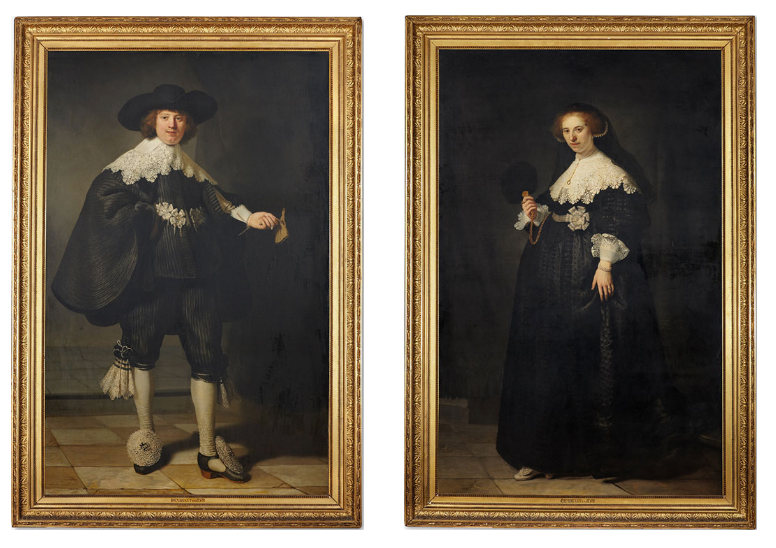
Rembrandt van Rijn, Portraits of Maerten Soolmans and Oopjen Coppit (1634)
“Madame le ministre, Ladies and gentlemen, We hébben ze! Nous les avons! We have got them!’’
— Speech by Dutch Minister for Education, Culture and Science Jet Bussemaker at the official signing ceremony for the Rembrandt portrait purchase
By Ana T. Iacob
On February 1, 2016, France and the Netherlands jointly acquired two works by Rembrandt van Rijn, the wedding portraits of Maerten Soolmans and his wife, Oopjen Coppit. This joint acquisition, otherwise known as the Rembrandt Treaty, was accomplished through an intergovernmental agreement signed by the French and Dutch Ministers of Culture, becoming thus one of the most expensive sales of Old Master paintings in history. Christie’s Private Sales channel facilitated the acquisition, which totaled €160 million for both portraits.
History of the Portraits
The two oil paintings, completed in 1634, represent the only full-length portraits painted by Rembrandt. In 1878, the portraits moved from the Van Loon collection in the Netherlands to France when they were purchased for the Rothschild Collection. The impending move to France spurred the Dutch government to attempt to acquire the paintings for the first time in order to prevent them from leaving the Netherlands. However, that did not occur due to the exorbitant price of the works. Accordingly, the portraits remained in the Rothschild Collection in France until 2013, when the Rothschild family announced its intent to sell the pair.
Immediately, the Dutch government saw the opportunity to have both paintings return to their nation of origin: the Netherlands. In an interview with BNR Nieuwsradio, the Dutch Minister for Education, Culture and Science Jet Bussemaker said it would be “very undesirable” if the works were sold to “a rich oil state” instead of returning to the Netherlands. The Dutch parliament feared that if the Netherlands did not secure the works, the two portraits would remain outside their country of origin indefinitely.
Sale of the Portraits
Both France and the Netherlands sought to individually purchase the portraits. According to Gary Schwartz, art historian and Rembrandt scholar, owning the portraits was a matter of national prestige for both the Netherlands and France. As early as September 2015, both the Rijksmuseum in Amsterdam and the Dutch government negotiated an agreement to bring €80 million to the table each in order to secure the paintings. Triggered by the eagerness of the Netherlands to acquire the works, the French Ministry of Culture, Fleur Pellerin, also offered €80 million to buy one of the portraits, with assistance provided by the Banque de France. According to Pellerin, France was ready to split the works with the Netherlands, even though there were no signs of agreement on the Dutch side and the uncertainty whether portrait owner Eric de Rothschild would even agree to separate the portraits.
The willingness of the Dutch government to massively contribute to the acquisition of the paintings surprised many. Arnold Witte, the head of art history at the Royal Netherlands Institute in Rome, noted that this would be the most expensive acquisition made by a public institution to this day. He further added that, given the current situation, if there is a will, there is a way to provide the necessary money. Indeed, the Dutch government had found a way to fund the purchase of a national treasure in the past: the government acquired Dutch national treasure “Victory Boogie Woogie” by Piet Mondrian in 1998 for €35 million. The public outcry in response to the government’s decision to spend such an amount at one time was widespread.
The desire of both countries to secure the masterworks for themselves clashed with the impossibility to pay the high asking price. A compromise was reached in the form of an intergovernmental agreement between France and the Netherlands, which stipulated that the Netherlands would own Maerten’s portrait and France would own the Oopjen portrait. The intergovernmental agreement further indicated that the works may never be separated from one another. To ensure that the portraits are always together, the pact contains firm provisions according to which the portraits will always be exhibited side by side, alternating between the Louvre and the Rijksmuseum. Both museums also agreed to incur joint responsibilities for the portraits. Furthermore, the agreement also allegedly memorialized the agreement to ban loans of the two portraits to institutions outside the two nations.
From a sequence of correspondence sent between the legal representatives of both parties, it turns out that the joint ownership transaction was supported by three legal documents. The documents included a protocol of cultural cooperation, which is a political document expressing the intent of the parties to engage; the intergovernmental agreement between the two countries; and, finally, the purchase agreement. The French representatives, in the explanations regarding French law, stressed the importance of mentioning that the contracts explain clearly that it is not a joint ownership, but rather a joint responsibility towards the paintings.
Legal Ramifications of the Joint Purchase
Historically, France has been very protective towards its cultural heritage, as demonstrated by French patrimony laws regarding national treasures. In this fashion, article L 111-1 of the Code of French Heritage defines the notion of national treasure. Cultural assets that qualify as national treasures are works within public collections, historic monuments and those works of major interest for national heritage. If the work passes a set value and seniority threshold, it may be subject to an export license refusal. Accordingly, if an item is older than 50 years and valued at more than €150,000, it may not granted the export license and the work cannot leave the country for a period of 30 months–a period in which the French government or a private patron could raise the required amount to acquire the works. In this case, even though the two portraits satisfied the two national treasure qualification requirements, the export license was granted without even submitting documents for the review of the Advisory Board of National Treasures. The Louvre and the French Ministry invoked “lack of funds” as an explanation for the granting of the export papers, even though some questioned the influence of the Rothschild family on the expedience of the process.
According to French law, the joint purchase by two Museums and subsequent transnational ownership of the works would have been unprecedented and perhaps legally impossible. However, the French government circumvented this difficulty by the separate and individual ownership of each of the portraits by the two governments. Accordingly, the Louvre owns Oopjen’s portrait while the Rijksmuseum owns Maerten’s, which satisfied French acquisition legislation.
Reaction to the Sale
In France, the sale was met with harsh criticism. For example, the French publication, La Tribune de L’Art, had very strong opinion on the matter, and expressed disappointment that the Ministry of Culture and the Louvre did not declare the works as national treasures by 2013, thus making them then available for sale. Had the works been declared national treasure, the sale would have been delayed for 30 months, giving the chance to the French state or a private patron to acquire the works. However, the Louvre and the Ministry explained that even if they would have delayed the sale, it would not have been enough to raise the necessary funds.
Inevitably, Eric de Rothschild, the portraits’ owner before the sale to France and the Netherlands, was also targeted by criticism. La Tribune de l’Art accused him of betraying the spirit of his family’s patronage, going so far as to say that Rothschild “should have honored his name.” In their opinion, even though he had the right to sell the work to whomever offered the highest price, as a great patron of art and as a member of Société des Amis du Louvre, Rothschild should have approached the museum and settled for a price that would have allowed the paintings to remain in the country unconditionally.
In the Netherlands, the opinion regarding this sale and the decision of the government to pledge such a big amount for the purchase varied. Dutch Parliamentary leader Alexander Pechtold played an important role in securing the Rembrandts. He led the campaign to raise the necessary funds for the sale and received praise for the fact that someone in his position would focus on works of Dutch cultural heritage. Dutch Minister Bussemaker explained that this was an opportunity that would never come again and, as such, had to be seized.
On the other hand, when asked on the street for their opinion, a number of individuals noted that in these times, such a great amount of money, spent at once, seemed excessive.
Conclusion
Joint ownership of artworks by two governments remains unusual and is not without complications. For example, in 2009 and 2012 respectively, two Titian paintings were purchased by the National Gallery in London and the National Gallery of Scotland for $147 million. Now, the status of this duo may be in jeopardy with the recent Brexit vote. Shared ownership of works, however, can be applied on smaller scales. Dual ownership of videos is occurring more often because it is logistically easier, such as with the joint acquisition of The Clock (Christian Marclay) by the Tate, the Centre Pompidou and the Israel Museum.
Although the examples above demonstrate other instances of dual acquisition, the joint purchase of the Rembrandt portraits is outstanding for a number of reasons: first, due to the record amount paid for the art by two nations and second, due to the unusual ownership arrangements between them. Pooling together extensive economic and political forces, both countries successfully secured two European masterpieces. It is unclear whether potential buyers of related artworks in the future will be able to use this dual acquisition model to guide their dealings, as the circumstances surrounding the Rembrandt portraits’ creation and ownership are unique in their own right. If nothing else, one positive outcome of the two nations cooperating is the the fact that for the first time in a long period, the portraits will be publicly displayed. Sales taxes, if any, seems to be owed exclusively to the French government.
Sources:
- M. Bailey, Polly Wants a Rembrandt, The Art Newspaper (Oct. 16, 2015), http://theartnewspaper.com/news/france-and-netherlands-finalize-160m-rembrandt-acquisition-/.
- Portraits of Maerten Soolmans and Oopjen Coppit by Rembrandt: An Exceptional Acquisition Exhibited at the Musée du Louvre, http://www.louvre.fr/en/portraits-maerten-soolmans-and-oopjen-coppit-rembrandtan-exceptional-acquisition-exhibited-musee-du.
- One of the Most Important Private Sales in History, Christie’s (Feb. 2, 2016), http://www.christies.com/features/The-Private-Sale-of-Rembrandt-Van-Rijn-Portrait-of-Oopjen-Coppit-and-Maerten-Soolmans-7044-1.aspx.
- Rembrandt Portraits of Maerten Soolmans and Oopjen Coppit to be Restored at Rijksmuseum, Codart (Feb. 1, 2016) http://www.codart.nl/news/1321/.
- M. Karmelek, Two Rembrandt Paintings Receive Dual Citizenship, Newsweek (Oct. 15, 2015), http://europe.newsweek.com/two-rembrandt-paintings-shared-france-netherlands-334864?rm=eu.
- L. Muñoz-Alonso, Sale of Rembrandt Portraits Owned by Eric De Rothschild Worth €150 Million Sparks Controversy, Artnet News (Mar. 18, 2015), https://news.artnet.com/art-world/rembrandt-portraits-rothschild-france-278667
- Nina Siegal, Rembrandt Portraits May Come Home, for Record Price, With Government Help, The New York Times, (Sept. 21, 2015), http://www.nytimes.com/2015/09/22/arts/design/rembrandt-portraits-may-come-home-for-record-price-with-government-help.html?_r=0
- I. Lindsay, Rembrandt Masterpieces May be Heading back to Holland, Russian Art Dealer (Sept. 24, 2015), http://www.russianartdealer.com/journal/rembrandts-heading-holland/
- TROTS OP AANKOOP REMBRANDTS, http://latenight.livewallcampaigns.com/item/964/trots_op_aankoop_rembrandts
- Maerten Soolmans en Oopjen Coppit – Nationaal bezit Rijksmuseum?, Kunst in de Wijk Kunst en Cultuur in de Wijken (Sept. 23, 2015), https://kunstwijk.wordpress.com/2015/09/23/maerten-soolmans-en-oopjen-coppit-nationaal-bezit-rijksmuseum/
- H. Fouquet and C. Ruhe, France Fights to Keep Rembrandt From Dutch With $89 Million, Bloomberg (Sept. 25, 2015), http://www.bloomberg.com/news/articles/2015-09-24/france-bids-eu80-mln-for-rare-rembrandt-after-netherlands-offer
- http://presse.louvre.fr/les-portraits-de-maerten-soolmans-et-doopjen-coppit-par-rembrandt_4614_4614/
- L. V. Prott, Handbook of National Regulations Concerning the Export of Cultural Property, http://unesdoc.unesco.org/images/0011/001191/119126eo.pdf
- Code du patrimoine (version consolidee au 23 fevrier 2015); National Heritage Code.
*About the Author:
Ana T. Iacob is a jurist living in Amsterdam, the Netherlands. She has a Master in European Private Law from the University of Amsterdam and is interested in art and intellectual property law.
Disclaimer: This article is intended as general information, not legal advice, and is no substitute for seeking representation.
Disclaimer: This article is for educational purposes only and is not meant to provide legal advice. Readers should not construe or rely on any comment or statement in this article as legal advice. For legal advice, readers should seek a consultation with an attorney.


