
Copyrightability of Obscene Works
November 4, 2021
By: Bhumika Sharma
“Art is never chaste. It ought to be forbidden to ignorant innocents, never allowed into contact with those not sufficiently prepared. Yes, art is dangerous. Where it is chaste, it is not art.”
-Pablo Picasso
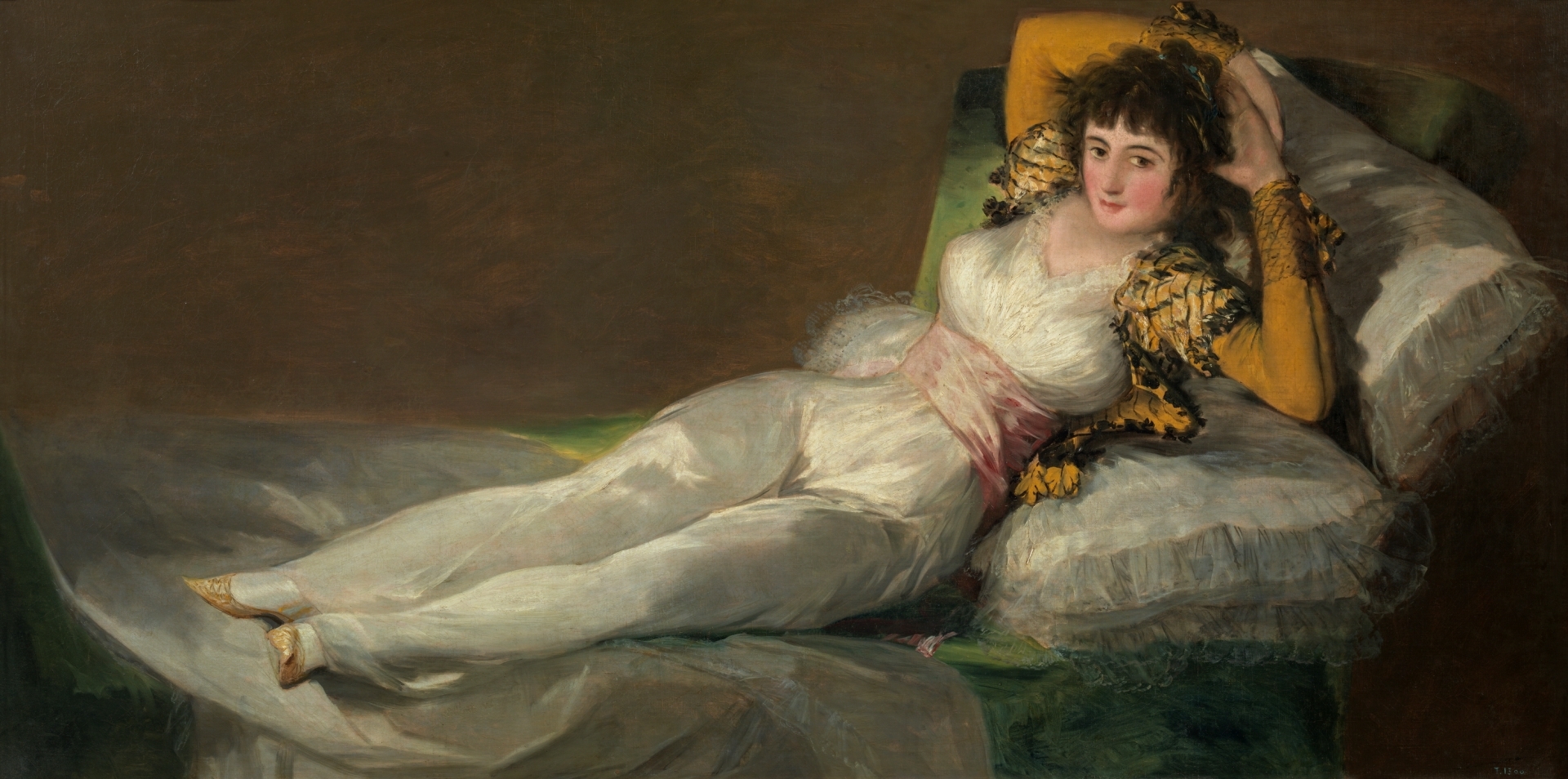
Obscene artworks have often invited the attention of courts, not just in recent times but also in the past. Created in circa 1797, Francisco Goya’s La Maja Desnuda, also called one of the sexiest paintings of all times, was once seized by the authorities. The painting portrays a woman lying naked on a green velvet bed and although this was not the first nude painting, what was so shocking about the painting was the fact that the woman in the painting held an unapologetic and unashamed gaze, looking directly into the eyes of the viewers. This painting was considered so deplorable that the curator and the first known owner of the painting, erstwhile Prime Minister of Spain Manuel de Godoy, were summoned in the court to identify the creator of this painting. Owing to which Goya was summoned in the court for moral depravity. Though the painting was once confiscated , today it hangs in one of the most prestigious museums in Spain, Museo del Prado in Madrid, an example of how art, no matter how shocking, finds acceptance from its audience over time.
The works of art and science are important as they aid in human flourishing in the society but what motivates the creators to make these works? Other than passion for the subject itself, the economic benefits earned due to the exclusive rights granted by the copyright protection act as an incentive for authors to create more works. But what works actually deserve this protection is a question often asked and seldom answered, especially when the works in question are obscene or illegal in nature.
The U.S. Constitution allows authors to protect their original expression of ideas to promote the progress of science and useful arts through the provisions of Copyright law.[1] The Copyright law protects artistic works; literary, musical, dramatic and architectural works.[2] As per Berne Convention, registration is not an essential for copyright protection, protection exists as soon as the work is created. Even the Copyright Code[3] does not place any restrictions on the protection of the works, as long as the works are original and in fixed and tangible medium, they are eligible for copyright protection. Thus, apart from these there are no content based restrictions on the eligibility for copyright protection.[4] Therefore, all kinds of work can be protected under Copyright law. The explanation for this could be that any restriction could abridge the freedom of speech under the First Amendment and the uncertainty of whether a work would be eligible for protection could cause a chilling effect on the creation of such works and, thus, discourage art.[5] Apart from this, imposing any aforesaid restrictions could empower the registrars to decide what constitutes as art and to define its scope, a work which the registrars aren’t trained for, as it would require aesthetic evaluations to decide the nature of such works.[6] Despite the evolution of the Code, the question of copyrightability of obscene and illegal works is unanswered. The reason being that often courts have considered obscenity outside the protection of the First Amendment.[7] Though, some decision would back the rule of no content based restrictions, even when the work is illegal,[8] some courts would disagree and deny ‘obscene’ any protection.[9]
To decide whether obscene works deserve copyright protection, it is important to first understand the meaning of the word obscene. Though, there is no fixed-legal definition for the word ‘obscene’, the overall meaning can be understood by referring to the various legal precedents. Any work can be said to be obscene if, ‘it has the tendency to corrupt the minds of people’,[10] and at some instances glamourizing the potential dangerous behavior can be held to be obscene.[11] Further, ‘obscene’ does not only include sexual content, in 1990, earrings made from human fetuses displayed at an art gallery were considered to be ‘obscene’.[12] Thus, anything that ‘appeals to a prurient interest in sex, portrays sexual conduct in a patently offensive way’[13] can be to be obscene, though violence has recently been removed from the definition of obscenity under the First Amendment.[14] The definition of obscene is unclear and thus, it relies on courts to decide it on case-to-case basis, and to deal with this ‘intractable obscenity problem’,[15] courts have set tests to determine whether a work is obscene in nature.
The first such test to be used was the Hicklin test, wherein the rule was to see if the tendency of the matter . . . is to deprave and corrupt those whose minds are open to such immoral influences,[16] which was later replaced by the Roth test. This test focused on the entire work as opposed to isolated passages and on the average person.[17] Even though these tests offered a direction to the courts dealing with the issue, the courts still struggled with cases of obscenity. The current in use and the most popular test in this respect is the Millers test,[18] which set the conditions to determine the nature of works.
Despite the development, defining ‘obscenity’ is still a challenge for the courts as said by Justice Potter “…I could never succeed in intelligibly doing so. But I know it when I see it…”.[19] The reason being, obscenity depends upon the moral standards, which are highly subjective and keep on changing continually. In 1867, a play was held to be uncopyrightable as it portrayed women in flesh-colored tights,[20] thus, which was as per the moral standards of the bygone era, but it is important to note that the term of copyright is for a long duration, thus, the work must be judged with foresight. Also considering the issue of copyright eligibility, the works of art have various media of expression like literature, visual arts, musical works, etc., in these cases, the definition of obscenity would change through this media. For instance, if a portrait of an explicit scene is granted copyright protection, would the photo or video of the same scene enjoy the protection too? or would they fall under pornography and be denied any protection. In such cases, where a work is considered obscene, the author would be subject to criminal action, and the only potential defense for obscene works is for the author to satisfy the balance of probability that the work is made for public good and,[21] to show that the said work is in the interest of science, literature, art or learning.[22]
The works that lay on the thin line of ‘obscene’ and ‘protected under freedom of expression’ have often received a mixed response by courts. In past, where some courts have been strict to apply the rules and ruled any obscene work uncopyrightable,[23] some courts have ruled in favour of such works, providing them copyright protection.[24] In the case of ‘Behind the Green Door’, the court held that while deciding the copyrightability of a work, court need not determine the nature of such work, as no content-based restrictions were placed by Congress except for the originality requirement. Even though the protection of obscene works is still debatable, the courts have often ruled that obscenity cannot be used as a defense in infringement cases, as the fair use parameters would apply to these works.[25] Though there has been a lot of progress on the issue of copyrightability of obscene works, yet there exist many unanswered questions.
As it is evident that the primary purpose of copyright is to promote ‘art and science’, it is pertinent to understand the scope and meaning of the term ‘art’ and the part that these alleged ‘obscene’ works hold in relation to the promotion of ‘art and science’. The term art has innumerable meanings and definition, it is undefined and the scope of it is broad enough to fit anything. From the duct taped banana[26] to the portrait of Mona Lisa, they all fall under the meaning of art. Many artworks have often been subject to mass criticism or opposition from a part of society, that is because art is a subjective term, its meaning changes from person to person. Due to its undefined nature, artworks have been successful at evoking strong emotions, of love, hatred, disgust, etc., of the audience. And only because art is offensive, it cannot be said to have fallen outside the domain of Free Speech.[27]
Art always tests its audience, as to how far they might go as audiences and this testing nature of art has helped art change the mindset of the society and bring a change. Historically, art has led to revolution, the reason being some artworks are always ahead of their time. These works are made to challenge the norms of society on subjects that are socially unacceptable at the time of the creation of the artwork. Examples for the above can be taken from Marcel Duchamp’s “Fountain”, Mapplethrope’s photographs exploring homosexuality[28] and the book ‘Bluest Eye,’ which deals with the concept of racism in society. The common factor among all these artworks is that they were all controversial and ahead of their time and thus, challenged. The audience during the creation of these works were not ready to accept these artworks, but in today’s world would the artworks on similar taboos be as controversial as they were in the past? Not likely, as we have evolved as a society. Thus, denying protection to works, which would affect the production of the said works, adjudged by standards of one era would affect the society’s growth, as these works would not only be acceptable but also inspirational for the later generations. Also, reiterating that copyright protection, unlike trademark and other IP, is for artistic works, it is pertinent to note that obscenity and taboo subjects have been the central theme of artworks for years. Thus, denying these artworks protection would be limiting the scope of art. Also, considering the positive social impact of the said artworks in the society, as they help the citizens attain the elements necessary for a good life like education, self-expression, autonomy, and engagement, under the cultural theory of IP, it would not be in public interest to deny these works protection. Moreover, courts have supported that these artworks come under the protection of free speech and hence, many such artworks have been permitted to be communicated or displayed to the public. For instance, Spencer Tunik was allowed to do a photo-shoot of 75+ naked models as respected Tunik right to engage in expression[29] and an artist had succeeded in a challenge against the policy of a public library against displaying nudes.[30] Thus, some of these artworks have enjoyed protection of freedom of expression, even though sometimes with certain restrictions.[31]
Conclusion
While considering the relationship of art with obscenity and the prominence of the said works in the society, it is pertinent to note the effects of these content-based restrictions on the copyright eligibility of works. It is argued that offering protection to such immoral works would lead to an increase in the production of these works, which is undesirable due to the negative effects of these works in the society, in public interest. On the contrary, offering protection to such works would offer the author a control over the circulation of the artworks as they would not be freely available to exploit for the public. As we have already seen that any aforesaid restriction would require the work to be judged by the current moral standards, this would not justify the loss to the society from interference in literary and artistic freedom.[32] Apart from this, applying any such content-based restrictions would make the registrars the judge of art. In a time where it is difficult for judges to define what is obscene, it would be unfair to push this task on the registrars.[33] Looking at the aforesaid restrictions through the theories of IP, any restriction would not be in consonance with the fairness and personality theory, as the former would argue that an author must be able to reap the fruits of his intellectual labor, the latter would assert that any work is an expression of a creator’s personality and thus, they must be protected.
Therefore, looking at the current situation, it can be said that the ambiguous nature of the eligibility of protection for obscene works has created an uncertainty among the creators. Thus, it is important for the court to offer a clear stance with respect to protection of the artworks and whether any aforesaid content-based restriction would be justified.
Considering various aspects like the importance of strong artistic works in shaping the society for future, relationship of art, obscenity and the scope of copyright law and the effects of the content-based restrictions, it would be wise to say that any such restriction would not only abridge the freedom of speech and expression but also defeat the purpose of copyright law.
Additional Reading Suggestions
- Amy M. Adler, Post-Modern Art and the Death of Obscenity Law, 99 Yale L.J. (1990). Available at: https://digitalcommons.law.yale.edu/ylj/vol99/iss6/4
- Amy Adler, The Art of Censorship, 103 W. VA. L. REV. 205 (2000).
- Arnold H. Loewy, Obscenity, Pornography, and First Amendment Theory, 2 WM. & MARY BILL RTS. J. 471, 476 (1993).
- Cara L. Newman, Eyes Wide Open, Minds Wide Shut: Art, Obscenity, and the First Amendment in Contemporary America, 53 DEPAUL L. REV. 121 (2003).
- Green, Ronald L. (1980) The Obscenity Defense to Copyright Revisited, Kentucky Law Journal: Vol. 69: Iss. 1, Article 6. Available at: https://uknowledge.uky.edu/klj/vol69/iss1/6
- James R. Alexander, Chasing Echos of Obscenity Exceptionalism in Copyright: Recent Swarm Cases, 17 Chi. -Kent J. Intell. Prop. 1 (2018) Available at: https://scholarship.kentlaw.iit.edu/ckjip/vol17/iss1/1
- Kurt L. Schmalz, Problems in Giving Obscenity Copyright Protection: Did Jartech and Mitchell Brothers Go Too Far?, 36 Vanderbilt Law Review 403 (1983) Available at: https://scholarship.law.vanderbilt.edu/vlr/vol36/iss2/5
- Saunders, David, “Copyright, Obscenity and Literary History.” ELH, vol. 57, no. 2, Johns Hopkins University Press, 1990, pp. 431–44, https://doi.org/10.2307/2873078 Snow, Ned, Copyright, Obscenity, and Unclean Hands (August 21, 2021). Baylor Law Review, Vol. 73, No. 1, 2021, Available at SSRN: https://ssrn.com/abstract=3908814
- Tirohl, Blu, Copyright, the obscene and all the things in between, Law for Artists (2015) Available at https://www.routledge.com/Law-for-Artists-Copyright-the-obscene-and-all-the-things-in-between/Tirohl/p/book/9780415702546
- Werbel, Amy, Lust on Trial: Censorship and the Rise of American Obscenity in the Age of Anthony Comstock (2018) Available at https://cup.columbia.edu/book/lust-on-trial/9780231175227
The additional reading suggestions list was put together by the Center for Art Law, with special thanks to Atreya Mathur for the assistance.
[1] U.S. CONST. art. 1, § 8, cl. 8.
[2] The Copyright Act, 17 USC 102 (a) (1976).
[3] Id.
[4] In re Mitchell Bros. Film Group v. Cinema Adult Theater, 604 F.2d 852 (5th Cir. 1979) the court held that“The history of content-based restrictions on copyrights, trademarks, and patents suggests that the absence of such limitations in the Copyright Act of 1909 is the result of an intentional policy choice and not simply an omission.
[5] Belcher v. Tarbox, 486 F.2d 1087, 1088 (CA9, 1973).
[6] In re Bleistein v. Donaldson Lithographing Company, 188 U.S. 239 (1903) Justice Homes said that, “It would be a dangerous undertaking for persons trained only to the law to constitute themselves final, judges of the worth of pictorial illustrations, outside of the narrowest and most obvious limits.”
[7] Miller v. California, 413 U.S. 15, 93 S. Ct. 2607 (1973).
[8] In re Belcher v. Tarbox, 486 F.2d 1087, 1088 (9th Cir. 1973), the court stated that “there is nothing in the Copyright Act to suggest that the courts are to pass upon the truth or falsity, the soundness or unsoundness, of the views embodied in a copyrighted work”.
[9] In re Devil Films, Inc. v. Nectar Video, 29 F.Supp.2d 174, 177 (S.D.N.Y.1998) the court held that “Once a court has determined that copyrighted material is obscene, there seems no reason to require it to expend its resources on behalf of a plaintiff who it could as readily be tried for a violation of the federal criminal law”; Liberty Media Holdings, LLC v. Swarm Sharing Hash File, 821 F.Supp.2d 444, 447 n.2 (D. Mass. 2011) (If the Works at issue are determined to be obscene, they are not copyrightable).
[10] Obscene Publications Act 1959; Regina v. Hicklin L.R. 3 Q.B. 360 (1868).
[11] Calder (Publications) Ltd v Powell, 1 QB 509 (1965).
[12] In re R. v Gibson (Richard Norman), Crim. L.R. 738 (1990), an artist attached earrings made out of freeze-dried human foetuses and displayed it in a gallery, he and the gallery were charged with, and convicted of, outraging public decency in the UK.
[13] Roth v. United States, 354 U.S. 476 (1957).
[14] Brown v. Entertainment Merchants Association, 564 U.S. 768 (2011).
[15] Interstate Circuit, Inc. v. Dallas, 390 U.S. 676 (1968).
[16] Regina v. Hicklin L.R. 3 Q.B. 360 (1868).
[17] Roth v. United States, 354 U.S. 476 (1957).
[18] In re Miller v. California, 413 U.S. 15, 93 S. Ct. 2607 (1973), the following conditions were set to determine obscenity; “(1) whether the average person, applying contemporary community standards, would find that the work, taken as a whole, appeals to the prurient interest; (2) whether the work depicts or describes, in a patently offensive way, sexual conduct specifically defined by the applicable state law; and (3) whether the work, taken as a whole, lacks serious literary, artistic, political, or scientific value.”
[19] In re Jacobellis v. Ohio, 378 U.S. 184 (1964), Justice Potter stated that, “I shall not today attempt further to define the kinds of material I understand to be embraced within that shorthand description; and perhaps I could never succeed in intelligibly doing so. But I know it when I see it, and the motion picture involved in this case is not that.”
[20] Society’s view of what is moral and immoral continually changes. To give one example, in Martinetti v. Maguire, 920 No. 9173, (C.C.Cal.1867).
[21] DPP v. Jordan, A.C. 699. 60 (1977).
[22] Obscene Publications Act, (c. 66), § 4 (1959).
[23] Devil Films, Inc. v. Nectar Video, 29 F.Supp.2d 174, 177 (S.D.N.Y.1998); Liberty Media Holdings, LLC v. Swarm Sharing Hash File, 821 F.Supp.2d 444, 447 n.2 (D. Mass. 2011); Barnes v. Miner, 122 F. 480 (C.C.S.D.N.Y. 1903); Broder v. Zeno Mauvais Music Co., 88 F. 74 (C.C.N.D. Cal. 1898); Richardson v. Miller, 20 F. Cas. 722 (No. 11791) (C.C.D. Mass. 1877); Bullard v. Esper, 72 F. Supp. 548 (N.D. Tex. 1947): Hoffman v. le Traunik, 209 F. 375, 379 (N.D.N.Y. 1913); Dane v. M. & H. Co., 136 U.S.P.Q. 426 (N.Y. Sup. Ct. 1963): Shook v. Daly, 49 How. Pr. 366 (N.Y. Sup. Ct. 1875).
[24] Mitchell Bros. Film Group v. Cinema Adult Theater, 604 F.2d 852 (5th Cir. 1979).
[25] Pillsbury Co. v. Milky Way Products, Inc., 215 U.S.P.Q (BNA) 124, 9 (N.D. Ga. 1981); Jartech, Inc. v. Clancy, 666 F.2d 403, 406 (9th Cir. 1982); Mitchell Bros. Film Group v. Cinema Adult Theater, 604 F.2d 852 (5th Cir. 1979).
[26] A banana duct taped to the wall was sold for a whopping amount at Miami Art Basel. [James Grebey, “This Banana Was Duct-Taped to a Wall It Sold for $120,000,” GQ, (7th December, 2019)].”
[27] As Sir Stephen Sedley, a former Court of Appeal judge, explained: “Free speech includes not only the inoffensive but the irritating, the contentious, the eccentric, the heretical, the unwelcome and the provocative provided it does not tend to provoke violence. Freedom only to speak inoffensively is not worth having.” (Redmond-Bate v Director of Public Prosecutions, EWHC Admin 733, (1999).
[28] Cincinnati v. Contemporary Arts Center, 566 N.E.2d 207 (Ohio Misc. 1990).
[29] Tunick v. Safir, 209 F.3d 67 (2d Cir. 2000).
[30] Bellospirito v. Manhasset Public Library, No. 93-CV-4484 (E.D.N.Y., 1995).
[31] Federal Communications Commission v. Pacifica Foundation, 438 U.S. 726 (1978); Lahme v. Univ. of Sw. La., 692 So. 2d 541 (La. Ct. App. 1997).
[32] Roth v. United States, 354 U.S. 476 (1957).
[33] Douglas dissent in Roth v. United States, 354 U.S. 476 (1957).
About the Author: Bhumika Sharma is currently pursuing her law undergraduate at University of Mumbai Law Academy. Along with being a law student, she is an art enthusiast, thus, the fields of copyright Law and art law interest her. She may be reached at bhumikasharma954@gmail.com.
Disclaimer: This article is for educational purposes only and is not meant to provide legal advice. Readers should not construe or rely on any comment or statement in this article as legal advice. For legal advice, readers should seek a consultation with an attorney.


