
Italian Street Art Law and the Crime of Expression
July 20, 2021
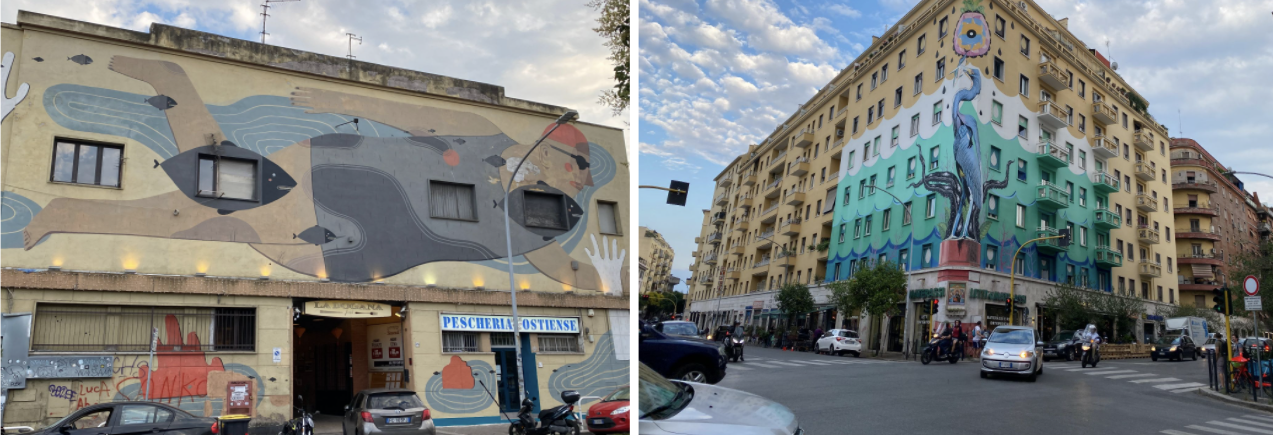
“I’m amazed, oh wall, that you haven’t fallen into ruins since you hold the boring scribbles of so many writers.”[1]
By Visala Alagappan.
2,000 years ago, these words were etched into the wall of a public building in the southwest quarter of Pompeii.[2] As the author of this message suggests, there are numerous remnants of graffiti and street art designs on this same wall and on others throughout the coastal town. Ranging from observational musings like the one above to political campaign slogans, from romantic poems to sketches of horses and boats, the extant markings on the preserved walls of Pompeii indicate that a street art and graffiti scene was alive and well in the ancient world.
While Italy’s robust cultural heritage and preservation laws have successfully protected the scribbles and sketches of the past, until very recently there has been meagre development in legislation to safeguard contemporary street art and defend street artists’ rights.[3] A few Italian regional governments have dedicated spaces and funds to street artists. Puglia, a region in southern Italy, was the first in the country to pass a law that directed substantial funds to supporting street artists.[4] Puglia’s government authorized a funding package of four million euros to help finance artistic projects to enrich peripheral areas of Puglia in disrepair.[5] The Regional Council of Lazio, the home of Italy’s capital, also recently passed legislation that will allocate 500,000 euros in 2021 and 2022 towards grants offered to street artists and instructs municipalities in the region to each create and publicly display a list of spaces that can be used legally for street art.[6] These efforts mark the beginning of a trend to make space for a mode of artistic expression that has traditionally been met with lawsuits and fines.
This legislation also reflects the growing popularity of Italian street artists in Italy since the 1980’s. Lucamaleonte, born and based in Rome, is an Italian artist whose dynamic murals of animals and vegetation began on neighborhood walls but have since made appearances in exhibitions around the world. Also, Jorit, a Naples-based street artist, has gained international acclaim for his distinctive and often politically charged portraits with hidden messages. Jorit’s work has been recognized as so impactful that two organizations, Inward (an observatory on urban creativity) and the National Office National Office against Racial Discrimination of the Department of Equal Opportunities for the Presidency of the Council of Ministers (UNAR) collaborated with the artist to combat social and racial injustice through a series of street art campaigns.[7] Blu is still another example of a globally admired Italian street artist, born in Bologna, whose murals decorate the via Porto Fluviale in Rome.
Yet, despite this flourishing Italian street art scene, a recent case involving an Italian graffitist, known as Geco, has highlighted several of the conflicting opinions that characterize the street art legality debate. Geco is (in)famous for tagging his name in block capital letters all across Rome and other European cities. Rome’s mayor, Virginia Raggi, openly and repeatedly censured Geco’s tagging of restricted monuments, specifically the water tower at the Termini train station and the Aurelian walls.[8] Perhaps his most well-known work was on the Via Magna Grecia in Rome: “Geco ti mette le ali” or “Geco gives you wings.” Geco’s repeated tags and impenetrable anonymity sparked a several months-long investigation, enthusiastically urged by Raggi, to discover and arrest the, what many called, most sought after writer in Europe.[9] After 18 months of nocturnal undercover operations, flight tracking, and signature and paint analyses, Raggi posted a triumphant image on Facebook of Geco’s graffiti materials; she applauded the Roman police and agents for identifying and reporting Geco, ending what she labeled “una storia non più tollerabile,” “a no longer tolerable story.” The very public and proud criminalization of Geco and his work, and the extremely critical response from many in the street art community in Rome underscore the ongoing debate surrounding the legality of street art. What is the line between street art and vandalism? Between vandalism and freedom of expression? Who judges what constitutes artistic contribution?
The Legality of Street Art
Several bodies of law determine the possible answers to these questions. First and foremost, the Italian Constitution, enacted in 1948, protects two fundamental rights that clash at the heart of street art: (1) freedom of expression,[10] and (2) the right to property.[11] Street art inevitably implicates both of these protected rights, and Italian courts have traditionally prioritized the latter.[12] Additionally, Article 639 of the Penal Code criminalizes damaging property belonging to another person without permission.[13] This law is typically what street artists are charged with violating if their work is unauthorized. In such cases, Italian courts tend to find street artists guilty, and thus recognize their work as “deturpamento e imbrattamento di cose altrui,” “defacing and soiling that belonging to another.”[14] However, an important case involving street artist Manu Invisible appeared to establish a different course.
The Manu Invisible case was crucial in street art law in Italy for several reasons, not least because it was the first case involving street art to arrive at the country’s Supreme Court.[15] Manu Invisible, famous for donning a self-made, shiny black geometric mask, began his career in Sardinia. It was not long before his work was known in the streets of Berlin, Bristol, Milan, and California.[16] In 2011, Manu Invisible was charged with violating Article 639 of the Penal Code for his street art at the Milano Lambrate train station. The court, departing from established trends in street art cases, considered the intention of the convicted street artist in his contested work. And, having established that Manu Invisible’s objective was to enhance an already sullied wall in a tunnel of a train station, the trial court acquitted the artist.[17] The judge, Marialillia Speretta, also used Manu Invisible’s established reputation as evidence to corroborate the court’s opinion.[18] This case has been noted as potentially groundbreaking in the street art law field.[19] For, in its verdict, the court considered the artist’s purpose and status as an artistic contributor – two non-conventional factors in Italian street art case law.[20]
While the Manu Invisible case symbolized a breakthrough in the street art world, many lamented that the aesthetic value of street art is still judged by the court and not the community. The determination of what street art legally qualifies as art remains in a few subjective hands. Nonetheless, Manu Invisible and his lawyer celebrated the verdict with a mural on a wall that read, “Art 639 = reato di espressione,” “Art 639 = a crime of expression.”
Street Artists’ Rights
While the Manu Invisible case was a watershed in the history of Italian street art law, this case did not broach many other pressing legal issues for street artists. Indeed, legally and non-legally working street artists alike often find themselves embroiled in copyright and intellectual property disputes. In addition, the fact that street artists are often anonymous actors further complicates such legal battles.
The first of several instances where the world’s most famous street artist, Bansky, was involved in a suit against a company profiting from his work was in Italy.[21] Pest Control Office Ltd. (Pest), the ostensible owner of the artist’s trademark, sought injunctive relief against 24 Ore Cultura Srl (24 Ore), the organizer of an exhibit on Bansky entitled “The Art of Bansky. A Visual Protest” at the Mudec Museum in Milan. Pest alleged copyright infringement and acts of unfair competition, and the unauthorized reproduction and merchandising of trademarked names and images (in particular, the name Bansky, and the two images Girl with the Red Balloon and Flower Thrower). In January 2019, the Milan court rendered a judgment that was mostly against Bansky, and that is a clear example of the intricate issues involved in street art law.
The court, finding that 24 Ore violated Art. 20 of Legislative Decree No. 30/2005 (the Italian Intellectual Property Code), ordered 24 Ore to cease distributing unauthorized merchandise with Bansky’s name and images.[22] The court held that even though Bansky’s images are publicly available, the museum could not merchandize them for profit since they are protected by trademark.[23] However, the court rejected all of Pest’s other arguments. First, 24 Ore’s use of Bansky’s name and images on the exhibit’s promotional materials was deemed lawful. For, the Mudec Museum used Bansky’s name and images only for descriptive purposes to characterize the event to the public. Second, the court also rejected Pest’s claim that the printing, publication and sale of Bansky’s works on the exhibit’s catalogues amounted to unfair competition. Interestingly, the court stated that 24 Ore’s conduct was, in fact, unfair: 24 Ore had not demonstrated any authorization from Bansky to the commercial exploitation of the artist’s works.[24] Absent any such authorization, under Italian copyright law, 24 Ore’s conduct constituted copyright infringement and unfair competition.[25] Nevertheless, the court found that Pest lacked standing to bring the claim of copyright infringement and unfair competition. While Pest successfully demonstrated they were the official organizer of Bansky’s exhibits, they failed to prove they also had the right to reproduce the artist’s works and/or proscribe such reproduction by third parties.[26] It’s fair to assume that if Bansky himself had brought this case, the injunction for this unfair competition claim would have been granted. Bansky’s failure to do so, and the resulting ambiguity in his relationship to Pest, penalized him – a cautionary tale for other anonymous street artists.
Most recently, a Roman street artist, Alessia Babrow brought a factually similar case against an unsuspecting defendant: the Vatican. She sued the Vatican for 130,000 euros when she discovered that her reproduction of Henrich Hofmann’s Ascension on a wall near the Vittorio Emanuele II bridge in Rome was used and sold on a collection of Easter stamps at the Vatican Museums without her permission.[27] Her image was noticed by the director of the Vatican’s Philatelic Office, and subsequently printed on 80,000 stamps without Babrow’s authorization.[28] When Babrow and her attorney attempted to contact the Vatican, they received no response.[29] The court has not heard the case yet, but assuming it recognizes Babrow’s image as art (like in the Manu Invisible case) and adheres to the principle that street art is worthy of protection under copyright law (like in the Bansky case), it will likely hold for Babrow. After all, Babrow’s work is applauded by the street art community as art and the Vatican certainly profited off of its unauthorized use. Regardless of the outcome of the case, many Italian lawyers, professors, and artists have deplored how brazenly Babrow’s art was lifted from a wall and sold in a gift shop for profit without her knowledge. For them, such commodification was a harsh reminder that street art as a form of creative expression is far from receiving full recognition under the law.
- The Ancient Graffiti Project, <http://ancientgraffiti.org/Graffiti/graffito/AGP-EDR158840> [accessed: 08 Jul 2021]. ↑
- The inscription is found on Basilica (VIII.1.1). AGP-EDR158840, The Ancient Graffiti Project, <http://ancientgraffiti.org/Graffiti/graffito/AGP-EDR158840> [accessed: 08 Jul 2021]. ↑
- Codice dei Beni Culturali e del Paesaggio. D.Lgs. 22 gennaio 2004, n. 42; Street art is deemed to fall under the protection of this code only if the art is declared a national treasure. This status is rare for street artists. ↑
- Staff Street Art Yep, La Street Art in Puglia e Legge; 4 milioni di euro di finanziamenti, Street Art Yep (22 Jun., 2020). ↑
- Id. ↑
- Marta Leonori, Street art, una nuova legge nel Lazio: fondi per il 2021 e 2022 e un elenco di “muri liberi” in ogni Comune, Roma Today (2020). ↑
- Helga Marsala, Inward, la street art contro il razzismo. Altro che ruspe: a Napoli Jorit Agoch dipinge su un muro il volto di una bambina Rom, Artribune (2015). ↑
- Arianna Di Cori, La denuncia di Geco riaccende il dibattito, arte o monnezza?, La Repubblica (2020). ↑
- Francesco de Paolis, Il caso GECO: innovativa espressione d’arte o reato contro il patrimonio?, the Wise Magazine (2021). ↑
- COSTITUZIONE [Constitution] Dec. 27, 1947, Part I, art. 21 (It.). ↑
- COSTITUZIONE [Constitution] Dec. 27, 1947, Part III, art. 42 (It.). ↑
- Sara Rosano and Birgit Kurtz, Tear Down this Wall?: The Destruction of Sanctioned Street Art Under U.S. and Italian Law, Fordham Intellectual Property, Media and Entertainment Law Journal (2020). ↑
- Art. 639 Codice Penale: “Deturpamento e imbrattamento di cose altrui.” ↑
- Id. ↑
- Salvo Cagnazzo, Street art in Cassazione: il caso di Manu Invisible, La Stampa (2016). ↑
- http://www.manuinvisible.com/en/biography/. ↑
- Salvo Cagnazzo, Street art in Cassazione: il caso di Manu Invisible, La Stampa (2016). ↑
- Id. ↑
- Sara Rosano and Birgit Kurtz, Tear Down this Wall?: The Destruction of Sanctioned Street Art Under U.S. and Italian Law, Fordham Intellectual Property, Media and Entertainment Law Journal (2020). ↑
- In a previous case, involving street artist AliCe, the court ignored these two considerations. La Repubblica, AliCe condannata a Bologna e celebrata in Molise, La Repubblica (Mar. 1, 2016). ↑
- Pest Control Office Limited c. 24 Ore Cultura s.r.l., Tribunale di Milano (2019). https://iusletter.com/wp-content/uploads/Ordinanza-15.01.2019_Banksy.pdf. ↑
- Id. ↑
- It is important to note that, today, it will be harder for Italian courts to adopt a similar approach. For, after Bansky’s suit in Milan, the European Union Intellectual Property Office (EUIPO) denied Bansky’s further attempt to trademark one of his works, citing the work’s intentional accessibility, the artist’s anonymity and bad faith claim as critical justifications. See, Eileen Kinsella, The E.U. Rules Against Bansky in His Trademark Fight With a Fight With a Greeting Card Company, Citing His Own Statement That ‘Copyright Is For Losers,’ Artnet (May 20, 2021). ↑
- Id. ↑
- Id. ↑
- Id. ↑
- Ilaria Faedda, Alessia Babrow contro il Vaticano: la querelle dei francobolli, Exibart (June 1, 2021). ↑
- Id. ↑
- Id. ↑
About the Author:
Visala Alagappan is a legal intern at the Center for Art Law. She is a second-year student at Harvard Law School. Before law school, she graduated with a B.A. in Classics from Princeton University and worked as a teaching assistant and guide for Latin students on school visits to Italy.
Disclaimer: This article is for educational purposes only and is not meant to provide legal advice. Readers should not construe or rely on any comment or statement in this article as legal advice. For legal advice, readers should seek a consultation with an attorney.


