• About
    • Mission
    • Team
    • Boards
    • Mentions & Testimonials
    • Institutional Recognition
    • Annual Reports
    • Current & Past Sponsors
    • Contact Us
  • Resources
    • Article Collection
    • Podcast: Art in Brief
    • AML and the Art Market
    • AI and Art Authentication
    • Newsletter
      • Subscribe
      • Archives
      • In Brief
    • Art Law Library
    • Movies
    • Nazi-looted Art Restitution Database
    • Global Network
      • Courses and Programs
      • Artists’ Assistance
      • Bar Associations
      • Legal Sources
      • Law Firms
      • Student Societies
      • Research Institutions
    • Additional resources
      • The “Interview” Project
  • Events
    • Worldwide Calendar
    • Our Events
      • All Events
      • Annual Conferences
        • 2025 Art Law Conference
        • 2024 Art Law Conference
        • 2023 Art Law Conference
        • 2022 Art Law Conference
        • 2015 Art Law Conference
  • Programs
    • Visual Artists’ Legal Clinics
      • Art & Copyright Law Clinic
      • Artist-Dealer Relationships Clinic
      • Artist Legacy and Estate Planning Clinic
      • Visual Artists’ Immigration Clinic
    • Summer School
      • 2026
      • 2025
    • Internship and Fellowship
    • Judith Bresler Fellowship
  • Case Law Database
  • Log in
  • Become a Member
  • Donate
  • Log in
  • Become a Member
  • Donate
Center for Art Law
  • About
    About
    • Mission
    • Team
    • Boards
    • Mentions & Testimonials
    • Institutional Recognition
    • Annual Reports
    • Current & Past Sponsors
    • Contact Us
  • Resources
    Resources
    • Article Collection
    • Podcast: Art in Brief
    • AML and the Art Market
    • AI and Art Authentication
    • Newsletter
      Newsletter
      • Subscribe
      • Archives
      • In Brief
    • Art Law Library
    • Movies
    • Nazi-looted Art Restitution Database
    • Global Network
      Global Network
      • Courses and Programs
      • Artists’ Assistance
      • Bar Associations
      • Legal Sources
      • Law Firms
      • Student Societies
      • Research Institutions
    • Additional resources
      Additional resources
      • The “Interview” Project
  • Events
    Events
    • Worldwide Calendar
    • Our Events
      Our Events
      • All Events
      • Annual Conferences
        Annual Conferences
        • 2025 Art Law Conference
        • 2024 Art Law Conference
        • 2023 Art Law Conference
        • 2022 Art Law Conference
        • 2015 Art Law Conference
  • Programs
    Programs
    • Visual Artists’ Legal Clinics
      Visual Artists’ Legal Clinics
      • Art & Copyright Law Clinic
      • Artist-Dealer Relationships Clinic
      • Artist Legacy and Estate Planning Clinic
      • Visual Artists’ Immigration Clinic
    • Summer School
      Summer School
      • 2026
      • 2025
    • Internship and Fellowship
    • Judith Bresler Fellowship
  • Case Law Database
Home image/svg+xml 2021 Timothée Giet Art law image/svg+xml 2021 Timothée Giet More than Just “Street Cred”: Why Intellectual Property Rights Matter to Street Artists
Back

More than Just “Street Cred”: Why Intellectual Property Rights Matter to Street Artists

May 26, 2015
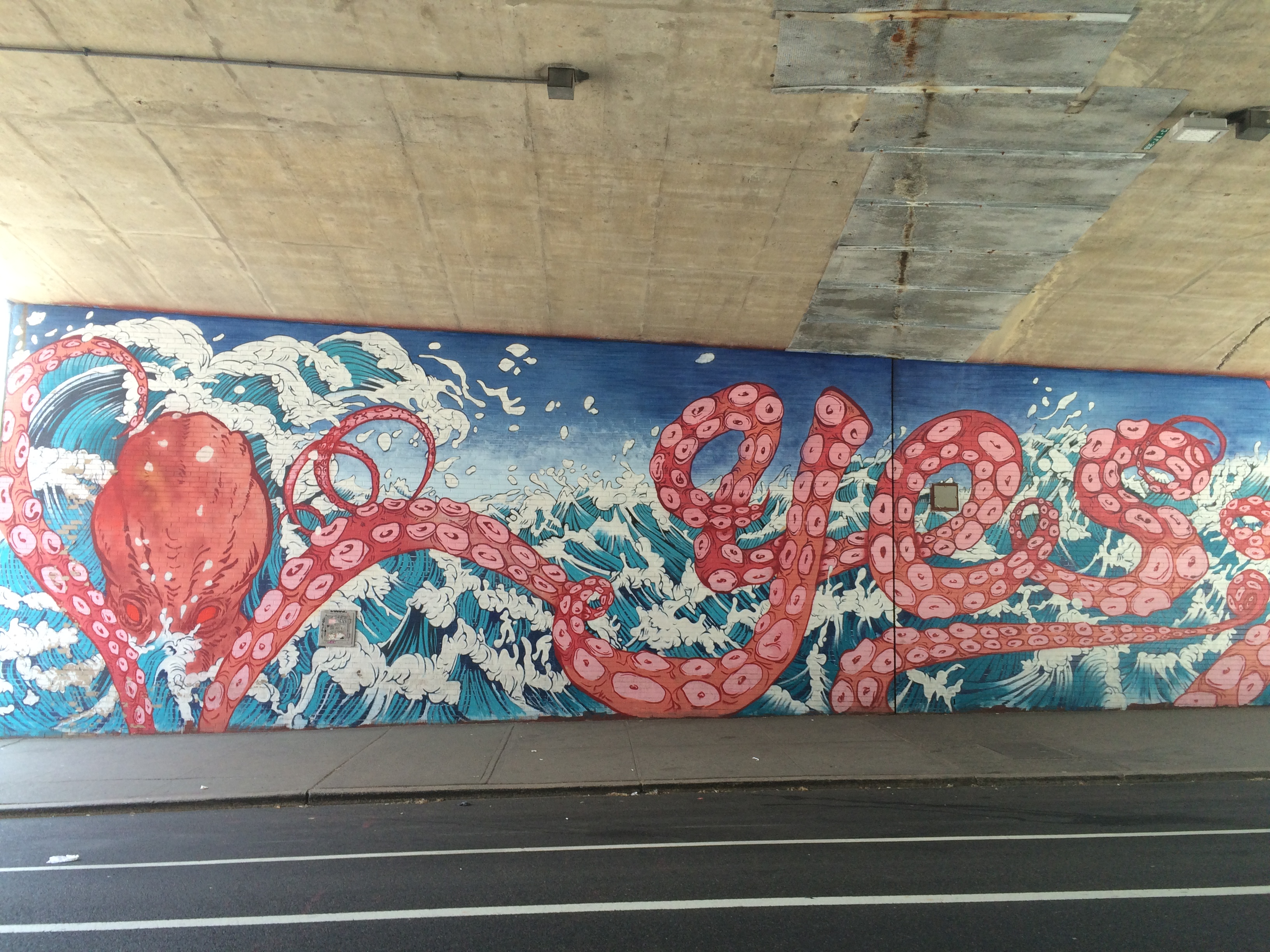
Street art near Center for Art Law's Headquarters in DUMBO. The DUMBO Improvement District commissioned this work with studio Sagmeister & Walsh, in partnership with Two Trees Management Co and the NYCDOT Urban Art Program, who collaborated with renowned Japanese illustrator Yuko Shimizu, and hand painted by Coby Kennedy.

By Christine E. Weller

Perhaps to the dismay of artists executing works in public spaces or on private property, street art and graffiti art has financial value and can be sold at auction without the artist’s consent. This commercialization does not sit well with some artists who engage in street art (illegally at times) as part of a political act, social commentary, or even just  for exposure.  Increasingly, graffiti and street artists who fight the involuntary commercialization of their work are achieving some success.

IMG_0339
Street art near Center for Art Law’s Headquarters in DUMBO. The DUMBO Improvement District commissioned this work with studio Sagmeister & Walsh, in partnership with Two Trees Management Co and the NYCDOT Urban Art Program, who collaborated with renowned Japanese illustrator Yuko Shimizu, and hand painted by Coby Kennedy.

While the terminology is unclear and used interchangeably, graffiti and street art are distinct.  The two disciplines can inform each other and are interrelated, but they differ in terms of style, method, and theme. Graffiti generally refers to stylized writing such as graffiti tags and visual work placed on buildings without permission.  Street art can take the form of murals or installations incorporated into property, more often with permission (tacit or explicit) of the property owner. Labels aside, street art lawsuits are garnering attention, and have enough merit to have caused several major commercial brands, including American Eagle Outfitters and Sony Music to settle infringement claims.

Since July 2014, there has been a rise in intellectual property (IP) lawsuits filed by street artists. However, a tension in the legal framework exists.  Many still view street art as an illegal act without artistic merit, to which no rights should attach. Notwithstanding the Visual Artists Rights Act (VARA), U.S. Copyright legislation that protects “moral” rights of artists in their work, there is legal precedent that street art may be destroyed by the property owner or painted over. Cohen v. G&M Realty LP, 988 F. Supp. 2d 212, 214, 109 U.S.P.Q.2d 1869 (E.D.N.Y. 2013)(Five Pointz). Nevertheless, the right to reproduce the street art may be protected by copyright or trademark law as evidenced by the successes in recent copyright cases brought by street artists.  The tension between the street artists’ intellectual property rights and the arrests and vandalism charges they may face is illustrated by the arrest of graffiti artist Cost (Adam Cole) and the recent false arrest lawsuit filed by Richard Pfeiffer, who police allegedly thought was Banksy. Richard Pfeiffer vs. The City of New York et al, No. 152797/2015 (N.Y. Sup Ct. Mar. 21, 2015).

However, with this new wave of successful suits and several forthcoming street art exhibitions, such as Coney Art Walls presented by Jeffrey Deitch in New York and Open Source: Engaging Audiences in Public Spaces presented by the Philadelphia Mural Arts Program, there is an increased need for both artists and brand owners to appreciate that intellectual property rights can attach to artworks installed or executed in public spaces.

A Legal Primer

IMG_0349
“Trust Your Vision” By gilf! Street art near our headquarters in DUMBO. Plaque next to art states: “As the world becomes more and more competitive it’s easy to lose sight of one’s goals and aspirations. This maze-inspired piece references the difficulty of navigating life, especially in a city like New York.”

Under U.S. Copyright law, legal protection attaches when an original work is “fixed in a tangible medium of expression.” 17 U.S. Code § 102. Originality is a fairly low bar. The holder of the copyright has several exclusive rights in the work for the duration of the copyright (the general rule today is the life of the author plus 70 years for most works), including: reproducing the work, preparing derivative works, distributing copies of the work and displaying the work publicly. Id. § 106.  Authors need not own the physical copy of the original, nor register their works in order for rights to attach.  However, registering the works with the U.S. Copyright Office is a prerequisite to bringing a lawsuit and allows for statutory damages. Id. § 411. In cases where actual damages are hard to prove, registration is a cheap and added benefit to the copyright owner.

Under U.S. Trademark law, protection attaches to words or symbols used to distinguish a good or service in commerce. 15 U.S. Code § 1051 et. seq. Trademark law is used to protect consumers against confusion. A trademark has the potential to last indefinitely provided that it is being used in commerce.  While the use in commerce requirement for trademarks may make it more challenging for an artist to obtain a trademark registration than a copyright registration, a trademark registration with the Patent and Trademark Office may be another source of artists’ rights in their work. Trademark protection may be especially relevant where an artist uses a graffiti or street art tag in commerce.

The Cases

Anasagasti v. American Eagle Outfitters, Inc., No. 1:14-cv-05618 (S.D.N.Y. Jul 23, 2014)

The recent wave of street art infringement cases began in 2014 with the copyright case filed by Cuban-American street artist Ahol Sniffs Glue (David Anasagasti).  In July, Anasagasti filed a copyright infringement action against American Eagle Outfitters for their use of his mural Ocean Grown (Fl) in an advertising campaign. The original mural, located in Miami’s Wynwood neighborhood, known for its abundance of street art, was commissioned by Ocean Grown Glass Gallery. Wynwood has a vibrant collection of murals, and according to the Miami Times, photographers often seek licenses from the artists before shooting the work. In his complaint, the artist alleges that no permission was sought, and the photography included models posing as if they were painting the murals. American Eagle and Anasagasti privately settled in December.

Hayuk v. Sony Music Entertainment et al, No. 1:14-cv-06659 (S.D.N.Y. Aug 19, 2014)

Well known and successful artist Maya Hayuk also brought and settled a copyright infringement case against musician Sara Bareilles and Sony Music for the unauthorized use of her mural, Chem Trails NYC, in promotional materials for Bareilles’ new album and tour. Previously, Hayuk has sued Urban Outfitters, Target, Coach, and Elle Warner, for the unauthorized use of her artwork.

Miller v. Toll Brothers, Inc., No. 1:15-cv-00322 (E.D.N.Y. Jan 21, 2015)

Luxury  real estate developers Toll Brothers settled with CAM (Craig Anthony Miller) for copyright infringement of his famous Elephant Mural (NYC). The mural was featured prominently in advertisements for luxury condos in Brooklyn that Toll Brothers were developing in the neighborhood where the artwork was originally located. CAM had painted the mural with permission of the property owner in 2009, but it was later painted over in 2013.

Franco Fasoli et al v. Voltage Pictures LLC et al., No. 2:15-cv-00889 (C.D. Cal. Feb 06, 2015)

In February, director Terry Gilliam also found himself at the center of a lawsuit over his film, The Zero Theorem (2013), when he  allegedly infringed a mural by Argentinian street artists Jaz (Franco Fasoli) and Ever (Nicolas Santiago Romero Escalada), along with Canadian artist, Other (Derek Shamus Mehaffey).  In Fasoli, the defendant filed a motion to dismiss.  The Court vacated the hearing date of May 4, 2015 and the parties await a finding on the papers.

Jason Williams et al v. Roberto Cavalli, S.p.A. et al, No. 2:14-cv-06659 (C.D. Cal. Aug 25, 2014)

Finally, in a case involving both copyright and trademark infringement claims, Revok, Reyes, and Steel (Jason Williams, Victor Chapa, and Jeffrey Rubin respectively) filed suit against fashion designer Cavalli for the use of the Plaintiffs’ mural in Cavalli clothing designs. In Williams, the Plaintiffs alleged that pieces of their work were reproduced on Cavalli clothing with their signatures obliterated, and the Cavalli trademark superimposed instead. Plaintiffs argued that this creates a false impression to the consumer as to the origin of the product. In February the court denied a motion to dismiss filed by another named defendant in the suit, Staff USA. Williams v. Cavalli, 113 U.S.P.Q.2d 1944 (C.D. Cal. 2015). This suit is currently pending in the District Court of the Central District of California (Western Division).  It will be interesting to see how the court will treat the trademark argument if the case does not settle.  Many of the artists that have brought suit engage in their own commercial transactions and have carefully policed their brands to control how their work is used and sold to ensure that they are being compensated. The disposition of Williams could establish a new legal tool for street artists.

Going Forward

Defendants in many of these cases, recognized brand owners such as Sony, Cavalli and American Eagle usually find themselves on the other side of IP infringement lawsuits. However, these graffiti and street art cases illustrate that savvy business people and corporations exploring new marketing strategies do not always appreciate that art appearing in “public” spaces is not necessarily in the “public domain.” Copying and distributing street art without permission may constitute infringement and may expose the copier or distributor to significant legal risks.

IMG_0344
“The Owls, Revealing Flight” by Craig Anthony Miller (CAM). Street art near our headquarters in DUMBO.

With the preceding examples in mind, street artists should consider their IP rights when installing work in public spaces, and the public and brand owners should be aware that artwork appearing in public spaces may be protected. Before using street art or graffiti art in marketing or product campaigns, brand owners should consider investigating who holds the rights to those works and seek appropriate permissions.  Going forward, street artists who install work in a public space may consider registering that work with the Copyright Office.  Where an artist uses a specific tag or name for commercial purposes, the artist could consider filing for a trademark.  While the notion of “use in commerce” in the context of street art is still untested, bringing a trademark claim in addition to a copyright infringement claim as in Williams might be an additional remedy for a recognized artist.

Select Sources:

  • Danielle Rahm, Banksy: The $20 Million Graffiti Artist Who Doesn’t Want His Art to Be Worth Anything, Forbes, October 22, 2013 available at http://www.forbes.com/sites/daniellerahm/2013/10/22/banksy-the-20-million-graffiti-artist-who-doesnt-want-his-art-to-be-worth-anything/
  • Cohen v. G&M Realty LP, 988 F. Supp. 2d 212, 214, 109 U.S.P.Q.2d 1869 (E.D.N.Y. 2013)(Five Pointz)
  • Rebecca Rosenberg, Famed Graffiti Artist ‘Cost’ charged with Vandalism, N.Y. Post, April 15, 2015, available at http://nypost.com/2015/04/02/famed-graffiti-artist-cost-charged-with-vandalism/
  • Richard Pfeiffer vs. The City of New York et al, No. 152797/2015 (N.Y. Sup Ct. Mar. 21, 2015)
  • Sarah Cascone, Artist Sues NYPD for falsely arresting him as Banksy, Artnet News, March 24, 2015, available at https://news.artnet.com/art-world/man-sues-nypd-for-false-banksy-arrest-280730
  • Randy Kennedy,Jeffrey Deitch Will Bring Street Art Show to Coney Island, N.Y. Times, April 29, 2015  available at http://artsbeat.blogs.nytimes.com/2015/04/29/jeffrey-deitch-will-bring-street-art-show-to-coney-island/?_r=0
  • Philadelphia Mural Arts to present Open Source: Engaging Audiences in Public Spaces, available at http://www.muralarts.org/opensource
  • Beckett Muffson, Urban Geodes Crystallize a Global Street Art Movement, The Creators Project Blog, April 30, 2015 available at http://thecreatorsproject.vice.com/blog/urban-geodes-crystallize-a-global-street-art-movement
  • 17 U.S.C. § 102.
  • 17 U.S.C. § 106.
  • 17 U.S.C. § 107.
  • 17 U.S.C. § 411.
  • 15 U.S.C. § 1051 et. seq.
  • Anasagasti v. American Eagle Outfitters, Inc., No. 1:14-cv-05618 (S.D.N.Y. Jul 23, 2014).
  • Carlos Suarez de Jesus, Miami Artist Aholsniffsglue sues American Eagle Outfitters, Miami Times, July 18, 2014 available at http://www.miaminewtimes.com/arts/miami-artist-aholsniffsglue-sues-american-eagle-outfitters-for-intellectual-property-infringement-6510571
  • Miller v. Toll Brothers, Inc., No. 1:15-cv-00322 (E.D.N.Y. Jan 21, 2015).
  • Franco Fasoli et al v. Voltage Pictures LLC et al., No. 2:15-cv-00889 (C.D. Cal. Feb 06, 2015).
  • Hayuk v. Sony Music Entertainment et al, No. 1:14-cv-06659 (S.D.N.Y. Aug 19, 2014).
  • Williams v. Cavalli, 113 U.S.P.Q.2d 1944 (C.D. Cal. 2015).
  • Jason Williams et al v. Roberto Cavalli, S.p.A. et al, No. 2:14-cv-06659 (C.D. Cal. Aug 25, 2014).

*About the Author: Christine E. Weller is an Associate at Griesing Law, LLC where she focuses her practice on new media, intellectual property, nonprofit, and employment law matters. She can be reached at (215) 732-3923 or cweller@griesinglaw.com.

Disclaimer: This article is for educational purposes only and is not meant to provide legal advice. Readers should not construe or rely on any comment or statement in this article as legal advice. For legal advice, readers should seek a consultation with an attorney.

Post navigation

Previous Art Investment Funds: The Basics
Next Art Dealer Professionals Beware of Purchasing Stolen Goods

Related Art Law Articles

Screen shot from Google scholar of different Warhol cases
Art lawCase ReviewArt Law

Degrees of Transformation: Andy Warhol’s 102 minutes of fame before the Supreme Court

November 17, 2022
Art lawArt Law

“Outsider Artists” and Inheritance Law: What Happens to an Artist’s Work When They Die Without a Will?

November 11, 2022
Art lawCase ReviewArt LawCase Review

Case Review: US v. Philbrick (2022)

November 7, 2022
Center for Art Law
Center for Art Law

Follow us on Instagram for the latest in Art Law!

Grab an Early Bird Discount for our new CLE progra Grab an Early Bird Discount for our new CLE program to train lawyers to assist visual artists and dealers in the unique aspects of their relationship.

Center for Art Law’s Art Lawyering Bootcamp: Artist-Dealer Relationships is an in-person, full-day training aimed at preparing lawyers for working with visual artists and dealers, in the unique aspects of their relationship. The bootcamp will be led by veteran attorneys specializing in art law.

This Bootcamp provides participants -- attorneys, law students, law graduates and legal professionals -- with foundational legal knowledge related to the main contracts and regulations governing dealers' and artists' businesses. Through a combination of instructional presentations and mock consultations, participants will gain a solid foundation in the specificities of the law as applied to the visual arts.

Bootcamp participants will be provided with training materials, including presentation slides and an Art Lawyering Bootcamp handbook with additional reading resources.

The event will take place at DLA Piper, 1251 6th Avenue, New York, NY. 9am -5pm.

Art Lawyering Bootcamp participants with CLE tickets will receive New York CLE credits upon successful completion of the training modules. CLE credits pending board approval. 

🎟️ Grab tickets using the link in our bio! 

#centerforartlaw #artlaw #legal #research #lawyer #artlawyer #bootcamp #artistdealer #CLE #trainingprogram
A recent report by the World Jewish Restitution Or A recent report by the World Jewish Restitution Organization (WRJO) states that most American museums provide inadequate provenance information for potentially Nazi-looted objects held in their collections. This is an ongoing problem, as emphasized by the closure of the Nazi-Era Provenance Internet Portal last year. Established in 2003, the portal was intended to act as a public registry of potentially looted art held in museum collections across the United States. However, over its 21-year lifespan, the portal's practitioners struggled to secure ongoing funding and it ultimately became outdated. 

The WJRO report highlights this failure, noting that museums themselves have done little to make provenance information easily accessible. This lack of transparency is a serious blow to the efforts of Holocaust survivors and their descendants to secure the repatriation of seized artworks. WJRO President Gideon Taylor urged American museums to make more tangible efforts to cooperate with Holocaust survivors and their families in their pursuit of justice.

🔗 Click the link in our bio to read more.

#centerforartlaw #artlaw #museumissues #nazilootedart #wwii #artlawyer #legalresearch
Join us for the Second Edition of Center for Art L Join us for the Second Edition of Center for Art Law Summer School! An immersive five-day educational program designed for individuals interested in the dynamic and ever-evolving field of art law. 

Taking place in the vibrant art hub of New York City, the program will provide participants with a foundational understanding of art law, opportunities to explore key issues in the field, and access to a network of professionals and peers with shared interests. Participants will also have the opportunity to see how things work from a hands-on and practical perspective by visiting galleries, artist studios, auction houses and law firms, and speak with professionals dedicated to and passionate about the field. 

Applications are open now through March 1st!

🎟️ APPLY NOW using the link in our bio! 

#centerforartlaw #artlawsummerschool #newyork #artlaw #artlawyer #legal #lawyer #art
Join us for an informative presentation and pro bo Join us for an informative presentation and pro bono consultations to better understand the current art and copyright law landscape. Copyright law is a body of federal law that grants authors exclusive rights over their original works — from paintings and photographs to sculptures, as well as other fixed and tangible creative forms. Once protection attaches, copyright owners have exclusive economic rights that allow them to control how their work is reproduced, modified and distributed, among other uses.

Albeit theoretically simple, in practice copyright law is complex and nuanced: what works acquire such protection? How can creatives better protect their assets or, if they wish, exploit them for their monetary benefit? 

🎟️ Grab tickets using the link in our bio! 

#centerforartlaw #artlaw #legal #research #lawyer #artlawyer #bootcamp #copyright #CLE #trainingprogram
In October, the Hispanic Society Museum and Librar In October, the Hispanic Society Museum and Library deaccessioned forty five paintings from its collection through an auction at Christie's. The sale included primarily Old-Master paintings of religious and aristocratic subjects. Notable works in the sale included a painting from the workshop of El Greco, a copy of a work by Titian, as well as a portrait of Isabella of Portugal, and Clemente Del Camino y Parladé’s “El Columpio (The Swing). 

The purpose of the sale was to raise funds to further diversify the museum's collection. In a statement, the institution stated that the works selected for sale are not in line with their core mission as they seek to expand and diversify their collection.

🔗 Click the link in our bio to read more.

#centerforartlaw #artlawnews #artlawresearch #legalresearch #artlawyer #art #lawyer
Check out our new episode where Paris and Andrea s Check out our new episode where Paris and Andrea speak with Ali Nour, who recounts his journey from Khartoum to Cairo amid the ongoing civil war, and describes how he became involved with the Emergency Response Committee - a group of Sudanese heritage officials working to safeguard Sudan’s cultural heritage. 

🎙️ Click the link in our bio to listen anywhere you get your podcasts! 

#centerforartlaw #artlaw #artlawyer #legal #research #podcast #february #legalresearch #newepisode #culturalheritage #sudaneseheritage
When you see ‘February’ what comes to mind? Birthd When you see ‘February’ what comes to mind? Birthdays of friends? Olympic games? Anniversary of war? Democracy dying in darkness? Days getting longer? We could have chosen a better image for the February cover but somehow the 1913 work of Umberto Boccioni (an artist who died during World War 1) “Dynamism of a Soccer Player” seemed to hit the right note. Let’s keep going, individuals and team players.

Center for Art Law is pressing on with events and research. We have over 200 applications to review for the Summer Internship Program, meetings, obligations. Reach out if you have questions or suggestions. We cannot wait to introduce to you our Spring Interns and we encourage you to share and keep channels of communication open. 

📚 Read more using the link in our bio! Make sure to subscribe so you don't miss any upcoming newsletters!

#centerforartlaw #artlaw #artlawyer #legal #research #newsletter #february #legalresearch
Join the Center for Art Law for conversation with Join the Center for Art Law for conversation with Frank Born and Caryn Keppler on legacy and estate planning!

When planning for the preservation of their professional legacies and the future custodianship of their oeuvres’, artists are faced with unique concerns and challenges. Frank Born, artist and art dealer, and Caryn Keppler, tax and estate attorney, will share their perspectives on legacy and estate planning. Discussion will focus on which documents to gather, and which professionals to get in touch with throughout the process of legacy planning.

This event is affiliated with the Artist Legacy and Estate Planning Clinic which seeks to connect artists, estate administrators, attorneys, tax advisors, and other experts to create meaningful and lasting solutions for expanding the art canon and art legacy planning. 

🎟️ Grab tickets using the link in our bio! 

#centerforartlaw #artlaw #clinic #artlawyer #estateplanning #artistlegacy #legal #research #lawclinic
Authentication is an inherently uncertain practice Authentication is an inherently uncertain practice, one that the art market must depend upon. Although, auction houses don't have to guarantee  authenticity, they have legal duties related to contract law, tort law, and industry customs. The impact of the Old Master cases, sparked change in the industry including Sotheby's acquisition of Orion Analytical. 

📚 To read more about the liabilities of auction houses and the change in forensic tools, read Vivianne Diaz's published article using the link in our bio!
Join us for an informative guest lecture and pro b Join us for an informative guest lecture and pro bono consultations on legacy and estate planning for visual artists.

Calling all visual artists: join the Center for Art Law's Artist Legacy and Estate Planning Clinic for an evening of low-cost consultations with attorneys, tax experts, and other arts professionals with experience in estate and legacy planning.

After a short lecture on a legacy and estate planning topic, attendees with consultation tickets artist will be paired with one of the Center's volunteer professionals (attorneys, appraisers and financial advisors) for a confidential 20-minute consultation. Limited slots are available for the consultation sessions.

Please be sure to read the entire event description using the LinkedIn event below.

🎟️ Grab tickets using the link in our bio!
On May 24, 2024 the UK enacted the Digital Markets On May 24, 2024 the UK enacted the Digital Markets, Competition and Consumers Act 2024 (DMCC). This law increases transparency requirements and consumer rights, including reforming subscription contracts. It grants consumers cancellation periods during cooling-off times. 

Charitable organizations, including museums and other cultural institutions, have concerns regarding consumer abuse of this option. 

🔗 Read more about this new law and it's implications in Lauren Stein's published article, including a discussion on how other jurisdictions have approached the issue, using the link in our bio!
Don't miss our on our upcoming Bootcamp on Februar Don't miss our on our upcoming Bootcamp on February 4th! Check out the full event description below:

Join the Center for Art Law for an in-person, full-day training aimed at preparing lawyers for working with art market participants and understanding their unique copyright law needs. The bootcamp will be led by veteran art law attorneys, Louise Carron, Barry Werbin, Carol J. Steinberg, Esq., Scott Sholder, Marc Misthal, specialists in copyright law.

This Bootcamp provides participants -- attorneys, law students, law graduates and legal professionals -- with foundational legal knowledge related to copyright law for art market clients. Through a combination of instructional presentations and mock consultations, participants will gain a solid foundation in copyright law and its specificities as applied to works of visual arts, such as the fair use doctrine and the use of generative artificial intelligence tools.

🎟️ Grab tickets using the link in our bio!
  • About the Center
  • Contact Us
  • Newsletter
  • Upcoming Events
  • Internship
  • Case Law Database
  • Log in
  • Become a Member
  • Donate
DISCLAIMER

Center for Art Law is a New York State non-profit fully qualified under provision 501(c)(3)
of the Internal Revenue Code.

The Center does not provide legal representation. Information available on this website is
purely for educational purposes only and should not be construed as legal advice.

TERMS OF USE AND PRIVACY POLICY

Your use of the Site (as defined below) constitutes your consent to this Agreement. Please
read our Terms of Use and Privacy Policy carefully.

© 2026 Center for Art Law
 

Loading Comments...
 

You must be logged in to post a comment.