• About
    • Mission
    • Team
    • Boards
    • Mentions & Testimonials
    • Institutional Recognition
    • Annual Reports
    • Current & Past Sponsors
    • Contact Us
  • Resources
    • Article Collection
    • Podcast: Art in Brief
    • AML and the Art Market
    • AI and Art Authentication
    • Newsletter
      • Subscribe
      • Archives
      • In Brief
    • Art Law Library
    • Movies
    • Nazi-looted Art Restitution Database
    • Global Network
      • Courses and Programs
      • Artists’ Assistance
      • Bar Associations
      • Legal Sources
      • Law Firms
      • Student Societies
      • Research Institutions
    • Additional resources
      • The “Interview” Project
  • Events
    • Worldwide Calendar
    • Our Events
      • All Events
      • Annual Conferences
        • 2025 Art Law Conference
        • 2024 Art Law Conference
        • 2023 Art Law Conference
        • 2022 Art Law Conference
        • 2015 Art Law Conference
  • Programs
    • Visual Artists’ Legal Clinics
      • Art & Copyright Law Clinic
      • Artist-Dealer Relationships Clinic
      • Artist Legacy and Estate Planning Clinic
      • Visual Artists’ Immigration Clinic
    • Summer School
      • 2026
      • 2025
    • Internship and Fellowship
    • Judith Bresler Fellowship
  • Case Law Database
  • Log in
  • Become a Member
  • Donate
  • Log in
  • Become a Member
  • Donate
Center for Art Law
  • About
    About
    • Mission
    • Team
    • Boards
    • Mentions & Testimonials
    • Institutional Recognition
    • Annual Reports
    • Current & Past Sponsors
    • Contact Us
  • Resources
    Resources
    • Article Collection
    • Podcast: Art in Brief
    • AML and the Art Market
    • AI and Art Authentication
    • Newsletter
      Newsletter
      • Subscribe
      • Archives
      • In Brief
    • Art Law Library
    • Movies
    • Nazi-looted Art Restitution Database
    • Global Network
      Global Network
      • Courses and Programs
      • Artists’ Assistance
      • Bar Associations
      • Legal Sources
      • Law Firms
      • Student Societies
      • Research Institutions
    • Additional resources
      Additional resources
      • The “Interview” Project
  • Events
    Events
    • Worldwide Calendar
    • Our Events
      Our Events
      • All Events
      • Annual Conferences
        Annual Conferences
        • 2025 Art Law Conference
        • 2024 Art Law Conference
        • 2023 Art Law Conference
        • 2022 Art Law Conference
        • 2015 Art Law Conference
  • Programs
    Programs
    • Visual Artists’ Legal Clinics
      Visual Artists’ Legal Clinics
      • Art & Copyright Law Clinic
      • Artist-Dealer Relationships Clinic
      • Artist Legacy and Estate Planning Clinic
      • Visual Artists’ Immigration Clinic
    • Summer School
      Summer School
      • 2026
      • 2025
    • Internship and Fellowship
    • Judith Bresler Fellowship
  • Case Law Database
Home image/svg+xml 2021 Timothée Giet Art law image/svg+xml 2021 Timothée Giet NOW you see it… Legalese of Street Art
Back

NOW you see it… Legalese of Street Art

December 17, 2013
IMG_6434
[Untitled] (Vilnius, Lithuania)
By Irina Tarsis, Esq.

Did you know that some street artists pay building owners for the right to paint graffiti? If so, it is almost as jarring as finding a tag on your business shutters early in the morning. What a synergistic example of the seemingly disparate interests: artistic, economic and legal — satisfied. According to Wilfredo Feliciano, a.k.a. Bio, quoted in a recent TNYT article, his group of street artists have been paying up to $1,000 for the right to paint ads and personal pieces on the streets of New York for years. Of course, paying to paint graffiti is probably an exception to the rule of the self-expression form that began as a subversion and turned into a social-cultural manifestation of the working class. Graffiti is still considered a crime and New York City still has a task force (Citywide Vandals Task Force) that is dedicated to battling vandalism of property by graffiti offenders (a rose by any other name).

Truth be told, graffiti and tags are ubiquitous in our post-industrial world. From Los Angeles to Vilnius, aerosol art, better known as graffiti, saturates walls of urban landscape. It is a phenomenon that started probably around the time when aerosol/spray paints became available to the general public.

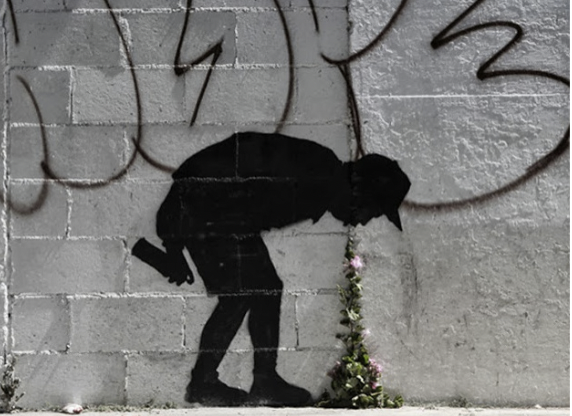
"Better Out than In," by Bansky (New York, NY)
“Better Out than In,” by Banksy (New York, NY)

Artists, as we have been told, just cannot help themselves; they need to create, they need to paint, they need to self-express. In the Fall 2013, New York City had been particularly focused on graffiti art because a world-famous prankster, Banksy, choosing the Big Apple for his artist-in-residency sojourn and because of the 5Pointz case and controversy (Read: Center for Art Law early coverage and discussion of the ultimate decision by Nicholas O’Donnell in the Art Law Report).

To say that graffiti makers are becoming interwoven into the mainstream is to say little. However, as the recent decision in 5Pointz dispute indicates, the law still favors the rights of the real property owners against those who paint on their property walls. Tagging by definition is an unsanctioned act of defacing a physical surface not advertised as a surface for self-expression. Between the right to free speech and the right to make you speech tangible and permanently a part of another’s private property begs questions related to the First Amendment of the US Constitution (freedom of expression and such). Banksy and many other street artists are very talented and poignant; however, they cannot expect unfettered and unlimited access to use walls of others indefinitely.

Most recently, The New York Times ran an article warning against the  “gradual loss” of wall space for street artists. There David Gonzalez interviewed a number of street artists, including J.J. Ramirez, who was “Mico” tagging subway cars and walls as early as the 1960s. According to Ramirez, the disappearing urban canvas indicates that the privileged care little for the “art form invented by the children of the working class.” This and other quotes from established taggers and graffiti writers (note the difference) foretell a looming fight between street artists for space to express themselves.

In hindsight, an amenable and logical solution to save space for street artists, such as the ones formerly graffitiing 5Pointz walls is to buy a space and create a new graffiti mecca (and may be charge rent) allowing graffiti writers to continue their creative quests. As Feliciano admits, he and his friends are regularly painting over a plywood replica of a 1980 subway car, equating this exercise to “painting at the office.” Well, when the artists decide to paint en plein air they brought canvas outside and then pack up and took everything back home, leaving nothing of value at the mercy of the elements (weather, market, and vandalism).

Sources and suggested readings: Rafael Schacter “The World Atlas of Street Art and Graffiti” (New Haven: Yale U. Press 2013); David Gonzalez, “As Legal Graffiti Walls Disappear, Street Artists Ponder Future ,”  The New York Times (Nov. 24, 2013).

Disclaimer: This article is for educational purposes only and is not meant to provide legal advice. Readers should not construe or rely on any comment or statement in this article as legal advice. For legal advice, readers should seek a consultation with an attorney.

Post navigation

Previous UPDATE: Artist Resale Royalty Rights – Is a US Droit de Suite in our Future?
Next A Plethora of Fakes and a Series of Thoughts: Where Has All The Real “Art” Gone?

Related Posts

They Had it Coming: New York Public Library Sued over Renovation Plans

March 3, 2009

"A Revolution in Museum Practice"

February 11, 2011

WYWH: Federal Bar Association’s Art Law & Litigation Conference

February 26, 2019
Center for Art Law
Center for Art Law

Follow us on Instagram for the latest in Art Law!

The expansion of the use of collaborations between The expansion of the use of collaborations between artists and major consumer corporations brings along a myriad of IP legal considerations. What was once seen in advertisement initiatives  has developed into the creation of "art objects," something that lives within a consumer object while retaining some portion of an artists work. 

🔗 Read more about this interesting interplay in Natalie Kawam Yang's published article, including a discussion on how the LOEWE x Ghibli Museum fits into this context, using the link in our bio.
We can't wait for you to join us on February 4th! We can't wait for you to join us on February 4th!  Check out the full event description below:

Join the Center for Art Law for an in-person, full-day training aimed at preparing lawyers for working with art market participants and understanding their unique copyright law needs. The bootcamp will be led by veteran art law attorneys, Louise Carron, Barry Werbin, Carol J. Steinberg, Esq., Scott Sholder, Marc Misthal, specialists in copyright law. 

This Bootcamp provides participants -- attorneys, law students, law graduates and legal professionals -- with foundational legal knowledge related to copyright law for art market clients. Through a combination of instructional presentations and mock consultations, participants will gain a solid foundation in copyright law and its specificities as applied to works of visual arts, such as the fair use doctrine and the use of generative artificial intelligence tools.

🎟️ Grab tickets using the link in our bio!
Don't forget to grab tickets to our upcoming Collo Don't forget to grab tickets to our upcoming Colloquium, discussing the effectiveness of no strike designations in Syria, on February 2nd. Check out the full event description below:

No strike designations for cultural heritage are one mechanism by which countries seek to uphold the requirements of the 1954 Hague Convention. As such, they are designed to be key instruments in protecting the listed sites from war crimes. Yet not all countries maintain such inventories of their own whether due to a lack of resources, political views about what should be represented, or the risk of misuse and abuse. This often places the onus on other governments to create lists about cultures other than their own during conflicts. Thus, there may be different lists compiled by different governments in a conflict, creating an unclear legal landscape for determining potential war crimes and raising significant questions about the effectiveness of no strikes as a protection mechanism. 

Michelle Fabiani will discuss current research seeking to empirically evaluate the effectiveness of no strike designations as a protection mechanism against war crimes in Syria. Using data on cultural heritage attacks from the height of the Syrian Conflict (2014-2017) compiled from open sources, a no strike list completed in approximately 2012, and measures of underlying risk, this research asks whether the designations served as a protective factor or a risk factor for a given site and the surrounding area. Results and implications for holding countries accountable for war crimes against cultural heritage are discussed. 

🎟️ Grab tickets using the link in our bio!

#centerforartlaw #artlaw #culturalheritage #lawyer #legalreserach #artlawyer
Don't miss our up coming in-person, full-day train Don't miss our up coming in-person, full-day training aimed at preparing lawyers for working with art market participants and understanding their unique copyright law needs. The bootcamp will be led by veteran art law attorneys, Louise Carron, Barry Werbin, Carol J. Steinberg, Esq., Scott Sholder, Marc Misthal, specialists in copyright law. 

This Bootcamp provides participants -- attorneys, law students, law graduates and legal professionals -- with foundational legal knowledge related to copyright law for art market clients. Through a combination of instructional presentations and mock consultations, participants will gain a solid foundation in copyright law and its specificities as applied to works of visual arts, such as the fair use doctrine and the use of generative artificial intelligence tools.

🎟️ Grab tickets using the link in our bio! 

#centerforartlaw #artlaw #legal #research #lawyer #artlawyer #bootcamp #copyright #CLE #trainingprogram
In order to fund acquisitions of contemporary art, In order to fund acquisitions of contemporary art, The Phillips Collection sold seven works of art from their collection at auction in November. The decision to deaccession three works in particular have led to turmoil within the museum's governing body. The works at the center of the controversy include Georgia O'Keefe's "Large Dark Red Leaves on White" (1972) which sold for $8 million, Arthur Dove's "Rose and Locust Stump" (1943), and "Clowns et pony" an 1883 drawing by Georges Seurat. Together, the three works raised $13 million. Three board members have resigned, while members of the Phillips family have publicly expressed concerns over the auctions. 

Those opposing the sales point out that the works in question were collected by the museum's founders, Duncan and Marjorie Phillips. While museums often deaccession works that are considered reiterative or lesser in comparison to others by the same artist, the works by O'Keefe, Dove, and Seurat are considered highly valuable, original works among the artist's respective oeuvres. 

The museum's director, Jonathan P. Binstock, has defended the sales, arguing that the process was thorough and reflects the majority interests of the collection's stewards. He believes that acquiring contemporary works will help the museum to evolve. Ultimately, the controversy highlights the difficulties of maintaining institutional collections amid conflicting perspectives.

🔗 Click the link in our bio to read more.
Make sure to check out our newest episode if you h Make sure to check out our newest episode if you haven’t yet!

Paris and Andrea get the change to speak with Patty Gerstenblith about how the role international courts, limits of accountability, and if law play to protect history in times of war.

🎙️ Click the link in our bio to listen anywhere you get your podcasts!
Alexander Butyagin, a Russian archaeologist, was a Alexander Butyagin, a Russian archaeologist, was arrested by Polish authorities in Warsaw. on December 4th. Butyagin is wanted by Ukraine for allegedly conducting illegal excavations of Myrmekion, an ancient city in Crimea. Located in present-day Crimea, Myrmekion was an Ancient Greek colony dating to the sixth century, BCE. 

According to Ukrainian officials, between 2014 and 2019 Butyagin destroyed parts of the Myrmekion archaeological site while serving as head of Ancient Archaeology of the Northern Black Sea region at St. Petersburg's Hermitage Museum. The resulting damages are estimated at $4.7 million. Notably, Russia's foreign ministry has denounced the arrest, describing Poland's cooperation with Ukraine's extradition order as "legal tyranny." Russia invaded and annexed Crimea in 2014.

🔗 Read more by clicking the link in our bio

#centerforartlaw #artlaw #artcrime #artlooting #ukraine #crimea
Join us on February 18th to learn about the proven Join us on February 18th to learn about the provenance and restitution of the Cranach painting at the North Carolina Museum of Art.

A beloved Cranach painting at the North Carolina Museum of Art was accused of being looted by the Nazis. Professor Deborah Gerhardt will describe the issues at stake and the evidentiary trail that led to an unusual model for resolving the dispute.

Grab your tickets today using the link in our bio!

#centerforartlaw #artlaw #legal #legalresearch #museumissues #artwork
“In the depth of winter, I finally learned that wi “In the depth of winter, I finally learned that within me there lay an invincible summer."
~ Albert Camus, "Return to Tipasa" (1952) 

Camus is on our reading list but for now, stay close to the ground to avoid the deorbit burn from the 2026 news and know that we all contain invincible summer. 

The Center for Art Law's January 2026 Newsletter is here—catch up on the latest in art law and start the year informed.
https://itsartlaw.org/newsletters/january-newsletter-which-way-is-up/ 

#centerforartlaw #artlaw #lawyer #artlawyer #legalresearch #legal #art #law #newsletter #january
Major corporations increasingly rely on original c Major corporations increasingly rely on original creative work to train AI models, often claiming a fair use defense. However, many have flagged this interpretation of copyright law as illegitimate and exploitative of artists. In July, the Senate Judiciary Committee on Crime and Counterterrorism addressed these issues in a hearing on copyright law and AI training. 

Read our recent article by Katelyn Wang to learn more about the connection between AI training, copyright protections, and national security. 

🔗 Click the link in our bio to read more!
Join the Center for Art Law for an in-person, all- Join the Center for Art Law for an in-person, all-day  CLE program to train lawyers to work with visual artists and their unique copyright needs. The bootcamp will be led by veteran art law attorneys specializing in copyright law.

This Bootcamp provides participants -- attorneys, law students, law graduates and legal professionals -- with foundational legal knowledge related to copyright law for art market clients. Through a combination of instructional presentations and mock consultations, participants will gain a solid foundation in copyright law and its specificities as applied to works of visual arts, such as the fair use doctrine and the use of generative artificial intelligence tools. 

🎟️ Grab tickets using the link in our bio!
Our interns do the most. Check out a day in the li Our interns do the most. Check out a day in the life of Lauren Stein, a 2L at Wake Forest, as she crushes everything in her path. 

Want to help us foster more great minds? Donate to Center for Art Law.

🔗 Click the link below to donate today!

https://itsartlaw.org/donations/new-years-giving-tree/ 

#centerforartlaw #artlaw #legal #legalresearch #caselaw #lawyer #art #lawstudent #internships #artlawinternship
  • About the Center
  • Contact Us
  • Newsletter
  • Upcoming Events
  • Internship
  • Case Law Database
  • Log in
  • Become a Member
  • Donate
DISCLAIMER

Center for Art Law is a New York State non-profit fully qualified under provision 501(c)(3)
of the Internal Revenue Code.

The Center does not provide legal representation. Information available on this website is
purely for educational purposes only and should not be construed as legal advice.

TERMS OF USE AND PRIVACY POLICY

Your use of the Site (as defined below) constitutes your consent to this Agreement. Please
read our Terms of Use and Privacy Policy carefully.

© 2026 Center for Art Law
 

Loading Comments...
 

You must be logged in to post a comment.