• About
    • Mission
    • Team
    • Boards
    • Mentions & Testimonials
    • Institutional Recognition
    • Annual Reports
    • Current & Past Sponsors
    • Contact Us
  • Resources
    • Article Collection
    • Podcast: Art in Brief
    • AML and the Art Market
    • AI and Art Authentication
    • Newsletter
      • Subscribe
      • Archives
      • In Brief
    • Art Law Library
    • Movies
    • Nazi-looted Art Restitution Database
    • Global Network
      • Courses and Programs
      • Artists’ Assistance
      • Bar Associations
      • Legal Sources
      • Law Firms
      • Student Societies
      • Research Institutions
    • Additional resources
      • The “Interview” Project
  • Events
    • Worldwide Calendar
    • Our Events
      • All Events
      • Annual Conferences
        • 2025 Art Law Conference
        • 2024 Art Law Conference
        • 2023 Art Law Conference
        • 2022 Art Law Conference
        • 2015 Art Law Conference
  • Programs
    • Visual Artists’ Legal Clinics
      • Art & Copyright Law Clinic
      • Artist-Dealer Relationships Clinic
      • Artist Legacy and Estate Planning Clinic
      • Visual Artists’ Immigration Clinic
    • Summer School
      • 2025
    • Internship and Fellowship
    • Judith Bresler Fellowship
  • Case Law Database
  • 2025 Year-End Appeal
  • Log in
  • Become a Member
  • Donate
  • 2025 Year-End Appeal
  • Log in
  • Become a Member
  • Donate
Center for Art Law
  • About
    About
    • Mission
    • Team
    • Boards
    • Mentions & Testimonials
    • Institutional Recognition
    • Annual Reports
    • Current & Past Sponsors
    • Contact Us
  • Resources
    Resources
    • Article Collection
    • Podcast: Art in Brief
    • AML and the Art Market
    • AI and Art Authentication
    • Newsletter
      Newsletter
      • Subscribe
      • Archives
      • In Brief
    • Art Law Library
    • Movies
    • Nazi-looted Art Restitution Database
    • Global Network
      Global Network
      • Courses and Programs
      • Artists’ Assistance
      • Bar Associations
      • Legal Sources
      • Law Firms
      • Student Societies
      • Research Institutions
    • Additional resources
      Additional resources
      • The “Interview” Project
  • Events
    Events
    • Worldwide Calendar
    • Our Events
      Our Events
      • All Events
      • Annual Conferences
        Annual Conferences
        • 2025 Art Law Conference
        • 2024 Art Law Conference
        • 2023 Art Law Conference
        • 2022 Art Law Conference
        • 2015 Art Law Conference
  • Programs
    Programs
    • Visual Artists’ Legal Clinics
      Visual Artists’ Legal Clinics
      • Art & Copyright Law Clinic
      • Artist-Dealer Relationships Clinic
      • Artist Legacy and Estate Planning Clinic
      • Visual Artists’ Immigration Clinic
    • Summer School
      Summer School
      • 2025
    • Internship and Fellowship
    • Judith Bresler Fellowship
  • Case Law Database
Home image/svg+xml 2021 Timothée Giet Art History image/svg+xml 2021 Timothée Giet The Eaton Collection: Off the Block at Rago
Back

The Eaton Collection: Off the Block at Rago

June 10, 2015
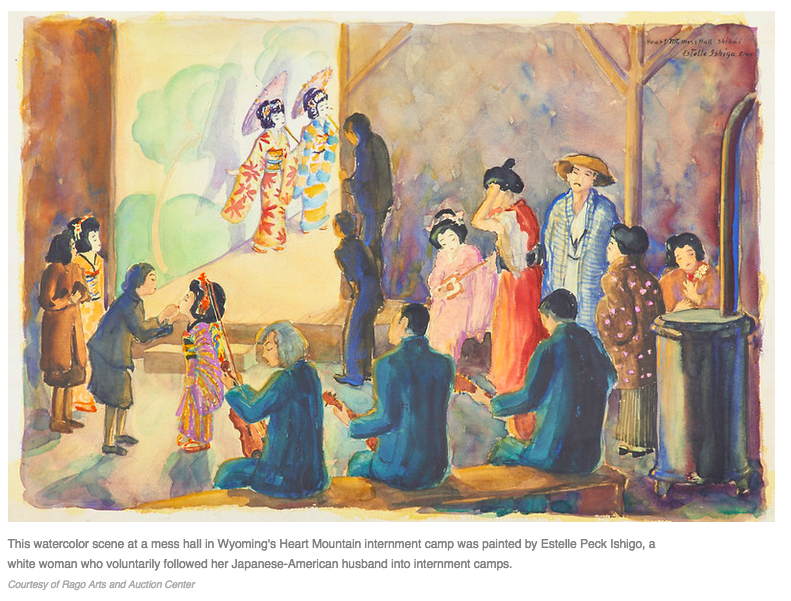
By Rebecca Krishnan-AyerScreen Shot 2015-06-10 at 12.26.01 AM

The Contested Sale

The New Jersey-based auction house Rago Arts and Auction Center (est. 1988) stirred controversy with the April 2015 projected sale of 450 works of art and artifacts from the Japanese-American internment camps established during World War II. In the wake of the New York Times article announcing the auction, activists and community leaders alike banded together to ignite a social media campaign against the auction house, whose annual sales total approximately $30 million. Rago initially stood behind their decision to proceed with the sale, citing a lack of alternate options available to the client for relinquishing the items. As the New York Times reported, “A spokeswoman for Rago wrote in an email that the unnamed auction consignor, who knew the Eaton family, is ‘not in a financial position’ to donate the material to institutions and ‘did not feel qualified to choose one institution over another.’ The consignor has described the protests as a ‘social media attack’ meant to ‘bully us into compliance with their demands.’”

Meanwhile, protest groups established a Facebook page, “Japanese American History: NOT for Sale,” assembling over 6,700 followers. Critics also launched a Change.org petition, lambasting “the betrayal of those imprisoned people who thought their gifts would be used to educate, not to be sold to the highest bidder in a national auction, pitting families against museums against private collectors.” Among those issuing a rallying call for action was Japanese American actor George Takei, who helped catapult the controversy to the forefront of Japanese American cultural groups’ and foundations’ agendas–he himself was interned in one of these camps at the age of five. Eric L. Muller, Dan K. Moore Distinguished Professor in Jurisprudence and Ethics at University of North Carolina School of Law, assisted with preparing the sale catalog for Rago, and declined to proceed with a lecture planned at the auction house after learning that the consignor had refused to transfer or donate the property to Japanese-American cultural institutions. “I did not feel that I could deliver a public lecture connected to the sale in good conscience,” Muller told the ArtsBeat blog of the New York Times of the ethical quandary he faced. As the social media campaign opposing the sale gained traction and an injunction was issued from one former internment camp site, the Heart Mountain Wyoming Foundation, Rago announced their agreement to cancel the auction on April 15, 2015. The auction house’s decision and underlying motivations still draw criticism from activists such as Shirley Higuchi, chairwoman of the Heart Mountain Wyoming Foundation, who stresses that only after the immediate threat of legal action did Rago agree to withdraw the items from the auction block.

The Objects

The ownership of the collection, comprising 23 lots, can be traced back to the 1950s. Following World War II, a number of former internees and Japanese American families donated works of art and furniture to Allen Hendershott Eaton, a historian conducting research for his 1952 book, Beauty Behind Barbed Wire: The Arts of the Japanese in Our War Relocation Camps. The objects were then handed down to an unnamed family friend of Eaton’s heirs based in Connecticut. Among the items bestowed to Eaton were unique “handmade cigarette boxes, delicate bird brooches carved of wood, intricate family nameplates, a cat figurine shaped from tree roots, and watercolors of life inside the camps, including children playing in dirt lanes and outdoor assemblies,” the LA Times reports. In an interview with NPR, Delphine Hirasuna, a scholar specializing in art created in the internment camps observes: “Here is something that gives them pride about what the[ir] grandparents created under really bad circumstances.” The emotional value of the collection far exceeds its monetary value (Rago appraised the lots for a collective estimate of around $26,000) and includes oil paintings and rare black and white photographs depicting families, internees creating works of art, and the rarely seen environs of camps in the West. Individuals born in internment camps or whose relatives experienced the tragic imprisonment of 120,000 Japanese Americans following the U.S. bombing of Pearl Harbor stand by the injustice in selling and monetizing such seminal memories and facets of history.

The Outcome

Screen Shot 2015-06-10 at 12.23.26 AMOn May 2, 2015, the Japanese American National Museum in Los Angeles announced plans to acquire the hotly contested collection as a result of Takei’s efforts to halt the public sale and with the cooperation of the would-be consignor. The museum recently honored Takei, a board trustee, for his contributions with the Japanese American National Museum’s Medal of Honor for Lifetime Achievement. According to Takei, “To put [the Eaton collection] up on the auction block to the highest bidder, where it would just disappear into someone’s collection, was insensitive. The most appropriate and obvious place for the collection was the Japanese American National Museum.” Rago Arts and Auction Center presumably played a role in the amicable settlement and urged the arts community to engage in a broader discussion on related legal and ethical dilemmas facing other institutions. Its managing partner, Miriam Tucker, affirms, “The issue extends beyond what is legal. It is something auction houses, galleries and dealers are faced with regularly.”

The Rago case recalls the efforts and ethics involved in recovering other culturally significant property such as Nazi-era looted works or Native American artifacts. Marc Masurovsky, co-founder of the Holocaust Art Restitution Project, describes a certain “sensibility and sensitivity” that must be acknowledged when dealing with such works. The attempted sale of the Eaton collection also raises interesting issues regarding precedent and discretion when it comes to auction houses accepting consignments, institutions acquiring objects, or galleries purchasing works. Legality aside, ethics and public good seem to challenge the notion of a “pure transaction” involving works of art and objects of cultural heritage.

Note from the editors: On the footsteps of the positive outcome for the Eaton collection, Center for Art Law is acutely interested in the auctions of Hopi artifacts that have taken place and continue to occur in France despite the communal and legal efforts to halt those contested sales. While Rago decided, with some backing from the court, to withdraw the Eaton items from auction, Hôtel Drouot, the largest auction house in Paris, has been proceeding with the sales of Hopi relics despite public outcry.

Select Sources:

  • Change.org, https://www.change.org/p/rago-negotiate-with-japanese-american-families-to-preserve-american-concentration-camp-artifacts
  • Catherine Saillant, Japanese Americans’ protests halt auction of internment camp items, The L.A. Times (Apr. 16, 2015) available at http://www.latimes.com/local/california/la-me-auction-internment-artifacts-20150417-story.html
  • Deborah Vankin, George Takei Helps L.A. Museum Acquire Internment Camp Artifacts, The L.A. Times (May 2, 2015) available at  http://www.latimes.com/entertainment/arts/culture/la-et-cm-japanese-american-national-museum-george-takei-internment-camp-artifacts-20150501-story.html#page=1
  • Eve M. Kahn, Auction of Art Made by Japanese-Americans in Internment Camps Sparks Protest, The New York Times (Apr.13, 2015) available at http://artsbeat.blogs.nytimes.com/2015/04/13/auction-of-art-made-by-japanese-americans-in-internment-camps-sparks-protest/?_r=1
  • Hansi Lo Wang, Art From Japanese- American Internment Camps Saved From Auction Block, NPR (Apr. 16, 2015) available at http://www.npr.org/sections/codeswitch/2015/04/18/400052232/auction-of-art-by-japanese-americans-in-internment-camps-cancelled
  • Japanese American National Museum, http://www.janm.org/events/2015/dinner/

About the Author: Rebecca Krishnan-Ayer received a B.A. in Art History and French Literature from Johns Hopkins University.

Disclaimer: This article is for educational purposes only and is not meant to provide legal advice. Readers should not construe or rely on any comment or statement in this article as legal advice. For legal advice, readers should seek a consultation with an attorney.

Post navigation

Previous Case Review: Foster v. Svenson (2015)
Next Hold your Horses: Art Authenticators Not Protected Yet

Related Posts

logo

Spotlight on Art Law Instruction

April 15, 2014
logo

WYWH: Introduction to Estate Planning for Artists in “Your Art Will Outlive You”

February 10, 2017

2011 Legal Issues in Museums Conference

May 25, 2011
Center for Art Law
A Gift for You

A Gift for You

this Holiday Season

Celebrate the holidays with 20% off your annual subscription — claim your gift now!


Get your Subscription Today!
Guidelines AI and Art Authentication

AI and Art Authentication

Explore the new Guidelines for AI and Art Authentication for the responsible, ethical, and transparent use of artificial intelligence.

Download here
Center for Art Law

Follow us on Instagram for the latest in Art Law!

Did you know that Charles Dickens visited America Did you know that Charles Dickens visited America twice, in 1842 and in 1867? In between, he wrote his famous “A Tale of Two Cities,” foreshadowing upheavals and revolutions and suggesting that individual acts of compassion, love, and sacrifice can break cycles of injustice. With competing demands and obligations, finding time to read books in the second quarter of the 21st century might get increasingly harder. As we live in the best and worst of times again, try to enjoy the season of light and a good book (or a good newsletter).

From all of us at the Center for Art Law, we wish you peace, love, and understanding this holiday season. 

🔗 Read more by clicking the link in our bio!

#centerforartlaw #artlaw #legalresearch #artlawyer #december #newsletter #lawyer
Is it, or isn’t it, Vermeer? Trouble spotting fake Is it, or isn’t it, Vermeer? Trouble spotting fakes? You are not alone. Donate to the Center for Art Law, we are the real deal. 

🔗 Click the link in our bio to donate today!

#centerforartlaw #artlaw #legalresearch #endofyear #givingtuesday #donate #notacrime #framingartlaw
Whether legal systems are ready or not, artificial Whether legal systems are ready or not, artificial intelligence is making its way into the courtroom. AI-generated evidence is becoming increasingly common, but many legal professionals are concerned that existing legal frameworks aren't sufficient to account for ethical dilemmas arising from the technology. 

To learn more about the ethical arguments surrounding AI-generated evidence, and what measures the US judiciary is taking to respond, read our new article by Rebecca Bennett. 

🔗 Click the link in our bio to read more!

#centerforartlaw #artlaw #legalresearch #artlawyer #lawyer #aiart #courtissues #courts #generativeai #aievidence
Interested in the world of art restitution? Hear f Interested in the world of art restitution? Hear from our Lead Researcher of the Nazi-Era Looted Art Database, Amanda Buonaiuto, about the many accomplishments this year and our continuing goals in this space. We would love the chance to do even more amazing work, your donations can give us this opportunity! 

Please check out the database and the many recordings of online events we have regarding the showcase on our website.

Help us reach our end of year fundraising goal of $35K.

🔗 Click the link in our bio to donate ❤️🖤
Make sure to grab your tickets for our discussion Make sure to grab your tickets for our discussion on the legal challenges and considerations facing General Counsels at leading museums, auction houses, and galleries on December 17. Tune in to get insight into how legal departments navigate the complex and evolving art world.

The panel, featuring Cindy Caplan, General Counsel, The Jewish Museum, Jason Pollack, Senior Vice President, General Counsel, Americas, Christie’s and Halie Klein, General Counsel, Pace Gallery, will address a range of pressing issues, from the balancing of legal risk management with institutional missions, combined with the need to supervise a variety of legal issues, from employment law to real estate law. The conversation will also explore the unique role General Counsels play in shaping institutional policy.

This is a CLE Event. 1 Credit for Professional Practice Pending Approval.

🎟️ Make sure to grab your tickets using the link in our bio! 

#centerforartlaw #artlaw #legalresearch #generalcounsel #museumissues #artauctions #artgallery #artlawyer #CLE
While arts funding is perpetually scarce, cultural While arts funding is perpetually scarce, cultural heritage institutions particularly struggle during and after armed conflict. In such circumstances, funds from a variety of sources including NGOs, international organizations, national and regional institutions, and private funds all play a crucial role in protecting cultural heritage. 

Read our new article by Andrew Dearman to learn more about the organizations funding emergency cultural heritage protection in the face of armed conflict, as well as the factors hindering effective responses. 

🔗 Click the link in our bio to read more! 

#centerforartlaw #artlaw #legalresearch #lawyer #artlawyer #culturalheritage #armedconflict #UNESCO
Join the Center for Art Law in welcoming Attorney Join the Center for Art Law in welcoming Attorney and Art Business Consultant Richard Lehun as our keynote speaker for our upcoming Artist Dealer Relationships Clinic. 

The Artist-Dealer Relationships Clinic helps artists and gallerists negotiate effective and mutually-beneficial contracts. By connecting artists and dealers to attorneys, this Clinic looks to forge meaningful relations and to provide a platform for artists and dealers to learn about the laws that govern their relationship, as well as have their questions addressed by experts in the field.

After a short lecture, attendees with consultation tickets will be paired with a volunteer attorney for a confidential 20-minute consultation. Limited slots are available for the consultation sessions.
Today we held our last advisory meeting of the yea Today we held our last advisory meeting of the year, a hybrid, and a good wrap to a busy season. What do you think we discussed?
We are incredibly grateful to our network of attor We are incredibly grateful to our network of attorneys who generously volunteer for our clinics! We could not do it without them! 

Next week, join the Center for Art Law for our Artist-Dealer Relationships Clinic. This clinic is focused on helping artists navigate and understand contracts with galleries and art dealers. After a short lecture, attendees with consultation tickets will be paired with one of the Center's volunteer attorneys for a confidential 20-minute consultation. Limited slots are available for the consultation sessions.
'twas cold and still in Brooklyn last night and no 'twas cold and still in Brooklyn last night and not a creature was stirring except for dog walkers and their walkees... And then we reached 7,000 followers!
Don't miss this chance to learn more about the lat Don't miss this chance to learn more about the latest developments in the restitution of Nazi-looted art. Tune in on December 15th at noon ET to hear from our panel members Amanda Buonaiuto, Peter J. Toren, Olaf S. Ossmann, Laurel Zuckerman, and Lilah Aubrey. The will be discussing updates from the HEAR act, it's implications in the U.S., modifications from the German Commission, and the use of digital tools and data to advance restitution research and claims. 

🎟️ Click the link in our bio to get tickets!
Making news is easy. Solving art crimes is hard. R Making news is easy. Solving art crimes is hard. Running a nonprofit is even harder.

Donate to the Center for Art Law to help us meet our year end goal! 

🔗 Click the link in our bio to donate today!
  • About the Center
  • Contact Us
  • Newsletter
  • Upcoming Events
  • Internship
  • Case Law Database
  • Log in
  • Become a Member
  • Donate
DISCLAIMER

Center for Art Law is a New York State non-profit fully qualified under provision 501(c)(3)
of the Internal Revenue Code.

The Center does not provide legal representation. Information available on this website is
purely for educational purposes only and should not be construed as legal advice.

TERMS OF USE AND PRIVACY POLICY

Your use of the Site (as defined below) constitutes your consent to this Agreement. Please
read our Terms of Use and Privacy Policy carefully.

© 2025 Center for Art Law
 

Loading Comments...
 

You must be logged in to post a comment.