
The Legal, Ethical, and Practical Dimensions of Removing Confederate Monuments
October 28, 2023
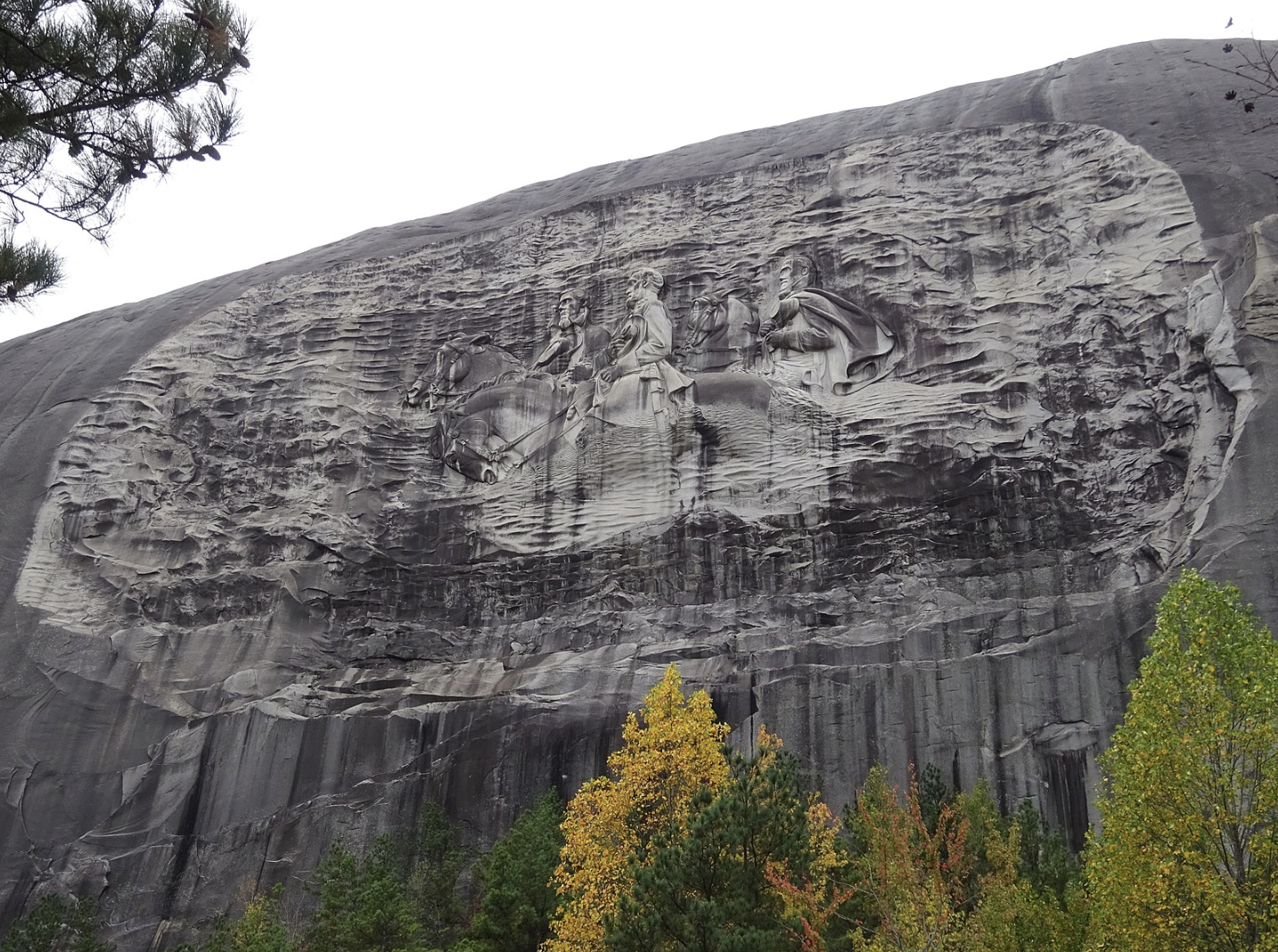
(Image Credit: The Confederate Memorial Carving, Stone Mountain, Georgia © VOA News)
By Stephanie Nicole Argueta
Introduction
Since the protests surrounding the death of George Floyd and Briana Taylor, many people within our nation have chosen to look inward to evaluate the historical mistreatment of people of color in this country. One such aspect of our country that many have chosen to reevaluate is the display of many Confederate statues across the country. Since 2020, the removal of Confederate monuments from public and private land has become a contentious and highly debated issue in the United States. These monuments, which commemorate figures from the Confederacy, have sparked a nationwide conversation about their historical significance, the discourse surrounding their removal, and the various solutions that can be pursued to address their historically oppressive past. But what does it truly take to remove one of these monuments? Can public backlash be enough to have these monuments removed or must something else be done? Do we lose anything from removing these monuments?
Legality of Removing Confederate Monuments
When looking at the legality surrounding the removal of Confederate monuments, it is a complex issue that is a case by case situation. When evaluating the possibilities one may have for requesting the removal of a Confederate monument, the issues relating to property law, first amendment law, and general personal protections come into play. This is due to the fact that many monuments are built on privately owned land or publicly owned land. This distinction is important to note because of the applicable laws that are relevant to the owner of the land in which the monument is located. This is then further complicated by the fact that some monuments were built not by public funding but rather private investors. This, coupled with each citizen’s first amendment right to free speech, creates the complicated nature of the removal of confederate monuments.
Monuments that are on publicly owned land and are publicly funded fall under the jurisdiction of local and state governments and are also governed by state property and cultural preservation laws. [1] In recent years, several states have enacted laws protecting Confederate monuments, making their removal more challenging. For example, in North Carolina, a 2015 law prohibits the removal or relocation of monuments on public property without the approval of the North Carolina Historical Commission.[2] Such laws have triggered legal battles over the authority of local governments to decide the fate of these monuments. One such legal battle was seen in the state of North Carolina, in Soc’y for the Hist. Pres. of the Twentysixth N.C. Troops, Inc. v. City of Asheville, the city government ordered the removal of the Zebulon Baird Vance Monument but was met by intense opposition by the plaintiff who filed a breach of contract claim, sought out a temporary restraining order, preliminary and permanent injunction, and declaratory judgment.[3] The plaintiffs attempted to use the North Carolina Historical Commission as a form of relief for their case, however the Court of Appeals in North Carolina went in favor of the city because the plaintiff failed to show that they actually suffered some kind of injury since it was unknown who actually owned the monument. [4] As of right now, the plaintiffs have appealed to the North Carolina Supreme Court, and they are waiting to begin oral arguments.[5]
On private property, the legality of removal is generally less clear-cut because of the complexities that arise when discussing the transfer of ownership. Property owners have the right to decide what is displayed on their land, but they may face backlash from the community or preservationists. One such example of a complex relationship of private land and monuments was a sculpture built in Stone Mountain, Georgia on land owned by the United Daughters of the Confederacy.[6] The mountain on which the monument was carved into was owned by segregationist Marvin Griffin and depicted three confederate leaders, including Robert E. Lee.[7] However, after years of backlash, the state purchased the mountain.[8] However, since this purchase, the monument still remains due to the fact that in Georgia there have been various cultural preservation laws that have passed which allows monuments such as this one to remain intact.[9]
Another such example of the complexities surrounding ownership of land with regards to Confederate monuments is the one outside of Nashville, Tennessee that honors Nathan Bedford Forrest, a confederate soldier and the first Grand Wizard of the Ku Klux Klan.[10] It was a 25-foot statue with Confederate flags around it that was installed in the 1990s by an individual on their property and which could be easily seen from the local highway.[11] Around the 2010s, many politicians and citizens voiced their frustrations with the statue being so visible and thus resulted in a petition to the Department of Transportation to plant foliage to block the statue.[12] The petition was then denied, and not long after, many people took matters into their own hands and began to vandalize the statue.[13] The owner of the statue eventually passed away in 2020, and in 2021, the executor of the estate chose to remove the statue, giving a list of reasons for its removal, including that the statue itself was “ugly”.[14] One major reason as to why the monument had stayed for so long is because the statue is protected under the Visual Artist Rights Act (VARA). VARA, which was enacted in the 90s, protects the moral rights of visual artists by protecting the works of art of these artists from getting destroyed by different entities.[15] The use of VARA makes the situation here in Tennessee different than in Georgia, because VARA is only applicable for works made after 1991.[16] Since the carving in Georgia was finished in the 1970s it is less likely to apply. However, this statue was erected in the 1990s after the implementation of VARA and the original artist had more protections over his work being damaged than others would. It is essential to navigate the delicate balance between property rights and the broader societal impact of maintaining Confederate monuments, especially when they promote values associated with slavery, racism, and oppression.
The Discourse Surrounding Monument Removal
The discourse surrounding the removal of Confederate monuments is multifaceted, reflecting a wide range of perspectives. Proponents of removal argue that these monuments symbolize a dark period in American history and glorify individuals who fought to preserve slavery and white supremacy. They contend that these monuments serve as painful reminders of oppression for African Americans and other marginalized communities. After 2020, the Black Lives Matter movement and heightened awareness of systemic racism have amplified these voices and led to renewed calls for removal. Conversely, opponents of removal often argue that these monuments represent an important part of American history and should be preserved for educational purposes. They contend that removing these monuments erases history and amounts to “canceling culture.” Some argue that it is better to contextualize the monuments with plaques or educational programs to provide a more comprehensive understanding of the Civil War and its implications. Additionally, the discourse includes discussions about the role of symbolism in society. Some argue that symbols like Confederate monuments can perpetuate racist attitudes and behaviors, while others maintain that they are harmless relics of a bygone era. The debate over the interpretation of these symbols further complicates the discourse.
Solutions Surrounding Confederate Monuments
To address the historically oppressive past associated with Confederate monuments, several solutions can be considered:
**Removal and Relocation**
In cases where it is legally possible, the removal and relocation of Confederate monuments to museums, cemeteries, or other appropriate settings can be an effective solution. This approach preserves historical artifacts while removing them from public spaces that may perpetuate hurtful ideologies. One ongoing example of confederate monument removal and relocation is going on in Arlington, Virginia. In this situation the Arlington National Cemetery has a large confederate statue that Congress has required to be removed and relocated to another space that the public has been asked to vote on. [17]

**Contextualization**
For monuments that remain in place, contextualization is crucial. This involves adding plaques or educational materials that provide a balanced historical perspective, acknowledging the monument’s origins and the context in which it was erected. This is particularly relevant for monuments located in states that have prohibited their removal. Once such state in which this occurred was in Georgia. In 2019, an Atlanta committee began the process of putting up placards on many confederate monuments across the city to contend with the “Lost Cause” narrative that has been prevalent in the south for years with regards to the Civil War.[18]
**Community Dialogue and Education**
Engaging in open and inclusive community dialogues about Confederate monuments can help build consensus on their fate. Educating the public about the historical context of these monuments and their impact on marginalized communities can lead to informed decision-making. The residents of Fairfax, Virginia engaged in this complex conversation during the pandemic in which the City Counsel led a conversation about the issues surrounding the confederacy’s long and hurtful relationship to the Black community.[19]Further the City Counsel has created a virtual space in which residents can engage more with the deeper questions of inequality and racism so that they can understand the reasons why the confederate south was so bad.[20]
**Legal Reform**
Advocates for removal can work to repeal or amend laws that protect Confederate monuments and vice versa. This approach requires political mobilization and legal efforts to change the legal landscape. This has taken on many forms but the most successful example of legal reform took place during the pandemic. In July of 2020, the House of Representatives were presented with the possibility of removing a bust of Chief Justice Roger B. Taney from the Old Supreme Court Chamber in the Capitol Building.[21] The original proposal was to replace not only the bust the bust with one of Justice Thurgood Marshal, but as well any statues or busts of figures who supported the confederacy.[22] It passed in the House and was pending in the Senate for a little bit, but in 2022, President Biden signed the bill to remove the bust.[23] However, through all this, there was still much opposition towards the removal with a total of 113 Republicans voting Nay to the removal of the bust.[24] One member of congress who has voiced his disagreement with the bill was Rep. David McKinley, who took issue with the fact that confederate statues and busts that were sent from individual states, including West Virginia, would be removed.[25] In his eyes this bill was infringing on states rights and thus influenced him to vote against the bill.[26]
Conclusion
The removal of Confederate monuments from both public and private land presents complex legal, ethical, and practical challenges. The discourse surrounding these monuments is emblematic of larger conversations about history, symbolism, and racial injustice in the United States. While there is no one-size-fits-all solution, it is crucial to address the historically oppressive past associated with these monuments in a way that respects the rights and sensitivities of all citizens. Whether through removal, contextualization, public art, community dialogue, or legal reform, the ultimate goal should be to promote a more inclusive and just society.
Suggested Readings
Deborah R. Gerhardt, Law in the Shadows of Confederate Monuments,27 Mich. J. Race & L. 1 (2021)
Jessica Owley,Jess Phelps & Sean W. Hughes, Private Confedrate Monuments, 25 Lewis & Clark L. Rev. 253 (2021)
Timmerman, Travis (2020). A Case for Removing Confederate Monuments. In Bob Fischer (ed.), Ethics, Left and Right: The Moral Issues that Divide Us. New York: Oxford University Press. pp. 513-522.
Jessica Owley & Jess Phelps, The Life and Death of Confederate Monuments,68 Buffalo L. Rev. 1393 (2020)
About the Author:
Stephanie Nicole Argueta is a second year law student at Brooklyn Law School. She received her B.A. in Political Science from CUNY Brooklyn Law School. Growing up as a first generation Latina in New York City she grew a deep passion for issues like cultural preservation in immigrant communities and artistic expression for many minority communities, thus influencing her decision to attend law school.
Sources and Citations:
- Understanding the Complicated Landscape of Civil War Monuments, 93 Ind. L.J. Supp. 15, 18 ↑
- N.C. Gen. Stat. § 143B-62 ↑
- Soc’y for the Hist. Pres. of the Twenty Sixth N.C. Troops, Inc. v. City of Asheville, 282 N.C. App. 701, 701 (2022) ↑
- Id. at 706-07, ↑
- Sarah Honosky, NC Supreme Court will take up lawsuit over removal of downtown Asheville’s Vance Monument, Dec.29, 2022, https://www.citizen-times.com/story/news/local/2022/12/29/nc-supreme-court-takes-up-suit-on-asheville-removal-of-vance-monument/69761539007/ ↑
- Legal experts say removal of Confederate monuments a complex, lengthy undertaking, Nov. 2019, https://www.americanbar.org/news/abanews/publications/youraba/2019/november-2019/legal-experts-say-removal-of-confederate-monuments-a-complex–le/ ↑
- Claire Haley, Stone Mountain: Carving Fact from Fiction, Nov. 18, 2022, https://www.atlantahistorycenter.com/blog/stone-mountain-a-brief-history/#:~:text=The%20original%20idea%20for%20a,side%20of%20the%20 granite%20 mountain. ↑
- Legal experts say removal of Confederate monuments a complex, lengthy undertaking, Nov. 2019, https://www.americanbar.org/news/abanews/publications/youraba/2019/november-2019/legal-experts-say-removal-of-confederate-monuments-a-complex–le/ ↑
- Claire Haley, Stone Mountain: Carving Fact from Fiction, Nov. 18, 2022, https://www.atlantahistorycenter.com/blog/stone-mountain-a-brief-history/#:~:text=The%20original%20idea%20for%20a,side%20of%20the%20granite%20mountain. ↑
- ARTICLE: Understanding the Complicated Landscape of Civil War Monuments, 93 Ind. L.J. Supp. 15, 22 ↑
- Id. ↑
- Id. ↑
- Id. ↑
- Nick Beres, Nathan Bedford Forrest statue along I-65 removed after more than 2 decades, Dec. 7, 2021, https://www.newschannel5.com/news/nathan-bedford-forrest-statue-along-i-65-being-removed-after-more-than-2-decades ↑
- 17 U.S.C. § 106A(a)(3)(b) ↑
- 17 U.S.C. § 106A(d) ↑
- Removal of the confederate memorial, Arlington National Cemetery. https://www.arlingtoncemetery.mil/About/Confederate-Memorial-Removal ↑
- https://www.cnn.com/2019/08/02/us/atlanta-confederate-monuments-context/index.html ↑
- https://patch.com/virginia/fairfaxcity/city-engaged-community-dialogue-over-its-confederate-legacy ↑
- id. ↑
- Ashley Ahn, Congress votes to remove a bust of the Dred Scott decision’s author from the Capitol, Dec. 15, 2022, https://www.npr.org/2022/12/15/1143113389/capitol-remove-roger-taney-dred-scott-statue#:~:text=Hourly%20News-,Congress%20votes%20to%20remove%20bust%20of%20former%20Justice%20Roger%20Taney,serve%20on%20the%20high%20court. ↑
- H. R. 3005, 117th Cong. (2021) ↑
- Amy B Wang and Marianna Sotomayor, Biden signs bill to remove bust of Dred Scott decision author from Capitol, Dec. 27, 2022 https://www.washingtonpost.com/politics/2022/12/14/dred-scott-taney-bust-slavery/ ↑
- Bryan Metzger, Congress passed a bill removing a bust from the Capitol of the Supreme Court justice who authored an infamous decision denying citizenship to Black Americans, Dec 14, 2022, https://www.businessinsider.com/congress-passes-bill-removing-bust-dred-scott-roger-taney-slavery-2022-12 ↑
- WEST VIRGINIA’S THREE U.S. HOUSE REPS VOTE AGAINST REMOVING CONFEDERATE STATUES FROM CAPITOL, Jun. 30, 2021, https://mooney.house.gov/west-virginias-three-u-s-house-reps-vote-against-removing-confederate-statues-from-capitol/#:~:text=3005%2C%20Kenna’s%20statue%20would%20be,decided%20to%20vote%20against%20H.R. ↑
- Id. ↑
Disclaimer: This article is for educational purposes only and is not meant to provide legal advice. Readers should not construe or rely on any comment or statement in this article as legal advice. For legal advice, readers should seek a consultation with an attorney.


You must be logged in to post a comment.