• About
    • Mission
    • Team
    • Boards
    • Mentions & Testimonials
    • Institutional Recognition
    • Annual Reports
    • Current & Past Sponsors
    • Contact Us
  • Resources
    • Article Collection
    • Podcast: Art in Brief
    • AML and the Art Market
    • AI and Art Authentication
    • Newsletter
      • Subscribe
      • Archives
      • In Brief
    • Art Law Library
    • Movies
    • Nazi-looted Art Restitution Database
    • Global Network
      • Courses and Programs
      • Artists’ Assistance
      • Bar Associations
      • Legal Sources
      • Law Firms
      • Student Societies
      • Research Institutions
    • Additional resources
      • The “Interview” Project
  • Events
    • Worldwide Calendar
    • Our Events
      • All Events
      • Annual Conferences
        • 2025 Art Law Conference
        • 2024 Art Law Conference
        • 2023 Art Law Conference
        • 2022 Art Law Conference
        • 2015 Art Law Conference
  • Programs
    • Visual Artists’ Legal Clinics
      • Art & Copyright Law Clinic
      • Artist-Dealer Relationships Clinic
      • Artist Legacy and Estate Planning Clinic
      • Visual Artists’ Immigration Clinic
    • Summer School
      • 2026
      • 2025
    • Internship and Fellowship
    • Judith Bresler Fellowship
  • Case Law Database
  • Log in
  • Become a Member
  • Donate
  • Log in
  • Become a Member
  • Donate
Center for Art Law
  • About
    About
    • Mission
    • Team
    • Boards
    • Mentions & Testimonials
    • Institutional Recognition
    • Annual Reports
    • Current & Past Sponsors
    • Contact Us
  • Resources
    Resources
    • Article Collection
    • Podcast: Art in Brief
    • AML and the Art Market
    • AI and Art Authentication
    • Newsletter
      Newsletter
      • Subscribe
      • Archives
      • In Brief
    • Art Law Library
    • Movies
    • Nazi-looted Art Restitution Database
    • Global Network
      Global Network
      • Courses and Programs
      • Artists’ Assistance
      • Bar Associations
      • Legal Sources
      • Law Firms
      • Student Societies
      • Research Institutions
    • Additional resources
      Additional resources
      • The “Interview” Project
  • Events
    Events
    • Worldwide Calendar
    • Our Events
      Our Events
      • All Events
      • Annual Conferences
        Annual Conferences
        • 2025 Art Law Conference
        • 2024 Art Law Conference
        • 2023 Art Law Conference
        • 2022 Art Law Conference
        • 2015 Art Law Conference
  • Programs
    Programs
    • Visual Artists’ Legal Clinics
      Visual Artists’ Legal Clinics
      • Art & Copyright Law Clinic
      • Artist-Dealer Relationships Clinic
      • Artist Legacy and Estate Planning Clinic
      • Visual Artists’ Immigration Clinic
    • Summer School
      Summer School
      • 2026
      • 2025
    • Internship and Fellowship
    • Judith Bresler Fellowship
  • Case Law Database
Home image/svg+xml 2021 Timothée Giet Art law image/svg+xml 2021 Timothée Giet The New Frontier of Cultural Property Protections: When Acquiring Cultural Objects Supports Terrorism
Back

The New Frontier of Cultural Property Protections: When Acquiring Cultural Objects Supports Terrorism

September 2, 2015
By Timur Tusiray

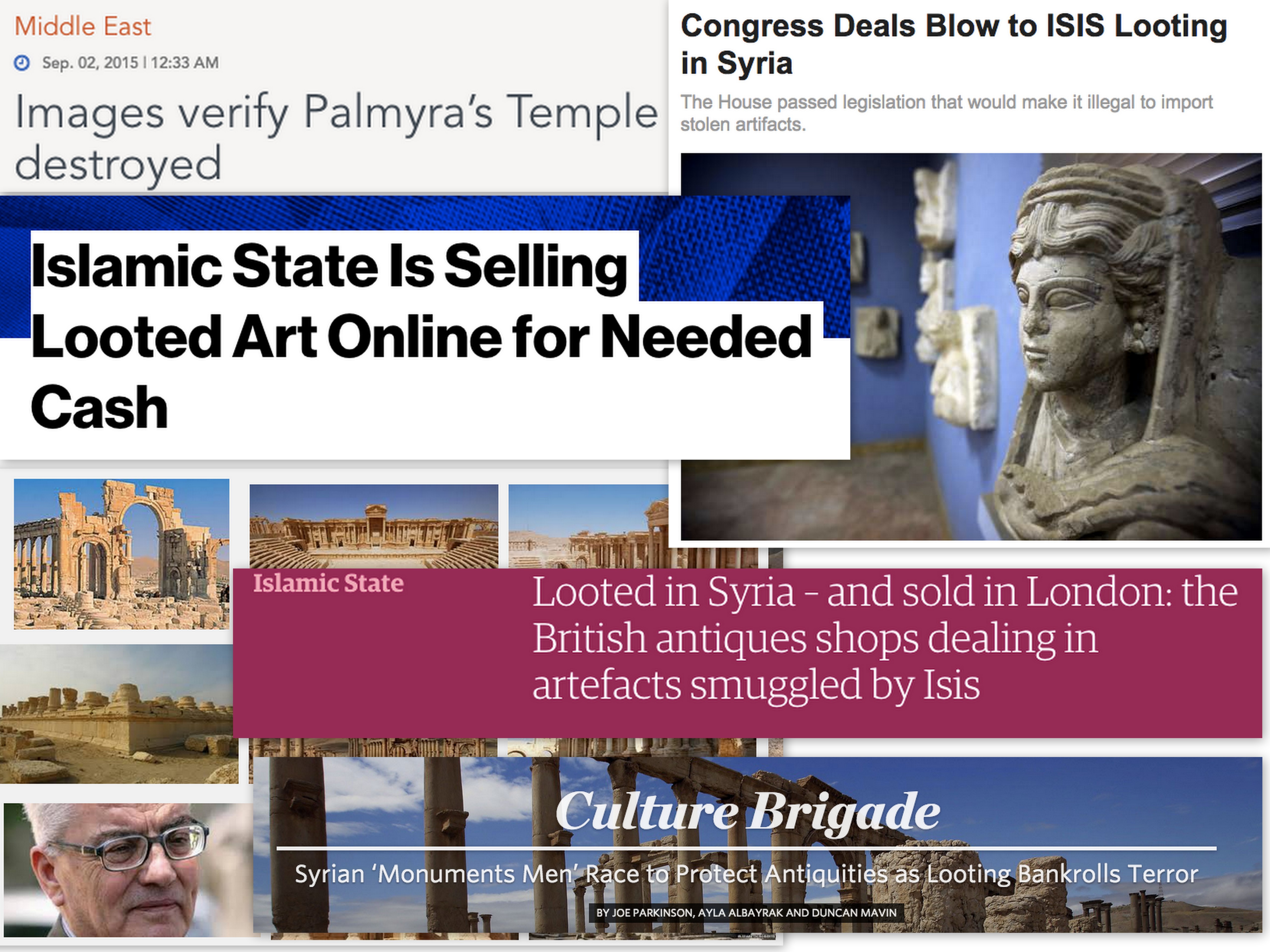
Collage of Headlines
Collage of Headlines featuring recent looting and destruction of cultural heritage in the Middle East areas under the ISIL control.

The United States Anti-Terror Act, 18 USC 2331, et seq. (“ATA”or the “Anti-Terror Act”), a potent anti-terrorism law (enacted in 1991) often used to prosecute financial institutions and other organizations, has now been identified as a tool to pursue individuals who operate in the cultural property market for materially supporting foreign terrorist organizations (“FTO”). In relevant parts it reads “Whoever knowingly provides material support or resources to a foreign terrorist organization, or attempts or conspires to do so, shall be fined under this title or imprisoned…” (18 U.S.C. § 2339B(b)). The implications of such a development are wide-ranging, and understanding them will be key for practitioners and individuals active in cultural property acquisitions.

Recent tumultuous events involving the illicit looting and trafficking of cultural objects from Syria and Iraq by the so-called Islamic State of Iraq and the Levant (“ISIL” formerly known as ISIS), an FTO, have many wondering how the illicit traffic of cultural heritage may be checked. The question is made more urgent by the tragic beheading of Professor Khaled al-As’ad, a university professor and former general manager of antiquities and museums in Palmyra, and the destruction of historic temples in the same region.

In light of these events, on August 25, 2015 the FBI released an unusual one-page alert calling for art and antiquities market leaders to aid in the international effort to prevent the sale and import of artifacts from ISIL-controlled Syria and Iraq. While such a call for cooperation echoes ongoing efforts by national and international governments and agencies to stem the flow of finances and support to ISIL, the document briefly highlights the Anti-Terror Act as an avenue of recourse for leveraging substantial civil and criminal penalties against those buying or trading in objects coming from hot zones in the Middle East. (Readers should note that the FBI document erroneously cites the law as “18 U.S.C. § 233A” instead of “18 U.S.C. § 2339A”).

The brevity with which the FBI mentions the ATA in its August 25th document, belies the potential for this law to become a robust tool in the fight against the illicit trade. Among other things, the ATA gives standing to American nationals who were victims of terror attacks, to sue those who knowingly provided material support to an FTO, or to terrorist activities, including raising funds for FTOs. (18 U.S.C. § 2339B).  With prescribed penalties ranging from fifty thousand dollars per infraction in civil cases, to life imprisonment in criminal cases, practitioners in the field would be wise to become familiar with the evolving case law around the ATA, especially with recent developments in the U.S. Court of Appeals for the Second Circuit.

In September 2014, in the case of Linde v. Arab Bank, 269 F.R.D. 186 (E.D.N.Y. 2010), a jury found Arab Bank guilty of several offenses under the ATA, including aiding and abetting terrorism by knowingly allowing tens of millions of dollars to flow through their accounts to the families of Hamas terrorists. More recently, in Weiss v. National Westminster Bank, PLC, 768 F.3d 202 (2d Cir. 2014) (“NatWest”), the Court of Appeals found that under the ATA, plaintiffs need only show that the bank had knowledge of, or exhibited deliberate indifference to, whether or not it maintained bank accounts that transferred funds to a charity organization that funneled money to Hamas. In both cases, a bank managed accounts that transferred cash to a “middle-man” organization, which in turn provided funds for both terrorist organizations and legal charitable activities. Victims of the terrorist organizations won rulings in their favor against third-party entities operating as middlemen for the FTO.

These Second Circuit cases set forth the following rules:

  1. Causation – A defendant’s acts “were a substantial factor in the sequence of responsible causation,” and that the “injury was reasonably foreseeable or anticipated as a natural consequence” of those acts. (Linde)
  2. Scienter Requirement – Defendant “knew or was deliberately indifferent” to whether the “middle-man” organization provided material support (financing) to a terrorist organization, irrespective of whether that support actually aided terrorist activities. (Weiss)
  3. Fungibility of Money – Acknowledged earlier rulings that the specific money provided to the charities from the bank did not need to directly fund terrorist activities. Instead, merely providing funds to an organization that may have applied it to both legal, and terror organization activities was sufficient to show material support of a terrorist organization. (Weiss)
  4. Applicability of Foreign Laws – Found that US laws can be applied to extraterritorial actions, and govern the applicability of the ATA, preempting foreign law. (Weiss)

These new rules highlight the expanded reach of the ATA, while the facts of these cases mirror the current structure of the illicit market in cultural property, making it directly applicable to the latest developments in international cultural property acquisition and trade.

The traditional pattern of cultural property circulating in the illicit market – often utilized by designated FTOs – is shown to work in four stages, as identified by Peter B Campbell: (1) looting; (2) trafficking by organized criminal or terrorist networks from source nations abroad; (3) laundering of objects to give them false provenances, typically through legitimate internationally-connected dealers; and (4) entry into the legal market. Each step is a sphere of activity, and there may be multiple actors within each sphere. ISIL has utilized this same traditional market structure, using well-established smuggling routes throughout Jordan, Turkey and Lebanon to sell objects to intermediary dealers who legitimize the objects, and sell through legal channels to buyers in the West. These channels may range from high-end antiquity dealers, to objects sold by individuals through online marketplaces. For example, earlier this year a Syrian coin from around 500 BC was being sold on eBay with dirt still caked on it, and was widely reported by various news sources, including the Guardian, as potentially being excavated from ISIL controlled territories.

In a contemporary development, as reported by David Kohn in the New Yorker, ISIL has also begun to take control of the intermediary steps, reportedly involved from the first stage of extraction to the final sale and exit of cultural property from their controlled territories. In some cases, there have been reports that ISIL representatives are establishing direct, one-on-one relationships with buyers in the West. (see Russell Howard, et al., Digging In and Trafficking Out: How the Destruction of Cultural Heritage Funds Terrorism)

The international community has already taken some well-publicized steps to denounce and curb this trade. The UN Security Council has passed resolutions banning all trade in antiquities from Syria and Iraq, while certain EU nations have increased their import controls for such objects. In the U.S. this year, the Protect and Preserve International Cultural Property Act was reintroduced, and has passed in the House. The Bill would, among other things, restrict imports of cultural property from Syria.

Even with this increased scrutiny, many of these transactions continue to occur, and are imperfectly addressed under traditional domestic laws (e.g. the National Stolen Property Act, 18 U.S.C. §§ 2314 and 2315; U.S. war crimes statute 18 U.S.C. § 2441(c)). However, as seen with the banks in the highlighted ATA cases, the burden of proof for wrongdoing has been significantly diminished, making successful litigation under the ATA a real possibility in the art and antiquities market. Under the ATA theory, members of the class harmed by the FTO’s activities would have to prove that an institution or collector buying a cultural object, provided some value to an intermediary (or directly to an FTO itself) knowing that object was trafficked by, or for an FTO. Or even simply showing that they were deliberately indifferent to the supply chain providing such an object would be sufficient. This is a low bar to be met with the increased media coverage, and academic and law enforcement scrutiny in the region.

Finally, the reach of the ATA is almost limitless. So long as there is some personal or financial harm suffered by a U.S. national from an act of terror, a cause of action can be brought under the ATA by the said individual, their estate or heirs against any defendant for both domestic and extraterritorial actions solely under U.S. law. (18 U.S.C. § 2333(a)). This article merely addresses regions encompassed by the conflicts in Syria and Iraq, the ATA would apply to any place in the world with operating terrorist organizations or activities as defined under the statute.

While the looting of cultural property to fund violence is a decades old practice unlikely to abate soon, the increasing global scrutiny on ISIL and the wide-reach of the FTO activities, the recent develops in the Second Circuit interpreting the ATA, and the FBI’s warning of liability under ATA seems to indicate the Anti-Terror Act’s future potential as an unexpected tool for curbing the illicit trafficking of cultural property.

Select Sources:

  • Brigadier General (Ret.) Russell Howard, et al., Digging In and Trafficking Out: How the Destruction of Cultural Heritage Funds Terrorism, Combatting Terrorism Center, (Feb. 27, 2015), available at https://www.ctc.usma.edu/posts/digging-in-and-trafficking-out-how-the-destruction-of-cultural-heritage-funds-terrorism.
  • Council Regulation (EU) No 1332/2013 of December 13, 2013, Amending Regulation (EU) No 36/2012, available at http://eur-lex.europa.eu/legal-content/EN/TXT/?uri=celex:32013R1332.
  • David Kohn, ISIS’s Looting Campaign, The New Yorker, (Oct. 14, 2014), available at http://www.newyorker.com/tech/elements/isis-looting-campaign-iraq-syria.
  • Federal Bureau of Investigation, ISIL Antiquities Trafficking Bulletin, (Aug. 25, 2015), available at https://www.fbi.gov/news/news_blog/stories/2015/august/isil-and-antiquities-trafficking/isil-antiquities-trafficking.
  • Linde v. Arab Bank, 269 F.R.D. 186 (E.D.N.Y. 2010).
  • National Stolen Property Act, 18 U.S.C. §§ 2314, 2315, available at https://www.law.cornell.edu/uscode/text/18/part-I/chapter-113.
  • Peter B. Campbell, The Illicit Antiquities Trade as a Transnational Criminal Network: Characterizing and Anticipating Trafficking of Cultural Heritage, International Journal of Cultural Property 20 (2013).
  • Protect and Preserve International Cultural Property Act, HR 1493, 114th Cong., 2015, available at https://www.govtrack.us/congress/bills/114/hr1493.
  • Rachel Shabi, Looted in Syria – and sold in London: the British antiques shops dealing in artefacts smuggled by Isis, The Guardian, (Jul. 3, 2015), available at http://www.theguardian.com/world/2015/jul/03/antiquities-looted-by-isis-end-up-in-london-shops.
  • United States Anti-terror Act, 18 U.S.C. § 2331, et seq, available at https://www.law.cornell.edu/uscode/text/18/part-I/chapter-113B.
  • United States war crimes statute, 18 U.S.C. § 2441(c), available at https://www.law.cornell.edu/uscode/text/18/2441.
  • Weiss v. National Westminster Bank, PLC, 768 F.3d 202 (2d Cir. 2014).

About the Author: Timur Tusiray is a recent graduate of USC Gould School of Law, specializing in art and cultural heritage laws, human rights, and business law. He is currently an Orfalea-Brittingham Fellow at the Clinton Foundation. He may be reached at timurtusiray@gmail.com.

Disclaimer: This article is for educational purposes only and is not meant to provide legal advice. Readers should not construe or rely on any comment or statement in this article as legal advice. For legal advice, readers should seek a consultation with an attorney.

Post navigation

Previous Cosby’s “Conversations”: How Should Museums Decide What is in the Public’s Best Interest?
Next WYWH: Forgeries and Fakes from “Fakes, Forgeries and Looted and Stolen Art”

Related Posts

Fiscal Sponsorship for Creatives

December 2, 2021

Burning Fake Chagall’s, Market Integrity versus Ownership Rights – A Zero Sum Game

February 18, 2014

WYWH: Art Law Issue Spotting at the “New York Comic Con” (NYC)

October 26, 2015
Center for Art Law
Center for Art Law

Follow us on Instagram for the latest in Art Law!

The expansion of the use of collaborations between The expansion of the use of collaborations between artists and major consumer corporations brings along a myriad of IP legal considerations. What was once seen in advertisement initiatives  has developed into the creation of "art objects," something that lives within a consumer object while retaining some portion of an artists work. 

🔗 Read more about this interesting interplay in Natalie Kawam Yang's published article, including a discussion on how the LOEWE x Ghibli Museum fits into this context, using the link in our bio.
We can't wait for you to join us on February 4th! We can't wait for you to join us on February 4th!  Check out the full event description below:

Join the Center for Art Law for an in-person, full-day training aimed at preparing lawyers for working with art market participants and understanding their unique copyright law needs. The bootcamp will be led by veteran art law attorneys, Louise Carron, Barry Werbin, Carol J. Steinberg, Esq., Scott Sholder, Marc Misthal, specialists in copyright law. 

This Bootcamp provides participants -- attorneys, law students, law graduates and legal professionals -- with foundational legal knowledge related to copyright law for art market clients. Through a combination of instructional presentations and mock consultations, participants will gain a solid foundation in copyright law and its specificities as applied to works of visual arts, such as the fair use doctrine and the use of generative artificial intelligence tools.

🎟️ Grab tickets using the link in our bio!
Don't forget to grab tickets to our upcoming Collo Don't forget to grab tickets to our upcoming Colloquium, discussing the effectiveness of no strike designations in Syria, on February 2nd. Check out the full event description below:

No strike designations for cultural heritage are one mechanism by which countries seek to uphold the requirements of the 1954 Hague Convention. As such, they are designed to be key instruments in protecting the listed sites from war crimes. Yet not all countries maintain such inventories of their own whether due to a lack of resources, political views about what should be represented, or the risk of misuse and abuse. This often places the onus on other governments to create lists about cultures other than their own during conflicts. Thus, there may be different lists compiled by different governments in a conflict, creating an unclear legal landscape for determining potential war crimes and raising significant questions about the effectiveness of no strikes as a protection mechanism. 

Michelle Fabiani will discuss current research seeking to empirically evaluate the effectiveness of no strike designations as a protection mechanism against war crimes in Syria. Using data on cultural heritage attacks from the height of the Syrian Conflict (2014-2017) compiled from open sources, a no strike list completed in approximately 2012, and measures of underlying risk, this research asks whether the designations served as a protective factor or a risk factor for a given site and the surrounding area. Results and implications for holding countries accountable for war crimes against cultural heritage are discussed. 

🎟️ Grab tickets using the link in our bio!

#centerforartlaw #artlaw #culturalheritage #lawyer #legalreserach #artlawyer
Don't miss our up coming in-person, full-day train Don't miss our up coming in-person, full-day training aimed at preparing lawyers for working with art market participants and understanding their unique copyright law needs. The bootcamp will be led by veteran art law attorneys, Louise Carron, Barry Werbin, Carol J. Steinberg, Esq., Scott Sholder, Marc Misthal, specialists in copyright law. 

This Bootcamp provides participants -- attorneys, law students, law graduates and legal professionals -- with foundational legal knowledge related to copyright law for art market clients. Through a combination of instructional presentations and mock consultations, participants will gain a solid foundation in copyright law and its specificities as applied to works of visual arts, such as the fair use doctrine and the use of generative artificial intelligence tools.

🎟️ Grab tickets using the link in our bio! 

#centerforartlaw #artlaw #legal #research #lawyer #artlawyer #bootcamp #copyright #CLE #trainingprogram
In order to fund acquisitions of contemporary art, In order to fund acquisitions of contemporary art, The Phillips Collection sold seven works of art from their collection at auction in November. The decision to deaccession three works in particular have led to turmoil within the museum's governing body. The works at the center of the controversy include Georgia O'Keefe's "Large Dark Red Leaves on White" (1972) which sold for $8 million, Arthur Dove's "Rose and Locust Stump" (1943), and "Clowns et pony" an 1883 drawing by Georges Seurat. Together, the three works raised $13 million. Three board members have resigned, while members of the Phillips family have publicly expressed concerns over the auctions. 

Those opposing the sales point out that the works in question were collected by the museum's founders, Duncan and Marjorie Phillips. While museums often deaccession works that are considered reiterative or lesser in comparison to others by the same artist, the works by O'Keefe, Dove, and Seurat are considered highly valuable, original works among the artist's respective oeuvres. 

The museum's director, Jonathan P. Binstock, has defended the sales, arguing that the process was thorough and reflects the majority interests of the collection's stewards. He believes that acquiring contemporary works will help the museum to evolve. Ultimately, the controversy highlights the difficulties of maintaining institutional collections amid conflicting perspectives.

🔗 Click the link in our bio to read more.
Make sure to check out our newest episode if you h Make sure to check out our newest episode if you haven’t yet!

Paris and Andrea get the change to speak with Patty Gerstenblith about how the role international courts, limits of accountability, and if law play to protect history in times of war.

🎙️ Click the link in our bio to listen anywhere you get your podcasts!
Alexander Butyagin, a Russian archaeologist, was a Alexander Butyagin, a Russian archaeologist, was arrested by Polish authorities in Warsaw. on December 4th. Butyagin is wanted by Ukraine for allegedly conducting illegal excavations of Myrmekion, an ancient city in Crimea. Located in present-day Crimea, Myrmekion was an Ancient Greek colony dating to the sixth century, BCE. 

According to Ukrainian officials, between 2014 and 2019 Butyagin destroyed parts of the Myrmekion archaeological site while serving as head of Ancient Archaeology of the Northern Black Sea region at St. Petersburg's Hermitage Museum. The resulting damages are estimated at $4.7 million. Notably, Russia's foreign ministry has denounced the arrest, describing Poland's cooperation with Ukraine's extradition order as "legal tyranny." Russia invaded and annexed Crimea in 2014.

🔗 Read more by clicking the link in our bio

#centerforartlaw #artlaw #artcrime #artlooting #ukraine #crimea
Join us on February 18th to learn about the proven Join us on February 18th to learn about the provenance and restitution of the Cranach painting at the North Carolina Museum of Art.

A beloved Cranach painting at the North Carolina Museum of Art was accused of being looted by the Nazis. Professor Deborah Gerhardt will describe the issues at stake and the evidentiary trail that led to an unusual model for resolving the dispute.

Grab your tickets today using the link in our bio!

#centerforartlaw #artlaw #legal #legalresearch #museumissues #artwork
“In the depth of winter, I finally learned that wi “In the depth of winter, I finally learned that within me there lay an invincible summer."
~ Albert Camus, "Return to Tipasa" (1952) 

Camus is on our reading list but for now, stay close to the ground to avoid the deorbit burn from the 2026 news and know that we all contain invincible summer. 

The Center for Art Law's January 2026 Newsletter is here—catch up on the latest in art law and start the year informed.
https://itsartlaw.org/newsletters/january-newsletter-which-way-is-up/ 

#centerforartlaw #artlaw #lawyer #artlawyer #legalresearch #legal #art #law #newsletter #january
Major corporations increasingly rely on original c Major corporations increasingly rely on original creative work to train AI models, often claiming a fair use defense. However, many have flagged this interpretation of copyright law as illegitimate and exploitative of artists. In July, the Senate Judiciary Committee on Crime and Counterterrorism addressed these issues in a hearing on copyright law and AI training. 

Read our recent article by Katelyn Wang to learn more about the connection between AI training, copyright protections, and national security. 

🔗 Click the link in our bio to read more!
Join the Center for Art Law for an in-person, all- Join the Center for Art Law for an in-person, all-day  CLE program to train lawyers to work with visual artists and their unique copyright needs. The bootcamp will be led by veteran art law attorneys specializing in copyright law.

This Bootcamp provides participants -- attorneys, law students, law graduates and legal professionals -- with foundational legal knowledge related to copyright law for art market clients. Through a combination of instructional presentations and mock consultations, participants will gain a solid foundation in copyright law and its specificities as applied to works of visual arts, such as the fair use doctrine and the use of generative artificial intelligence tools. 

🎟️ Grab tickets using the link in our bio!
Our interns do the most. Check out a day in the li Our interns do the most. Check out a day in the life of Lauren Stein, a 2L at Wake Forest, as she crushes everything in her path. 

Want to help us foster more great minds? Donate to Center for Art Law.

🔗 Click the link below to donate today!

https://itsartlaw.org/donations/new-years-giving-tree/ 

#centerforartlaw #artlaw #legal #legalresearch #caselaw #lawyer #art #lawstudent #internships #artlawinternship
  • About the Center
  • Contact Us
  • Newsletter
  • Upcoming Events
  • Internship
  • Case Law Database
  • Log in
  • Become a Member
  • Donate
DISCLAIMER

Center for Art Law is a New York State non-profit fully qualified under provision 501(c)(3)
of the Internal Revenue Code.

The Center does not provide legal representation. Information available on this website is
purely for educational purposes only and should not be construed as legal advice.

TERMS OF USE AND PRIVACY POLICY

Your use of the Site (as defined below) constitutes your consent to this Agreement. Please
read our Terms of Use and Privacy Policy carefully.

© 2026 Center for Art Law
 

Loading Comments...
 

You must be logged in to post a comment.