
Too Little, Too Late? Funding for Cultural Heritage Protection during Armed Conflict
October 31, 2025
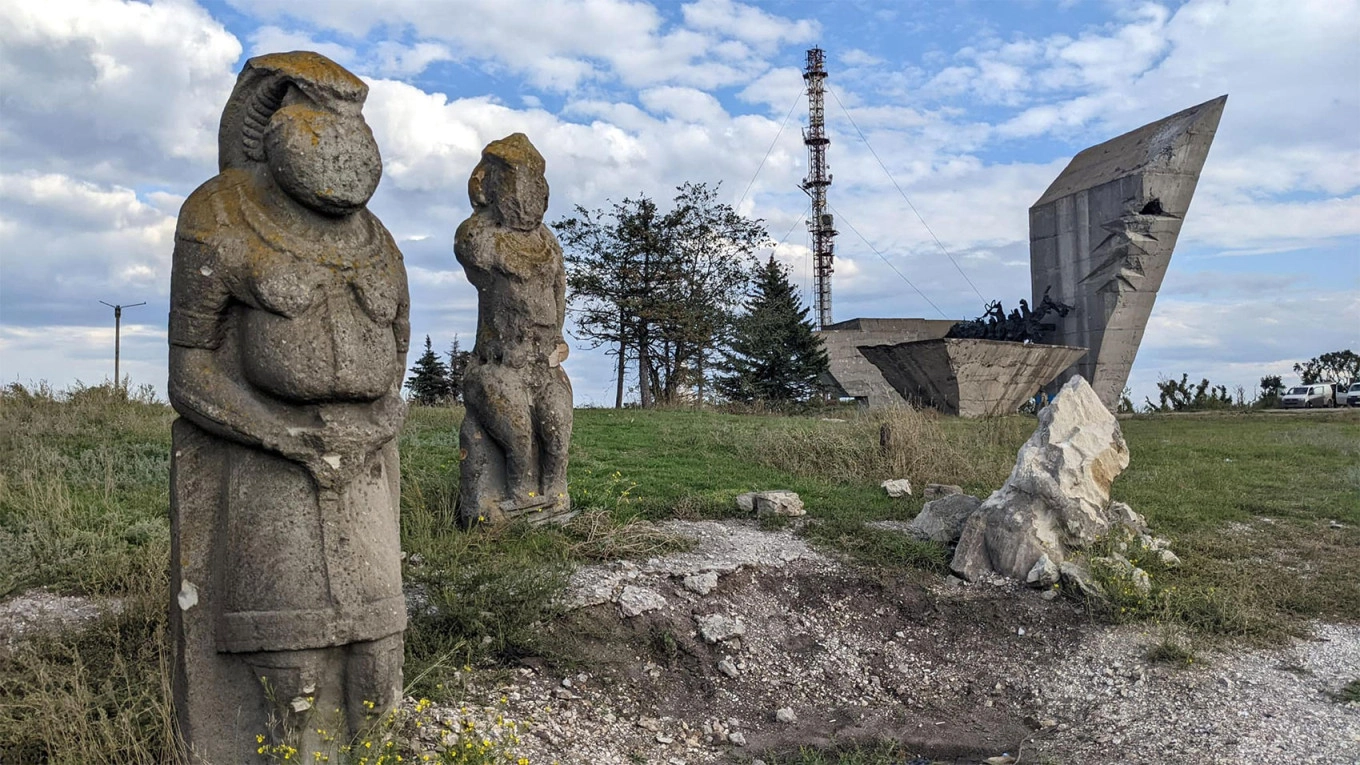
Polovtsian stone sculptures (babas) on Mount Kremenets following Russian shelling during the Battle of Izium. One of the statues was completely destroyed. A nearby World War II monument (seen in the right-hand background) was partially destroyed.
By Andrew Dearman
There is never enough funding for the arts. Globally, cultural heritage institutions have long struggled with mounting costs and fixed or shrinking budgets; a burden that becomes especially acute during and after armed conflict. War-torn countries face economic crises, and traditional funding channels collapse.[1] Meanwhile, private donations towards emergency preservation initiatives remain scarce.[2] This article surveys key international organisations that provide critical funding for emergency cultural heritage protection. However, despite good intentions, these international governmental organizations and NGOs are often fundamentally ill-equipped to respond to the urgency of armed conflict. Bureaucratic delays and donor-led political agendas continue to hinder effective responses.[3]
UNESCO: The Fund for the Protection of Cultural Property in the Event of Armed Conflict

As part of the 1999 Second Protocol to the 1954 Hague Convention, UNESCO established the Fund for the Protection of Cultural Property in the Event of Armed Conflict (the “Fund”). The Fund is maintained by voluntary contributions from UNESCO member states, organizations, and private donors, and typically offers between $15,000 and $50,000 financial support per project.[4] Requests for funding usually need to be submitted six months before the ordinary meeting of the Committee for the Protection of Cultural Property in the Event of Armed Conflict (the “Committee”). However, in emergencies, this process is waived, and the Committee aims to review requests as quickly as possible.[5]
The fund supports protective measures during peacetime, such as providing experts to train staff, creating inventories, and setting up administrative structures to safeguard cultural property. These initiatives are specifically aligned with the articles of the 1954 Hague Convention, for example, providing advice on marking cultural property with the ‘distinctive emblem’ referred to in Article 6.[6] The Fund can also provide emergency assistance during and immediately after armed conflict. During war, funds can be allocated towards setting up temporary facilities for administrative work, as well as refuges for movable cultural property. After conflict, funds may support the reinstallment of cultural property and conservation efforts.[7]
However, UNESCO has drawn scepticism around their ability to effectively take action during wartime.[8] The application process in extensive, and unclear timelines create uncertainty for countries requesting assistance.[9] UNESCO’s effectiveness is also undermined by their lack of neutrality, governed by the political interests of their member states.[10] This encourages selectivity when choosing what cultural heritage to protect.[11] Ultimately, the procedural and ethical issues embedded within UNESCO’s fund exemplify the wider issues that plague this sector.
ALIPH: The International Alliance for the Protection of Heritage

Established in 2016 as a response to the growing threat to cultural heritage posed by ISIS in the Middle East, ALIPH was heralded as a promising newcomer in the landscape of cultural heritage funding.[12] The organisation, governed from Geneva, positioned itself as an agile, forward-thinking funding body, dedicated to safeguarding heritage endangered by armed conflict, climate change, and natural disasters.[13] Announced as part of a Franco-Emirati initiative, it rapidly secured backing from several member state governments, alongside public and private donors.[14] They regularly call for projects in targeted funding rounds, but also operate an emergency relief mechanism that provides up to $75,000 per project.[15]
ALIPH’s collaborations with organisations such as UNESCO enhance their credibility, but also entangle them within the same systems of geopolitical influence and selectivity. They have, however, also been praised for their willingness to engage with politically sensitive regions such as Cambodia, where UNESCO has not fully intervened due to conflicts of interest.[16] As always, any attempts by foreign governments to invest in the heritage of other countries is often intertwined with soft power campaigns. In international relations, soft power initiatives seek to influence others through culture and diplomacy rather than force. This dynamic is heightened post-conflict when nations rely on international allies, creating opportunities for donor states to gain stakes in recovering economies.[17]
ALIPH emphasises speed and responsiveness as their core and distinctive values. Their emergency relief fund aims to answer requests within one month, although they still require a precise budget and evidence that the project can be implemented promptly.[18] However, in the past they have successfully wired finances within less than a week, supporting a Ukrainian museum mere days after the Russian invasion.[19] At times, their support has even been criticised as premature, with ongoing conflicts threatening to reverse the conservation efforts they have funded.[20] Nevertheless, ALIPH continues to play a leading role in emergency cultural heritage protection, recently announcing over $16 million in funding for new projects.[21]
CER: Cultural Emergency Response

Acting with a similar agility to ALIPH, Cultural Emergency Response was founded in 2003 by the Prince Claus Fund for Culture and Development, but now functions as an independent NGO.[22] Based in Amsterdam, they provide targeted financial support and expertise to local communities where cultural heritage is under immediate threat. Describing themselves as a ‘cultural ambulance,’ the organisation prioritises rapid response ‘first aid’ interventions, aimed at mitigating damage and loss, rather than supporting long term restoration efforts.[23] Such actions include stabilising heritage sites, evacuating and documenting cultural property, digitising manuscripts, and making damage assessments.[24]
Although CER provides comparatively modest grants, ranging from €15,000 and €35,000, their strength lies in their ability to react quickly with limited bureaucracy.[25] Initially, they request a brief ‘statement of need,’ to assess whether a project meets the basic criteria for support. If eligible, applicants are invited to submit a full application. Crucially, the organisation only requires basic project details to facilitate timely decision-making processes, assisted by their dedicated 24/7 response team.[26] Unlike larger organisations, CER emphasises urgency over administrative perfection, making it more accessible for smaller, less experienced institutions. While this streamlined approach may raise questions around long-term accountability and project success, CER remains one of the few funding bodies capable of delivering support at the critical moment when conflict erupts and cultural heritage is most vulnerable.
CER believes decentralisation is key to the future of heritage protection, and works closely with local organisations to ensure communities have agency over the protection of their heritage.[27] This locally driven approach addresses the criticisms levelled at institutions like UNESCO, who in the past have negligently imposed heritage reconstruction programmes whilst overstepping local voices.[28] Furthermore, CER has established regional hubs across the globe to support the long-term sustainability of local expertise and strengthen international networks for cultural heritage protection.[29]
National and Regional Funding Bodies

While international organisations play a vital role in supporting cultural heritage protection, many national governments and regional institutions have developed their own funding schemes. These initiatives not only demonstrate a state’s commitment to cultural heritage protection, but also function as instruments of soft diplomacy, fostering diplomatic connections with affected states and securing footholds in post-crisis economies.[30] These government-led schemes are vital, especially as Western nations slash their budgets for international development aid, including cultural cooperation initiatives.[31]
For instance, the British Council administers the Cultural Protection Fund, founded in 2016 as the UK government’s official response to the growing need for international cultural heritage protection. The fund supports a range of global projects, as to demonstrate the UK’s dedication to cultural heritage protection.[32] However, due to the cumbersome nature of governmental processes, the fund only operates through periodic funding rounds, obstructing their ability to respond flexibly during moments of crisis. The United Kingdom also contributes directly to UNESCO’s Heritage Emergency Fund. Rather than establish their own funding bodies, many European governments similarly donate to international organisations such as UNESCO and ALIPH.[33]
In the United States, the Ambassadors Fund for Cultural Preservation, administered by the U.S. Department of State since 2001, supports a wide range of initiatives aimed at safeguarding cultural heritage. The Department of State highlight the fund’s secondary purpose as a tool of soft power diplomacy, demonstrating their ‘respect for other cultures’.[34] The US Ambassador Fund’s grants typically range from $25,000 to $500,000 and are awarded through U.S. embassies abroad through ad hoc calls for projects. Applications are reviewed in collaboration with the Bureau of Educational and Cultural Affairs, and in the past successful projects have included recovery efforts in post-conflict communities.[35]
Historically, the National Endowment for the Humanities also contributes to cultural heritage protection. In the absence of a dedicated emergency response fund in the US, the NEH promotes the ‘Protecting our Cultural Heritage’ special encouragement, focusing on projects that engage with primarily preventative actions concerning at-risk cultural property.[36] However, this scheme has recently come under attack, when Trump’s administration rescinded $72 million of the NEH’s annual funding, leading to the termination of nearly 1500 grants.[37] This development mirrors significant cuts to U.S. foreign aid imposed by the U.S. Department of State in 2025, which has heavily affected cultural heritage organisations.
For instance, the World Monuments Fund, an international NGO headquartered in New York, also suffered budget cuts of over $800,000, disrupting projects to rehabilitate sites damaged by conflict.[38] The World Monuments Fund initiate and implement projects around the globe to safeguard global heritage, in collaboration with local communities, governments, and funders.[39]
Other funding bodies are geographically targeted, such as the African World Heritage Fund. Launched in 2006 and hosted by the South African government, the AWFH focuses on addressing the vulnerability of African heritage sites, including efforts to overhaul locations designated on the ‘World Heritage in Danger’ list.[40] The fund provides different routes of funding for conservation and education but also issues emergency grants to heritage sites facing escalating disaster situations.[41]
Regional initiatives like the AWHF represent an important shift towards more autonomous and locally led approaches, although currently they function as UNESCO Category II Centre, and are guided by UNESCO’s strategic objectives.[42] Nevertheless, the AWHF stands as a critical counterbalance to the often externally imposed priorities of international agencies, reinforcing the need for heritage protection strategies to be regionally led, culturally involved, and distanced from colonial pasts.[43]
NGOs and Private Funding
Finally, while private funding clearly plays a crucial role in cultural heritage protection, it also demands scrutiny. On the one hand, private funding can circumvent administrative protraction and reach crisis zones swiftly. However, it is also not bound by the ethical and regulatory oversight of national and inter-governmental institutions. Instead, funding directly reflects the ideologies of individual foundations, who can ultimately decide what cultural heritage they deem worthy of preservation.[44] As such, private funding risks reproducing colonial power dynamics under the guise of philanthropy.
It also remains difficult to identify and secure private funding, especially for institutions with little experience of crisis management.[45] Instead, many foundations and individuals support indirectly by giving money to the international funding bodies outlined above or other cultural operators. For example, the JM Kaplan Fund and Whiting Foundation have both regularly supported efforts to preserve cultural heritage during armed conflict, both directly, and through partnerships with the Cultural Emergency Response.[46] But ultimately, private funding remains too elusive and inconsistent to be a dependable foundation for cultural heritage preservation.
Conclusion
There is no doubt that the field of emergency cultural heritage protection remains critically underfunded, reliant on international cooperation whilst constantly navigating changing political climates. At present, active wars in places such as Ukraine, Yemen, Palestine, and Sudan continue to threaten and destroy cultural property, including several World Heritage Sites inscribed on the List of World Heritage in Danger.[47]
Across the West, governments continue to reduce funding for cultural preservation, prioritising defence expenditure. Recent cuts by the U.S. Department of State to foreign aid impacted major cultural operators, stripping ALIPH of a $645,000 grant earmarked for Ukraine.[48] In the UK, the downturn in government funding for the Arts has been described as a threat to soft power, coinciding with an increased defence budget and cuts to overseas aid.[49] As government support continues to decline, private funding for cultural heritage protection also remains ethically contentious and inconsistent.
Beyond financial scarcity, the Cultural Heritage protection sector is hindered by structural flaws. Large institutions like UNESCO struggle with bureaucratic delays and are governed by the geopolitical agendas of their member states. Whereas agile organisations such as ALIPH and CER attempt to confront these issues by providing rapid interventions and working directly with local communities. Despite overall limitations, emergency funding will always be indispensable to the preservation of global heritage worldwide, and ultimately, rebuilding community identity post-conflict.
About the Author:
Andrew Dearman is an undergraduate History of Art student at the Courtauld Institute in London. He previously worked in the antiquities department at Christie’s, and served as a Summer 2025 Intern at the Center for Art Law. He is interested in cultural heritage policy, specifically the legal and ethical concerns surrounding the trade and restitution of antiquities.
Select References:
- Eden Stiffman, Cultural Preservation in Disasters, War Zones Presents Big Challenges, The Chronicle of Philanthropy (June 4, 2025), available at https://www.philanthropy.com/article/cultural-preservation-in-disasters-war-zones-presents-big-challenges/. ↑
- Id. ↑
- René Teijgeler and Mehiyar Kathem, Ethics In International Cultural Heritage Interventions. What We Can Learn from Humanitarian Principles, UCL Blogs (December 1, 2021), available at https://blogs.ucl.ac.uk/nahrein/2021/12/01/what-we-can-learn-from-humanitarian-principles-ethics-in-international-cultural-heritage-interventions/. ↑
- UNESCO, Fund for the Protection of Cultural Property in the Event of Armed Conflict, https://www.unesco.org/en/heritage-armed-conflicts/international-fund (last visited July 20, 2025). ↑
- Id. ↑
- UNESCO, The Fund for the Protection of Cultural Property in the Event of Armed Conflict (2020), available at https://unesdoc.unesco.org/ark:/48223/pf0000378063. ↑
- Id. ↑
- Thomas G. Weiss and Nina Connelly, Cultural Cleansing and Mass Atrocities: Protecting Cultural Heritage in Armed Conflict Zones, 1 J. Paul Getty Trust Occasional Papers In Cultural Heritage Policy 23 (2017), available athttps://www.getty.edu/publications/occasional-papers-1/downloads/WeissConnelly_CulturalCleansing.pdf. ↑
- The application requirements include a detailed breakdown of the proposed project, budget, work plan and expected results.UNESCO, International Assistance Application Form, available at https://www.unesco.org/sites/default/files/medias/fichiers/2024/04/International%20Assistance%20Request%20Form_EN.pdf?hub=180145 (last visited July 20, 2025). ↑
- Mehiyar Kathem, Eleanor Robson and Lina G. Tahan, Cultural heritage predation in Iraq, Chatham House Research Publications (March 24, 2022), available at https://www.chathamhouse.org/2022/03/cultural-heritage-predation-iraq/04-economic-and-geostrategic-dimensions-cultural-heritage. ↑
- Thomas G. Weiss and Nina Connelly, Cultural Cleansing and Mass Atrocities: Protecting Cultural Heritage in Armed Conflict Zones, 1 J. Paul Getty Trust Occasional Papers In Cultural Heritage Policy 23 (2017), available athttps://www.getty.edu/publications/occasional-papers-1/downloads/WeissConnelly_CulturalCleansing.pdf.René Teijgeler and Mehiyar Kathem, Ethics In International Cultural Heritage Interventions. What We Can Learn from Humanitarian Principles, UCL Blogs (December 1, 2021), available at https://blogs.ucl.ac.uk/nahrein/2021/12/01/what-we-can-learn-from-humanitarian-principles-ethics-in-international-cultural-heritage-interventions/. ↑
- Thomas G. Weiss and Nina Connelly, Cultural Cleansing and Mass Atrocities: Protecting Cultural Heritage in Armed Conflict Zones, 1 J. Paul Getty Trust Occasional Papers In Cultural Heritage Policy 24 (2017), available athttps://www.getty.edu/publications/occasional-papers-1/downloads/WeissConnelly_CulturalCleansing.pdf. ↑
- ALIPH, Mission, https://www.aliph-foundation.org/en/our-ambition (last visited July 20, 2025). ↑
- Melissa Gronlund, Inside Aliph, the organisation racing to save the world’s heritage, The Art Newspaper (November 29, 2024), available at https://www.theartnewspaper.com/2024/11/29/inside-aliph-the-organisation-racing-to-save-the-worlds-heritage. ↑
- ALIPH, Grants, https://www.aliph-foundation.org/en/our-grants (last visited July 20, 2025). ↑
- Melissa Gronlund, Inside Aliph, the organisation racing to save the world’s heritage, The Art Newspaper (November 29, 2024), available at https://www.theartnewspaper.com/2024/11/29/inside-aliph-the-organisation-racing-to-save-the-worlds-heritage.Alice Lopes Fabris, Protecting Cultural Heritage during an Occupation in International Courts versus Non-Compliance Mechanisms 445 (2024), available at https://www.cambridge.org/core/books/international-courts-versus-noncompliance-mechanisms/protecting-cultural-heritage-during-an-occupation/5BDA1AA52793CFE79DAD30E6CBED49BF?utm_campaign=shareaholic&utm_medium=copy_link&utm_source=bookmark ↑
- Id. ↑
- ALIPH, Grant Application Guidelines (2019), HnHsXeiJ9qJorfPo1zjkzGKlTHUvMO53LXVygGJq.pdf. ↑
- Melissa Gronlund, Inside Aliph, the organisation racing to save the world’s heritage, The Art Newspaper (November 29, 2024), available at https://www.theartnewspaper.com/2024/11/29/inside-aliph-the-organisation-racing-to-save-the-worlds-heritage. ↑
- Id. ↑
- Melissa Gronlund, Syria, Ukraine and Gaza among countries to receive heritage funds from Aliph, The Art Newspaper (July 10, 2025), available at https://www.theartnewspaper.com/2025/07/10/syria-ukraine-and-gaza-are-among-countries-to-receive-heritage-funds-from-aliph. ↑
- Cultural Emergency Response, Who We Are, https://www.culturalemergency.org/programs/about-cer (last visited July 20, 2025). ↑
- Id. ↑
- Cultural Emergency Response, How We Help, https://www.culturalemergency.org/programs/first-aid-to-cultural-heritage (last visited July 20, 2025). ↑
- Id. ↑
- Id. ↑
- Cultural Emergency Response, Network of CER Regional Hubs, https://www.culturalemergency.org/programs/regional-hubs (last visited July 20, 2025). ↑
- Mehiyar Kathem, Eleanor Robson and Lina G. Tahan, Cultural heritage predation in Iraq, Chatham House Research Publications (March 24, 2022), available at https://www.chathamhouse.org/2022/03/cultural-heritage-predation-iraq/04-economic-and-geostrategic-dimensions-cultural-heritage. ↑
- Cultural Emergency Response, Network of CER Regional Hubs, https://www.culturalemergency.org/programs/regional-hubs (last visited July 20, 2025). ↑
- Melissa Gronlund, Inside Aliph, the organisation racing to save the world’s heritage, The Art Newspaper (November 29, 2024), available at https://www.theartnewspaper.com/2024/11/29/inside-aliph-the-organisation-racing-to-save-the-worlds-heritage. ↑
- The Urgency of Cultural Development Aid Amid Global Cuts, Prince Claus Fund (March 12, 2025), available at https://princeclausfund.nl/news/the-urgency-of-cultural-development-aid-amid-global-cuts.Gabriella Angeleti, ‘We can’t predict the future or what will happen’: Trump’s slashing of US foreign aid hits heritage conservation, The Art Newspaper (April 2, 2025), available at https://www.theartnewspaper.com/2025/04/02/trumps-slashing-of-us-foreign-aid-hits-heritage-conservation. ↑
- British Council, What is the Cultural Protection Fund?, https://cultural-protection-fund.britishcouncil.org/about (last visited July 20, 2025). ↑
- UNESCO, Heritage Emergency Fund, https://www.unesco.org/en/culture-emergencies/heritage-emergency-fund (last visited August 25, 2025).ALIPH, Our Partners, https://www.aliph-foundation.org/en/our-partners (last visited August 25, 2025). ↑
- United States Department Of State, Ambassadors Fund for Cultural Preservation, https://eca.state.gov/Cultural-Heritage-Center/Ambassadors-Fund-Cultural-Preservation (last visited July 20, 2025). ↑
- U.S. Embassy In Egypt, U.S. Ambassadors Fund for Cultural Preservation, https://eg.usembassy.gov/education/u-s-ambassadors-fund-for-cultural-preservation/?_ga=2.161866748.1580815848.1752919877-1180090519.1752919877 (last visited July 20, 2025).United States Department Of State, Ambassadors Fund for Cultural Preservation, https://eca.state.gov/Cultural-Heritage-Center/Ambassadors-Fund-Cultural-Preservation (last visited July 20, 2025). ↑
- National Endowment For The Humanities, About “Protecting our Cultural Heritage”, https://www.neh.gov/about-protecting-our-cultural-heritage (last visited July 20, 2025). ↑
- Interior, Environment, and Related Agencies Appropriations Bill, 2026 https://appropriations.house.gov/sites/evo-subsites/republicans-appropriations.house.gov/files/evo-media-document/fy26-interior%2C-environment%2C-and-related-agencies-bill-sumnmary-subcommittee.pdf.Jessica Blake, What Happened to the Smaller Agencies Trump Tried to Shutter?, Inside Higher Ed (July 16, 2025), available at https://www.insidehighered.com/news/government/science-research-policy/2025/07/16/neh-americorps-and-others-face-financial-freezes. ↑
- Gabriella Angeleti, ‘We can’t predict the future or what will happen’: Trump’s slashing of US foreign aid hits heritage conservation, The Art Newspaper (April 2, 2025), available at https://www.theartnewspaper.com/2025/04/02/trumps-slashing-of-us-foreign-aid-hits-heritage-conservation. ↑
- World Monuments Fund, WMF HQ https://www.wmf.org/global-offices/wmf-headquarters (last visited August 25, 2025). ↑
- African World Heritage Fund, Investing in Heritage https://awhf.net/ (last visited July 20, 2025). ↑
- African World Heritage Fund, Grants https://awhf.net/grants/ (last visited July 20, 2025). ↑
- African World Heritage Fund, Governance https://awhf.net/governance/ (last visited July 20, 2025). ↑
- Melissa Gronlund, Inside Aliph, the organisation racing to save the world’s heritage, The Art Newspaper (November 29, 2024), available at https://www.theartnewspaper.com/2024/11/29/inside-aliph-the-organisation-racing-to-save-the-worlds-heritage. ↑
- René Teijgeler and Mehiyar Kathem, Ethics In International Cultural Heritage Interventions. What We Can Learn from Humanitarian Principles, UCL Blogs (December 1, 2021), available at https://blogs.ucl.ac.uk/nahrein/2021/12/01/what-we-can-learn-from-humanitarian-principles-ethics-in-international-cultural-heritage-interventions/. ↑
- Eden Stiffman, Cultural Preservation in Disasters, War Zones Presents Big Challenges, The Chronicle of Philanthropy (June 4, 2025), available at https://www.philanthropy.com/article/cultural-preservation-in-disasters-war-zones-presents-big-challenges/. ↑
- A War on Collective Memory in Ukraine, Cultural Emergency Response (November 29, 2022), available at https://www.culturalemergency.org/stories/a-war-on-collective-memory. ↑
- UNESCO, List of World Heritage in Danger, https://whc.unesco.org/en/danger-list/ (last visited August 25, 2025). ↑
- Gabriella Angeleti, ‘We can’t predict the future or what will happen’: Trump’s slashing of US foreign aid hits heritage conservation, The Art Newspaper (April 2, 2025), available at https://www.theartnewspaper.com/2025/04/02/trumps-slashing-of-us-foreign-aid-hits-heritage-conservation. ↑
- Franklin Nelson, Budget cuts threaten UK soft power, warns government adviser, Financial Times (May 30, 2025), available at https://www.ft.com/content/2981be3a-5f01-424b-bc19-de2bedc6ac17.George Parker and Sam Fleming, Rachel Reeves unveils 3% NHS spending boost but cuts other budgets, Financial Times (June 11, 2025), available at https://www.ft.com/content/4c8d65cc-d652-4998-9c47-e06763710773. ↑
Disclaimer: This article is for educational purposes only and is not meant to provide legal advice. Readers should not construe or rely on any comment or statement in this article as legal advice. For legal advice, readers should seek a consultation with an attorney.


You must be logged in to post a comment.