

Dear Readers,
You may have had a deja vu with our February newsletter. Our apologies if you read that issue twice. Our attention has been split between major upcoming events (Annual Conference on April 10th, Summer School in May, Bootcamps (wait for it), and so much more), interviewing incredibly talented and promising interns for the summer, traveling, reading/avoiding reading the news, family obligations and daily duties that no AI is able to tame. Before March is over, take a look at what we have compiled for you this month.
With our website recovering from a tedious hack, we are remarking that our Instagram following surpassed 6,000 and our mailing list exceeded five digits. What do these numbers indicate? Other key performance indicators are more informative (record number of interactions did we see with our Immigration Under Trump Workshop, the excellent discussion during the webinar about Jeanne-Claude and Christo’s unrealized project, Over the River, preparations for our amicus brief, gearing up for a webinar in London, etc). But enough about us! We want to hear from you as we prepare to end FY2025 strong. If you think we missed something important, remember that sharing is caring, and if you have funds to spend on high-ticket items come May auctions, imagine how much more you can get for becoming a sponsor of the Center. According to people in the know, there are trillions of dollars waiting for the “next great wealth transfer” and decline of public funding for the arts. Something to think about.
Onwards,
Center for Art Law Team
Content
In Brief
-
[Repatriation] The Metropolitan Museum of Art (Met) Returns Bronze Sculpture to Greece
In coordination with the Hellenic Republic of Greece, the Met has agreed to repatriate a 7th-century BC bronze griffin head after the museum’s provenance researchers determined it had been illicitly removed from Greece in the 1930s. As part of the agreement, the griffin will be loaned to the Met next year for a special exhibition. Following the launch of the Met’s Cultural Property Initiative, additional objects in its collection are under investigation. [Read more here.] [DD]
-
[Repatriation] Ohio Museum Returns Greco-Roman Statue to Turkey
A headless ancient bronze statue is being returned to Turkey after years of dispute over its provenance. In August 2023, the Manhattan District Attorney’s Antiquities Trafficking Unit issued a “seized in place” order for the 6-foot-3-inch sculpture, leading to a lawsuit over ownership. Once thought to depict the Roman Emperor Marcus Aurelius, new evidence suggests it represents a philosopher. Officials from the Cleveland Museum of Art traveled to Bubon, Turkey, to investigate the statue’s origins. Scientific testing confirmed that the statue had been looted, prompting the museum to agree to its return and to drop the lawsuit against the Manhattan DA. Read more here and here. [DD]
-
[Looting] Syria Calls for an End to Looting and the Restoration of Its Cultural Heritage
Looting and unauthorized excavations across Syria since 2011 have caused extensive damage to the country’s cultural heritage. Since the fall of the Assad regime, tens of thousands of artifacts remain unaccounted for, archaeological sites are in disarray, and museums have been targeted by thieves and terrorists. In response, citizens and experts have mobilized to advocate for the protection of Syria’s cultural heritage and to combat the illicit trade of antiquities. In addition to restoration efforts, advocates are calling for a coordinated national initiative. Read more here and here. [DD]
-
[Legislation and Regulation] Cherokee Nation Extends the Artists Recovery Act for Native Americans
The 2022 Artists Recovery Act (ARA) was initially implemented to support Cherokee artists through the economic and social challenges brought on by the COVID-19 pandemic. The ARA provides funding for classes, registration and conference fees, travel, tax preparation, and access to commercial opportunities. The Cherokee Nation Council unanimously approved a proposal to extend the ARA through 2026, along with a $1 million funding increase. Read more here. [DD]
-
[Repatriation] Netherlands to Return 113 Benin Bronzes to Nigeria
The Benin Bronzes are a collection of artifacts looted by British soldiers during a punitive expedition in 1897. While Nigeria has requested the return of all Benin Bronzes—numbering in the thousands and primarily made of brass, wood, ceramic, and ivory—the Netherlands has now become the largest country to grant such a request.
Dutch Minister of Culture Eppo Bruins stated that the Netherlands is “contributing to the redress of a historical injustice that is still felt today.” However, concerns over public access to the artifacts arose in March 2023 after Nigerian President Muhammadu Buhari issued a decree transferring ownership of all repatriated Benin Bronzes to the Oba of Benin, Ewuare II, and the Benin Royal Family. The decree also applies to future repatriations, including those from the Netherlands.
On February 26, 2025, Nigeria’s National Commission for Museums and Monuments (NCMM) assured the public that it would oversee the retrieval and preservation of the Benin Bronzes, with the Oba’s approval. As the designated custodian, the Oba has agreed to allow the NCMM to manage the artifacts until proper infrastructure is established for their display. Read more here and here. [DD]
-
[Art Theft] Trial Begins for Stolen Gold Toilet
In 2019, Maurizio Cattelan’s fully functional, 18-carat gold toilet was stolen from Blenheim Palace. Five men allegedly rammed through the gates, taking only five minutes to remove the artwork. According to prosecutors, the toilet has never been recovered and is believed to have been melted down and divided into smaller gold pieces.
Three men are now on trial for the theft. Michael Jones has been charged with burglary and has pleaded not guilty. Fred Doe and Bora Guccuk face charges of conspiracy to convert or transfer criminal property (gold) and have also denied the charges. The trial is expected to last four weeks. Read more here and here. [EK]
-
[VARA] Federal Lawsuit Filed to Save Elizabeth Street Garden in Manhattan
On February 18, 2025, Joseph Reiver—whose father transformed a city lot into the Elizabeth Street Garden—filed a federal lawsuit against New York City over its plan to replace the garden with affordable housing. Reiver’s lawsuit, brought under the Visual Artists Rights Act (VARA), argues that the garden itself is a work of art deserving of legal protection. Read the complaint and the history of the Elizabeth Street Garden. [EK]
-
[Authentication] Basquiat Forgery Lawsuits Dropped Following Former Director’s Death
In 2022, the FBI raided the Orlando Museum of Art (OMA) and seized 25 forgeries falsely attributed to Jean-Michel Basquiat. The museum subsequently fired its director and chief executive, Aaron De Groft, who later filed a countersuit against OMA.
Following De Groft’s passing in January 2025, both parties have agreed to drop their respective lawsuits. Read more here
-
[Censorship] Arts Organizations Condemn Trump Administration’s Cultural Policies
On February 26, 2025, the National Coalition Against Censorship, The Authors Guild, The Dramatists Guild of America, The Dramatists Legal Defense Fund, Artists at Risk Connection, AICA International, and PEN America issued a statement criticizing recent executive orders affecting the National Endowment for the Arts and the National Endowment for the Humanities. The groups also condemned Trump’s self-appointment as chairman of the Kennedy Center for the Performing Arts. Read the statement here. [EK]
-
[Restitution] Manhattan DA Announces Return of 107 Antiquities to Italy
On February 18, 2025, Manhattan District Attorney Alvin L. Bragg, Jr. announced the repatriation of 107 antiquities to Italy. Among the key pieces returned are a Terracotta Kylix Band-Cup, an Apulian Volute Krater, and a Bronze Patera. These artifacts passed through the hands of alleged antiquities smugglers and infamous art dealers, including one previously convicted of trafficking in the UK. Read more here. [EK]
-
[Historic Preservation] Miami Moves Forward with Marine Stadium Restoration
After decades of neglect, Miami officials are advancing plans to restore the historic Miami Marine Stadium, an architectural landmark on Virginia Key that has been closed since 1992. The city has issued a request for proposals to find a private operator to oversee the venue’s renovation and programming. If approved by voters by the end of 2025, the stadium—once a beloved site for boat races and concerts—could soon rival venues like Red Rocks Amphitheater. Read more here. [DP]
-
[Museums] Brooklyn Museum and Guggenheim Face Backlash Over Layoffs
-
[Public Art] Black Lives Matter Mural Removed in Washington, D.C.
-
[Forgery] Italian Police Raid Art Forger’s Home
After identifying a fake artwork on eBay, police found 71 paintings in total at a home in Rome. The room was set up to create counterfeit pieces, including fake stamps and signatures. No arrests have been made, and the identity of the forger has not been revealed. Read more here. [MG]
-
[Vandalism] Greek Politician Destroys “Blasphemous” Art
At Greece’s National Gallery, a right-wing Greek politician vandalized four “blasphemous” paintings, leading to the museum’s temporary closure. The politician threw the paintings from the wall, damaging the glass of at least two of them. Read more here. [MG]
-
[Art Theft] More Than $200 Million Worth of Stolen Paintings Secured by French Authorities
French authorities have secured 135 paintings, valued at over $208 million, for Uthman Khatib, a private collector seeking to recover a collection of 1,800 pieces of Russian avant-garde art that he alleges were stolen from a German storage facility in 2019. The paintings were seized last spring from the Paris-based art authentication service, ArtAnalysis.
In 2020, an agreement was signed to divide the collection of 1,800 works amassed by art dealer Itzhak Zarug among himself, Mozes Frisch, and Khatib. Khatib ultimately obtained ownership of 871 of the works. However, he claims that Frisch appropriated some of the pieces to which he was entitled under the original agreement. The works seized in Paris will be held by a Paris court bailiff until a Frankfurt court issues a ruling on the alleged theft. Read more here. [NS]
-
[Art Repatriation] San Francisco Museum to Return Four Looted Thai Bronzes
“Moving Objects: Learning from Local and Global Communities,” an exhibition on view at the Asian Art Museum through March 10, explores the history of four ancient bronzes from Thailand that the museum acknowledges were illegally excavated.
The bronzes, over 1,000 years old, are part of a collection known as the “Prakhon Chai hoard.” In 2022, The Denver Postpublished an investigation into how these valuable antiquities were looted from a secret vault at the Plai Bat II temple in northeast Thailand and sold to collector Douglas Latchford. Emma Bunker, a consultant for the Denver Art Museum, helped legitimize Latchford’s collection by publishing articles and books about the pieces and fabricating provenance documents.
The four sculptures on display at the Asian Art Museum were once owned by Latchford. The museum is currently working with the Thai government to transfer ownership of these objects back to Thailand. Read more here. [NS]
-
[Nazi-Looted Art] Germany Approves Tribunal to Decide Nazi-Looted Art Claims
In January, the German government approved a reform aimed at helping the heirs of Jewish collectors recover Nazi-looted art. The reform introduces a binding arbitration tribunal to adjudicate claims, allowing heirs to bring cases without requiring the agreement of the artwork’s current holder. This change makes the restitution process more accessible and legally binding.
While some critics worry that the reform could increase the burden of proof for claimants, many welcome the decision as a critical step in addressing this chapter of history. Read more here. [NS]
-
[Under De-construction] Trump Administration Ends Task Force KleptoCapture, Documenting Damage to Cultural Heritage Sites and Tracking of Kidnapped Children
During an interdisciplinary workshop “The Wartime Art Archive: Developing Research Cultures of Resistance” in London on March 21st, art historians, curators, and artists spoke about archival impulses when they presented the curated project of “The Wartime Art Archive.” Making, collecting and commenting on artistic expression is also about agency. Human reactions are not predictable. Looking at artists, sometimes they cannot help themselves and they produce artistic, visual responses to the current events in real time and sometimes they are paralyzed and number and it takes time to express and react.
Following the announcements of Trump’s administration disbanding KleptoCapture TaskForce in February, disappearing of the Conflict Observatory Portal, and more recently the going dark of the Yale-operated database about children abducted from Ukraine during the Russian-Ukrainian war, questions about war crimes and getting away with these crimes in the context of preservation of culture and art have taken on additional dimensions. Looking at attorneys, sometimes they wait for the right clients to come along to advocate, and sometimes they anticipate what is right and start archiving evidence and laws for future application.
Nazi-era Disputed Art: Research and Restitution
Annual Art Law Conference
Join us in 2025 to discuss Nazi-era looted art research and restitution cases as precedent is meant to help finding fair and just solutions for future wrongs faster.
80 years after the end of World War II and more than 25 years after the 1998 Washington Conference, which set the stage for modern restitution efforts, we continue to face title disputes and build on the pioneering work of those who came before us. Decades of meticulous research, digitization, and scholarship have expanded our understanding of Nazi-era looted art, yet much remains unfinished. Armed with new tools and technologies, how do we persist in the pursuit of fair and just solutions to the enduring legacies of war, genocide, and theft?
The Nazi-Era Disputed Art: Research & Restitution Conference will examine ongoing efforts to document, analyze, and facilitate the restitution of Nazi-era looted art. It will highlight the evolving role of research, digital resources, and interdisciplinary collaboration in uncovering provenance, advancing legal claims, and ensuring accountability. By bringing together attorneys, art historians, museum professionals, heirs, journalists, and scholars, the conference will explore seminal cases, evidence-gathering methodologies, and the evolving challenges of restitution in the 21st century.

VLA, Legal Issues in Photography: Copyright, Contracts, and AI
Join VLA for a comprehensive workshop exploring the key legal issues in the photography business. This session will cover essential topics such as copyright law, contracts, privacy rights, social media, and the impact of AI on photography. Designed for photographers and visual artists of all disciplines, this class will provide both foundational legal principles and practical strategies for navigating common challenges. Whether you’re protecting your own work or using others’ creative content, you’ll gain valuable insights and actionable steps to safeguard your rights and responsibilities.
American Bar Association, Destruction of Cultural Heritage and International Criminal Law
Destruction of cultural heritage is employed by perpetrators to target a community’s unique identity. Destruction of cultural heritage occurs but is not limited to armed conflict, environmental factors (climate change), and development projects. This program will focus on intentional destruction of cultural heritage and developments of cultural heritage protections in international criminal law.
VLA, Legal Issues for Visual Artists
This webinar offers essential legal knowledge for artists and legal professionals on protecting and licensing creative work. Designed for painters, illustrators, photographers, and digital artists, the session covers key topics such as copyright ownership, moral rights, work-for-hire agreements, and fair use. Participants will gain a clear understanding of how to safeguard their work, navigate collaborations, and legally share or monetize their art. Open to creators, collectors, and legal advisors, this webinar provides valuable insights into the legal landscape of the art world.
ARCA’s 15th Annual Interdisciplinary Art Crime Conference
ARCA’s annual Amelia Conference serves as an arena for intellectual and professional exchange and highlights the nonprofit’s mission to facilitate a critical appraisal of the need for protection of art and heritage worldwide. Over the course of one weekend each summer, this art crime-focused event serves as a forum to explore the indispensable role of detection, crime prevention, and scholarly and criminal justice responses, at both the international and domestic level, in combatting all forms of crime related to art and the illicit trafficking of cultural property.
The Association’s 15th annual conference begins on Friday, June 20, 2025 with a networking cocktail open to all Amelia Conference attendees and speakers. At the heart of the conference are two days devoted to presentations selected through this Call to be held in the Collegio Boccarini Conference Hall, on Saturday and Sunday, June 21 and June 22, 2025.

Provenance Research Today: Issues, Resources and Networks
The Center for Art Collection Ethics (ACE) at the University of Denver (DU) is pleased to announce a hybrid training program: Provenance Research Today: Issues, Resources and Networks. The program will run June 23-27, 2025. In its fourth iteration since 2021, the program is geared toward graduate students and emerging museum and art market professionals.
Nazi-Looted Art and the Ongoing Fight for Justice
This FEU conference will explore how the issue of looted art is not merely a historical concern but an ongoing challenge. Our four speakers will examine the complexities of art restitution, the ethical responsibilities of institutions, and the efforts required to return stolen works to their rightful heirs. By shedding light on several issues, this conference aims to foster a deeper understanding of the moral, legal, and historical imperatives surrounding art restitution. Through continued dialogue and action, our French and American guests will reaffirm the importance of accountability, remembrance, and cultural preservation in the wake of one of history’s most devastating cultural crimes.
The process of recovering looted artworks is an intricate undertaking that demands rigorous historical research, genealogical expertise, and forensic investigative techniques to accurately trace the provenance of each piece. Restitution is not merely a legal act; it is a profound engagement with history that sheds light on the intellectual and cultural legacies of families who suffered immense loss during the Holocaust.
Each successful restitution represents a victory against historical erasure. Beyond the return of an artwork, it reclaims narratives that were forcibly silenced, ensuring that the stories of the victims and their descendants are honored and preserved. These efforts play a crucial role in combating Holocaust denial and historical distortion, reinforcing the importance of memory, justice, and truth.


Career Opportunities
-
Contributing Editors, The Museum of Looted Antiquities
The Museum of Looted Antiquities (MOLA) is seeking two volunteer Contributing Editors to assist with developing and peer-reviewing new cases for publication and upcoming exhibits. This part-time, remote role offers flexible hours, requiring a minimum commitment of 12 hours per month for six months. Responsibilities include editing and fact-checking case submissions, conducting peer reviews, researching new cases, and supporting MOLA’s digital platform. Candidates should have strong editing and writing skills, experience with fact-checking, and a background in archaeology, antiquities trafficking, or art law. Contributing Editors will receive training and be publicly credited for their work. To apply, please send a cover letter and writing samples to MOLA@AchillesResearch.org.
-
General Counsel and Associate Register of Copyrights, U.S Copyright Office, Washington D.C
This senior-level position at the U.S. Copyright Office, within the Office of the General Counsel, involves advising the Register of Copyrights on legal and policy matters, representing the Copyright Office in domestic and international forums, and contributing to professional publications. The role includes supervising attorneys and managing the Copyright Law Clerk Program. Responsibilities encompass conducting legal research, drafting policy documents, overseeing reports for Congress, engaging with legislative staff, and consulting with various stakeholders in the copyright ecosystem. The position requires expertise in copyright law, leadership skills, and the ability to influence national and international copyright policy. It is based in Washington, D.C., with no relocation expenses covered.
Read more and apply here.
-
Provenance Research Assistant, Yale U.
Reporting to the Curator for Provenance Research and working with curators, museum assistants, and registrars, the provenance research assistant will support provenance research at the Gallery by reviewing provenance for proposed acquisitions and loans; reviewing collection objects’ ownership histories for outgoing loans; researching collection objects’ ownership histories; assisting with Gallery programming related to provenance; assist with administrative tasks such as data entry and collecting and filing documentation.
Essential Duties: Assist with reviewing provenance research conducted on acquisitions and loans. Assist with reviewing provenance research conducted on outgoing international loans (Immunity from Seizure). Assist with researching, fact-checking and formatting provenance information on permanent collection items for hard-copy files, the Gallery collections database, and online records. Assist with compiling and entering provenance data related to works of art in the museum database.
Assist with research on the historic art market and prior owners of works of art. Organize images of marks of ownership on the backs and undersides of works of art. Monitor press on provenance research and related cultural property issues and compile reading lists. Assist with gallery teaching and working with the Education department to inform Gallery visitors and the wider Yale community on provenance research and related topics. Assist with supervision of undergraduate and graduate bursary students. Assist with daily administrative and technological tasks as needed. Other tasks and duties as needed.
Read more and apply HERE.
-
Addressing Heritage Losses, inherit Fellowships 2026-7 (Berlin, Germany)
Fellowships can be awarded for a maximum period of 10 months. Preference may be given to applications for the full time period, which runs from the beginning of October 2026 until the end of July 2027. Other than for short visits elsewhere, it is required that you spend the time of your fellowship in Berlin and that you participate in the work of inherit. A monthly stipend whose rate is determined by career stage and whether family members accompany the fellow, or, in the case of applicants based in Germany, replacement cover, will be awarded. In addition, the costs for the return journey (economy) to Berlin and any necessary visa costs will be reimbursed. You are required to cover accommodation, health insurance and any further costs. Read more and apply HERE.

Educational & Other Opportunities
-
Summer Internships (Princeton University Art Museum)
Undergraduate and graduate students are invited to apply for an eight-week summer internship at the Princeton University Art Museum. The 2025 summer internship program will run from Monday, June 2, to Friday, July 25. Undergraduate students enrolled in any accredited college or university program and graduate students enrolled in any accredited post-baccalaureate program are eligible to apply. Princeton University students are given priority.
Participants in the program will have the opportunity to intern in one of several departments, including curatorial, education, and information technology. Based on the available internship opportunities listed below, summer applicants should select ONE opportunity in their application; however, the Museum cannot guarantee that applicants will be offered an internship in their preferred department.
Interns are selected on the basis of their experience, academic training, and existing skills. Most interns will have the opportunity to learn about collections research firsthand.
Read more and apply here.
-
The Phil Cowan-Judith Bresler Memorial Scholarship Writing Competition (NYSBA)
The New York State Bar Association Entertainment, Arts and Sport Law (EASL) committee offers The Phil Cowan-Judith Bresler Memorial Scholarship Writing Competition to students in New York and New Jersey law schools. EASL awards two scholarships of $2,500 each for outstanding research & writing in the areas of entertainment law, arts law, sports law and related areas such as fashion law, gaming law and Intellectual property. The deadline is April 1, 2025.For more details, rules and requirements, please visit the competition site.
-
Provenance Research Today: Issues, Resources and Networks (U. of Denver)
The Center for Art Collection Ethics (ACE) at the University of Denver (DU) is offering Provenance Research Today: Issues, Resources and Networks, a hybrid training program running June 23-27, 2025. Now in its fourth year, the program is designed for graduate students and emerging museum and art market professionals. Twenty students will be selected for an on-campus postgraduate certificate with support from the Art Ashes Foundation, while select sessions will be open for virtual attendance. Recordings will be available for one year.
The program is led by experts in the field, including Renée Albiston (Denver Art Museum), Antonia Bartoli (Yale University Art Gallery), and Elizabeth Campbell (DU, ACE).
Learn more and apply here.
-
The Newark Museum of Art Internship Program
The Newmark Museum of Art is launching its Summer 2025 Internship program, including roles related to Public Programs, Collections, and Provenance Research. Learn more and apply here.


Case Law Corner
View both new and old art law cases featured this month in our Case Law Database:
- Safani Gallery, Inc. v. Italian Republic, No. 1:2019cv10507 – Document 97 (S.D.N.Y. 2025).
- Hayden v. Koons, No. 21-CV-10249 (TMR), 2025 U.S. Dist. LEXIS 33345 (S.D.N.Y. Feb. 25, 2025).
- Republic of Hungary v. Simon, No. 23-867., 2025 BL 55756, 2025 Us Lexis 549 (U.S. Feb. 21, 2025).
- Booth v. Anschutz Ent. Grp., Inc., Civil Action No. 3:24-CV-0194-X, 2025 U.S. Dist. LEXIS 19431 (N.D. Tex. Feb. 3, 2025).

Plunder?: How Museums Got Their Treasures
In this thought-provoking new work, historian Justin M. Jacobs challenges the widely accepted belief that much of Western museums’ treasures were acquired by imperialist plunder and theft. The account reexamines the allegedly immoral provenance of Western collections, advocating for a nuanced understanding of how artifacts reached Western shores. Jacobs examines the perspectives of Chinese, Egyptian, and other participants in the global antiquities trade over the past two and a half centuries, revealing that Western collectors were often willingly embraced by locals. This collaborative dynamic, largely ignored by contemporary museum critics, unfolds a narrative of hope and promise for a brighter, more equitable future—a compelling reassessment of one of the institutional pillars of the Enlightenment.
About Jacobs from the University of Chicago Press: “Justin M. Jacobs is associate professor of history at American University. He is the author of Indiana Jones in History and Xinjiang and the Modern Chinese State. He also serves as editor of The Silk Road journal and hosts Beyond Huaxia, a podcast on East Asian history.”
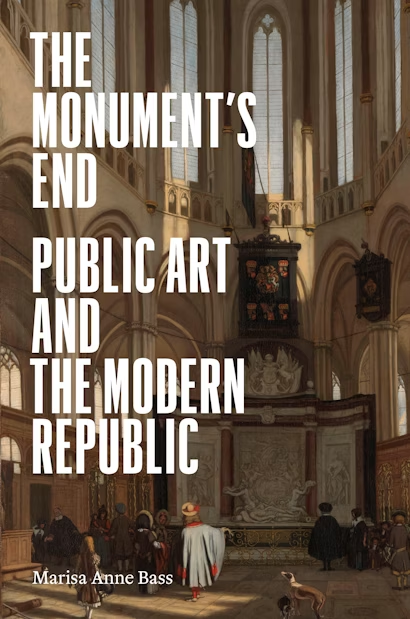
The Monument’s End: Public Art and the Modern Republic
Monuments occupy a controversial place in nations founded on principles of freedom and self-governance. It is no accident that when we think of monuments, we think of statues modeled on legacies of conquest, domination, and violence. The Monument’s End reveals how the artists, architects, poets, and scholars of the early modern Netherlands contended with the profound disconnect between the public monument and the ideals of republican government. Their experiences offer vital lessons about the making, reception, and destruction of monuments in the present.

Art in a State of Siege
Art in a State of Siege tells the story of three compelling images created in dangerous moments and the people who experienced them—from Philip II of Spain to Carl Schmitt—whose panicked gaze turned artworks into omens.
Acclaimed art historian Joseph Koerner reaches back to the eve of iconoclasm and religious warfare to explore the most elusive painting ever painted.

Le front de l’art: Défense des collections françaises, 1939-1945
Monuments Woman Rose Valland, one of the greatest heroines of the arts, risked her life during World War II working under the watchful eyes of the Nazis. Her remarkable story is told in her memoir Le front de l’art: Défense des collections françaises 1939–1945, a book that sheds light on one of the darkest periods in human history.

Die venezianischen Fälle
The aim of disputes over property looted during the National Socialist era is to find a ‘just and fair solution’. But what are ‘just and fair solutions’? And how do you investigate cases of Nazi-looted property? This new kind of publication presents approaches to such cases and the development of solutions. ‘Alternate history’ elements such as Leonardo da Vinci’s “Formula of Invisibility”, Antonio Vivaldi’s composition “The Five Seasons”, or a map from 1506, which mentions a new continent called “America” for the first time are starting points for examining and resolving the cases. The Venetian cases thus provide bridges between art, history, law and ethics. They are accompanied by aspects and models of solutions, as well as a sample restitution agreement.
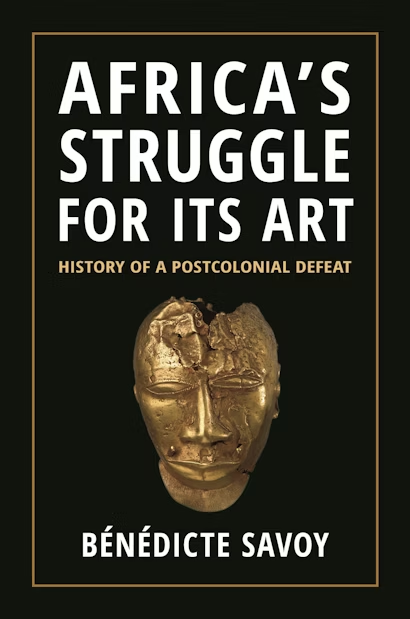
Africa’s Struggle for Its Art: History of a Postcolonial Defeat
For decades, African nations have fought for the return of countless works of art stolen during the colonial era and placed in Western museums. In Africa’s Struggle for Its Art, Bénédicte Savoy brings to light this largely unknown but deeply important history. One of the world’s foremost experts on restitution and cultural heritage, Savoy investigates extensive, previously unpublished sources to reveal that the roots of the struggle extend much further back than prominent recent debates indicate, and that these efforts were covered up by myriad opponents.
Shortly after 1960, when eighteen former colonies in Africa gained independence, a movement to pursue repatriation was spearheaded by African intellectual and political classes. Savoy looks at pivotal events, including the watershed speech delivered at the UN General Assembly by Zaire’s president, Mobutu Sese Seko, which started the debate regarding restitution of colonial-era assets and resulted in the first UN resolution on the subject. She examines how German museums tried to withhold information about their inventory and how the British Parliament failed to pass a proposed amendment to the British Museum Act, which protected the country’s collections. Savoy concludes in the mid-1980s, when African nations enacted the first laws focusing on the protection of their cultural heritage.
Making the case for why restitution is essential to any future relationship between African countries and the West, Africa’s Struggle for Its Art will shape conversations around these crucial issues for years to come.

The Social World of Galleries
This book presents the first detailed study of the place of contemporary art galleries and gallerists, especially within the art markets of Europe and the United States. Based on the author’s field research carried out for over a decade, and combining ethnographic material with quantitative data, the book reveals the major role galleries play in the creation of art value.
Despite being pillars of the art market, there has been very little in-depth research on galleries, especially when compared with the analysis of artists, critics, and dealers. Written by a sociologist who has spent a decade as an art critic, the book builds on work conducted by art historian and sociologist Raymonde Moulin from the 1960s to the 1990s. Drawing on ethnographic observations and interviews with those working in the field today, it provides a thorough and up-to-date analysis of what contemporary art galleries really are: the spaces they occupy both physically and online; their position within gallery ‘districts’; their relation to art fairs and biennials; and how friendship with clients is built and trends within the business, in turn illuminating the hierarchized structure of the sector. The book concludes by addressing a significant gap in data on the art market by providing a sociological ranking of international contemporary art galleries.
Offering a detailed analysis to a topic that has never been fully studied, The Social World of Galleries is essential reading for scholars and students of art sociology, art history and art business, as well as gallerists, collectors or art lovers, and artists themselves.

Deaccessioning Museum Objects: Transparency and ethics in disposal practice
Deaccessioning Museum Objects is an innovative exploration of museum collections management practice and the ethical complexities of object disposal within the contemporary social context.
Disposal of objects from museum collections aids the creation of dynamic and sustainable institutions but can be perceived as a betrayal of public trust and professional duty. Written by an experienced museum professional and researcher, Jennifer Durrant delves into the historical development of disposal to offer insight to the fundamental transience of museum collections. Durrant explains the ethical timeliness and social responsibility of object removal, presenting real-life examples and practical models for transparency creation to show how deaccessioning can be brought to public view and understanding. Emphasising the interaction between professional practice, personal action, and the centrality of conscious reflection, Durrant helpfully investigates what ‘open and honest’ working entails and explores the creation of transparency to museum practices through the lens of disposal.
The combination of theory and practice within Deaccessioning Museum Objects is essential reading for academics and students of museums and heritage; and practitioners in museums, galleries, libraries and archives around the world.

Irascible: The Combative Life of Douglas Cooper, Collector and Friend of Picasso
Born into a wealthy family whose money was made in the 19th century in Australia, Cooper (1911–84) built up much of his collection of works by Picasso, Braque, Gris and Léger in the 1930s. He also trained himself to become a respected art historian, his reputation as a scholar resting largely on his catalogue of the Courtauld Collection (1954) and his catalogue raisonné of Juan Gris (1977). He also organised exhibitions of Gauguin, Braque and two major displays of Cubism. The second of these, The Essential Cubism, co-curated with Gary Tinterow and held at the Tate in 1983, was one of the most remarkable accumulations of Cubist painting, sculpture and drawings ever brought together.
Based on extensive research and packed with new material and fresh interpretations, Irascible focuses attention on Cooper’s colourful life and significant accomplishments: his financing and directorship of the Mayor Gallery in London as a young man in the 1930s, when he became close to artists such as Francis Bacon, Paul Nash, Henry Moore, Paul Klee, Joan Miró, and Max Ernst; his wartime experiences as an ambulance driver in support of the collapsing French army in 1940; his job as a senior Monuments Man in charge of tracking down Nazi-looted art in Switzerland; his move to the south of France in the early 1950s, taking his collection with him; and his legendary feuds with leading figures and institutions in the British art world. This book is also the definitive account of Cooper’s collecting, art dealing, writing and curating.


