
From Italy to India: Cultural Heritage and the Risks of Climate Change
July 15, 2019

By Cates Saleeby.
The global rising of temperatures, sea levels, and pollution rates indicate some of the problems that anthropogenic climate change can cause. The U.K., the government has declared a “national climate emergency” in May 2019.[1] The impacts of climate change have further implications for cultural heritage sites, including the Taj Mahal, the Venetian Lagoon, and the Easter Islands.
World Heritage Addresses Climate Change
The UNESCO keeps and periodically updates a list of World Heritage sites, first established in 1972. Just last week in July 2019, twenty-nine new sites were added to the list, including the old town of Babylon in Iraq and the architecture of Frank Lloyd Wright in the United States. Typically, these sites are locations that offer “outstanding universal value” and meet at least one of ten criteria, such as “represent[ing] a masterpiece of human genius” or “bear unique or at least exceptional testimony to a cultural tradition.”[2] The list is intended to encourage people to appreciate the sites’ history and protect them from violence, political unrest, environmental factors, or other harm.

The UNESCO first addressed the threat that climate change poses to World Heritage sites at their 33rd General Conference in Paris in 2005, where a group of experts convened to explore potential danger and design a protection strategy. The following year, those experts presented the “Strategy to Assist States Parties to the Convention to Implement Appropriate Management Responses” report (“the Report”). The Report notes possible damages, lists preventative and corrective actions, and calls for greater scientific research.[3] The same panel of experts also presented “Predicting and Managing the Effects of Climate Change on World Heritage,” offering a summary of the major effects of climate change and case studies on at-risk sites. It also suggests that climate change may jeopardize a site’s place on the list by removing outstanding universal value.
While the goals, such as communication with policy-makers about the issue and greater participation in climate change mitigation, are noble, they lack binding power upon governments.[4] The reports impose no duty on the states involved in the agreement, offering encouragement rather than consequences.
For several years, the World Heritage section of the United Nations did not specifically address climate change with any major initiatives. Other branches of the United Nations have discussed the issue, as with the enactment of the 2016 Paris Agreement, but neither this document nor any other addresses the particular needs of cultural heritage sites.[5]
Finally, in 2019, a UNESCO session in Baku (Azerbaijan) readdressed climate change and the dangers it poses. It released the Climate Vulnerability Index (“CVI”), a “rapid assessment tool” made to analyze the level of risk a World Heritage site faces.[6] The example analysis of sites at Orkney in Scotland provides evidence that CVI does provide a more consistent method for examining sites in danger.[7] Still, the included policy recommendations are weak, and the report does not give any promise that the organization managing the site will follow through.
This article will use two case studies of cultural heritage sites at risk from a variety of environmental factors aggravated by climate change and explore a potential model for national responsibility.
Venice and Its Lagoon: Ban the Wells
UNESCO has listed the entirety of “Venice and Its Lagoon” as a cultural heritage site since 1987, noting the city’s innovative urban design over 118 small islands, the high concentration of monuments like San Marco and the Palazzo Ducale, the many masterful paintings created and housed there, and the ecological value of the lagoon.[8] The rising sea levels caused in part by climate change threaten the value of this place, leading to flooding that damages the historic buildings with frequent moisture and exposure to salt.
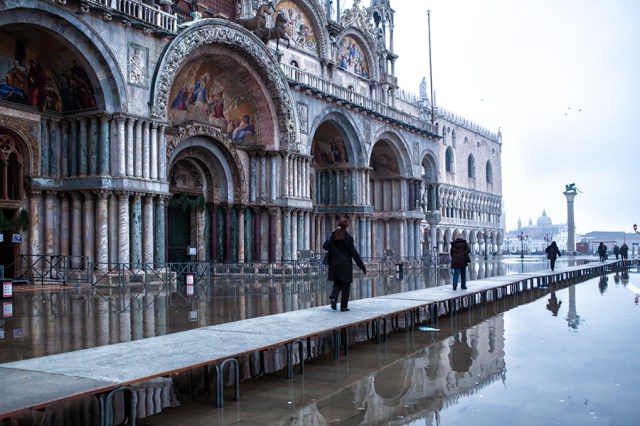
The Piazza San Marco, a centerpiece of Venice and its tourism industry, now floods around sixty times per year, as compared to around four times per year in 1900.[9] This increase is a reflection of the rise in sea levels combined with the erosion and sinking of the islands, leading to standing water in the streets more frequently than ever. The National Research Center of Venice predicts that it is possible that such flooding could occur with nearly every high tide – twice per day – within the next century.[10] This would undoubtedly harm the integrity of the buildings that exhibit Venice’s cultural value and importance in global history.
The city of Venice believed that it had found a solution in the Modulo Sperimentale Elettromeccanico, or Experimental Electromechanical Module (“MOSE”), a series of underwater gates meant to block the flow of water into the city during high tides, thereby stopping the damaging waters. MOSE, Italian for the Biblical figure of Moses who parted the Red Sea, began in 2003 and still has not been completed, despite the five billion euros invested over the years.[11]
Venice may be able to start using MOSE in 2022; even then its function will be limited.[12] While the gates can prevent the highest tides, they cannot block “medium-high” tides that are far more common.[13] The hinges of the gates also are prone to corrosion, meaning that upkeep for MOSE will be expensive.[14] Despite the good intentions of the researchers behind MOSE, their solution will likely not make a significant difference in the safety of the city.
Political corruption has also followed the MOSE project. Several were arrested for embezzling over twenty million euros from a fund intended to support the MOSE project. Giorgio Orsoni, Venice’s mayor from 2010 to 2014, was arrested for taking bribes from this group for his political campaign, and a judge sentenced him to house arrest.[15]
The Italian government has failed to establish any other long-term plans for addressing Venice’s plight, and no international organization has required Italy or any other country to adhere to specific guidelines.[16] On July 4, 2019, a representative from Europa Nostra spoke out against the Italian government’s recent decision to allow cruise ships in the Venetian lagoon at the UNESCO World Heritage Committee Meeting. The speaker argued that allowing the ships into the lagoon will exacerbate flooding and place several sites in greater danger, as the presence of large ships can cause more of the medium-high tides that flood the Piazza San Marco.[17] Italy’s seeming continued apathy towards the risks that Venetian treasures face will lead to near-certain damage to many cultural landmarks.
The Taj Mahal Turns Green
The Taj Mahal, a major artistic and architectural landmark in India, also faces environmental threats to its integrity. Shah Jahan built it in the mid-17th century with the finest materials to commemorate his wife Mumtaz Mahal. Extreme air pollution has tinted the white marble yellow despite regulations placing limits on factories nearby, and water pollution in the area attracts insects that damage the property. India’s Supreme Court has been active over the past thirty years in attempting to mitigate and reverse damage to the Taj Mahal, but efforts have been unsuccessful.

In 1996, the Supreme Court of India issued a ruling to protect the Taj Mahal from degradation by pollution. The decision established regulations for industries in the Taj Trapezium Zone, or TTZ. This zone covers a little over ten thousand square kilometers in area, and the rules for industries within it are meant to shield the Taj Mahal from the effects of air pollution.[18] The decision bars the combustion of fuels like coal and oil and limits the functioning of industries with fertilizer and petrochemicals, all in an effort to reduce the amount of sulfur dioxide in the air. Sulfur dioxide, when mixed with oxygen, can lead to acid rain, which yellows the marble on the Taj.[19] While this decision has lowered emissions in an area that would otherwise have much higher output, the Taj still experiences discoloration, sometimes severe, from air pollution. The Supreme Court continues to uphold this ruling and has recently blocked new industries from opening in the TTZ.[20]

Water pollution in the nearby Yamuna River has also led to problems for the Taj Mahal. The detritus in the river attracts insects, whose waste turns green on the marble of the monument. Clearing this green color away is possible, but the intensive scrubbing that the cleaning process requires often damages the delicate carvings beneath.[21]
The Supreme Court of India has taken a strong interest in the preservation of this monument, challenging the government of Uttar Pradesh, the state in which the Taj is located, to take the air and water pollution into account.[22] In 2018, the court called for the creation of a Vision Document, a long-term plan for the monument’s preservation to be approved and then submitted to UNESCO. When the Uttar Pradesh government filed an unfinished Vision Document, Justices Lokur and Gupta criticized the lack of detail.[23] A committee of judges demanded that the Taj must be “shut down” or “demolished” if it is not “restored.”[24] The court’s most recent decision, made in February 2019, allowed for an extension in drafting the Vision Document and for experts to further examine the environmental state of the area.[25]
India has made several commitments to increasing sustainability nationally, but it has no “binding target” for any of these goals.[26] Recently, a nine-year-old from Uttarakhand, in northern India, filed a lawsuit in New Delhi against the Union of India, claiming that the country should taking a more active stance to protect the environment, especially as a top-five carbon emitting nation.[27] India has been more active than Italy in attempting to reverse the damage to cultural sites and preserve them for the future, but the Taj Mahal still faces environmental dangers that even a more responsive government is slow to fix.
International Solutions
In recent years, environmental factors, both natural and anthropogenic, have destroyed a staggering amount of cultural history and value. Uncontrollable weather events can harm culturally important places, like the hurricanes and earthquakes that have irreparably damaged monuments and archaeological sites at Oaxaca, Mexico.[28] Purposeful human activity and mass tourism has also ruined historic temples, artifacts, and archaeological sites, as in the flooding caused by the construction of the Three Gorges Dam in China.[29]
The international community must address this risk and ensure that states are held responsible for the protection and preservation of their cultural heritage, starting by the UNESCO using its leadership role more wisely. The list of World Heritage in Danger should include sites under threat because of environmental issues like rising sea level and air pollution. This inclusion would allow UNESCO to create binding agreements with specific goals and targets for the home countries of those sites, holding them accountable for failing to meet environmental standards.
Criminalizing the lack of action that often leads to the deterioration of major cultural sites may also create stronger motivations for countries to save major monuments and art threatened by environmental factors. Out of the Hague, the International Criminal Court (ICC) declared in 2016 that it would focus more on environmental crimes.[30] The ICC could address cultural heritage protection in this category, which seems possible considering the court’s involvement with heritage preservation in the past. In 2016, the ICC sentenced Ahmad al-Mahdi to nine years in prison for his involvement in the destruction of ten historical and religious landmarks in Timbuktu.[31] This possibility of legal consequences from the international community could force individual governments to tighten their national and site-specific regulations in order to preserve valuable cultural sites.
National Solutions
Depending on the country, there may also be a possibility for the problem to be handled internally. This could potentially expand the number of protected sites beyond what the international community may recognize, because individual nations and governments may keep their own lists of places of cultural value.
Although the case would be difficult to establish, the United States are under the obligation to preserve and educate about “nationally significant properties.”[32] The U.S. keeps its own list, the National Register of Historic Places, and passed the National Environmental Policy Act (“NEPA”), which, as amended in 2012, states the following:
“In order to carry out the policy set forth in this Act, it is the continuing responsibility of the Federal Government to use all practicable means, […] to improve and coordinate Federal plans, functions, programs, and resources to the end that the Nation may […] (4) preserve important historic, cultural, and natural aspects of our national heritage, and maintain wherever possible, an environment which supports diversity and variety of individual choice; (5) achieve a balance between population and resource use which will permit high standards of living and a wide sharing of life’s amenities […].”
Nat’l Envtl. Policy Act, 42 U.S.C. § 4331(b) (2012).
This commitment establishes a duty for the U.S. government to preserve sites and objects related to cultural heritage. Failing to care for these sites properly could potentially lead to grounds for a negligence claim against the U.S. government, especially when those departments of the U.S. government assign sites to lists like National Historic Landmarks or National Register of Historic Places.
Enough studies have been performed and knowledge disseminated for the U.S. government to reasonably know the risks that, for example, a rising sea level could pose to sites of cultural importance. With over two thousand sites on the National Register of Historic Places, many of them coastal, this environmental factor will threaten several noteworthy sites within the next century.
In a case of negligence, one must establish causation; even if a certain monument was completely destroyed by a rise in sea level that had been correctly predicted decades ago, there are so many variables involved in climate change that proving that the specific non-action of, for example, not tightening carbon emissions regulations or not banning certain industries in an area, led to the destruction.
If the causation is proven, then the level of injury must also be determined. In Trinity Church in Boston v. John Hancock Mut. Life Ins. Co.,[34] a neighboring property owner damaged Trinity Church, a national historic landmark in Boston, MA. Because of the church’s special status as a landmark, the court had to examine the best possible way for reparations to be made. It ultimately decided to restore the church to its condition prior to the damage being done on matter of cost of reparations rather than diminution in value, taking into account the building’s historic methods of construction.[35] Depending on the nature of the harmed monument, processes for restoration may take different paths than those for more modern properties. The climatic conditions that caused the damage may or may not be reversible, and it may be necessary to consider the cost of lost cultural heritage and public value in addition to the material losses faced.

Without any cases regarding cultural heritage and preventable environmental damage to set a precedent, this is all speculation. Courts have so far not hesitated to enforce the NEPA, but it is uncertain how they would address the cultural heritage portion of the law. Lawsuits are also not a dependable way to protect the heritage of an entire country, but a high profile suit could call attention to the problem and encourage adherence to the law.
Conclusion
Climate change effects have begun to interfere with the integrity of cultural heritage sites around the globe. While many international groups and nations have recognized the threat that sites face, the actions of the groups and those countries’ governments have not lived up to purported concern. While international accountability is not yet perfected, States should feel the need to protect their own patrimony, as a testament to their history. As the French student initiative Réseau Etudiant Pour Un Patrimoine Bleu puts it: “Climate urgency […] must be addressed through a strong and efficient mobilization. As young adults interested in spending a few more decades on this planet, it is our duty to raise our voices.”
[1] Lindsay Brown, Climate change: What is a climate emergency?, BBC News (May 3, 2019). Alex Fraser and Dylan Martinez, Goldman Sachs, Bank of England and Treasury targeted by climate activists in London, Reuters (Apr. 25, 2019).
[2] The Criteria for Selection, UNESCO.
[3] Strategy to Assist States Parties to the Convention to Implement Appropriate Management Responses, UNESCO (July 2006).
[4] Id.
[5] Paris Agreement to the United Nations Framework Convention on Climate Change, Dec. 12, 2015, T.I.A.S. No. 16-1104. https://unfccc.int/sites/default/files/english_paris_agreement.pdf.
[6] CVI Heritage Comm., About Climate Vulnerability Index,UNESCO.
[7] Jon C Day et al., Climate Risk Assessment for Heart of Neolithic Orkney World Heritage Site, UNESCO (June 2019).
[8] World Heritage List: Venice and Its Lagoon, UNESCO.
[9] Carl Amos and Georg Umgiesser, Venice Flooding Is Getting Worse – And the City’s Grand Plan Won’t Save It, The Independent (Nov. 18, 2018).
[10] Id.
[11] Brit Mccandless Farmer, Parting the Sea with Venice’s Project Moses, CBS News (Sept. 23, 2018).
[12] Roberto Giovanni, Venice and MOSE: A Story of Failure, La Stampa (Oct. 12, 2017).
[13] Id.
[14] Id.
[15] Mayor of Venice Resigns after Corruption Inquiry, BBC News (June 13, 2014).
[16] Anna Somers Cocks, Goodbye Venice, Goodbye Ravenna, Goodbye Ferrara, Goodbye Carthage?, The Art Newspaper (Dec. 4, 2018).
[17] Anna Somers Cocks, Dramatic Speech in Baku Challenges UNESCO’s Support for Damaging Venice Cruise Ship Decision, The Art Newspaper (July 5, 2019).
[18] M.C. Mehta v. Union of India and Others, A.I.R. 1986 S.C. 1086 (India).
[19] Id.
[20] M.C. Mehta v. Union of India and Others, A.I.R. 2019 S.C. 1086 (India).
[21] Nida Najar and Suhasini Raj, Taj Mahal Under Attack by Bugs and Their Green Slime, New York Times (May 17, 2016).
[22] India Losing Tourists, Eiffel Tower Draws 8 Times More Crowd, Times of India (July 11, 2018).
[23] Supreme Court Slams Uttar Pradesh for Filing Draft Vision Document on Taj Mahal, Economic Times (July 26, 2018).
[24] Gareth Harris, Demolish or Restore Discoloured Taj Mahal, India’s Supreme Court Tells Government, The Art Newspaper (July 16, 2018).
[25] M.C. Mehta v. Union of India and Others, A.I.R. 2019 S.C. 1086 (India).
[26] Grantham Research Institute on Climate Change and the Environment, India: Country Profile, London School of Economics and Political Science (Aug. 22, 2017).
[27] Grantham Research Institute on Climate Change and the Environment, Pandey v. India, London School of Economics and Political Science (Aug. 22, 2017).
[28] Document of the State of Mexico: Policy for Climatic Impact on World Heritage Sites, UNESCO (Feb. 9, 2007).
[29] Patrick E. Tyler, Dam’s Inexorable Future Spells Doom for Yangtze Valley’s Rich Past, New York Times (Oct. 6, 1996). Martin Fackler, China Races Flood to Save Its History, Los Angeles Times (Feb. 3, 2002).
[30] Chris Arsenault,International Court to Prosecute Environmental Crimes in Major Shift, Reuters (Sept. 15, 2016).
[31] Prosecutor v. Ahmad Al Faqi Al Mahdi, ICC-01/12-01/15, Judgment and Sentence (Int’l Crim. Ct. 2016). ICC Convicts Al-Mahdi of War Crime for Destroying Cultural Sites, Int’l Justice Resource Center (Oct. 5, 2016).
[32] Purpose of the National Historic Landmarks Program, Nat’l Park Serv. (Aug. 29, 2018).
[33] Nat’l Envtl. Policy Act, 42 U.S.C. § 4331(b) (2012).
[34] 502 N.E.2d 532 (Mass. 1987).
[35] Id.
Additional Readings:
Anna Somers Cocks, Venice has no official plan for how deal with climate change, The Art Newspaper (July 15, 2019). https://www.theartnewspaper.com/analysis/venice-has-no-official-plan-for-how-deal-with-climate-change
Ben Marzeion and Anders Levermann, Loss of cultural world heritage and and currently inhabited places to sea level rise, Environmental Research Letters (2014).
Adam Vaughan, Sydney Opera House and Statue of Liberty Will Be Lost to Sea Level Rise, The Guardian (Mar. 4, 2014).
Lefteris Papadimas and Idyli Tsakiri,Les changements climatiques affectent les monuments grecs, Changements (June 25, 2019).
About the Author: Cates Saleeby is a Summer 2019 Intern at the Center for Art Law. She is a rising senior at Vanderbilt University and will graduate with a double major in Classics and Medicine, Health, & Society in 2020. Cates can be reached at cates.saleeby@vanderbilt.edu.
Disclaimer: This article is for educational purposes only and is not meant to provide legal advice. Readers should not construe or rely on any comment or statement in this article as legal advice. For legal advice, readers should seek a consultation with an attorney.


You must be logged in to post a comment.