
Copyright Registration for AI Generated Works: Zarya of the Dawn and the Dawn of a New Creator
July 6, 2023
By Atreya Mathur

Artificial intelligence (AI) has most certainly taken over many aspects of life… making things easier? Fascinating? More complex? AI is generating magical hyperrealistic art, music collaborations with artists who have never met, creating enticing cooking recipes, predicting compatibility, answering random research inquiries and so much more. Artists are collaborating with AI to engage creatively and produce works that have been inspired by others or sometimes stolen. Regardless, how much of a work can be protected if it is created by or with AI? Is a “human” author still necessary? How “creative” does the work have to be? Is it protected at all by copyright? The rules and laws are continuously changing with the ever increasing number of AI platforms as well as lawsuits and ethical concerns that come along with the use of AI.
On March 15, 2023, the U.S. Copyright Office announced that works created with the assistance of artificial intelligence (AI) may be copyrightable, provided the work involves sufficient human authorship.[1] This statement comes soon after the decision made by the U.S. Copyright Office in regard to the “Zarya of the Dawn” copyright registration letter. According to the policy statement, works created by AI without human intervention or involvement still cannot be copyrighted, as they fail to meet the human authorship requirement. On the other hand, a work containing AI-generated material may be copyrightable where there is sufficient human authorship, such as when a human selects or arranges AI-generated material in a creative way or modifies material originally generated by AI technology. Ultimately, copyright protection will depend on whether the AI’s contributions are “the result of mechanical reproduction,” or they reflect the author’s “own mental conception.[2] The answer will depend on the circumstances, particularly how the AI tool operates and how it was used to create the final work.”[3] The Copyright Office stated that it may issue additional guidance in the future related to the registration of works produced by, and other copyright issues presented by, this technology and intends to publish a notice of inquiry seeking public input on additional legal and policy topics involving AI. These steps indicate the Copyright Office’s intent to remain involved in the evolving legal landscape of AI technology and its implications for copyright law.[4]
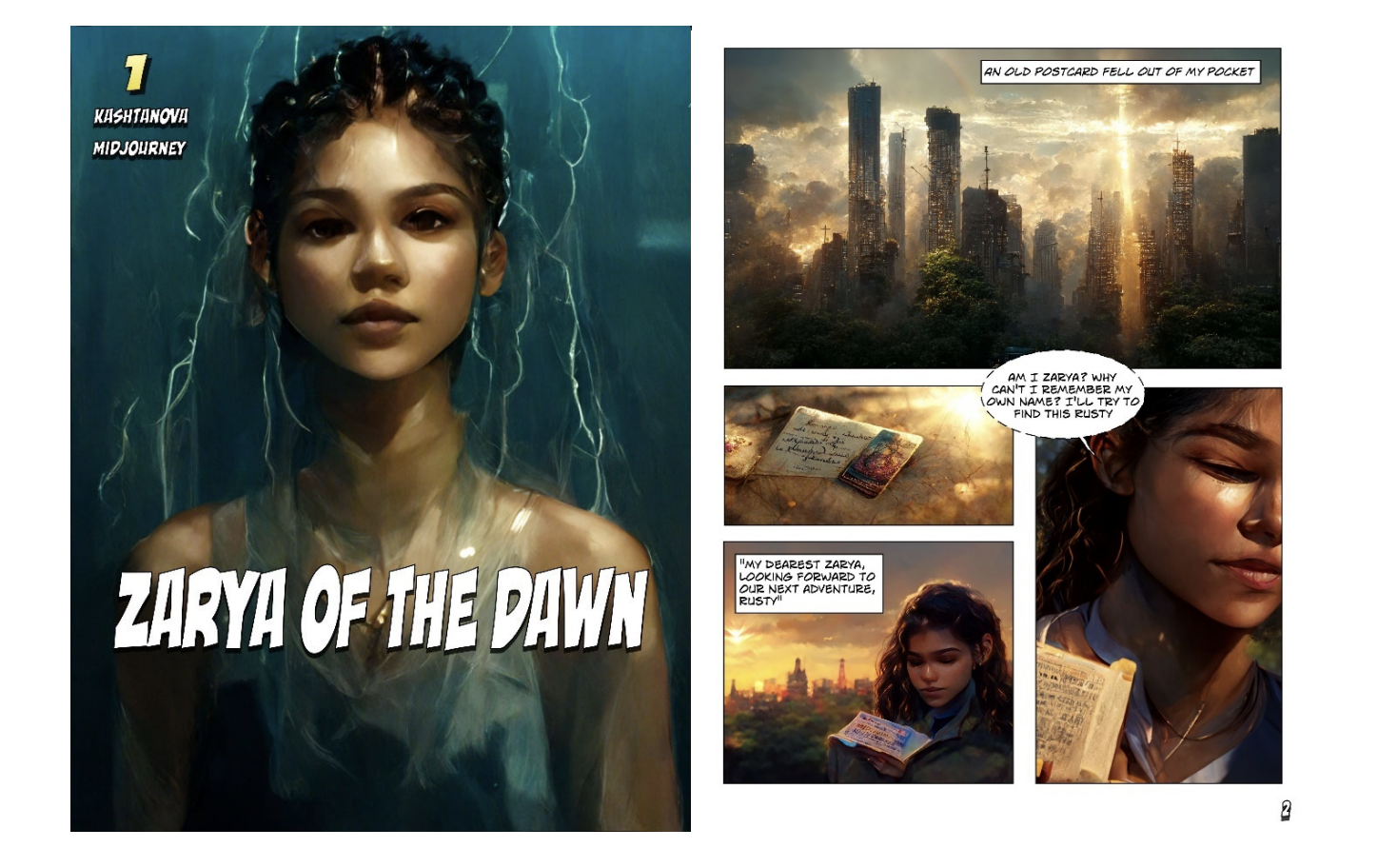
On February 21, 2023, the U.S. Copyright Office (USCO) made a significant decision regarding AI authorship, leading to the partial cancellation of artist Kristina Kashtanova’s registration for the comic book “Zarya of the Dawn.”[5] The Office determined that the AI program used by Kashtanova, called Midjourney, played a primary role in generating the visual output that was excluded from the copyright registration.[6] This decision raises questions about whether AI-generated works can be protected under U.S. copyright law and highlights the tension between the requirements of human authorship and the evolving means of expression available to creators.
Introduction
The decision revolves around Kristina Kashtanova, who utilized the Midjourney platform to create their graphic novel, “Zarya of the Dawn,” and sought copyright registration for their work. Kashtanova asserted that they extensively employed text prompts and underwent numerous iterations to bring their artistic vision to life.[7] They also mentioned making edits to the images generated by Midjourney, investing considerable time and effort into the creation of “Zarya of the Dawn.”[8] The Copyright Office initially granted registration for Kashtanova’s comic book on September 15, 2022, which consisted of text authored by Kashtanova and images created using Midjourney, a program similar to OpenAI’s DALL-E that generates images based on textual descriptions.[9]

However, after learning of Kashtanova’s public statements about using an AI program, the Office initiated the cancellation of the registration[10] and gave Kashtanova an opportunity to present reasons why it should not be canceled.[11] Kashtanova argued that her use of Midjourney was analogous to a photographer using a camera or a graphic designer using Adobe Photoshop. She claimed that her creative input, including text prompts and previously developed images, as well as her iterative selection process, led to the creation of “Zarya of the Dawn.”[12] The Copyright Office concluded that the images produced by Midjourney lacked sufficient human involvement in the creative process to qualify for copyright protection.
According to the USCO, even if a human user inputs text prompts into Midjourney and iterates on the image until it aligns with their desires, they remain somewhat out of control over what the generative AI ultimately produces.[13] The Copyright Office stated that a person providing text prompts to Midjourney does not “actually form” the generated images and cannot be considered the mastermind behind them.[14] Midjourney initiates the image generation process with visual “noise,” refining it based on user prompts that relate to its training database.[15] While the prompt text may influence the generated image, it does not dictate a specific result.
In its decision, the Copyright Office also drew a comparison between Kashtanova’s use of Midjourney and a photographer’s use of a camera. Unlike photographers who exercise significant control over various aspects of their photographs, such as framing, lighting, subject, presentation, exposure time, and depth of field, Midjourney users do not possess the same level of control over the AI-generated images.[16] The process of obtaining a satisfactory image through Midjourney is different from that of a human artist, writer, or photographer. Users’ initial prompts generate four different images based on Midjourney’s training data. While subsequent prompts applied to one of these initial images can influence subsequent iterations, the user does not have control over the process as it is impossible to predict what Midjourney will create in advance.

Although it may be tempting to view this ruling as a win or loss, it is more nuanced than that. Limitations on copyright can be beneficial to creativity, allowing artists to freely build upon existing works and contributing to the common pool of knowledge.Furthermore, although Kashtanova’s registration for the full work was not approved, the Copyright Office clarified that there are ways for artists to incorporate AI-generated content into copyrightable works by introducing sufficient creativity.[17] The Office acknowledged the copyrightability of Kashtanova’s original text and the “selection and arrangement of the text and images” together.[18] Additionally, it stated that works containing otherwise unprotectable material that has been edited, modified, or revised by a human author can be registered, but in this case, there was insufficient evidence of such changes.[19] The boundaries of copyrightability in these situations will need to be further explored in future instances.
Implications of the decision
Importantly, both the artist and Midjourney did not consider this outcome as a loss. While the artist criticized the decision, they expressed it as a positive development for those creating using Midjourney and similar tools, believing it encompasses numerous uses for the AI art community.[20]
Kashtanova stated on Facebook and on Instagram that “I received the Copyright Office’s decision today about Zarya of the Dawn. The great news is that they affirmed my copyright, so Zarya of the Dawn will stay officially registered.”
Similarly, Midjourney’s general counsel regarded the decision as a victory, highlighting that the Office clearly acknowledges the potential for copyright to apply if an artist exerts creative control over an image-generating tool like Midjourney.[21]
The Copyright Office’s examination of “Zarya of the Dawn” raises questions about the extent of human input and independence required for copyright protection. Firstly, if copyright authorship is undermined by the use of unpredictable tools, what impact does it have on artistic experimentation? Artists often take risks and experiment with different tools, mediums, and modes of creation, all of which involve an inherent level of unpredictability. If the evaluation of means of expression is based on predictability, many significant works of art may be denied copyright protection. The logical consequence of the Office’s reasoning may lead to problematic outcomes.[22]
Secondly, even though the Office concluded that Midjourney users lack creative control, can users exert a greater degree of control over the generated images? For instance, Kashtanova used text prompts for some images and provided previously developed images for others. Did she exercise more creative control when mimicking visual content for Midjourney? Can some users’ prompts be detailed and nuanced enough to transform them from suggestions to orders?[23]
Thirdly, how much creative control is necessary to establish authorship under U.S. copyright law, and does the required level of control vary depending on the means of creative expression used? While the Office typically considers photographs protectable and assumes creative control over lighting, angle, timing, and other aspects, its decision on “Zarya of the Dawn” suggests that AI-generated works receive heightened scrutiny. However, such scrutiny may be unwarranted. One could argue that Kashtanova exercised the same degree of control over Midjourney as a film director does on set, where improvisation by actors is common.[24] If Kashtanova made significant contributions to the images, is she any less deserving of joint authorship than a film director?[25]
It remains uncertain how this decision will impact copyright protection for AI-generated works. The Office’s ruling on “Zarya of the Dawn” may not be indicative of the broader copyright issues.
However, the grant of partial copyright protection does not conclude the matter for “Zarya of the Dawn” or disputes surrounding generative AI. Kashtanova’s legal team contends that the Copyright Office focused excessively on the AI’s output, neglecting the creative input of the human user. They now have the option to request reconsideration from the Copyright Office and may proceed to federal court if their request is denied. Reconsideration and potential litigation would likely be time-consuming and resource-intensive processes.
The outcome of the copyright case for “Zarya of the Dawn” holds significance not only for MidJourney but also for other generative AI platforms like ChatGPT and DALL-E. Users of these platforms can expect similar treatment concerning their AI-assisted content generation. The decision’s impact extends beyond individual cases, potentially shaping the availability of copyright protection for generative AI content and providing a competitive advantage for developers who meet the legal standards.[26]
Moreover, generative AI platforms face various legal challenges in addition to copyright protection. Critics argue that using images to train generative AI without proper licensing violates state and federal laws, while there is a risk of infringing upon protected work. As a result, platforms themselves could face secondary liability for infringements.[27] Additionally, generative AI platforms must navigate different legal and regulatory requirements across jurisdictions, further complicating the landscape. Furthermore, the copyrightability of works that are fully autonomously created by machines is currently under debate in the case of Thaler v. Perlmutter.[28] This case involves a dispute against the Copyright Office for denying registration to a work where the claimed author is artificial intelligence. The outcome of this case may provide valuable insights and guidance on the questions surrounding the copyrightability of AI-generated works in the near future.[29] As the number of generative AI platforms increases, it is crucial to address issues related to copyright protection, licensing, liability, and compliance with laws and regulations. Finding a balance that respects the rights of artists, acknowledges the contributions of AI tools, and fosters innovation will be essential in this evolving landscape.
What does this mean for artists and “art theft” by AI?
While the current stance by the Copyright Office emphasizes the requirement of human authorship, there is a need to reevaluate and potentially update existing copyright laws to account for the contributions of AI technologies.[30] Acknowledging the creative input and effort involved in training and utilizing AI tools, it becomes essential to consider granting copyright protection to AI-generated works. This protection would not only incentivize further development and innovation in the field but also ensure that creators using AI tools receive recognition and legal safeguards for their contributions.[31] However, determining the extent of human involvement and control over AI-generated works remains a critical factor in defining copyright eligibility. Striking the right balance between recognizing the contributions of AI and preserving the principles of authorship and creativity could be a challenging task.[32] It would require careful consideration of factors such as the level of human input, the role of AI as a tool or collaborator, and the overall impact on the creative landscape. Protecting artists’ work from being stolen by AI presents a significant challenge in the evolving landscape of creative technologies. As AI continues to advance and demonstrate its capacity to generate original content, it becomes crucial to develop mechanisms that safeguard artists’ rights and ensure their creative efforts are duly recognized.
One potential approach to protecting artists’ work from AI theft is to explore legal frameworks that encompass both human and AI authorship. By recognizing the collaborative nature of AI-generated artworks, laws can be updated to attribute ownership and copyright protection to both the artist and the AI system involved in the creative process. This would require reevaluating traditional notions of authorship and acknowledging the role of AI as a tool or collaborator rather than a sole creator.[33]Another avenue to consider is implementing technical measures to embed digital markers or watermarks within AI-generated works.[34] These markers could serve as digital fingerprints, uniquely identifying the original artist and providing evidence of ownership.[35] Additionally, advancements in blockchain technology offer promising solutions for creating immutable and transparent records of ownership and provenance, making it more challenging for AI-generated works to be falsely claimed by unauthorized individuals or systems.
Collaboration between artists, AI developers, and legal experts is vital in establishing clear guidelines and best practices for protecting artistic creations. This collaborative effort can involve creating standardized licenses or agreements specifically tailored to AI-generated content, outlining the rights and responsibilities of all parties involved. Such agreements could address issues like ownership, usage rights, attribution, and limitations on commercial exploitation. Education and awareness also play a crucial role in protecting artists’ work from AI theft. Artists should stay informed about the capabilities and limitations of AI technologies, enabling them to make informed decisions about utilizing AI tools in their creative processes. They should also be aware of the legal implications and potential risks associated with AI-generated works, helping them navigate the complex landscape and protect their rights effectively. Protecting artists’ work from being stolen by AI requires a multifaceted approach that combines legal frameworks, technical measures, collaboration, and education.
Conclusion
The legal challenges surrounding the use of AI in creative works extend beyond copyright protection. Issues related to licensing, ownership, liability, and potential infringements need to be addressed to ensure a fair and balanced legal framework for AI-generated artworks. While the current decision reflects the limitations of existing copyright laws, it underscores the need for a comprehensive and nuanced approach to AI protection in the realm of creative works. The evolving nature of AI technology necessitates a reevaluation of copyright standards and a thoughtful examination of the creative contributions made by both humans and machines. By adapting copyright laws to the realities of AI-generated art, society can foster innovation, protect creators, and ensure a fair and inclusive artistic landscape in the digital age. Perhaps the decision made by the copyright office is a step in the right direction to formulate a balanced approach but with certainty it can be said there is more to be done and lots more to come with AI, art, law and regulations.
Suggested Readings
- Greg Lambert & Marlene Gebauer, “From Pain to Creativity: How AI Helped Kristina Kashtanova Illustrate Their “Zarya of the Dawn” Story – featuring Richmond Law’s Ashley Dobbs and Roger Skalbeck” (TGIR Ep. 196) (April 7, 2023) available at https://www.geeklawblog.com/2023/04/from-pain-to-creativity-how-ai-helped-kristina-kashtanova-illustrate-her-zarya-of-the-dawn-story-featuring-richmond-laws-ashley-dobbs-and-roger-skalbeck-tgir-ep-196.html
- Atreya Mathur, “Lensa & the Law: A Story of “Magic” or Theft?” (January 11, 2023) available at https://itsartlaw.org/2023/01/11/lensa-the-law-a-story-of-magic-or-theft/
- Atreya Mathur, “Art-istic or Art-ificial? Ownership and copyright concerns in AI-generated artwork” (November 21, 2022) available at https://itsartlaw.org/2022/11/21/artistic-or-artificial-ai/
About the Author
Atreya Mathur is the Director of Legal Research at the Center for Art Law. She was the inaugural Judith Bresler Fellow at the Center (2021-22) and earned her Master of Laws from New York University’s School of Law where she specialized in Competition, Innovation, and Information Laws, with a focus on copyright, intellectual property, and art law.
- Copyright Registration Guidance: Works Containing Material Generated by Artificial Intelligence, 88 Fed. Reg. 16,190 (Mar. 16, 2023) (to be codified at 37 C.F.R. § 202). ↑
- Id. ↑
- Id. ↑
- Can Works Created with AI Be Copyrighted? Copyright Office Issues Formal Guidance (March 17, 2023) available at https://www.ropesgray.com/en/newsroom/alerts/2023/03/can-works-created-with-ai-be-copyrighted-copyright-office-issues-formal-guidance#:~:text=On%20March%2015%2C%202023%2C%20the,work%20involves%20sufficient%20human%20authorship. ↑
- See United States Copyright Office, Registration # VAu001480196, available at https://www.copyright.gov/docs/zarya-of-the-dawn.pdf ↑
- Id. ↑
- Stephen Wolfson, Zarya of the Dawn: US Copyright Office Affirms Limits on Copyright of AI Outputs, Creative Commons (February 27, 2023) available at https://creativecommons.org/2023/02/27/zarya-of-the-dawn-us-copyright-office-affirms-limits-on-copyright- of-ai-outputs/ ↑
- Id. ↑
- United States Copyright Office, Registration # VAu001480196, available at https://www.copyright.gov/docs/zarya-of-the-dawn.pdf ↑
- Stephen Wolfson, Zarya of the Dawn: US Copyright Office Affirms Limits on Copyright of AI Outputs, Creative Commons (February 27, 2023) available at https://creativecommons.org/2023/02/27/zarya-of-the-dawn-us-copyright-office-affirms-limits-on-copyright-of-ai-outputs/ ↑
- Id. ↑
- Id; Also seehttps://www.scribd.com/document/614862700/The-Appeal-Sent-to-The-U-S-Copyright-Office-on-Behalf-of-Artist-Kris-Kashtanova# ↑
- United States Copyright Office, Registration # VAu001480196, available at https://www.copyright.gov/docs/zarya-of-the-dawn.pdf ↑
- Id. ↑
- Id. ↑
- Stephen Wolfson, Zarya of the Dawn: US Copyright Office Affirms Limits on Copyright of AI Outputs, Creative Commons (February 27, 2023) available at https://creativecommons.org/2023/02/27/zarya-of-the-dawn-us-copyright-office-affirms-limits-on-copyright-of-ai-outputs/ ↑
- Id. ↑
- Id. ↑
- Id. ↑
- See https://www.instagram.com/p/Co-aYkQumio/ ↑
- Blake Brittain, AI-created images lose U.S. copyrights in test for new technology, Reuters (February 22, 2023) available at https://www.reuters.com/legal/ai-created-images-lose-us-copyrights-test-new-technology-2023-02-22/ ↑
- Sam Eichner, et. al., A New Dawn for Copyright in AI-Generated Works? Pillsbury internet + social media (March 9, 2023) available at https://www.internetandtechnologylaw.com/zarya-copyright-ai-generated-works/ ↑
- Id. ↑
- Id. ↑
- Id. ↑
- Blake Brittain, AI-created images lose U.S. copyrights in test for new technology, Reuters (February 22, 2023) available at https://www.reuters.com/legal/ai-created-images-lose-us-copyrights-test-new-technology-2023-02-22/ ↑
- James Vincent, The scary truth about AI copyright is nobody knows what will happen next, The Verge (November 15, 2022) available at https://www.theverge.com/23444685/generative-ai-copyright-infringement-legal-fair-use-training-data ↑
- Thaler v. Perlmutter, 1:22-cv-01564, (D.D.C.) ↑
- Id. ↑
- Ellen Glover, AI-Generated Content and Copyright Law: What We Know, Built In (April 18, 2023) available at https://builtin.com/artificial-intelligence/ai-copyright ↑
- Id. ↑
- See generally Daniel Grant, New US copyright rules protect only AI art with ‘human authorship’, The Art Newspaper (May 4, 2023) available at https://www.theartnewspaper.com/2023/05/04/us-copyright-office-artificial-intelligence-art-regulation ↑
- See United States Copyright Office, Registration # VAu001480196, available at https://www.copyright.gov/docs/zarya-of-the-dawn.pdf ↑
- Hany Farid, Watermarking ChatGPT, DALL-E and other generative AIs could help protect against fraud and misinformation, The Conversation (March 27, 2023) available at https://theconversation.com/watermarking-chatgpt-dall-e-and-other-generative-ais-could-help-protect-against-fraud-and-misinformation-202293 also See https://www.reddit.com/r/ArtistLounge/comments/12riofc/movement_to_watermark_ai_generated_content/ ↑
- Id, also see ihttps://www.wrk.com/blog/financial-transparency-blockchian-ai/#:~:text=The%20transparent%20and%20tamper%2Devident,and%20the%20decision%2Dmaking%20process. ↑
Disclaimer: This article is for educational purposes only and is not meant to provide legal advice. Readers should not construe or rely on any comment or statement in this article as legal advice. For legal advice, readers should seek a consultation with an attorney.


You must be logged in to post a comment.