• About
    • Mission
    • Team
    • Boards
    • Mentions & Testimonials
    • Institutional Recognition
    • Annual Reports
    • Current & Past Sponsors
    • Contact Us
  • Resources
    • Article Collection
    • Podcast: Art in Brief
    • AML and the Art Market
    • AI and Art Authentication
    • Newsletter
      • Subscribe
      • Archives
      • In Brief
    • Art Law Library
    • Movies
    • Nazi-looted Art Restitution Database
    • Global Network
      • Courses and Programs
      • Artists’ Assistance
      • Bar Associations
      • Legal Sources
      • Law Firms
      • Student Societies
      • Research Institutions
    • Additional resources
      • The “Interview” Project
  • Events
    • Worldwide Calendar
    • Our Events
      • All Events
      • Annual Conferences
        • 2026 Art Law Conference
        • 2025 Art Law Conference
        • 2024 Art Law Conference
        • 2023 Art Law Conference
        • 2022 Art Law Conference
        • 2015 Art Law Conference
  • Programs
    • Visual Artists’ Legal Clinics
      • Art & Copyright Law Clinic
      • Artist-Dealer Relationships Clinic
      • Artist Legacy and Estate Planning Clinic
      • Visual Artists’ Immigration Clinic
    • Summer School
      • 2026
      • 2025
    • Internship and Fellowship
    • Judith Bresler Fellowship
  • Case Law Database
  • Log in
  • Become a Member
  • Donate
  • Log in
  • Become a Member
  • Donate
Center for Art Law
  • About
    About
    • Mission
    • Team
    • Boards
    • Mentions & Testimonials
    • Institutional Recognition
    • Annual Reports
    • Current & Past Sponsors
    • Contact Us
  • Resources
    Resources
    • Article Collection
    • Podcast: Art in Brief
    • AML and the Art Market
    • AI and Art Authentication
    • Newsletter
      Newsletter
      • Subscribe
      • Archives
      • In Brief
    • Art Law Library
    • Movies
    • Nazi-looted Art Restitution Database
    • Global Network
      Global Network
      • Courses and Programs
      • Artists’ Assistance
      • Bar Associations
      • Legal Sources
      • Law Firms
      • Student Societies
      • Research Institutions
    • Additional resources
      Additional resources
      • The “Interview” Project
  • Events
    Events
    • Worldwide Calendar
    • Our Events
      Our Events
      • All Events
      • Annual Conferences
        Annual Conferences
        • 2026 Art Law Conference
        • 2025 Art Law Conference
        • 2024 Art Law Conference
        • 2023 Art Law Conference
        • 2022 Art Law Conference
        • 2015 Art Law Conference
  • Programs
    Programs
    • Visual Artists’ Legal Clinics
      Visual Artists’ Legal Clinics
      • Art & Copyright Law Clinic
      • Artist-Dealer Relationships Clinic
      • Artist Legacy and Estate Planning Clinic
      • Visual Artists’ Immigration Clinic
    • Summer School
      Summer School
      • 2026
      • 2025
    • Internship and Fellowship
    • Judith Bresler Fellowship
  • Case Law Database
Home image/svg+xml 2021 Timothée Giet Art law image/svg+xml 2021 Timothée Giet Case Review: US v. Mask of Ka-Nefer-Nefer (8th Cir.)
Back

Case Review: US v. Mask of Ka-Nefer-Nefer (8th Cir.)

August 11, 2014

Screen Shot 2014-08-10 at 9.50.38 PM

By Angelea Selleck

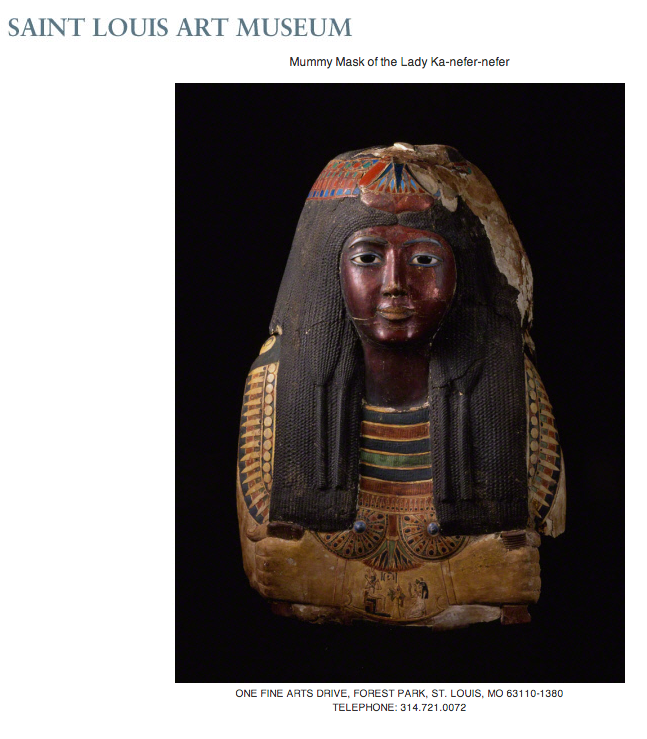
After nearly three years of legal battles between the United States government and the St. Louis Art Museum (the “SLAM”), the forfeiture case known as U.S. v. Ka-Nefer-Nefer (8th Cir. Jun 2014) has finally come to an end. Ka-Nefer-Nefer was an ancient Egyptian noblewoman during the Nineteenth Dynasty. The case was concerned with the ownership of the sacred funerary mask of Ka-Nefer-Nefer, which the SLAM purchased in good faith for half a million dollars from Phoenix Ancient Art, an international art gallery based in Switzerland with a murky past. Years following the purchase, Egyptian authorities approached the SLAM, claiming that the mask was stolen and illegally removed from Egypt. Upon this realization, the United States government attempted to seize the mask from the SLAM with a civil forfeiture action. Instead of complying with the government’s request, the SLAM sued the US government to assert their ownership. On 12 June 2014 the Eighth Circuit Court of Appeals decided that the mask would to stay in the possession of the SLAM.

Before discussing the details of the case, it is important to elaborate briefly on the process that museums undergo when acquiring an antiquity. Most museums in North America abide by the Code of Ethics set out by the International Council of Museums (ICOM) and the Association of Art Museum Directors (AAMD). The SLAM is a member of the AAMD and has adopted the principles set out in the Guidelines on the Acquisition of Archaeological Material and Ancient Art,which, among other requirements, state that museums should thoroughly research the ownership history of a work prior to the acquisition and make a strong effort to obtain all written records and documentation regarding its history. More importantly, the Guidelines also emphasize that museums should not acquire a work unless the provenance research confirms that the work was outside its country of discovery before 1970, which reflects the criteria in UNESCO’s 1970 Convention on the Means of Prohibiting and Preventing the Illicit Import, Export and Transfer of Ownership of Cultural Property. The SLAM is not a member of ICOM however, which tends to carry more weight in ethical matters.

It is also important to point out that it is rather uncommon for museums to sue the government when asked to return an object. Patty Gerstenblith, DePaul School of Law Professor, commented that this is a very unusual response to forfeiture claims and it is the first time a public institution like a museum decided to expend its funds to proactively sue the government.  Neither the museum’s nor the government’s litigation costs have been disclosed as of yet.

The United States government claims that the mask was stolen before it was brought into the country, thereby violating the Tariff Act of 1930. The United States filed a motion based on the National Stolen Property Act (NSPA), which allows the US government to prosecute on behalf of a foreign government and defend their national ownership law. The Act serves to deter U.S. citizens from dealing with international stolen goods. The strength of NSPA was illustrated in the landmark case U.S. v Schultz, where prominent art dealer Frederick Schultz was convicted of importing and selling looted Egyptian antiquities.

In the Schultz case, the U.S. court upheld Egypt’s patrimonial law, Egyptian Law on the Protection of Antiquities Law 117, which asserts Egyptian public ownership of antiquities and restricts private possession or ownership of cultural property. This law is arguably one of the world’s clearest ownership laws and probably the most efficient route for repatriation by stating all antiquities are the property of the government. Upholding Egypt’s patrimonial laws could have been a more efficient way to return the mummy mask to its original owners.

Screen Shot 2014-08-10 at 9.50.52 PM

According to Egyptian records, the Ka-Nefer-Nefer mask was excavated in 1952 and registered as Egyptian property a year later. It was then placed in a storage facility at Saqqara and later sent to Cairo in 1966. It was not until 1973, during a routine inventory, that museum authorities noticed the mask was missing. The Museum has no record of sale or transfer of the mask between 1966-1973. The SLAM maintains that they conducted due diligence and purchased the mask from reputable sources. Furthermore, the SLAM claims that prior to the purchase, they inquired about its provenance with the Art Loss Register, the International Foundation for Art Research, INTERPOL and consulted with the then-director Mohammed Saleh, of the Cairo Museum. All of these institutions had confirmed that this piece was licit and there were no reports of the mask missing at the time of the proposed purchase.

In order to assert their ownership of the mask, SLAM maintained that they purchased the mask in good faith and that the statue of limitations had expired when the United States filed for forfeiture. The SLAM claims that the US government received notice of the importation in 2005 but only filed the forfeiture complaint until 2011. Due to the fact that the statute of limitations in the United States is five years, and more than five years have passed, SLAM believes that they have rightful ownership of the mask. 

In April 2012, the U.S. District Court, Eastern District of Missouri, dismissed the US government’s forfeiture complaint for failing to articulate with specificity “how the mask was stolen and smuggled, or how it was brought into the United States contrary to law”. Afterwards, the US filed a motion to reconsider when the government revealed new information that could support an amended complaint. However, the Court denied this motion and the parties attempted to settle this matter out of court. The negotiations failed and US government then appealed to the Eighth Circuit Court to re-open the case . The issue raised in their appeal is whether the District Court abused its discretion in denying the government’s post-dismissal motion for leave to file an amended civil forfeiture complaint.

Oral arguments took place in mid-January 2014, during which time Circuit Court Judge James Loken held that the US government made mistakes in the eyes of the District Court and that “they will have to beg for a do-over”.  The Court resumed on 12 June 2014 where the Court of Appeals affirmed the District Court’s procedural ruling.  Judge Diana Murphy acknowledged that the lower court did not abuse its discretion when dismissing the government’s forfeiture case. Murphy also emphasized that “the government was dilatory” with their amended complaint. In addition, she included cautionary comments about the subject matter of the case:

“The substantive issues underlying this litigation are of great significance, and not only to museums which responsibly seek to build their collections. The theft of cultural patrimony and its trade on the black market for stolen antiquities present concerns of international import…

…While this case turns on a procedural issue, courts are bound to recognize that the illicit sale of antiquities poses a continuing threat to the preservation of the world’s international cultural heritage. Museums and other participants in the international market for art and antiquities need to exercise caution and care in their dealings in order to protect this heritage and to understand that the United States might ultimately be able to recover such purchases.”

While the case of the US v. Mask of Ka-Nefer-Nefer has been settled, it will be interesting to see if there will be any future diplomatic actions undertaken by either the United States or Egypt for the return of the Ka-Nefer-Nefer mask.

Sources:

  • US v. Mask of Ka-Nefer-Nefer, No. 12-2578 (8th Cir. June 12, 2014), aff’ig 11-CV-504-HEA (E.D. Mo. Mar. 31, 2012).
  • Guidelines on the Acquisition of Archaeological Material and Ancient Art, Association of Art Museum Directors (2013), https://aamd.org/sites/default/files/document/Guidelines%20on%20the%20Acquisition%20of%20Archaeological%20Material%20and%20Ancient%20Art%20revised%202013_0.pdf
  • Malcom Gay, For the St. Louis Art Museum, A Legal Victory Raises Ethical Questions, The Atlantic (May 30, 2012, 12:34 PM), available at http://www.theatlantic.com/national/archive/2012/05/for-the-st-louis-art-museum-a-legal-victory-raises-ethical-questions/257839/
  • 19 U.S.C. § 1595a
  • 18 USC Section 2314
  • Victoria A. Russell, Don’t Get SLAMmed into Nefer Nefer Land: Complaints in the Civil Forfeiture of Cultural Property, 4 Pace I.P., Sports & Entertainment Law Forum, (2014)
  • Patty Girstenblith Enforcing International Cultural Heritage Law, 79-108,  (Francesco Francioni & James Gordley eds.,Oxford University Press 2013).
  • Ricardo A. St. Hilaire, District Court Dismisses Government’s Case to Forfeit SLAM Mummy Mask, Cultural Heritage Lawyer (April 2, 2012), http://culturalheritagelawyer.blogspot.com/2012/04/district-court-dismisses-governments.html
  • —, SLAM Mummy Mask Appeal: “You Now Have to Beg for a Do-Over”, Cultural Heritage Lawyer (Jan. 14, 2014), http://culturalheritagelawyer.blogspot.com/2014/01/slam-mummy-mask-appeal-you-now-have-to.html.

About the Author: Angelea Selleck is a contributing writer with Center for Art Law; she is a research intern at Iran Human Rights Documentation Center in New York.

Disclaimer: This article is for educational purposes only and is not meant to provide legal advice. Readers should not construe or rely on any comment or statement in this article as legal advice. For legal advice, readers should seek a consultation with an attorney.

Post navigation

Previous Infamous Piracy: How the Lucrative Market for Forgeries is Transforming the World of Fine Art
Next Knoedler Obituary (1857 – 2011): Select Legal History of the Oldest American Art Gallery

Related Art Law Articles

Screen shot from Google scholar of different Warhol cases
Art lawCase ReviewArt Law

Degrees of Transformation: Andy Warhol’s 102 minutes of fame before the Supreme Court

November 17, 2022
Art lawArt Law

“Outsider Artists” and Inheritance Law: What Happens to an Artist’s Work When They Die Without a Will?

November 11, 2022
Art lawCase ReviewArt LawCase Review

Case Review: US v. Philbrick (2022)

November 7, 2022
Center for Art Law
What the Heck is Copyright (2)

What is Copy, Right?

2026 Annual Conference

Let’s explore Visual Art, AI, and the Law in the 21st Century together.


Reserve Your Ticket TODAY
Guidelines AI and Art Authentication

AI and Art Authentication

Explore the Guidelines for AI and Art Authentication for the responsible, ethical, and transparent use of artificial intelligence.

Download here
Center for Art Law

Follow us on Instagram for the latest in Art Law!

Whose collections? Whose heritage? What happens wh Whose collections? Whose heritage? What happens when the present confronts colonial memory? Join us in Zurich for a special screening of "Elephants & Squirrels," a documentary following Sri Lankan artist Deneth Piumakshi Veda Arachchige as she traces looted artifacts and human remains of the indigenous Wanniyala-Aetto people, held in Swiss museum collections for over a century, and fights for their return home.

Film director Gregor Brändli and the artist will open the evening with reflections on colonial collecting, cultural heritage, and the ethics of museum stewardship.

📅 May 12, 2026 | 18:00 – 21:00
📍 schwarzescafé | Luma Westbau, Limmatstrasse 270, Zurich

This event is free to attend and is offered as part of the CineLöwenbräukunst series. Link in bio for more information.

#ArtLaw #CulturalHeritage #Restitution #Repatriation #Zurich #FilmScreening #ColonialHistory #MuseumEthics 

#MuseumEthics
Join us on May 27th at Brooklyn Law School for our Join us on May 27th at Brooklyn Law School for our Annual Art Law Conference 2026: What is Copy, Right? 

We are very excited to introduce you to the topic and speakers for, Panel 1: So Inappropriate — Lessons About Copyright Law and Art: First There Was Art, Then Copyright, Then Fair Use… and Now AI?

From early copyright doctrines to contemporary fair use debates, this panel examines how artists and lawyers have navigated questions of ownership, appropriation, and originality in visual art. Panelists will explore key developments in copyright law affecting traditional artistic practices, from borrowing and remixing to transformative use, while also considering how emerging technologies, including AI, are beginning to reshape long‑standing legal frameworks and artistic norms.

Moderator: Irina Tarsis, Founder, Center for Art Law
Speakers: Vivek Jayaram, Founder, Jayaram Law; Vincent Wilcke, Pace Gallery; Greg Allen, Artist and writer 

Reserve your tickets using the link in our bio or by visiting our website itsartlaw.org 🎟️ 
See you soon!
Next stop: Venice. The 61st Biennale has been maki Next stop: Venice. The 61st Biennale has been making waves and headlines for weeks and the doors have not even opened yet. The jury refused to award prizes and resigned nine days before the opening over geopolitical controversies. Some artists boycott while others show up even if unwelcome. Some pavilions will be empty, some will not be open to the public… Sources of funds, sources of inspiration, so many questions, so much on display for critical eyes. Meanwhile the boats are waiting for anyone lucky enough to find themselves in the floating world.

Help us reflect on the Biennale by sharing your art law stories.

#ArtLaw #Venice #Biennale2026 #ArtWorld #BiennaleofDissent #LaSerenissima #GoldenLion #SeeArtThinkArtLaw
Center for Art Law is very pleased to welcome Prof Center for Art Law is very pleased to welcome Professor Ben Zhao as the Keynote Speaker for our Annual Art Law Conference 2026! 

Ben Zhao is the Neubauer Professor of Computer Science at the University of Chicago where he, and a team of researchers at the university, developed NightShade & Glaze, two data-poisoning tools which protects artists' work from being scraped for AI data training. 

Professor Zhao will discuss tools, such as NightShade, which can assist in defending art in the age of AI. 

The 2026 conference will focus on copyright law as it relates to visual art, artificial intelligence, and the rapidly evolving legal landscape of the 21st century. The program will begin with Professor Zhao's keynote address, followed by three substantive panels designed to build on one another throughout the afternoon. In addition, we will host a curated group of exhibitors featuring databases, legal tools, and technology platforms relevant to artists’ rights, copyright, and AI. The program will conclude with a reception, providing time for continued discussion, networking, and engagement among speakers, exhibitors, and attendees. 

We hope you join us! Reserve your tickets now using the link in our bio 🎟️ 

#centerforartlaw #artlaw #copyrightlaw
A huge thank you to our hosts and incredible speak A huge thank you to our hosts and incredible speakers who made this London panel discussion truly special! 🙏✨ 🇬🇧 🇺🇦 

We were so fortunate to hear from:

🎤 Rakhi Talwar | RTalwar Compliance
🎤 Raminta Dereskeviciute | McDermott Will & Schulte
🎤 Daryna Pidhorna, Lawyer & Analyst | The Raphael Lemkin Society
🎤 Timothy Kompancheko | Bernard, Inc.
🎤 Yuliia Hnat | Museum of Contemporary Art NGO
🎤 Irina Tarsis | Center for Art Law

Your insights, expertise, and passion made this a conversation we won't forget. Thank you for sharing your time and knowledge with us! 💫

Bottom Line: the art market has power and responsibility. Our panel "Art, Money, and the Law: Sanctions & AML Enforcement in 2026" tackled the hard questions around money laundering, sanctions compliance, and what's at stake for art market participants in today's regulatory landscape.

⚠️ Regulators are watching and "history has it's eyes on you..." too We don't have to navigate the legal waters alone. Let's keep the conversation going.

What was your biggest takeaway? 

#ArtLaw #AMLCompliance #Sanctions #ArtMarket #ArtAndMoney #Enforcement2026
At the Center for Art Law we are preparing for our At the Center for Art Law we are preparing for our Annual Art Law Conference 2026, "What is Copy, Right? Visual Art, AI, and the Law in the 21st Century", and we hope you are as excited as we are! The event will take place on May 27th at Brooklyn Law School. 

In addition to the panels throughout the day, which will offer insights into the rapidly shifting landscape of art and copyright law, our conference will feature exhibitors showcasing resources for promoting artists' rights, and a silent auction aimed at bolstering the Center's efforts. 

We would like to invite you to take part in and support this year's Annual Art Law Conference by being an exhibitor or sponsor. We express our sincere appreciation to all of our sponsors, exhibitors and you! 

Find more information and reserve your tickets using the link in our bio! See you soon!
In this episode, we speak with art market expert D In this episode, we speak with art market expert Doug Woodham to unpack how Jean-Michel Basquiat became one of the most enduring cultural icons of our time.

Moving beyond his rise in 1980s New York, this episode focuses on what happened after his death. We explore how his estate, led by his father, shaped his legacy through control of supply, copyright, and narrative; how early collectors and market forces drove the value of his work; and how museums and media cemented his place in art history.

Together, we explore the bigger question: is creating great art enough, or does becoming an icon require an entire ecosystem working behind the scenes?

🎙️ Check out the podcast anywhere you get your podcasts using the link in our bio!

Also, please join us on May 27  for the highly anticipated Art Law Conference 2026, held at Brooklyn Law School and Online (Hybrid). Entitled “What is Copy, Right? Visual Art, AI, and the Law in the 21st Century,” this year’s conference explores the evolving relationship between visual art, copyright law, and artificial intelligence!

#centerforartlaw #artlaw #artlawyer #podcast #legal #research #legalresearch #newepisode #artmarket #basquiat
Amy Sherald cancelled her mid-career retrospective Amy Sherald cancelled her mid-career retrospective, scheduled at the National Portrait Gallery (NPG) in D.C., after a curatorial controversy over the potential removal of her recent work, "Trans Forming Liberty" (2024). Sherald denounced the attempt to remove this work as a blatant and intentional erasure of trans lives. 

This is one of the best examples and the most illustrative examples of the current administration's growing efforts to control the Smithsonian Institution's programming. In this climate of political tension, how do cultural institutions defend themselves against censorship and keep their curatorial independence?

📚 Click the link in our bio to read more!

#centerforartlaw #artlaw #legal #artlawyer #legalreserach #artcuration #curatorialindependance #censorship
Grab 15% off tickets the upcoming bootcamp on Arti Grab 15% off tickets the upcoming bootcamp on Artist-Dealer Relations, now available online!! 

Center for Art Law’s Art Lawyering Bootcamp: Artist-Dealer Relationships is an in-person, full-day training aimed at preparing lawyers for working with visual artists and dealers, in the unique aspects of their relationship. The bootcamp will be led by veteran attorneys specializing in art law.

This Bootcamp provides participants -- attorneys, law students, law graduates and legal professionals -- with foundational legal knowledge related to the main contracts and regulations governing dealers' and artists' businesses. Through a combination of instructional presentations and mock consultations, participants will gain a solid foundation in the specificities of the law as applied to the visual arts.

Bootcamp participants will be provided with training materials, including presentation slides and an Art Lawyering Bootcamp handbook with additional reading resources.

Art Lawyering Bootcamp participants with CLE tickets will receive New York CLE credits upon successful completion of the training modules. CLE credits pending board approval.

🎟️ Grab tickets using the link in our bio!

Get 15% off using the code: Final15 

#centerforartlaw #artlaw #legal #research #lawyer #artlawyer #bootcamp #artistdealer #CLE #trainingprogram
On the night of April 15–16, 2026 alone, Russia se On the night of April 15–16, 2026 alone, Russia sent hundreds of drones and missiles on sleeping cities across Ukraine, killing and injuring dozens of civilians. War is funded in part by individuals who have important artworks in their personal collections. This full-scale invasion of Ukraine, now in its fifth year, daily exacts a grave toll on Ukrainian lives and cultural heritage, while fundamentally disrupting European commerce. In response, art market participants have adapted their practices, most have accepted, if not always embraced, the need to scrutinize the source of funds and the ultimate beneficiaries of their transactions. Yet there is a growing sense that parts of the trade are holding their breath, waiting to see when they might safely return to dealing with the oligarchs who continue to fund the Russian war machine.

For art market participants operating in the UK, compliance is no longer a peripheral concern, it is a legal imperative. Regulators are watching, the consequences of non-compliance increasingly extend beyond administrative penalties into criminal liability, and private-public partnerships offer the most credible path toward a more resilient and trustworthy market. 

Join us on April 24th for a panel discussion in London on the current state of AML enforcement and sanctions.

🎟️ Grab your tickets using the link in our bio!

#centerforartlaw #artlaw #artlawyer #lawyer #artcrime #london #artissues #museumissues
Sotheby's sold Modigliani’s Portrait de Leopold Zb Sotheby's sold Modigliani’s Portrait de Leopold Zborowski to Cahn in 2003 for the low price of about $1.55 million. In 2016, Cahn claimed he was verbally informed about authenticity issues with the painting by Sotheby's. The parties did make an agreement regarding Cahn reselling with Sotheby's for a guaranteed price in exchange for releasing the auction house from all claims related to the painting. Cahn claims that he attempted to set this process in motion in June 2025, but he received no response. Cahn now seeks damages totaling $2.67 million, plus interest and attorneys’ fees, for breach of contract. 

Through this dispute, Vivianne Diaz's article highlights a bigger issue in the art market by explaining how forgeries negatively affect both collectors and auction houses, and how auction houses need to be more careful, but most importantly, proactive in their authentication determinations.

📚 Click the link in our bio to read more!

#centerforartlaw #artlaw #artlawyer #legalresearch #art #Modigliani #LeopoldZborowski #sothebys
Don't miss our upcoming April 20th bootcamp on Art Don't miss our upcoming April 20th bootcamp on Artist-Dealer Relations, now available online!!

Center for Art Law’s Art Lawyering Bootcamp: Artist-Dealer Relationships is an in-person, full-day training aimed at preparing lawyers for working with visual artists and dealers, in the unique aspects of their relationship. The bootcamp will be led by veteran attorneys specializing in art law.

This Bootcamp provides participants -- attorneys, law students, law graduates and legal professionals -- with foundational legal knowledge related to the main contracts and regulations governing dealers' and artists' businesses. Through a combination of instructional presentations and mock consultations, participants will gain a solid foundation in the specificities of the law as applied to the visual arts.

Bootcamp participants will be provided with training materials, including presentation slides and an Art Lawyering Bootcamp handbook with additional reading resources.

Art Lawyering Bootcamp participants with CLE tickets will receive New York CLE credits upon successful completion of the training modules. CLE credits pending board approval.

🎟️ Grab tickets using the link in our bio!

#centerforartlaw #artlaw #legal #research #lawyer #artlawyer #bootcamp #artistdealer #CLE #trainingprogram
  • About the Center
  • Contact Us
  • Newsletter
  • Upcoming Events
  • Internship
  • Case Law Database
  • Log in
  • Become a Member
  • Donate
DISCLAIMER

Center for Art Law is a New York State non-profit fully qualified under provision 501(c)(3)
of the Internal Revenue Code.

The Center does not provide legal representation. Information available on this website is
purely for educational purposes only and should not be construed as legal advice.

TERMS OF USE AND PRIVACY POLICY

Your use of the Site (as defined below) constitutes your consent to this Agreement. Please
read our Terms of Use and Privacy Policy carefully.

© 2026 Center for Art Law

Loading Comments...

You must be logged in to post a comment.