• About
    • Mission
    • Team
    • Boards
    • Mentions & Testimonials
    • Institutional Recognition
    • Annual Reports
    • Current & Past Sponsors
    • Contact Us
  • Resources
    • Article Collection
    • Podcast: Art in Brief
    • AML and the Art Market
    • AI and Art Authentication
    • Newsletter
      • Subscribe
      • Archives
      • In Brief
    • Art Law Library
    • Movies
    • Nazi-looted Art Restitution Database
    • Global Network
      • Courses and Programs
      • Artists’ Assistance
      • Bar Associations
      • Legal Sources
      • Law Firms
      • Student Societies
      • Research Institutions
    • Additional resources
      • The “Interview” Project
  • Events
    • Worldwide Calendar
    • Our Events
      • All Events
      • Annual Conferences
        • 2026 Art Law Conference
        • 2025 Art Law Conference
        • 2024 Art Law Conference
        • 2023 Art Law Conference
        • 2022 Art Law Conference
        • 2015 Art Law Conference
  • Programs
    • Visual Artists’ Legal Clinics
      • Art & Copyright Law Clinic
      • Artist-Dealer Relationships Clinic
      • Artist Legacy and Estate Planning Clinic
      • Visual Artists’ Immigration Clinic
    • Summer School
      • 2026
      • 2025
    • Internship and Fellowship
    • Judith Bresler Fellowship
  • Case Law Database
  • Log in
  • Become a Member
  • Donate
  • Log in
  • Become a Member
  • Donate
Center for Art Law
  • About
    About
    • Mission
    • Team
    • Boards
    • Mentions & Testimonials
    • Institutional Recognition
    • Annual Reports
    • Current & Past Sponsors
    • Contact Us
  • Resources
    Resources
    • Article Collection
    • Podcast: Art in Brief
    • AML and the Art Market
    • AI and Art Authentication
    • Newsletter
      Newsletter
      • Subscribe
      • Archives
      • In Brief
    • Art Law Library
    • Movies
    • Nazi-looted Art Restitution Database
    • Global Network
      Global Network
      • Courses and Programs
      • Artists’ Assistance
      • Bar Associations
      • Legal Sources
      • Law Firms
      • Student Societies
      • Research Institutions
    • Additional resources
      Additional resources
      • The “Interview” Project
  • Events
    Events
    • Worldwide Calendar
    • Our Events
      Our Events
      • All Events
      • Annual Conferences
        Annual Conferences
        • 2026 Art Law Conference
        • 2025 Art Law Conference
        • 2024 Art Law Conference
        • 2023 Art Law Conference
        • 2022 Art Law Conference
        • 2015 Art Law Conference
  • Programs
    Programs
    • Visual Artists’ Legal Clinics
      Visual Artists’ Legal Clinics
      • Art & Copyright Law Clinic
      • Artist-Dealer Relationships Clinic
      • Artist Legacy and Estate Planning Clinic
      • Visual Artists’ Immigration Clinic
    • Summer School
      Summer School
      • 2026
      • 2025
    • Internship and Fellowship
    • Judith Bresler Fellowship
  • Case Law Database
Home image/svg+xml 2021 Timothée Giet Art law image/svg+xml 2021 Timothée Giet Infamous Piracy: How the Lucrative Market for Forgeries is Transforming the World of Fine Art
Back

Infamous Piracy: How the Lucrative Market for Forgeries is Transforming the World of Fine Art

July 30, 2014

2014-07-30

By Emma Kleiner

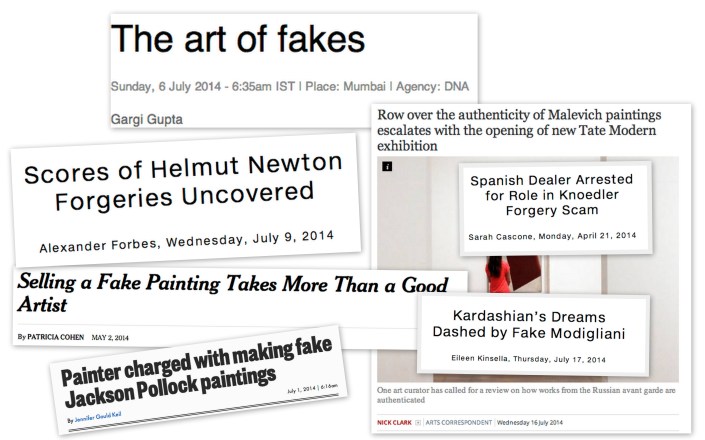
Stories of art forgeries capture the public’s imagination in a singular way: fascination centers upon the art itself and the disbelief that collectors, galleries, and professionals could have been misled by a fraud. Today, the expanding and profitable international art market has a correspondingly lucrative market in art forgery. While there have always been ways for forgeries to enter the art market, today’s forgery market is enlarged by the ease of creating fake masterpieces coupled with the multitude of sites where fakes can be sold—at auction, through galleries, or online. The negative publicity generated by any involvement with fine art forgeries is usually enough to steer away potential buyers or admirers; however, in a small set of cases the hoaxes or forgeries themselves become well-known in their own right and take on an infamy of their own. While no centralized national or international system for analyzing how to best regulate the art market exists, the recent strands of art forgery cases around the globe offer policy considerations to help eliminate the market for forgeries.

The art market has rebounded almost to its 2008 pre-crisis level. In 2013, the international art market registered sales of $64.5 billion, which was “close to its highest ever recorded level.” However, buyers are wary of collecting unfamiliar artists, and art purchases have largely focused on household names such as Francis Bacon, Andy Warhol, and Yves Klein. The lucrative art market creates a market ripe for talented forgers, who view art forgery as a very profitable enterprise. Based on a number of recent incidents, it appears that successful art forgeries are easier than ever to execute, with wealthy collectors eager to believe in, and ready to fuel, the high prices commanded by art masterpieces. Just recall the now defunct Knoedler Gallery, which closed in 2011 following the discovery that the gallery had sold $63 million of fakes. Although Ann Freedman, the gallery’s former president, insisted that she had no knowledge that she was selling forged modern classics, there were basic elements that should have alerted her to that fact. In one painting the signature was visibly spelled incorrectly: the painting was signed “Pollok” instead of the correct spelling of “Pollock.” Even so, the painting, which was purchased by the gallery for $230,000, was eventually sold to a Wall Street executive for $2 million.

With the new era of online art retailers, the art forgery market is becoming even more decentralized and easily profitable. In June 2014, John Re, an East Hampton painter, was arrested after netting $1.9 million selling forged Jackson Pollock paintings to private collectors and online through eBay. This forger used shell bidders to drive up prices of the fakes on eBay while assuring bidders that his paintings were “real.” Similarly, British amateur artist Geoffrey Spilman was arrested last year after selling forged modern masterpieces on eBay. Consequently, Spilman was banned for life from eBay. These events highlight the issue that the art market is quickly moving online. Online buyers may present an easier target for forged artwork due to the lack of pre-auction previews, the absence of quality records, and the awareness that auction experts did not vet the pieces. This new area of selling and buying art necessitates strong guidelines for digital art markets.

The abundance of art forgeries sold at auction, online, through galleries, and by private collectors has created a ripple effect in the art market. The repercussions of buying and selling fakes are beginning to be reflected in the management and practices of artists’ reputations and foundations. A recent trend is the increasing reluctance of artist foundations to recognize any new or uncovered artwork as authentic. Artist foundations do not want to become targets for litigation if an authentication dispute flares up between individuals, and thus many foundations no longer offer authenticating services. The Andy Warhol Art Authentication Board, Inc., created in association with the Andy Warhol Foundation for the Visual Arts, was dissolved in 2012. The authentication boards of the Keith Haring Foundation and the estate of Jean-Michel Basquiat were likewise dissolved in 2012. Such disassociation largely shields artist foundations from litigation alleging the foundation authenticated a forgery. However, this insulation not only affects buyers and sellers wishing to determine the authenticity of artwork, it also negatively affects art historical knowledge of these artists. Unauthenticated works cannot be included in official catalogues raisonnés and will remain unknown to future scholars and collectors. Therefore, if artist foundations refuse to analyze problematic artwork, then future scholarship will suffer. This larger impact of the forgery market is critical to appreciating the urgency with which the proliferation of fakes must be curbed. The forged art market affects not only buyers and sellers; it also affects the collective knowledge of future generations.

Usually, the public relations nightmare of being caught in an art forgery scandal is enough to destroy reputations, as demonstrated by the closing of the Knoedler Gallery. However, as mentioned above, the hoaxes themselves sometimes become famous in their own right due to the mastery of the forgery. For example, an exhibition is being planned for fake Amedeo Modigliani statues to be exhibited in Livorno, Italy, the artist’s hometown. Three carved heads were found in July 1984 as part of a hoax orchestrated by local students. Modigliani is famously a popular target for art forgers, and thus this episode become part of the legacy of Modigliani himself and his hometown of Livorno. Commenting on the plan for this exhibition, Livorno Culture Councilor Mario Tredici stated, “For a long time we have wanted to tell a story that was unique in the 20th century and is sure to be a tourist attraction.”

Today, there is no unified national or international approach to curbing the forged art market. The current debate in India, where the art market is currently encountering an unprecedented number of uncovered fakes, might be helpful to informing policy decisions in the United States, where cases concerning art forgeries are fractured across jurisdictions and courts. Art experts in India have called for contradictory safety measures. Some express favor for creating a national authentication body in charge of art sales. However, other scholars have expressed a less common alternative preference for deregulating the currently tightly regulated art market in India. In a recent Op-Ed, Girish Shahane, Artistic Director of the India Art Fair, explains how the tightly controlled national art market in India has stunted the development of the art market and encouraged the proliferation of fakes through the promise of great profit: “Expertise and transparency have been strangled by the Antiquities Act, which makes the owning and selling of antiquities difficult, their export illegal, and restricts trade in the work of a number of modern artists labeled national treasures . . . While there is no silver bullet solution for the problem of forgeries, partial fixes emerge as a natural consequence of trade.” This proposal suggests that greater cooperation and unified trade practices amongst art industry professionals around the globe would create mutual responsibility. The opaqueness of the art market is in part responsible for the circulation of forged artwork, and, instead of effectively shutting down the art market through the creation of regulatory bodies, perhaps it is time for the art world to acknowledge the damaging effects of fakes and open up new pathways to international discussion.

Sources:

  • Eileen Kinsella, Dodgy eBay Sellers Peddle Tall Tales and Fake Art, July 9, 2014, Artnet News, http://news.artnet.com/market/dodgy-ebay-sellers-peddle-tall-tales-and-fake-art-57412.
  •  Girish Shahane, As fakes unnerve India’s art market, the trade is pushing for an antiquated solution, July 7, 2014, Quartz India, http://qz.com/230750/as-fakes-unnerve-indias-art-market-the-trade-is-pushing-for-an-antiquated-solution.
  •  Jennifer Gould Keil, Painter charged with making fake Jackson Pollock paintings, July 1, 2014, New York Post, http://nypost.com/2014/07/01/painter-charged-with-making-fake-jackson-pollock-paintings.
  •  Jennifer Maloney, The Deep Freeze in Art Authentication, April 24, 2014, The Wall Street Journal, http://online.wsj.com/news/articles/SB10001424052702304279904579518093886991908.
  •  Livorno exhibit of Modigliani fakes, May 19, 2014, ANSA, http://www.ansa.it/english/news/lifestyle/arts/2014/05/19/livorno-exhibit-of-modigliani-fakes_d6adbb91-4237-4782-9edb-7ab608f65783.html.
  • London Auctions Cap a Go-Go Season, July 6, 2014, N.Y. Times, http://www.nytimes.com/2014/07/07/arts/international/london-auctions-cap-a-go-go-season.html.
  • Patricia Cohen, Note to Forgers: Don’t Forget the Spell Check, June 11, 2014, N.Y. Times, http://www.nytimes.com/2014/06/12/arts/design/note-to-forgers-dont-forget-the-spell-check.html?_r=0.
  • Robert Mendick and Claire Duffin, Rogue’s gallery of fake art on eBay, June 29, 2014, The Telegraph, http://www.telegraph.co.uk/culture/art/10933016/Rogues-gallery-of-fake-art-on-eBay.html.
  • TEFAF Art Market Report 2014, 2014, Arts Economics, http://artseconomics.com/project/tefaf-amr-2014.
  •  E. McMorrow, East Hampton Ex-Con Arrested in $1.9 Million Art Fraud, June 23, 2014, The East Hampton Star, http://easthamptonstar.com/Lead-article/2014623/East-Hampton-Ex-Con-Arrested-19-Million-Art-Fraud.

About the author: Emma Kleiner is a second-year student at Stanford Law School.

Disclaimer: This article is for educational purposes only and is not meant to provide legal advice. Readers should not construe or rely on any comment or statement in this article as legal advice. For legal advice, readers should seek a consultation with an attorney.

Post navigation

Previous The Copyright Office’s Recent Fee Changes
Next Case Review: US v. Mask of Ka-Nefer-Nefer (8th Cir.)

Related Art Law Articles

Screen shot from Google scholar of different Warhol cases
Art lawCase ReviewArt Law

Degrees of Transformation: Andy Warhol’s 102 minutes of fame before the Supreme Court

November 17, 2022
Art lawArt Law

“Outsider Artists” and Inheritance Law: What Happens to an Artist’s Work When They Die Without a Will?

November 11, 2022
Art lawCase ReviewArt LawCase Review

Case Review: US v. Philbrick (2022)

November 7, 2022
Center for Art Law
What the Heck is Copyright (2)

What is Copy, Right?

Annual Conference

2026 edition explores Visual Art, AI, and the Law in the 21st Century.


Early Bird Tickets Available
Center for Art Law

Follow us on Instagram for the latest in Art Law!

Check out our recent article by Lauren Stein revie Check out our recent article by Lauren Stein reviewing Amy Werbel’s "Lust on Trial: Censorship and the Rise of American Obscenity in the Age of Anthony Comstock." Werbel's book showcases a portrait of Anthony Comstock, America’s first professional censor, a man obsessed with purity and self-control who regarded masturbation as a sign of moral corruption. 

Read more about this public figure and Werbel's telling of his life including the impact he had on the US's early attempts to curtail desire in the decades before World War I, in Lauren's review. 

 📚 Click the link in our bio to read more! 

#centerforartlaw #artlaw #artlawyer #lawyer #legalresearch #bookreview #censorship #artistissues
One of our interns, Jacqueline, stopped by the Mor One of our interns, Jacqueline, stopped by the Morgan after the blizzard to catch their exhibition, “Caravaggio’s Boy with a Basket of Fruit in Focus." In partnership with the Foundation for Italian Art and Culture (FIAC) and on loan from the Galleria Borghese in Rome, this is the first time in decades that Caravaggio's early masterpiece has come to the United States. 

"The Morgan is just two blocks away from my university, the Graduate Center. The library and museum have been a rich resource for me, representing an institution that honors the rich legacy of its collector, while also maintaining exciting rotating exhibitions," Jacqueline said. 

The painting is in conversation with other works by those who influenced Caravaggio and those he subsequently inspired. The exhibition's sparkling 3-month run comes to a close April 19.

📚 Check out more information on the exhibition using the link in our bio!

#centerforartlaw #artlaw #artmuseum #caravaggio #themorgan #nyc #artlawyer #legalresearch
Check out our upcoming bootcamp on Artist-Dealer R Check out our upcoming bootcamp on Artist-Dealer Relations, now available online!!

Center for Art Law’s Art Lawyering Bootcamp: Artist-Dealer Relationships is an in-person, full-day training aimed at preparing lawyers for working with visual artists and dealers, in the unique aspects of their relationship. The bootcamp will be led by veteran attorneys specializing in art law.

This Bootcamp provides participants -- attorneys, law students, law graduates and legal professionals -- with foundational legal knowledge related to the main contracts and regulations governing dealers' and artists' businesses. Through a combination of instructional presentations and mock consultations, participants will gain a solid foundation in the specificities of the law as applied to the visual arts.

Bootcamp participants will be provided with training materials, including presentation slides and an Art Lawyering Bootcamp handbook with additional reading resources.

Art Lawyering Bootcamp participants with CLE tickets will receive New York CLE credits upon successful completion of the training modules. CLE credits pending board approval.

🎟️ Grab tickets using the link in our bio!

#centerforartlaw #artlaw #legal #research #lawyer #artlawyer #bootcamp #artistdealer #CLE #trainingprogram
Join us on May 27 for the highly anticipated Art L Join us on May 27 for the highly anticipated Art Law Conference 2026, held at Brooklyn Law School and Online (Hybrid). Entitled “What is Copy, Right? Visual Art, AI, and the Law in the 21st Century,” this year’s conference explores the evolving relationship between visual art, copyright law, and artificial intelligence.

Our event will feature a series of dynamic panels, each offering invaluable insights into the rapidly shifting landscape of art and copyright law. Together, let’s trace the impact of copyright law on visual arts, examine the U.S. Copyright Office’s landmark reports on AI, and contemplate the future of licensing in a world where registration is no longer enough.

In addition to substantive portion of the day, our conference with feature exhibitors and a silent auction aimed at raising funds to support Center’s Summer Internship program and bolster our efforts to provide accessible and affordable legal resources to the artistic community.

🎟️ Find more information and grab your tickets using the link in our bio! 

#artlaw #centerforartlaw #artlawyer #legalresearch #copyrightlaw #artcopyright #copyright #ailaw #artlawconference #nyu
Check out the newly released podcast episode! Andr Check out the newly released podcast episode! Andrea and Paris speak with Elysia Borowy, Executive Director of the Rema Hort Mann Foundation, Christy Ceriale, founder of the foundation’s Young Collectors Initiative, and Antonio Vidal, one of the recipients of the 2026 Emerging Artist Grant.

Through these three perspectives, they explored the inner workings of one of New York’s most prominent art foundations, hearing firsthand about the realities of running a philanthropic arts organization, building a career as a working artist, and navigating the world of collecting as a young person in the city.

Founded in 1995, the Rema Hort Mann Foundation supports both emerging visual artists and individuals battling cancer, providing grants and resources at pivotal moments in their lives and careers. 

🎙️ Click the link in our bio to listen anywhere you get your podcasts! 

#centerforartlaw #artlaw #artlawyer #legal #research #podcast #legalresearch #newepisode #artmarket
Join the Center for Art Law on April 30th in conve Join the Center for Art Law on April 30th in conversation with author and prosecutor Adena J. Bernstein as she examines the legal and ethical complexities surrounding the restitution of Nazi-looted art. 

Drawing from her book Stolen Legacies: The Fight for Nazi-Looted Art, she explores how different countries have addressed Holocaust-era cultural theft through legislation, litigation, and museum policies. The discussion will review key restitution frameworks, including the Washington Principles, evolving provenance research standards, and the role of courts in resolving ownership disputes decades after the Holocaust. Bernstein also reflects on the human aspect of these cases and why unresolved cultural losses remain an enduring legal and moral legacy of World War II.

🎟️ Get your tickets using the link in our bio!

#centerforartlaw #artlaw #artlawyer #lawyer #nazilootedart #restitution #stolenart #artcrime #internationallaw
Digital repatriation is a practice being used by m Digital repatriation is a practice being used by museums to "return" a digital version of a work to source communities while retaining the physical object. Digitization itself can increase eduction and access to items, but does a digital version of an object truly act as a sufficient substitute to the heritage contained in the original or does it create a further layer of colonial control through the access to such digital property?

Read out recent article by Afroditi Karatagli to learn more about the impact of digital repatriations and what actions should be taken instead. 

📚 Find the full article using the link in our bio!

#centerforartlaw #artlaw #artlawyer #lawyer #legalresearch #digitalrepatriation #digitalart #artmarket #artistissues #museumissues
Join us for a on April 9th for a new colloquium on Join us for a on April 9th for a new colloquium on the legal foundations for restitution of Nazi-looted art. Raymond J. Dowd will discuss his recent article "Taking The Profit Out of War: Why International Law Requires Restitution of Nazi-Looted Art" published in the Fordham Law Review Online. He will delve into the impact of international property law on those looking to bring restitution claims. 

🎟️ Grab you tickets using the link in our bio!

#centerforartlaw #artlawyer #artlaw #restitution #nazilootedart #lootedart #artcrimes
In January, two Roman bronze statutes of toddlers In January, two Roman bronze statutes of toddlers reaching for partridges, were returned and displayed by the Spanish Museo Arqueológico Nacional. The statues had previously been sold by Christie's in 2012 to a private collector. Christie's had stated the statues came from an unnamed collector, who had gotten them from Giovanni Züst. This was determined to be false. 

After a lengthly journey through the Swiss legal system, due to a Swiss man stating the statues were in his family, before being taken by an Italian man, and then later false documents being prepared prior to the Christie's sale. Later investigators in Spain determined the statues were looted property taken from Spain around 2007. The statues were voluntarily restituted 

📚 Read more using the link in our bio! 

#centerforartlaw #artlaw #artlawyer #legalresearch #looting #artcrimes #spain #restitution
You may have noticed our February newsletter arriv You may have noticed our February newsletter arrived twice, think of it as an encore. March has arrived with its familiar whirlwind, and like many of you, we find ourselves following world affairs with disbelief, dismay, and a deepening sense of urgency. Mahatma Gandhi observed that “the difference between what we do and what we are capable of doing would suffice to solve most of the world’s problems.” At the Center, we believe that building knowledge, access, and community in art law is one meaningful way to solve some of the world’s problems; we wish we could do more. 

🔗 Check out our March newsletter, using the link in our bio, to get a curated collection of art law news, our most recent published articles, upcoming events, and much more!!

#centerforartlaw #artlaw #artlawyer #lawyer #artissues #newsletter #march #legalresearch
Don't miss out on our upcoming Copyright Clinic on Don't miss out on our upcoming Copyright Clinic on March 18th!! Join us for an informative presentation and pro bono consultations to better understand the current art and copyright law landscape. Copyright law is a body of federal law that grants authors exclusive rights over their original works — from paintings and photographs to sculptures, as well as other fixed and tangible creative forms. Once protection attaches, copyright owners have exclusive economic rights that allow them to control how their work is reproduced, modified and distributed, among other uses.

Albeit theoretically simple, in practice copyright law is complex and nuanced: what works acquire such protection? How can creatives better protect their assets or, if they wish, exploit them for their monetary benefit?

🎟️ Grab tickets using the link in our bio!

#centerforartlaw #artlaw #legal #research #lawyer #artlawyer #bootcamp #copyright #CLE #trainingprogram
September of 2025 stuck a potential death blow to September of 2025 stuck a potential death blow to the NFT market: Christie's announced the closing of their digital art department. It had only lasted 3 years. NFTs experienced a incredibly  fast tracked rise and fall in popularity, leaving behind questions as to their continuing value and ownership rights. And yet, there could be some lasting change on how digital ownership will continue moving foward. 

📚 To learn more about this niche and potentially, completely, disappearing market read Shaila Gray's recently published article using the link in our bio!

#centerforartlaw #artlaw #artlawyer #lawyer #legalresearch #nfts #blockchain #digitalart #artmarket #artistissues
  • About the Center
  • Contact Us
  • Newsletter
  • Upcoming Events
  • Internship
  • Case Law Database
  • Log in
  • Become a Member
  • Donate
DISCLAIMER

Center for Art Law is a New York State non-profit fully qualified under provision 501(c)(3)
of the Internal Revenue Code.

The Center does not provide legal representation. Information available on this website is
purely for educational purposes only and should not be construed as legal advice.

TERMS OF USE AND PRIVACY POLICY

Your use of the Site (as defined below) constitutes your consent to this Agreement. Please
read our Terms of Use and Privacy Policy carefully.

© 2026 Center for Art Law
 

Loading Comments...
 

You must be logged in to post a comment.