• About
    • Mission
    • Team
    • Boards
    • Mentions & Testimonials
    • Institutional Recognition
    • Annual Reports
    • Current & Past Sponsors
    • Contact Us
  • Resources
    • Article Collection
    • Podcast: Art in Brief
    • AML and the Art Market
    • AI and Art Authentication
    • Newsletter
      • Subscribe
      • Archives
      • In Brief
    • Art Law Library
    • Movies
    • Nazi-looted Art Restitution Database
    • Global Network
      • Courses and Programs
      • Artists’ Assistance
      • Bar Associations
      • Legal Sources
      • Law Firms
      • Student Societies
      • Research Institutions
    • Additional resources
      • The “Interview” Project
  • Events
    • Worldwide Calendar
    • Our Events
      • All Events
      • Annual Conferences
        • 2025 Art Law Conference
        • 2024 Art Law Conference
        • 2023 Art Law Conference
        • 2022 Art Law Conference
        • 2015 Art Law Conference
  • Programs
    • Visual Artists’ Legal Clinics
      • Art & Copyright Law Clinic
      • Artist-Dealer Relationships Clinic
      • Artist Legacy and Estate Planning Clinic
      • Visual Artists’ Immigration Clinic
    • Summer School
      • 2026
      • 2025
    • Internship and Fellowship
    • Judith Bresler Fellowship
  • Case Law Database
  • Log in
  • Become a Member
  • Donate
  • Log in
  • Become a Member
  • Donate
Center for Art Law
  • About
    About
    • Mission
    • Team
    • Boards
    • Mentions & Testimonials
    • Institutional Recognition
    • Annual Reports
    • Current & Past Sponsors
    • Contact Us
  • Resources
    Resources
    • Article Collection
    • Podcast: Art in Brief
    • AML and the Art Market
    • AI and Art Authentication
    • Newsletter
      Newsletter
      • Subscribe
      • Archives
      • In Brief
    • Art Law Library
    • Movies
    • Nazi-looted Art Restitution Database
    • Global Network
      Global Network
      • Courses and Programs
      • Artists’ Assistance
      • Bar Associations
      • Legal Sources
      • Law Firms
      • Student Societies
      • Research Institutions
    • Additional resources
      Additional resources
      • The “Interview” Project
  • Events
    Events
    • Worldwide Calendar
    • Our Events
      Our Events
      • All Events
      • Annual Conferences
        Annual Conferences
        • 2025 Art Law Conference
        • 2024 Art Law Conference
        • 2023 Art Law Conference
        • 2022 Art Law Conference
        • 2015 Art Law Conference
  • Programs
    Programs
    • Visual Artists’ Legal Clinics
      Visual Artists’ Legal Clinics
      • Art & Copyright Law Clinic
      • Artist-Dealer Relationships Clinic
      • Artist Legacy and Estate Planning Clinic
      • Visual Artists’ Immigration Clinic
    • Summer School
      Summer School
      • 2026
      • 2025
    • Internship and Fellowship
    • Judith Bresler Fellowship
  • Case Law Database
Home image/svg+xml 2021 Timothée Giet Art law image/svg+xml 2021 Timothée Giet The “Artist Visa”: Immigration Law Primer and Artists’ Perspectives
Back

The “Artist Visa”: Immigration Law Primer and Artists’ Perspectives

December 16, 2019
By Yuchen Xie.

On January 30th, 2020, the Center for Art law will launch its Visual Artists’ Immigration Clinic. Since our 2017 discussion on the issues of art and immigration law at the Georges Bergès Gallery, recent regulations have renewed interest in the topic. The following is an introduction of immigration law, taking into account three artists’ perspectives.


The history of art in the United States is peppered with names of immigrant artists, including Marcel Duchamp (French), Tamara Łempicka (Polish), Mark Rothko (Russian), Arshile Gorky (Armenian), Yoko Ono (Japanese), Louise Bourgeois (French) and David Hockney (who announced that he was moving to France so that he could smoke freely).[1] Around the turn of the 20th century, with the rapid development of modern art, immigrant visual artists poured into New York.[2] After the 1930s, countless refugees seeking to escape the Nazis found refuge in the U.S., including Geroge Grosz (German), Marc Chagall (Belarusian-Russian-French), Piet Mondrian (Dutch), and Eric Isenburger (German). The influx of talented artists interested in living and working in the US continues with film makers, sculptures, photographs, painters, and many others applying for entry every year.

Thanks in part to the infusion of international talents, the U.S. has become “the domicile for many of the world’s leading artists, who contribute not only to the creativity and innovativeness of the American society but also shape the global cultural heritage significantly.”[3] As John. F. Kennedy said, “everywhere immigrants have enriched and strengthened the fabrics of American life.”[4] However, the settlement in the U.S. does not automatically guarantee a legal immigration status – besides permanent residency, several visa options allow artists to work and reside legally in the U.S. for a relatively long period of time. The Immigration and Nationality Act of 1965[5] “erected a legal framework that prioritized highly skilled immigrants.”[6] In 1990, Congress created a new visa classification, the O and P visas, for “aliens with extraordinary abilities, accompanying aliens, athletes and entertainers,”[7] noting that “immigration and foreign workers should substantially benefit the national economy, culture, and welfare.”[8] In contrast to the Immigration Act of 1965, the 1990 Act “revised the preference system, creating a three-track structure of family, employment, and diversity based preferences.”[9] While the overall impact of the new law “did not result in any reduction of immigration,” with changes in rules for sponsoring relative in 1996 as well as larger economic/political factors, it “has led to a decline in immigration by poorer immigrants and some diversification in terms of origins of immigrants.”[10]

According to the U.S. Citizenship and Immigration Services (“USCIS”), today, the commonly sought-after visa category for artists, the O visa, is a non-immigrant visa for “aliens of extraordinary ability in the sciences, arts (including the television and motion picture industry), education, business, or athletics,” with an initial duration of 3 years and option for renewal.[11] One key benefit of this classification is that, unlike the H-1B visa, it is not subject to a cap, a yearly limit on number of applicants being granted this visa. The specific classifications of the O visa include:

  • O-1A for “individuals with an extraordinary ability in the sciences, education, business, or athletics;”
  • O-1B for “individuals with an extraordinary ability in the arts or the extraordinary achievement in the motion picture or television industry;”
  • O-2 for “individuals who accompanies an O-1 individual to assist in a specific event or performance;” and
  • O-3 for “individuals who are the spouse or children of O-1s and O-2s.”[12]

From the Artist’s Perspective: Finding a Good Lawyer and Documentation is Key

Take a glimpse into the experience of Agnieszka “Aga” Pestka, an emerging artist from Poland, with multiple exhibitions held during Art Basel this year. After creating art in New York City under a tourist visa and then a student visa for two years, Aga realized that she needed a long-term visa. In an interview given to the Center for Art Law, Aga explained “with the visa, I can be more professional. I can set up my business, start working with art dealers, and selling my artworks.” Having been introduced to different visa options, Aga chose the O-1A visa since her career aspirations as a visual artist fit herself the most into this classification.

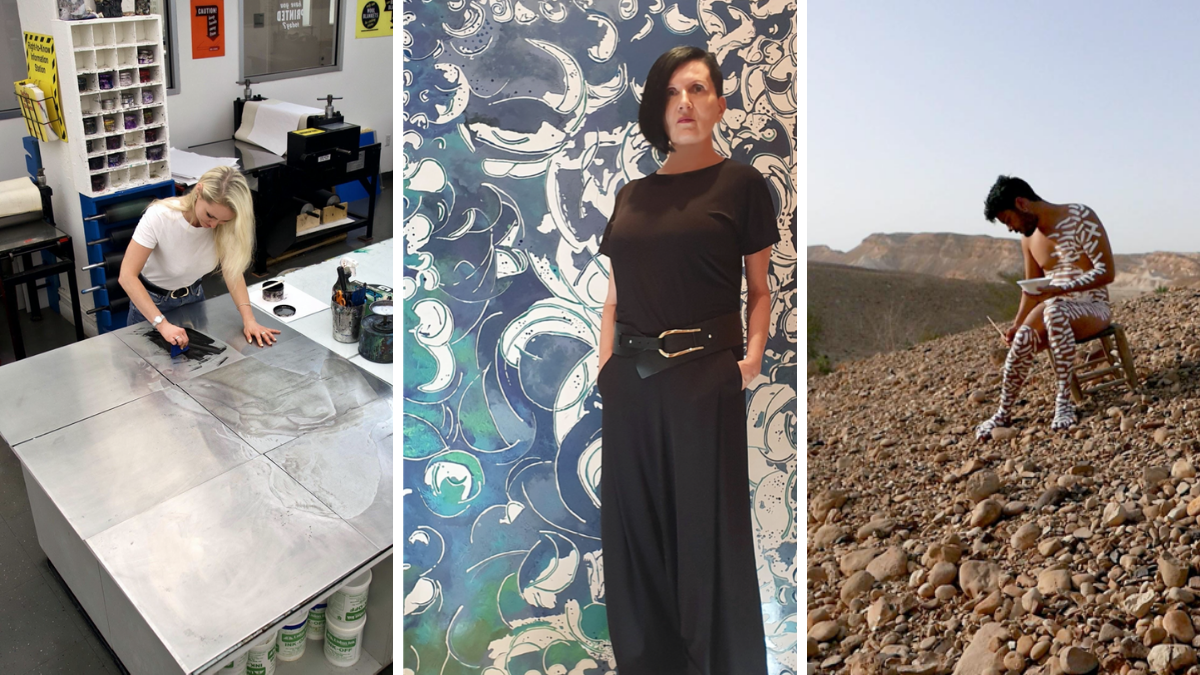
Agnieszka “Aga” Pestka making an etching in her studio, courtesy of the artist. https://www.apestka.com/

Aga’s experience working with attorneys is a rather complicated one: she had consulted three attorneys. While the first one turned out to be “not knowledgeable enough in regards to the artist visa,” the second one was helpful and informative in guiding her to prepare for the documents needed to establish a work history as an artist. Aga also met with a third attorney who had helped a friend of hers in obtaining the O-1A visa, but Aga relates that they spent more time talking about Aga’s art (which the attorney thought was “too commercial”) rather than talking about the merits of her application.

Aga’s experience underscores the unique difficulties facing O visa applicants – the fact that art can trigger subjective opinions makes it imperative that the attorney be careful in remaining a professional source of legal advice. By way of advice for fellow artists in the process of seeking the O-1 visa, Aga repeatedly emphasized the need to “do the research by yourself” and “come to the attorney with an informed mind.” Instead of relying completely on whichever attorney is available, artists, like Aga, can make wise decisions in selecting the most helpful and knowledgeable attorney. The importance of having a good attorney is further testified in the case of Pedro Mesa, a visual artist from Colombia who obtained his O-1 visa earlier this year after graduation from the School of Visual Arts in May 2018.

Pedro Mesa, A cardboard box has sat in the sun too long (2019, short film of 20:00 minutes), courtesy of the artist. https://www.pedromesa.com/

According to Mesa, his attorney discussed the strengths of his application in relation to his peers and worked with him on different tasks, such as preparing for exhibitions and collecting documentations from past exhibitions, every week for a duration of approximately six months. Mesa also mentioned, during the interview with the Center, that he should have taken the initiative to speak with an attorney even earlier so that he would know the requirements and gradually build up a strong application with less stress.

Sabrina Puppin had a rather different experience with the O-1 visa application. An Italian-born artist who has been painting for more than twenty years, Puppin obtained the O-1 visa in June, 2019 after graduating the School of Visual Arts with an M.F.A. in 2018. According to her, the biggest challenge for most emerging artists, especially international M.F.A students, is that they do not have a long artistic practice and a record of reputable exhibitions. Indeed, according to Mesa, “being a young artist doesn’t help, for sure.” For Puppin (with exhibition history around Europe and Qatar), the challenge was not to prove that she has an established career as an artist but to find the proof itself – many of her smaller exhibitions in Europe were not documented, especially those during the early years of her career. After the painstaking recreation of her career chronology and retrieval of exhibition records (catalogs, posters, reviews), she has come to realize the importance of documentation: “now I keep a record of everything.”

Sabrina Puppin in front of her painting Tsunami – Fury, courtesy of the artist. http://www.sabrinapuppin.com/

In terms of working with an attorney, Puppin had no trouble acquiring sufficient legal assistance. She successfully submitted her application after working with the attorney for three and a half months. Notably, with the assistance of her lawyer, she was able to interpret the educational aspect of her career at the Museum of Islamic Art in Qatar as part of her artistic practice, further extending the length of her career as an artist and strengthening the extraordinariness of her artistic ability.

The O-1 visa application process, while seemingly tedious, can be a moral building and a self-discovery process, that inadvertently gives an additional positive push for the advancement of the artist’s career. For instance, according to Aga, her visa application process was “very motivating and helpful” because the desire to demonstrate her outstanding qualities as an artist to secure the visa has pushed her to produce new works diligently, apply for inclusion in more exhibitions and publications, and constantly engage with the artistic community in New York City. Having gone so far with the O-1A visa application, “I feel more confident (about myself as an artist) now,” said Aga. Similarly, Puppin also had a significant career advancement during the visa application process. After the attorney pointed out that her application could benefit from the addition of at least one solo exhibition, she actively sought opportunities and successfully had five solo exhibitions in New York within five months: “you have to prove that there are galleries in the business that see (that) you have a future,” said Puppin.

A Quick Overview of the P Visa

The P visa, as compared to the O visa, provides a more temporary status for artists, athletes, and entertainers, with an initial period of stay not exceeding 1 year: the P-1 B classification applies to individuals who “are coming to the United States temporarily to perform” as a “member of an internationally recognized entertainment group… for a sustained and substantial period of time”; the P-2 classification applies to “individual performer or part of a group entering to perform under a reciprocal exchange program”; the P-3 classification applies to artists or entertainers “coming temporarily to perform, teach or coach as artists or entertainers… under a program that is culturally unique.”[13] Apparently, the P visa has more restricted terms for eligibility and does not apply to freelance artists.

Some Data and Numbers

USCIS, Non-immigrant Worker RFE Data (Jan. 2, 2019). Source: USCIS.

According to visa statistics reported by the U.S. Department of State, in fiscal year 2018, a total of 30,259 O visas were issued (Europe ranked the top in terms of region total, with a number of 15,661 O visas received; Asia ranked the second, with a total of 6,453 O visas received).[14] In the same period, a total of 36,075 P visas were issued (Europe ranked the top, with a number of 13,565 P visas received; Asia ranked the second, with a total of 8,613 P visas received).[15] While the approval rate for the P visa classification is not specified, the initial approval rate for the petitions for the O visa classification is 92.9% and the approval rate with Requests for Evidence (“RFE”) is 70.4%, as averaged from the aggregated data of visa approval rates from fiscal year 2015 to 2018, according to USCIS.[16]

In a word, with proper legal assistance and careful planning, the O and P visa categories can be highly beneficial for artists looking to develop their careers in the U.S. Even the application process itself can be conducive for the artist’s career. In preparing to obtain the visa, it is essential that artists make an informed decision regarding the timeline of the application process and the selection of attorney, meanwhile remaining organized and focused with their application materials.

Next year, with the Center’s Launch of the Visual Artists’ Immigration Clinic, we look to bring experienced attorneys and artists applying or extending work visas together to contribute to the vibrant arts community in New York and the US.


Endnotes:

  1. Margaretta Frederick, Art in America is a Story of Immigration, Delaware Online (March 31, 2016), link. ↑
  2. Margaretta Frederick, ibid. ↑
  3. Karol Jan Borowiecki, The Origins of Creativity: The Case of the Arts in the United States since 1850, Discussion Papers on Business and Economics, No. 3/2019. 3 (Feb. 2019). ↑
  4. President John F. Kennedy, A Nation of Immigrants, p.11, Pickle Partners Publishing (2016). ↑
  5. Immigration and Nationality Act of 1965 § 203, 8 U.S.C. § 1153 (1965). ↑
  6. Immigration and Nationality Act of 1965, History, Art & Archives, U.S. House of Representatives (Dec. 02, 2019), link. ↑
  7. The Visa for People Officially Deemed “Extraordinary”, the Atlantic (2016), link. ↑
  8. S.358 – Immigration Act of 1990 §207, link. ↑
  9. Malcom Collier, The Immigration Act of 1990, Summary prepared by Malcom Collier, SFSU (Feb. 2006), link. ↑
  10. Id. ↑
  11. O-1 Visa: Individuals with Extraordinary Ability or Achievement, U.S. Citizenship and Immigration Services (Jan. 5, 2017), link. ↑
  12. Id. ↑
  13. P-3 Artist or Entertainer Coming to Be Part of a Culturally Unique Program, U.S. Citizenship and Immigration Services (July 17, 2015), link. ↑
  14. U.S. Department of State, Bureau of Consular Affairs, Nonimmigrant Visas Issued by Classification and Nationality (Including Border Crossing Cards): Fiscal Year 2018, link. ↑
  15. Id. ↑
  16. USCIS, Non-immigrant Worker RFE Data (Jan. 2, 2019), link.↑

Suggested Readings:

  • Artists from Abroad
  • Jovana Vojinovic, How to get a US O-1 Visa: The Ultimate Guide, Nomad Capitalist (April 27, 2019), https://nomadcapitalist.com/2019/04/27/how-to-get-o1-visa/
  • US Visa for Artists and Entertainers, VisaPro, http://www.visapro.com/resources/article/us-visa-for-artists-and-entertainers/
  • Sharon Brenner, Apply for a Work Visa in the US: Artists & Musicians, Medium (Aug. 30, 2016), https://medium.com/@shesaid.so/applying-for-a-work-visa-in-the-us-artists-musicians-6d9932d1c6cc
  • Protima Daryanani, The O-1 Visa: Top 10 Misconceptions, Daryanani Law Group Blog (Jan. 10, 2019), https://dlgvisablog.com/blog/the-o-1-visa-top-10-misconceptions

The author would like to thank Agnieszka Pestka, Sabrina Puppin, and Pedro Mesa for sharing their experience with the O-1 visa application. Their works can be found at:

https://www.apestka.com/

http://www.sabrinapuppin.com

https://www.pedromesa.com

About the Author: Yuchen Xie is a Fall 2019 Intern at the Center for Art Law and is pursuing her M.A. in Arts Administration at Columbia University. She holds her B.A. in Studio Art and French from the University of Virginia (2018). She can be reached at yx2472@tc.columbia.edu.

Disclaimer: This article is for educational purposes only and is not meant to provide legal advice. Readers should not construe or rely on any comment or statement in this article as legal advice. For legal advice, readers should seek a consultation with an attorney.

Post navigation

Previous Update: Repatriation of Cambodian Art
Next Art and Restorative Justice: Transformative Healing Through Expression

Related Art Law Articles

Center for Art Law AI Artibtrator Article
Art lawadr

No Industry Seems Untouched by the AI Avalanche – Where Does AI Stand With ADR? Or Better Asked, Where Does ADR Stand With AI?

February 25, 2026
Center for Art Law AML Laundry Machines Ad
Art law

Regulation Without Legislation: Combatting Money Laundering in the U.S. Art Market

February 21, 2026
Center for Art Law Susan (Central Park) Legacy Over Licensing Josie Goettel
Art lawcopyrightlicensing

Legacy Over Licensing: How Artist Estates and Museums Are Redefining Control in the Digital Age

February 19, 2026
Center for Art Law
Summer School Promo

2026 Art Law Summer School

Applications Now Open

Want to learn MORE about art law? Join us for an unforgettable week of art law in NYC!


Apply Now
Center for Art Law

Follow us on Instagram for the latest in Art Law!

Have you seen the 2024 documentary "The Spoils"? O Have you seen the 2024 documentary "The Spoils"? Our latest review covers Jamie Kastner's film that follows the Max Stern Foundation's restitution efforts and asks hard questions about who holds power in the art world. Savannah Weiler reviews it and we want to hear your take. Read it via the link in bio and drop your thoughts in the comments! 👇 

#centerforartlaw #FILMREVIEW #nazieralootedart #maxsternfoundation
Smile — you're at the Center for Art Law! 🌷 Meet o Smile — you're at the Center for Art Law! 🌷 Meet our Spring 2026 intern team, joining us from schools and graduate programs across the country! 🎓 

Our Spring 2026 Interns have been learning and working hard starting January! We are pleased to introduce to you Donyea James (Legal Intern, Fordham Law, 3L), Alexandra Kharchenko (Legal Intern, French LLM Grad of Northwestern Pritzker School of Law), Jacqueline Koutrodimos-Lewis (Graduate Intern, with MA in Classics and BA in Art History), Prisha Mehta (Undergraduate Intern, University of Texas at Austin, Class of 2026), Halle O’Hern (Legal Intern, Brooklyn Law, 2L), Marina Rastorfer (Legal Intern, Cardozo Law, LLM), and Savannah Weiler (Graduate Intern, MA in History of Art). 

From legal research to event planning, our interns are doing it all — under careful supervision!

Interested in joining our team? Fall 2026 internships begin the 2nd week of September — visit the link in our bio to learn more!
📌 We are looking for interns who can commit to working with us the entire academic year. 

#ArtLaw #LegalInterns #SpringInterns #InternSpotlight #ArtAndLaw #LawSchool #Internship BrooklynLawSchool #FordhamLaw #CardozoLaw #Northwestern #UTAustin #ClassicsAndArt #ArtHistory #NextGenLawyers
🏒 🎨⚖️ Thank you to all the applicants interested 🏒 🎨⚖️

Thank you to all the applicants interested in our 2026 summer internship program. We are humbled by the talent and volume of applications received. We only wish we could offer placement to all of you. If we cannot accommodate your interest this summer, please consider joining us as guest writers, volunteers and students at the upcoming summer school.
Grab an Early Bird Discount for our new CLE progra Grab an Early Bird Discount for our new CLE program to train lawyers to assist visual artists and dealers in the unique aspects of their relationship.

Center for Art Law’s Art Lawyering Bootcamp: Artist-Dealer Relationships is an in-person, full-day training aimed at preparing lawyers for working with visual artists and dealers, in the unique aspects of their relationship. The bootcamp will be led by veteran attorneys specializing in art law.

This Bootcamp provides participants -- attorneys, law students, law graduates and legal professionals -- with foundational legal knowledge related to the main contracts and regulations governing dealers' and artists' businesses. Through a combination of instructional presentations and mock consultations, participants will gain a solid foundation in the specificities of the law as applied to the visual arts.

Bootcamp participants will be provided with training materials, including presentation slides and an Art Lawyering Bootcamp handbook with additional reading resources.

The event will take place at DLA Piper, 1251 6th Avenue, New York, NY. 9am -5pm.

Art Lawyering Bootcamp participants with CLE tickets will receive New York CLE credits upon successful completion of the training modules. CLE credits pending board approval. 

🎟️ Grab tickets using the link in our bio! 

#centerforartlaw #artlaw #legal #research #lawyer #artlawyer #bootcamp #artistdealer #CLE #trainingprogram
A recent report by the World Jewish Restitution Or A recent report by the World Jewish Restitution Organization (WRJO) states that most American museums provide inadequate provenance information for potentially Nazi-looted objects held in their collections. This is an ongoing problem, as emphasized by the closure of the Nazi-Era Provenance Internet Portal last year. Established in 2003, the portal was intended to act as a public registry of potentially looted art held in museum collections across the United States. However, over its 21-year lifespan, the portal's practitioners struggled to secure ongoing funding and it ultimately became outdated. 

The WJRO report highlights this failure, noting that museums themselves have done little to make provenance information easily accessible. This lack of transparency is a serious blow to the efforts of Holocaust survivors and their descendants to secure the repatriation of seized artworks. WJRO President Gideon Taylor urged American museums to make more tangible efforts to cooperate with Holocaust survivors and their families in their pursuit of justice.

🔗 Click the link in our bio to read more.

#centerforartlaw #artlaw #museumissues #nazilootedart #wwii #artlawyer #legalresearch
Join us for the Second Edition of Center for Art L Join us for the Second Edition of Center for Art Law Summer School! An immersive five-day educational program designed for individuals interested in the dynamic and ever-evolving field of art law. 

Taking place in the vibrant art hub of New York City, the program will provide participants with a foundational understanding of art law, opportunities to explore key issues in the field, and access to a network of professionals and peers with shared interests. Participants will also have the opportunity to see how things work from a hands-on and practical perspective by visiting galleries, artist studios, auction houses and law firms, and speak with professionals dedicated to and passionate about the field. 

Applications are open now through March 1st!

🎟️ APPLY NOW using the link in our bio! 

#centerforartlaw #artlawsummerschool #newyork #artlaw #artlawyer #legal #lawyer #art
Join us for an informative presentation and pro bo Join us for an informative presentation and pro bono consultations to better understand the current art and copyright law landscape. Copyright law is a body of federal law that grants authors exclusive rights over their original works — from paintings and photographs to sculptures, as well as other fixed and tangible creative forms. Once protection attaches, copyright owners have exclusive economic rights that allow them to control how their work is reproduced, modified and distributed, among other uses.

Albeit theoretically simple, in practice copyright law is complex and nuanced: what works acquire such protection? How can creatives better protect their assets or, if they wish, exploit them for their monetary benefit? 

🎟️ Grab tickets using the link in our bio! 

#centerforartlaw #artlaw #legal #research #lawyer #artlawyer #bootcamp #copyright #CLE #trainingprogram
In October, the Hispanic Society Museum and Librar In October, the Hispanic Society Museum and Library deaccessioned forty five paintings from its collection through an auction at Christie's. The sale included primarily Old-Master paintings of religious and aristocratic subjects. Notable works in the sale included a painting from the workshop of El Greco, a copy of a work by Titian, as well as a portrait of Isabella of Portugal, and Clemente Del Camino y Parladé’s “El Columpio (The Swing). 

The purpose of the sale was to raise funds to further diversify the museum's collection. In a statement, the institution stated that the works selected for sale are not in line with their core mission as they seek to expand and diversify their collection.

🔗 Click the link in our bio to read more.

#centerforartlaw #artlawnews #artlawresearch #legalresearch #artlawyer #art #lawyer
Check out our new episode where Paris and Andrea s Check out our new episode where Paris and Andrea speak with Ali Nour, who recounts his journey from Khartoum to Cairo amid the ongoing civil war, and describes how he became involved with the Emergency Response Committee - a group of Sudanese heritage officials working to safeguard Sudan’s cultural heritage. 

🎙️ Click the link in our bio to listen anywhere you get your podcasts! 

#centerforartlaw #artlaw #artlawyer #legal #research #podcast #february #legalresearch #newepisode #culturalheritage #sudaneseheritage
When you see ‘February’ what comes to mind? Birthd When you see ‘February’ what comes to mind? Birthdays of friends? Olympic games? Anniversary of war? Democracy dying in darkness? Days getting longer? We could have chosen a better image for the February cover but somehow the 1913 work of Umberto Boccioni (an artist who died during World War 1) “Dynamism of a Soccer Player” seemed to hit the right note. Let’s keep going, individuals and team players.

Center for Art Law is pressing on with events and research. We have over 200 applications to review for the Summer Internship Program, meetings, obligations. Reach out if you have questions or suggestions. We cannot wait to introduce to you our Spring Interns and we encourage you to share and keep channels of communication open. 

📚 Read more using the link in our bio! Make sure to subscribe so you don't miss any upcoming newsletters!

#centerforartlaw #artlaw #artlawyer #legal #research #newsletter #february #legalresearch
Join the Center for Art Law for conversation with Join the Center for Art Law for conversation with Frank Born and Caryn Keppler on legacy and estate planning!

When planning for the preservation of their professional legacies and the future custodianship of their oeuvres’, artists are faced with unique concerns and challenges. Frank Born, artist and art dealer, and Caryn Keppler, tax and estate attorney, will share their perspectives on legacy and estate planning. Discussion will focus on which documents to gather, and which professionals to get in touch with throughout the process of legacy planning.

This event is affiliated with the Artist Legacy and Estate Planning Clinic which seeks to connect artists, estate administrators, attorneys, tax advisors, and other experts to create meaningful and lasting solutions for expanding the art canon and art legacy planning. 

🎟️ Grab tickets using the link in our bio! 

#centerforartlaw #artlaw #clinic #artlawyer #estateplanning #artistlegacy #legal #research #lawclinic
Authentication is an inherently uncertain practice Authentication is an inherently uncertain practice, one that the art market must depend upon. Although, auction houses don't have to guarantee  authenticity, they have legal duties related to contract law, tort law, and industry customs. The impact of the Old Master cases, sparked change in the industry including Sotheby's acquisition of Orion Analytical. 

📚 To read more about the liabilities of auction houses and the change in forensic tools, read Vivianne Diaz's published article using the link in our bio!
  • About the Center
  • Contact Us
  • Newsletter
  • Upcoming Events
  • Internship
  • Case Law Database
  • Log in
  • Become a Member
  • Donate
DISCLAIMER

Center for Art Law is a New York State non-profit fully qualified under provision 501(c)(3)
of the Internal Revenue Code.

The Center does not provide legal representation. Information available on this website is
purely for educational purposes only and should not be construed as legal advice.

TERMS OF USE AND PRIVACY POLICY

Your use of the Site (as defined below) constitutes your consent to this Agreement. Please
read our Terms of Use and Privacy Policy carefully.

© 2026 Center for Art Law
 

Loading Comments...
 

You must be logged in to post a comment.